Have you ever come across genus and genera and wondered which one you should use? While Genus vs Genera may look confusing at first, the difference is actually quite simple. These two words refer to the same biological classification level, but they differ in number and usage.
Genus is the singular form, meaning one group of closely related species. Genera is the plural form, meaning more than one group. Both terms are commonly used in biology, taxonomy, and scientific writing.
Examples:
- Rosa is a genus of flowering plants.
- Rosa and Prunus are two different genera.
The confusion is understandable. People often search for genus vs genera, genus meaning, genera meaning, is genera plural, or what is the plural of genus because the word genera does not follow the usual English plural pattern. And here’s the kicker: although genus and genera have the same basic meaning, using the wrong form can make a sentence grammatically incorrect.
In this guide, you’ll learn the complete Genus vs Genera difference, including their meanings, definitions, pronunciation, plural forms, correct usage, and examples in sentences. You’ll also discover where these terms come from, how they are used in biological classification, and how to remember the difference between genus and genera.
Genus vs. Genera: Quick Difference
| Word | Number | Meaning | Example |
| genus | Singular | One taxonomic group | Panthera is a genus. |
| genera | Plural | Two or more taxonomic groups | Panthera and Felis are genera. |
| genuses | Plural | English alternative plural of genus | Several genuses were discussed. |
The easiest rule to remember is:
One genus, two or more genera.
In formal biological and academic writing, genera is usually the better choice when you need the plural. Oxford lists genera as the plural of genus, while Merriam Webster gives both genera and genuses.
Genus in a sentence
The lion belongs to the genus Panthera.
The sentence discusses one taxonomic group, so genus is correct.
Genera in a sentence
The researchers compared three genera of large cats.
The sentence discusses multiple taxonomic groups, so genera is correct.
That small change from genus to genera carries an important grammatical difference.
What Does Genus Mean?
A genus is a rank in biological classification. It sits above species and below family in the traditional taxonomic hierarchy. A genus brings together species that taxonomists consider closely related based on characteristics such as anatomy, genetics, evolutionary history, or other evidence.
The basic hierarchy looks like this:
Kingdom → Phylum → Class → Order → Family → Genus → Species
Not every classification system uses exactly the same set of ranks in every situation. Scientists can also use intermediate ranks such as subfamily, subgenus, or subspecies. However, genus remains one of the central ranks used to organize biological diversity.
The Natural History Museum explains the relationship clearly: a family collects related genera, while a genus consists of closely related species. For example, the family Cervidae includes the genus Cervus, which contains species such as red deer and elk.
What does a genus contain?
A genus can contain:
- One recognized species
- Several recognized species
- Many recognized species
The number isn’t fixed. Taxonomists determine which species belong together within a genus based on the evidence and classification system being used.
This point matters because genus does not mean “a group containing exactly a certain number of species.” It describes a taxonomic rank and the group assigned to that rank.
Genus is above species
Consider the scientific name Homo sapiens.
- Homo = genus
- sapiens = specific epithet
- Homo sapiens = complete binomial species name
Here, Homo identifies the genus to which the species belongs.
The same pattern appears throughout biological nomenclature. The genus provides the broader taxonomic context, while the complete two part name identifies a particular species.
What Does Genera Mean?
Genera is the plural of genus.
When you talk about more than one genus, you use genera. Cambridge gives genera as the plural and defines a genus as a biological group that falls between family and species in the classification system.
For example:
Panthera is a genus.
But:
Panthera and Felis are genera.
The second sentence doesn’t describe one taxonomic group. It describes multiple groups.
Examples of genera
Here are a few examples:
- Panthera is a genus of cats.
- Canis is a genus that includes dogs, wolves, and related species.
- Homo is the genus that includes modern humans.
- Cervus is a genus containing several deer species.
- Quercus is a genus containing many species of oak.
When discussing two or more of these groups together, genera becomes the correct plural form.
Genus vs. Genera in Biology
The distinction between genus vs. genera becomes especially important in biology because taxonomic writing constantly moves between individual groups and collections of groups.
Suppose a researcher studies Panthera. The researcher might write:
The genus Panthera contains several recognized species.
Now suppose the researcher compares Panthera with Felis:
The two genera differ in several morphological characteristics.
Both sentences use the same taxonomic concept. The only difference is the number of groups being discussed.
One genus
Use genus when the sentence refers to one taxonomic group.
Examples:
- This genus contains five recognized species.
- The species belongs to the genus Canis.
- Researchers identified a new genus.
- The genus Homo has an extensive fossil record.
Multiple genera
Use genera when the sentence refers to more than one taxonomic group.
Examples:
- The family contains several genera.
- Researchers compared three genera.
- These organisms belong to different genera.
- The study examined bacteria from multiple genera.
The surrounding noun phrase usually gives you the answer. Words such as one, a, or this generally point toward genus. Words such as several, many, two, and multiple point toward genera.
Why Is the Plural of Genus Genera?
The unusual plural comes from Latin.
The Latin noun genus belongs to the third declension and is a neuter noun. Its nominative singular form is genus, while its nominative plural is genera.
The basic pattern is:
| Latin form | Number |
| genus | Singular |
| genera | Plural |
The word originally carried meanings connected with ideas such as birth, race, kind, stock, or class. English later adopted genus as a technical term for biological classification. Oxford traces the English word to Latin and gives its origin as “birth, race, stock.”
This Latin origin also explains why the plural doesn’t simply become genuses in traditional scientific usage.
English contains many words with Latin or Greek plurals:
- genus → genera
- phylum → phyla
- criterion → criteria
- datum → data
- medium → media
However, English sometimes creates regular plurals alongside traditional forms. That’s why genuses also appears in dictionaries.
Is Genuses Correct?
Yes, genuses exists as an English plural of genus. Merriam Webster explicitly lists both genera and genuses.
That doesn’t mean the two forms have equal value in every context.
For formal scientific writing, genera remains the standard and most recognizable choice. You’ll see it throughout biological literature, taxonomic resources, and scientific terminology.
For example:
Several genera were represented in the fossil sample.
This sounds natural in scientific writing.
The alternative:
Several genuses were represented in the fossil sample.
is grammatically understandable, but it doesn’t fit scientific convention as naturally.
When should you use genera?
Choose genera when writing:
- Biology papers
- Taxonomy articles
- Scientific reports
- Academic assignments
- Textbooks
- Research summaries
- Museum or educational material
- Formal descriptions of organisms
A useful rule is simple:
If the subject is biological taxonomy, use “genera” for the plural unless a specific style guide tells you otherwise.
How to Pronounce Genus and Genera
The pronunciation changes along with the spelling.
Genus pronunciation
Genus is pronounced approximately:
JEE-nus
Oxford gives the pronunciation as /ˈdʒiːnəs/.
Genera pronunciation
Genera is pronounced approximately:
JEN-er-uh
Oxford gives /ˈdʒenərə/. Cambridge gives the same general pronunciation pattern for American English.
So:
| Word | Approximate pronunciation |
| genus | JEE-nus |
| genera | JEN-er-uh |
The pronunciation can seem strange at first because the vowel sound changes when the word moves from singular to plural.
Genus vs. Genera in Scientific Names
The word genus also matters because genus names form the first part of scientific species names.
This naming system is known as binomial nomenclature.
Take the familiar scientific name:
Homo sapiens
The two parts have different roles:
| Part | Example | Role |
| Genus | Homo | Identifies the genus |
| Specific epithet | sapiens | Distinguishes the species within the genus |
| Full scientific name | Homo sapiens | Identifies the species |
The genus name starts with a capital letter and is normally written in italics.
The specific epithet begins with a lowercase letter and is also italicized.
So these forms are correct:
- Homo sapiens
- Panthera leo
- Canis lupus
- Cervus elaphus
The genus name is not the entire species name. In Panthera leo, for example, Panthera identifies the genus while Panthera leo identifies the species.
Why the genus matters in a scientific name
A common name can refer to different organisms in different regions. Scientific names reduce that ambiguity by placing each species within a standardized naming system.
The genus also gives readers immediate taxonomic information.
If you see:
- Panthera leo
- Panthera tigris
- Panthera onca
the shared first word tells you that all three species belong to the same genus, Panthera.
That doesn’t mean they are the same species. It means they share the same genus.
Genus vs. Genera vs. Species
One of the easiest ways to understand genus vs. genera is to compare both terms with species.
A species sits below genus in the traditional hierarchy. A genus can contain one or more species, while a family can contain one or more genera.
| Taxonomic rank | Singular example | Plural term |
| Family | Felidae | families |
| Genus | Panthera | genera |
| Species | Panthera leo | species |
Notice something important: species doesn’t change form between singular and plural.
You can say:
This species is endangered.
And:
Several species live in the region.
But genus does change:
This genus contains several species.
And:
These genera contain several species.
That difference creates many of the grammar questions surrounding taxonomic vocabulary.
Genus vs. Genera vs. Family
A family is broader than a genus.
A family brings together related genera. The Natural History Museum gives Cervidae as an example of a family containing several deer related genera, including Cervus.
The relationship can be visualized like this:
Family
↓
Genus
↓
Species
When there are several groups at the genus level, you use the plural:
Family → genera → species
For example:
- Felidae = family
- Panthera = one genus
- Felis = another genus
- Panthera and Felis = two genera
- Panthera leo = one species
This distinction prevents a common mistake: treating genera as though it means “many species.”
It doesn’t.
Genera means multiple genera.
Each genus can contain multiple species.
Genus vs. Genera Examples
The fastest way to master the difference is to see the words in real sentences.
Examples using genus
- Panthera is a genus in the family Felidae.
- The lion belongs to the genus Panthera.
- Scientists described a new genus of fossil organisms.
- This genus contains several closely related species.
- The species was originally placed in a different genus.
- The researchers focused on one genus during the survey.
Each sentence discusses one taxonomic group.
Examples using genera
- The family contains several genera.
- Researchers compared two genera of mammals.
- The fossil record includes several extinct genera.
- These species belong to different genera.
- The study examined bacteria from multiple genera.
- Several genera occur in the same habitat.
Each sentence refers to more than one genus.
Side by side
| Singular | Plural |
| One genus | Several genera |
| This genus | These genera |
| A genus of plants | Three genera of plants |
| The genus contains… | The genera contain… |
| That genus is… | Those genera are… |
The last row also demonstrates subject verb agreement.
Genus is singular.
Genera are plural.
Common Mistakes With Genus and Genera
The difference looks simple, but several mistakes appear often in scientific and educational writing.
Mistake: Using genus as a plural
Incorrect:
Several genus were found in the sample.
Correct:
Several genera were found in the sample.
The word several signals that more than one group is involved.
Mistake: Treating genera as singular
Incorrect:
This genera contains five species.
Correct:
This genus contains five species.
If the sentence starts with this, you’re referring to one group.
Mistake: Using the wrong verb
Incorrect:
Several genera is represented in the collection.
Correct:
Several genera are represented in the collection.
Because genera is plural, it takes the plural verb are.
Mistake: Confusing genera with species
Consider:
The family contains three genera.
That means the family contains three taxonomic groups at the genus rank.
It doesn’t necessarily mean the family contains only three species.
Each of those genera may contain multiple species.
Mistake: Assuming every genus contains the same number of species
A genus isn’t defined by a fixed number of species.
Taxonomic classifications change as scientists discover new evidence, describe new organisms, or revise relationships between existing groups.
That’s why a genus can have a very different number of recognized species from another genus.
A Simple Case Study: Panthera
Consider the genus Panthera.
It provides a useful example because several familiar large cats belong to this genus.
Examples include:
- Panthera leo — lion
- Panthera tigris — tiger
- Panthera onca — jaguar
- Panthera pardus — leopard
The word Panthera identifies the genus in each scientific name.
If you discuss only Panthera, you write:
Panthera is a genus of cats.
If you compare Panthera with another genus, such as Felis, you write:
Panthera and Felis are genera within the cat family.
The example demonstrates the entire distinction without changing the underlying biology.
One group = genus.
Multiple groups = genera.
A Second Case Study: Human Classification
The scientific name of modern humans is Homo sapiens.
Here, Homo is the genus.
The complete species name is Homo sapiens.
Now imagine discussing several human related genera in a broader evolutionary context. The plural form becomes appropriate:
Fossil evidence has been used to compare several hominin genera.
The key point isn’t how many species each genus contains. The grammatical choice depends on how many genera the sentence discusses.
This makes genus and genera useful terms not only for living organisms but also for discussions of fossils and extinct organisms.
Genus vs. Genera in Zoology
Zoologists use genus and genera when classifying animals.
For example:
The species belongs to the genus Canis.
When researchers compare Canis with other genera:
The researchers compared several genera of carnivores.
The International Code of Zoological Nomenclature specifically defines genus, with genera as its plural, as a rank in the genus group below the family group and above the subgenus.
This illustrates why the terms aren’t merely casual vocabulary. They represent formal taxonomic concepts.
Genus vs. Genera in Botany
The same singular and plural distinction applies to plants.
For example:
Quercus is a genus of oak trees.
When discussing more than one plant genus:
The study examined several genera of flowering plants.
The grammatical rule stays the same regardless of whether the organisms are animals, plants, fungi, or other organisms.
Genus is the singular taxonomic rank. Genera is its plural.
Genus vs. Genera in Microbiology
Microbiologists also use genus and genera constantly.
A scientific discussion might say:
The sample contained bacteria belonging to the genus Bacillus.
A broader comparison could say:
The researchers identified organisms from several bacterial genera.
Again, the number determines the word.
The subject doesn’t change the rule.
Genus vs. Genera in Paleontology
Taxonomic language also appears in paleontology, where researchers classify fossil organisms.
A fossil study might discuss a particular genus when focusing on one lineage.
If the study compares multiple lineages, researchers may refer to several genera.
This is especially useful when discussing extinct organisms because a genus can contain species known only from fossils.
How Genus Names Are Written
When referring to a formal genus name, scientific writing follows capitalization and formatting conventions.
A genus name is generally:
- Capitalized
- Italicized in running text
- Written as a singular Latin or latinized noun
For example:
- Homo
- Panthera
- Canis
- Cervus
The International Code of Zoological Nomenclature also recognizes the genus name as the generic name and treats genus as a formal rank within zoological classification.
Don’t confuse the word genus with the genus name itself.
For example:
The genus Panthera contains several species.
Here, genus is a common noun describing the rank, while Panthera is the actual scientific name.
That distinction becomes important in polished scientific writing.
Genus vs. Genera: Grammar Rules
Because genus and genera have different numbers, they require different determiners and verbs.
Singular grammar
Use:
- a genus
- one genus
- this genus
- that genus
- the genus
- the genus is
Example:
This genus is widely distributed.
Plural grammar
Use:
- several genera
- two genera
- many genera
- these genera
- those genera
- the genera are
Example:
These genera are distributed across several regions.
A quick grammar test can help:
Can you replace the word with “one group”?
If yes, use genus.
Can you replace it with “multiple groups”?
If yes, use genera.
How to Remember Genus vs. Genera
A short memory trick works better than memorizing a complicated rule.
One genus, many genera.
Think of the final -a in genera as a signal that you’re dealing with more than one.
You can also memorize this pattern:
1 → genus
2+ → genera
Another useful connection is:
Genus = one group. Genera = groups.
Once that distinction becomes automatic, most sentences become easy to correct.
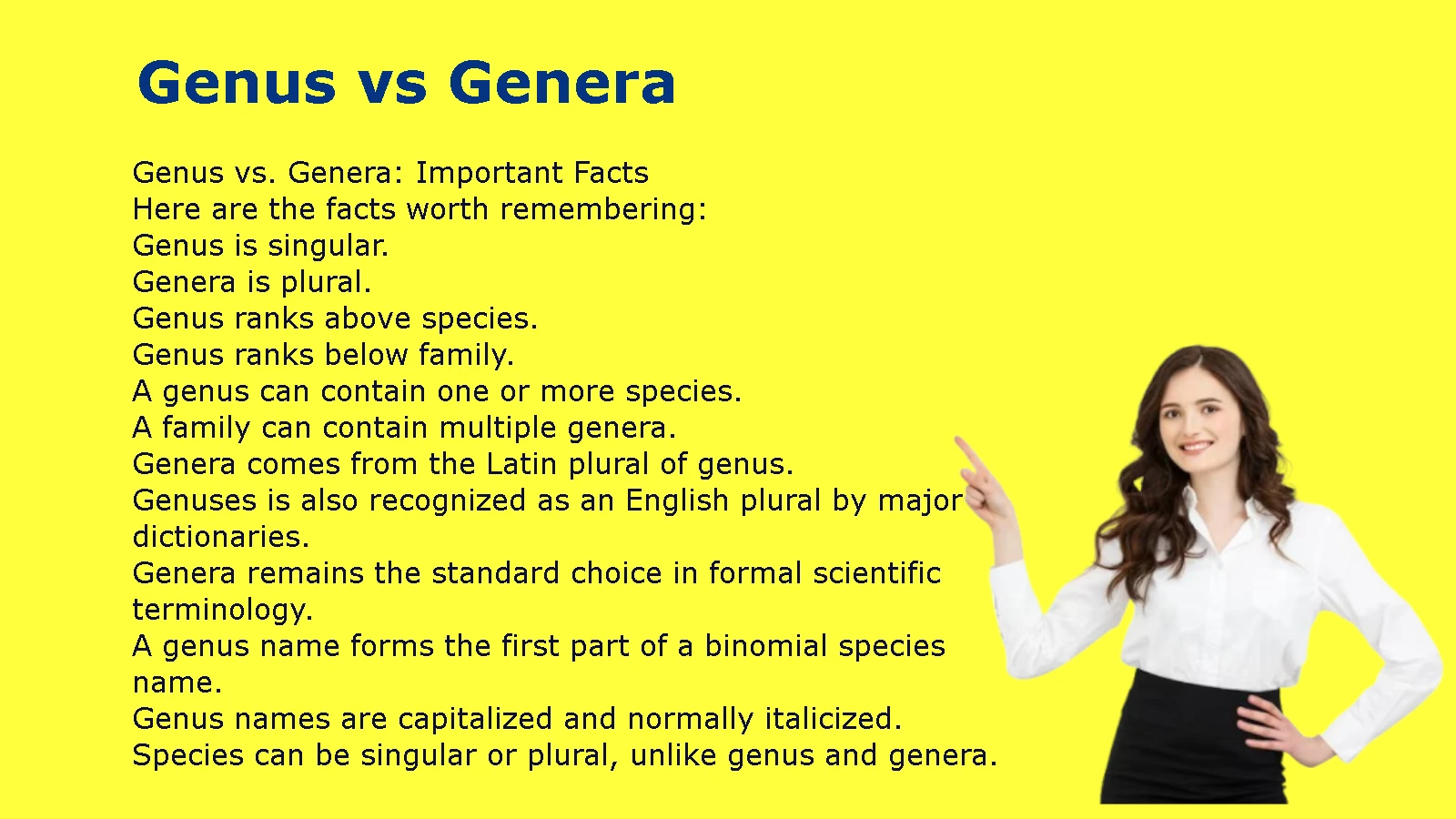
Genus vs. Genera: Important Facts
Here are the facts worth remembering:
- Genus is singular.
- Genera is plural.
- Genus ranks above species.
- Genus ranks below family.
- A genus can contain one or more species.
- A family can contain multiple genera.
- Genera comes from the Latin plural of genus.
- Genuses is also recognized as an English plural by major dictionaries.
- Genera remains the standard choice in formal scientific terminology.
- A genus name forms the first part of a binomial species name.
- Genus names are capitalized and normally italicized.
- Species can be singular or plural, unlike genus and genera.
Frequently Asked Questions About Genus vs. Genera
Is genus singular or plural?
Genus is singular. It refers to one taxonomic group.
Example:
Panthera is a genus.
Is genera singular or plural?
Genera is plural. It refers to two or more genera.
Example:
Panthera and Felis are genera.
What is the plural of genus?
The traditional and standard scientific plural is genera. Dictionaries also recognize genuses as an English plural.
Is “genuses” wrong?
No. Genuses is recognized as an English plural. However, genera is the conventional form in formal biological and taxonomic writing.
What is an example of a genus?
Panthera is an example of a genus. It includes species such as lions, tigers, jaguars, and leopards.
What is an example of genera?
Panthera and Felis are examples of genera because they represent more than one genus.
Is genera the plural of genus?
Yes. Genus → genera.
What is the difference between genus and species?
A genus is a taxonomic rank above species. A species is a lower rank within that classification.
For example, in Panthera leo, Panthera is the genus and the complete name identifies the species.
Can a genus contain several species?
Yes. A genus can contain multiple species. The number of species varies between genera.
What is the difference between genus and genera?
Genus refers to one taxonomic group, while genera refers to multiple taxonomic groups.
How do you pronounce genus?
Genus is pronounced approximately JEE-nus. Oxford gives /ˈdʒiːnəs/.
How do you pronounce genera?
Genera is pronounced approximately JEN-er-uh, with Oxford giving /ˈdʒenərə/.
Should genus names be capitalized?
Yes. A formal genus name begins with a capital letter and is normally italicized in scientific writing.
For example:
Canis
not:
canis
Should genera be capitalized?
The common noun genera isn’t capitalized unless it begins a sentence. Individual genus names are capitalized.
Correct:
Several genera, including Canis and Felis, were examined.
Genus vs. Genera: Final Answer
The difference between genus vs. genera comes down to number.
Genus is singular. Use it for one taxonomic group.
Genera is plural. Use it for two or more taxonomic groups.
The relationship is straightforward:
| If you mean… | Use… |
| One taxonomic group | genus |
| More than one taxonomic group | genera |
| Formal scientific plural | genera |
| Alternative English plural | genuses |
The simplest rule is worth remembering:
One genus, several genera.
So you might write:
The species belongs to the genus Panthera.
But:
The study compared several genera of mammals.
Once you connect genus with singular and genera with plural, the difference becomes easy. The unusual spelling isn’t random either. It reflects the Latin history of the word, while modern scientific usage has preserved genera as the familiar plural form.
For formal biology, taxonomy, zoology, botany, microbiology, and academic writing, genus vs. genera isn’t a matter of style alone. Choosing the right form tells the reader exactly whether the discussion concerns one taxonomic group or several.