Based Off vs Based On is a common English grammar question that comes up when writing essays, business reports, emails, and everyday messages. “Based on” is the standard and preferred phrase in formal writing, while “based off” and “based off of” are common informal alternatives that many editors recommend replacing. Both expressions can communicate that an idea, decision, design, or story comes from a source, but they differ in conventional usage and tone.
Understanding the difference between based on meaning, based off grammar, and the related expression based upon helps you choose the right phrase for your audience. Whether you’re describing a movie inspired by real events, explaining a decision supported by evidence, or polishing a résumé, the same practical rule applies: use “based on” when you want clear, conventional wording that works in almost any context.
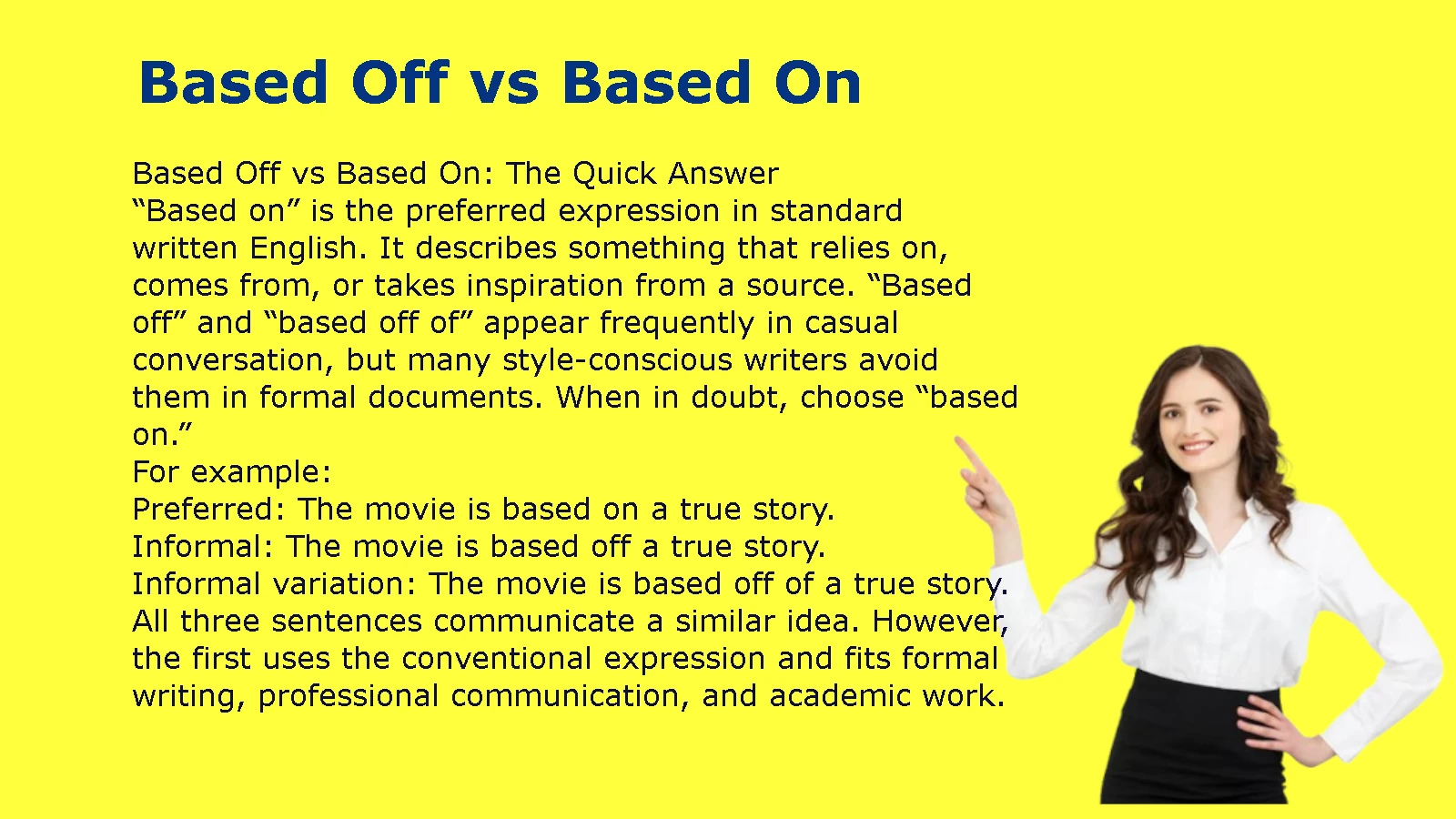
Based Off vs Based On: The Quick Answer
“Based on” is the preferred expression in standard written English. It describes something that relies on, comes from, or takes inspiration from a source. “Based off” and “based off of” appear frequently in casual conversation, but many style-conscious writers avoid them in formal documents. When in doubt, choose “based on.”
For example:
- Preferred: The movie is based on a true story.
- Informal: The movie is based off a true story.
- Informal variation: The movie is based off of a true story.
All three sentences communicate a similar idea. However, the first uses the conventional expression and fits formal writing, professional communication, and academic work.
What Does Based On Mean?
Based on means founded on, supported by, developed from, or influenced by something. The phrase identifies the information, experience, principle, or material that serves as the foundation for another thing.
The source can be a physical object, a set of facts, a creative work, or an abstract idea.
Consider these examples:
- The report is based on the latest sales figures.
- Her novel is based on experiences from her childhood.
- The company changed its policy based on customer feedback.
- Our final decision was based on the available evidence.
- This painting is based on a photograph of the countryside.
In each sentence, “based on” connects an outcome to its source. The sales figures support the report, childhood experiences inspire the novel, and customer feedback informs the policy change.
The phrase doesn’t always mean that something copies its source exactly. A film can be based on a book while changing characters or events. Similarly, a business plan can be based on historical data while including new assumptions about future performance.
What Does Based Off Mean?
Based off is an informal expression that speakers often use to mean based on, derived from, or inspired by. It communicates the intended relationship in many everyday situations, even though “based on” remains the more conventional choice in edited English.
For example:
- I designed the invitation based off a picture I found online.
- The video game is based off an older arcade title.
- We created the schedule based off everyone’s availability.
- Her character was based off someone she knew in college.
These sentences are easy to understand. In formal writing, however, you can usually replace “based off” with “based on” without changing the intended meaning.
This distinction matters because common usage and formal editorial preference aren’t always identical. An expression can be widespread in conversation without becoming the preferred choice for academic papers, business proposals, or carefully edited articles.
Why Is Based On the Preferred Expression?
The preference for “based on” comes from established English usage and the relationship between the word base and the preposition on. When something is based on another thing, the second thing provides support, evidence, or a foundation.
Although the physical image helps explain the expression, grammar isn’t determined by physical logic alone. Established word combinations and usage conventions also influence which phrases sound natural in standard writing.
The Meaning of Base and the Preposition On
Think about the foundation of a building. The foundation supports the structure above it. In the same way, evidence can support a conclusion, research can support a recommendation, and a historical event can provide the foundation for a movie.
The preposition on expresses this relationship between a foundation and what depends on it.
For example:
- The argument is based on scientific evidence.
- The proposal is based on three months of research.
- The documentary is based on historical records.
- The estimate is based on current operating costs.
Each sentence identifies something that supports or informs another thing.
The word off, by contrast, often describes separation, removal, or movement away from a surface. That’s one reason some writers find “based off” less natural in formal prose. However, the expression has developed a common figurative meaning, so its usage cannot be explained by the physical distinction alone.
A useful memory trick is to imagine an idea standing on a platform of evidence. If the idea rests on that information, write based on.
Is Based Upon Also Correct?
Yes. Based upon is a grammatically acceptable alternative to based on. Both expressions can indicate that something relies on evidence, originates from a source, or takes inspiration from an earlier work.
Compare these sentences:
- The decision was based on the investigation.
- The decision was based upon the investigation.
Both communicate the same basic idea. The second may sound slightly more formal or traditional, but the difference is usually small.
Use “based on” when you want straightforward, natural language. Choose “based upon” when it fits the tone of your document or when you want a more formal rhythm.
Don’t assume that the longer phrase automatically makes your writing more professional. Clear, direct wording often works better than unnecessarily formal language.
Is Based Off Grammatically Incorrect?
The answer depends on what you mean by incorrect.
In standard formal writing, based on is the safer and more widely preferred construction. Teachers, editors, and professional readers may flag “based off” because it departs from conventional usage.
In everyday speech, however, “based off” is a familiar expression that many English speakers understand and use naturally. Calling every occurrence universally ungrammatical overlooks the difference between formal editorial standards and actual language use.
Use this practical distinction:
- Academic writing: Prefer “based on.”
- Business communication: Prefer “based on.”
- Résumés and cover letters: Prefer “based on.”
- News articles and formal reports: Prefer “based on.”
- Casual conversations: “Based off” may sound natural to some speakers.
- Creative dialogue: Use the expression that fits the character’s voice and context.
The goal isn’t to criticize every informal expression. It’s to recognize your audience and choose wording that suits the situation.
Based Off vs Based On: Key Differences
The main difference between based on vs. based off involves conventional acceptance, formality, and editorial preference. Both phrases can express a relationship between a source and something developed from it, but “based on” works across a wider range of writing situations.
| Feature | Based on | Based off / based off of |
| General usage | Standard and widely preferred | Common informal alternatives |
| Formal writing | Recommended | Usually revised to “based on” |
| Academic writing | Appropriate | Less suitable |
| Everyday conversation | Natural | Common in some varieties of English |
| Meaning | Founded on, supported by, or inspired by | Often intended to mean founded on or inspired by |
| Example | The series is based on a novel. | The series is based off a novel. |
| Formal alternative | Based upon | Based on |
The table provides a useful editing rule, but it doesn’t mean that readers will misunderstand “based off.” In most cases, the meaning remains clear. The difference is primarily about choosing conventional wording for the intended audience.
Based Off Of vs. Based On
Based off of is another common variation. Some speakers use the three-word phrase instead of “based off,” while others prefer it in particular conversational settings.
For example:
- Informal: The design was based off of an old photograph.
- Preferred: The design was based on an old photograph.
The second sentence is shorter and follows the standard expression. It also avoids a wording choice that some editors may consider awkward or unnecessarily complicated.
However, it’s useful to be precise about the grammar. The phrase “off of” appears in ordinary English, and its acceptability varies with context and editorial standards. The main recommendation here is narrower: when you mean that something is founded on or inspired by a source, based on is the conventional choice.
You don’t need to rewrite the entire sentence to fix the expression. Simply replace “based off of” with “based on.”
Based On vs. Based Off: Everyday Sentence Examples
Examples make the distinction easier to recognize. The following sentences show how both expressions appear in everyday contexts and how you can revise informal wording for a polished result.
Correct Examples With Based On
Use based on when describing evidence, creative inspiration, business decisions, personal experiences, or the information behind a conclusion.
Movies and entertainment
- The new film is based on a bestselling mystery novel.
- The television series is based on events from the 1980s.
- The character was based on a real person the writer once met.
Business and professional writing
- We calculated the budget based on the department’s projected expenses.
- The marketing strategy is based on recent customer research.
- The hiring decision was based on the candidate’s qualifications.
- The team revised its forecast based on the latest sales figures.
Academic writing and research
- The conclusion is based on the results of the experiment.
- The essay is based on evidence from several historical documents.
- The researcher developed the hypothesis based on earlier findings.
Everyday situations
- I chose the restaurant based on my friend’s recommendation.
- She bought the jacket based on the product photographs.
- We planned the trip based on the weather forecast.
Notice how the phrase connects an action or result to its source. This relationship makes “based on” useful in almost every area of writing.
Informal Examples With Based Off
The following examples show common conversational usage. Each sentence can be revised with “based on” when a more conventional style is needed.
| Informal sentence | Preferred revision |
| I chose my outfit based off a picture online. | I chose my outfit based on a picture online. |
| We made the rules based off of what we remembered. | We made the rules based on what we remembered. |
| The character was based off a real person. | The character was based on a real person. |
| I picked the recipe based off a video. | I picked the recipe based on a video. |
| The estimate was based off last year’s costs. | The estimate was based on last year’s costs. |
In each revision, the core meaning remains unchanged. The adjustment simply makes the wording more conventional.
A Practical Case Study: Editing a Business Report
Imagine that a marketing manager writes the following sentence in a quarterly report:
“Our campaign strategy was based off of customer feedback and last year’s sales figures.”
The meaning is clear, but the phrasing may distract readers who expect formal business English.
A simple revision produces this sentence:
“Our campaign strategy was based on customer feedback and last year’s sales figures.”
The revised version improves the sentence in three ways:
- It follows conventional usage. The phrase “based on” is the standard construction.
- It removes unnecessary wording. Replacing “based off of” with “based on” makes the sentence more concise.
- It keeps the focus on the evidence. Readers can concentrate on the information behind the campaign strategy rather than the wording.
This example illustrates an important editing principle: you don’t need to make a sentence complicated to make it professional. Often, the smallest change is the most effective.
When Should You Use Based On Instead of Based Off?
Choose based on whenever you want a reliable option for formal, professional, or academic communication. It works in almost every context where you need to explain what supports an idea, informs a decision, or inspires a creative work.
“Based off” can still appear in informal conversation and dialogue. The best choice depends on your audience, purpose, and desired tone.
Academic and Professional Writing
In academic and professional documents, readers expect consistent wording and established grammatical conventions. Using “based on” helps you avoid an unnecessary distraction.
Choose “based on” in:
- Research papers and essays
- Business reports and proposals
- Résumés and cover letters
- Legal and policy documents
- Presentations and analytical reports
- Professional emails
- Website content and published articles
For example, consider these résumé statements:
Less suitable: Developed a sales strategy based off customer trends.
Preferred: Developed a sales strategy based on customer trends.
The second version communicates the same accomplishment while using more conventional language.
Similarly, a student writing “The argument is based off three historical sources” can revise it to “The argument is based on three historical sources.”
These changes are small, but they help maintain a consistent professional tone.
Casual Conversations and Dialogue
Informal speech follows different expectations from academic writing. People often choose phrases because they sound familiar, fit the rhythm of a conversation, or reflect the language of their social group.
For example, someone might say:
“I based the whole outfit off that picture you sent me.”
A listener will probably understand the intended meaning without difficulty. In a casual conversation, the expression may not create any practical problem.
Creative writers also need to consider character voice. A character who speaks casually may naturally use “based off.” Replacing every informal expression with formal wording could make the dialogue sound less authentic.
The distinction is straightforward:
- Use “based on” when consistency, formality, and broad editorial acceptance matter.
- Consider “based off” when writing realistic informal dialogue or reproducing a speaker’s natural wording.
Don’t confuse informal style with a failure to communicate. Instead, choose the expression that fits the situation.
A Simple Trick to Remember the Difference
If you often mix up “based off” and “based on,” connect the phrase to the idea of a foundation.
Imagine a building resting on a solid foundation. The foundation supports the structure. In the same way, facts can support an argument, experience can inform a decision, and a book can provide the foundation for a movie.
Remember this rule:
If something is founded on, supported by, or inspired by a source, use “based on.”
You can also follow this quick editing process:
- Step 1: Find the phrase “based off” or “based off of” in your draft.
- Step 2: Identify the source that informs the idea, decision, or creation.
- Step 3: Replace the phrase with “based on.”
- Step 4: Read the sentence again to ensure that the meaning remains clear.
For example:
Original: The proposal was based off of the client’s requirements.
Revised: The proposal was based on the client’s requirements.
The revised sentence is direct, concise, and appropriate for professional communication.
Better Alternatives to Based Off
Although “based on” is the most versatile option, you can use other expressions when they convey your meaning more precisely. The right alternative depends on whether you want to emphasize evidence, origins, inspiration, or a supporting principle.
| Alternative | Best use | Example |
| Based upon | Formal or traditional wording | The decision was based upon the findings. |
| Derived from | Showing an origin or source | The formula was derived from earlier research. |
| Founded on | Emphasizing a supporting principle | The policy is founded on fairness. |
| Rooted in | Highlighting origins, beliefs, or traditions | The custom is rooted in local history. |
| Supported by | Emphasizing evidence | The claim is supported by recent data. |
| Inspired by | Describing creative influence | The painting was inspired by a mountain landscape. |
| Informed by | Showing how information influenced a decision | The strategy was informed by customer feedback. |
These alternatives aren’t interchangeable in every sentence. For example, “inspired by” emphasizes creative influence, while “supported by” emphasizes evidence. Selecting the precise expression can make your writing more informative.
Based Upon
Use based upon when you want a slightly more formal or traditional alternative to “based on.”
Example: “The committee reached its decision based upon the available evidence.”
You could also write “The committee reached its decision based on the available evidence.” Both versions work, so choose the one that fits your sentence and the style of the surrounding text.
Derived From
Use derived from when you want to emphasize where something originated or how it was obtained.
Examples:
- The word is derived from an older English expression.
- The estimate was derived from historical sales data.
- The design was derived from an earlier prototype.
This phrase is particularly useful in explanations involving language, research, calculations, and technical processes.
Founded On or Rooted In
Use founded on when a principle, system, or argument rests on a particular foundation.
Example: “The organization is founded on the principles of honesty and accountability.”
Use rooted in when you want to emphasize origins, history, traditions, or underlying beliefs.
Example: “The festival is rooted in a centuries-old local tradition.”
Both alternatives can improve precision because they explain the relationship between an idea and its source more specifically than the general phrase “based off.”
Frequently Asked Questions
Is Saying Based Off Grammatically Correct?
“Based off” is common in informal English, but “based on” is the conventional choice in formal and edited writing. If you’re writing an essay, business report, résumé, or professional email, choose “based on” to follow standard usage and avoid unnecessary criticism of your wording.
Can You Say Based Off Of?
Yes, people use “based off of” in everyday speech. However, the phrase is generally less suitable for formal writing than “based on.” If both expressions communicate the same idea, replacing “based off of” with “based on” creates a simpler, more conventional sentence.
What Is the Difference Between Based On and Based Off?
Both expressions can describe something that comes from, depends on, or takes inspiration from a source. The main difference is conventional usage: “based on” is widely preferred in standard writing, while “based off” is a common informal alternative.
Is Based Upon Correct English?
Yes. “Based upon” is grammatically acceptable and carries essentially the same meaning as “based on.” It can sound slightly more formal or traditional, although “based on” is usually the more concise and natural choice for everyday professional writing.
What Is Another Word for Based On?
Useful alternatives include derived from, founded on, rooted in, supported by, informed by, and inspired by. Choose the expression that matches the relationship you want to describe. For example, use “supported by” when emphasizing evidence and “inspired by” when discussing creative influence.
Should I Use Based On or Based Off in an Essay?
Use based on in an essay. It follows conventional written English and works well in academic arguments, research discussions, and explanations of evidence. For example, write “The conclusion is based on the available research” rather than “The conclusion is based off the available research.”
Conclusion: Choose Based On for Clear, Correct Writing
When comparing Based Off vs Based On, the practical choice is simple: use “based on” as your default in formal, academic, and professional writing. It clearly connects an idea, decision, conclusion, or creative work to its source and follows established English usage.
“Based off” and “based off of” remain common in casual conversation and may suit realistic dialogue. However, they can distract readers in polished documents, where conventional phrasing matters.
Before submitting an essay, sending a business proposal, or publishing an article, scan your draft for these expressions. Replace “based off” with “based on” whenever you mean that something rests on evidence, originates from information, or takes inspiration from a source.