Have you ever wondered whether “police” and “polices” can both be used as plural forms? The difference between Police vs Polices can be confusing because the word police does not follow the usual plural rules in English.
Police is a noun that refers to the official organization responsible for maintaining law and order, or to police officers collectively. It can also be used as a verb meaning to control, monitor, or enforce rules. Polices is mainly used as the third person singular form of the verb “police.”
Examples:
- The police are investigating the incident.
- The government polices the industry to ensure safety.
The confusion is understandable. People often search for police vs polices, is polices a word, police plural, or polices meaning because police can function as both a noun and a verb, while polices has a much more specific grammatical role.
In this guide, you’ll learn the complete difference between Police vs Polices, including their meanings, grammar, pronunciation, correct usage, and examples in sentences. You’ll also discover why police is usually treated as a plural noun, when to use polices, and common mistakes to avoid.
Police vs. Polices: Quick Difference
The fastest way to understand police vs. polices is to look at their grammatical roles.
| Word | Part of speech | Main use | Example |
| police | Noun | A law enforcement organization or its members | The police arrived quickly. |
| police | Verb | To control, regulate, guard, or enforce rules | Officers police the area. |
| polices | Verb | Third person singular present form of police | The agency polices the industry. |
| polices | Noun | Not the standard plural form for police officers | Use police officers instead. |
Merriam Webster lists police as a noun whose plural form is also police. It also lists police as a verb meaning to control, regulate, supervise, or perform the functions of a police force.
Cambridge likewise identifies police as a plural noun and as a verb. Its American Dictionary explains that the noun can mean an official force or its members, while the verb can mean to control or maintain order.
By contrast, polices is the third person singular present form of the verb police.
The simple rule
Use police when:
- You mean the law enforcement organization.
- You mean police officers collectively.
- The subject is I, you, we, or they and police works as a verb.
- You use police as the base form of the verb.
Use polices when:
- Police functions as a verb.
- The subject is he, she, it, or a singular noun.
For example:
- The police are outside.
- Police officers patrol the neighborhood.
- They police the border.
- The agency polices the border.
The last two sentences reveal the main grammatical difference.
What Does “Police” Mean?
The word police has more than one grammatical use. It can work as a noun and as a verb, so context determines what it means.
Police as a Noun
As a noun, police generally refers to an organized law enforcement force or the members of that force.
Cambridge defines police as the official organization responsible for protecting people and property, enforcing the law, investigating crime, and catching people who commit crimes. It also describes the word as referring to members of that organization.
Consider these examples:
- The police arrived at the scene.
- The police are investigating the robbery.
- The police questioned several witnesses.
- The police stopped the vehicle.
- The police are looking for additional information.
In each sentence, police refers to law enforcement officers or the organization they represent.
Notice something important: English doesn’t normally use police like a regular singular count noun.
You wouldn’t normally say:
- ❌ I spoke to a police.
- ❌ A police arrived at the door.
Instead, say:
- ✅ I spoke to a police officer.
- ✅ A police officer arrived at the door.
When you need to refer to one individual, police officer provides the correct countable noun.
Police as a Verb
Police can also function as a verb. In this form, it means to control, regulate, guard, supervise, or enforce rules.
For example:
- Officers police the streets.
- Security forces police the border.
- Regulators police financial markets.
- Officials police the event.
- The organization must police its own rules.
The meaning can extend beyond traditional law enforcement. Cambridge gives examples involving the regulation of potentially dangerous activities and the enforcement of rules. Merriam Webster similarly defines the verb in terms of controlling, regulating, supervising, and performing police functions.
So, if a government agency polices an industry, that doesn’t necessarily mean police officers walk through factories. It can mean the agency monitors and enforces rules within that industry.
What Does “Polices” Mean?
Polices is a standard English word. However, its normal role in this comparison is as a verb, not as the plural of the noun police.
More specifically, polices is the third person singular present tense of police. Merriam Webster’s thesaurus identifies polices as the present tense third person singular form of police.
Look at the pattern:
| Subject | Correct form | Example |
| I | police | I police the area. |
| You | police | You police the area. |
| We | police | We police the area. |
| They | police | They police the area. |
| He | polices | He polices the area. |
| She | polices | She polices the area. |
| It | polices | It polices the area. |
| The agency | polices | The agency polices the industry. |
The spelling follows the normal English pattern for many verbs ending in a sound that takes -es in the third person singular.
Examples of “Polices”
Here are several natural examples:
- The agency polices financial regulations.
- The department polices traffic violations.
- The regulator polices the industry.
- The organization polices its internal standards.
- The government polices the market.
- The security unit polices the border.
- The platform polices its content rules.
Dictionary.com also identifies polices as the present tense third person singular form of police. Its current examples include uses such as an agency that polices traffic violations and a legal body that polices remedies.
Is “Polices” the Plural of “Police”?
No. Not in standard English when you’re referring to police officers or police forces.
This is the central point of police vs. polices.
The noun police already has a plural meaning when it refers to members of a police force. Cambridge labels the noun as plural and provides examples such as “The police are investigating.”
Therefore:
- ❌ The polices arrived.
- ✅ The police arrived.
And:
- ❌ Three polices were standing outside.
- ✅ Three police officers were standing outside.
If you want to talk about several law enforcement organizations, more precise expressions include:
- police forces
- police departments
- law enforcement agencies
- police organizations
For example:
Several police forces participated in the operation.
Here, forces is the countable plural noun. That construction makes the meaning clear.
Why the confusion happens
English learners often see police and assume that adding -s should create its plural form:
police → polices
That pattern works with many English nouns, but it doesn’t work here.
The spelling polices already has a different grammatical job. It normally signals that police is being used as a verb with a singular third person subject.
Think of it like this:
The police = a group
The agency polices = an action
Once you see the grammatical role, the distinction becomes much easier.
Why “Police” Doesn’t Work Like a Regular Singular Noun
One reason police vs. polices creates confusion is that police doesn’t behave like ordinary countable nouns such as officer.
Compare:
- one officer
- two officers
But:
- one police officer
- two police officers
- the police
You don’t normally count individual people by saying one police in standard American English. Instead, you use police officer.
This gives you a useful pattern:
| Meaning | Natural expression |
| One law enforcement worker | a police officer |
| More than one | police officers |
| Law enforcement group | the police |
| More than one organization | police forces |
| A singular organization enforcing rules | the agency polices |
Merriam Webster defines the noun police as including the police force and, in a plural sense, police officers.
Police vs. Polices as Nouns
When police functions as a noun, it can refer to the law enforcement organization or its members.
For example:
The police are investigating the incident.
Here, police is the noun.
By contrast, polices isn’t the normal noun you should choose when you mean multiple police officers.
Instead of:
❌ The polices arrived at the scene.
write:
✅ The police arrived at the scene.
Or, if you want to emphasize individual people:
✅ Several police officers arrived at the scene.
If you’re discussing different law enforcement organizations, use a countable expression:
Police forces from three states participated in the operation.
That sentence gives the reader a clear picture. It doesn’t force police into an unusual plural construction.
Police vs. Polices as Verbs
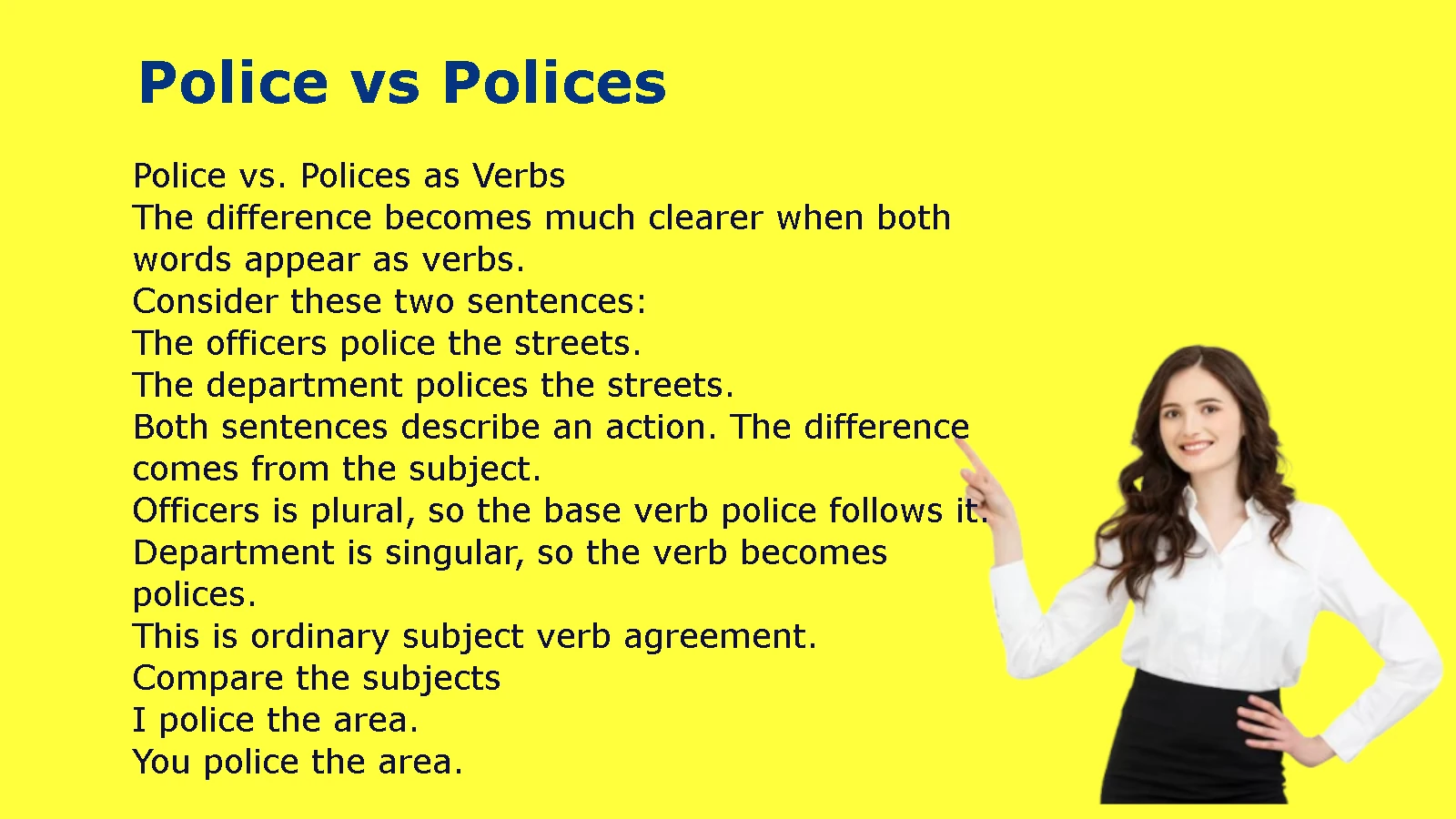
The difference becomes much clearer when both words appear as verbs.
Consider these two sentences:
The officers police the streets.
The department polices the streets.
Both sentences describe an action. The difference comes from the subject.
Officers is plural, so the base verb police follows it.
Department is singular, so the verb becomes polices.
This is ordinary subject verb agreement.
Compare the subjects
- I police the area.
- You police the area.
- We police the area.
- They police the area.
- He polices the area.
- She polices the area.
- The agency polices the area.
- The department polices the area.
The word polices doesn’t mean “more than one police.” It means that a singular third person subject performs the action of policing.
That distinction solves most questions about police vs. polices.
Police vs. Polices Sentence Examples
The following examples show how the two forms work in real sentences.
| Sentence | Role of the word | Explanation |
| The police arrived within minutes. | Noun | Refers to law enforcement officers. |
| The police are investigating the case. | Noun | Functions as a plural noun. |
| Officers police the neighborhood. | Verb | Plural subject takes the base verb. |
| They police the border. | Verb | They takes the base form. |
| The department polices the neighborhood. | Verb | Singular subject takes polices. |
| The agency polices financial activity. | Verb | Agency is singular. |
| Several police officers attended the meeting. | Noun phrase | Refers to individual officers. |
| Several police forces worked together. | Noun phrase | Refers to multiple organizations. |
The key isn’t the spelling alone. Look at what the word is doing in the sentence.
Common Mistakes With Police and Polices
Small grammatical mistakes can change the meaning or make a sentence sound unnatural. Here are the most common ones.
Mistake: Using “Polices” as the Plural of “Police”
Incorrect:
❌ The polices arrived at the station.
Correct:
✅ The police arrived at the station.
Or:
✅ Several police officers arrived at the station.
The first correction refers to the group collectively. The second emphasizes individual officers.
Mistake: Saying “A Police”
Incorrect:
❌ A police stopped the driver.
Correct:
✅ A police officer stopped the driver.
Because police doesn’t normally function as a singular count noun for one officer, police officer is the natural choice.
Mistake: Using “Police Is”
Incorrect in standard American usage when police refers to the officers collectively:
❌ The police is investigating the case.
Correct:
✅ The police are investigating the case.
Cambridge specifically illustrates this plural agreement with examples such as “The police are investigating.”
Mistake: Confusing the Noun and Verb
Compare:
The police patrol the streets.
and:
The department polices the streets.
In the first sentence, police is a noun.
In the second sentence, polices is a verb.
The words look closely related because they are. Their grammatical roles are different.
Mistake: Using “Polices” for Multiple Police Forces
Instead of:
❌ Three polices coordinated the investigation.
Use:
✅ Three police forces coordinated the investigation.
Or:
✅ Three law enforcement agencies coordinated the investigation.
The right choice depends on what you’re actually describing.
Police, Police Officer, Police Force, and Police Department
These terms overlap, but they aren’t interchangeable in every sentence.
| Term | Meaning | Example |
| police | A law enforcement organization or its members collectively | The police arrived. |
| police officer | One individual member of a police force | A police officer spoke to the witness. |
| police force | An organized body of police officers | The city has its own police force. |
| police department | A particular police organization or administrative body | The police department released a statement. |
| law enforcement agency | A broader term for an organization that enforces laws | The law enforcement agency opened an investigation. |
| policing | The activity or practice of enforcing laws or maintaining order | Community policing can involve local partnerships. |
Choosing the right term makes writing more precise.
For example, the police department points to a particular organization. The police can refer more broadly to the officers or force. A police officer identifies one person.
Police vs. Polices: Verb Forms
If you’re using police as a verb, learning its basic forms makes the police vs. polices distinction almost automatic.
| Verb form | Example |
| Base form | They police the area. |
| Third person singular | The agency polices the area. |
| Past tense | They policed the area. |
| Past participle | They have policed the area. |
| Present participle | They are policing the area. |
Merriam Webster gives policed as the past form and policing as the present participle.
Police
Use police after subjects such as I, you, we, and they.
Examples:
- We police the area.
- They police the border.
- Officers police the streets.
The base form also appears after modal verbs:
- They must police the area.
- Officials should police the activity.
- The agency can police the market.
Polices
Use polices with a singular third person subject.
Examples:
- The department polices the city.
- She polices the event.
- The regulator polices the market.
- The organization polices its own standards.
Policed
Use policed for the past tense and past participle.
Examples:
- Officers policed the event yesterday.
- The border was heavily policed.
- The agency has policed the industry for decades.
Policing
Use policing as the present participle or gerund.
Examples:
- Officers are policing the area.
- Policing requires careful judgment.
- The department is improving its policing methods.
How to Choose Between “Police” and “Polices”
When you’re unsure which form belongs in a sentence, don’t guess from the spelling. Check the subject and grammatical role.
Ask whether “police” is a noun
If you’re talking about law enforcement officers collectively, use:
police
Example:
The police are investigating the incident.
Don’t add an s.
Ask whether “police” is a verb
If the word describes an action, identify the subject.
With a plural subject:
Officers police the area.
With a singular third person subject:
The department polices the area.
Use this four step test
- Are you talking about law enforcement officers collectively?
Use police. - Are you talking about one individual officer?
Use police officer. - Are you using police as a verb with I, you, we, or they?
Use police. - Are you using police as a verb with he, she, it, or a singular noun?
Use polices.
This approach works far better than trying to memorize isolated sentences.
Police vs. Polices in Formal Writing
Formal writing benefits from precision. If your sentence could confuse the reader, choose a more specific expression.
For example:
The police investigated the complaint.
This is clear when the context concerns law enforcement officers.
However:
Three police forces investigated the complaint.
is more precise when three separate organizations took part.
Likewise, if you’re discussing regulation rather than traditional police work, polices may be the right verb:
The federal agency polices the industry.
That sentence says the agency monitors and enforces standards. It doesn’t necessarily mean that the agency itself is a conventional police department.
Cambridge’s Business English definition reflects this broader use of police, including making sure rules within an activity or organization are followed.
Police vs. Polices in American English
In American English, police commonly functions as a plural noun when it refers to law enforcement officers collectively.
For example:
The police are investigating the robbery.
The plural verb are matches the plural treatment of police in this meaning.
You can also say:
Police arrested two suspects.
Here, police appears without the article the. This construction is common in news reporting and headlines.
Cambridge’s American Dictionary describes police as a plural noun meaning an official force or the members of that force. It also gives police as a verb meaning to control or maintain order.
At the same time, polices remains the third person singular verb:
The agency polices financial markets.
So American English doesn’t turn police into polices when talking about multiple officers.
A Closer Look at “The Police Are”
One of the most useful grammar points in this topic involves the phrase the police.
In standard American English, when police means police officers or the police force collectively, it normally takes a plural verb.
Correct:
The police are investigating the case.
Correct:
The police have arrested a suspect.
Correct:
The police were called to the scene.
Incorrect in standard usage:
❌ The police is investigating the case.
The reason is simple: police functions as a plural noun in this meaning.
Compare it with the singular expression police department:
The police department is investigating the case.
Now the subject is department, which is singular. Therefore, is is correct.
This gives you another useful contrast:
| Subject | Correct verb |
| The police | are |
| The police officers | are |
| The police department | is |
| The police force | is |
| The police forces | are |
The noun that controls the verb matters.
Case Study: Why the Subject Changes the Verb
Consider a fictional local investigation.
First, the sentence says:
The police are investigating the theft.
Here, police refers to the officers collectively. The plural verb are fits.
Now change the subject:
The police department is investigating the theft.
The meaning remains closely related, but the grammatical subject is now department. Because department is singular, the verb becomes is.
Now change the sentence again:
The department polices several high crime areas.
Here, polices is no longer part of the noun phrase. It’s the main verb. The singular subject department requires polices.
Three sentences. Three grammatical patterns:
- The police are investigating.
- The police department is investigating.
- The department polices the area.
Once you separate noun from verb, the confusion disappears.
Police vs. Polices: Practice Test
Choose police or polices in each sentence.
Questions
- The ___ arrived within minutes.
- The agency ___ the financial sector.
- Several ___ officers attended the meeting.
- The organization ___ its members.
- The ___ are searching the building.
- They ___ the area at night.
- The department ___ traffic regulations.
- We ___ the event every year.
- She ___ the facility during major events.
- The ___ have requested additional information.
Answers
- police
- polices
- police
- polices
- police
- police
- polices
- police
- polices
The pattern is consistent.
Common Questions About Police vs. Polices
Is “polices” a correct word?
Yes. Polices is a standard English word when used as the third person singular present form of the verb police.
For example:
The agency polices the industry.
Merriam Webster identifies polices as the third person singular present form of police.
Is “polices” the plural of “police”?
No, not in standard English when you mean police officers.
Use:
the police
or:
police officers
If you’re referring to multiple law enforcement organizations, use:
police forces
or:
police departments
Can you say “three polices”?
In standard American English, three police officers is the safer and clearer expression when you mean three individual officers.
Use:
Three police officers were standing outside.
rather than:
❌ Three polices were standing outside.
The noun police already carries plural meaning when it refers collectively to officers.
Should you say “the police is” or “the police are”?
Use the police are when police refers to the officers or force collectively.
The police are investigating the case.
However, use a singular verb when the actual subject is singular:
The police department is investigating the case.
What is the verb form of “police” for he or she?
Use polices.
Examples:
- He polices the area.
- She polices the event.
- The agency polices the industry.
What is the past tense of “police”?
The past tense is policed.
Example:
Officers policed the event throughout the evening.
What is the present participle of “police”?
The present participle is policing.
Example:
Officers are policing the area.
What should you use instead of “polices” for multiple police forces?
Use a phrase such as:
- police forces
- police departments
- law enforcement agencies
For example:
Several police forces cooperated during the investigation.
That’s much clearer than trying to use polices as a plural noun.
Police vs. Polices: Key Differences at a Glance
| Police | Polices |
| Can be a noun | Normally a verb in this comparison |
| Refers to law enforcement collectively | Means that a singular subject regulates, controls, guards, or enforces |
| Can be the base form of the verb | Third person singular present form of police |
| Example: The police are here. | Example: The agency polices the area. |
| Doesn’t normally become polices to mean multiple officers | Doesn’t normally function as the plural noun for police officers |
The most important distinction is grammatical rather than visual.
Police can be either a noun or a verb.
Polices is normally the third person singular form of that verb.
Final Takeaway: Police vs. Polices
The difference between police vs. polices becomes simple once you identify the word’s role in the sentence.
Police can refer to a law enforcement organization or its members collectively:
The police are investigating the incident.
It can also function as a verb:
They police the area.
Polices, on the other hand, normally functions as the third person singular present form of the verb:
The department polices the area.
So, don’t think of the relationship as:
police → polices = singular → plural
Think of it as:
police = noun or base verb
polices = third person singular verb
The simplest rule is worth keeping in mind:
The police are a group. A department polices an area.
Once that distinction clicks, choosing between police and polices becomes much easier.