Have you ever wondered whether “person” and “people” mean the same thing? While both words refer to human beings, Person vs People can be confusing because they are used differently depending on whether you are talking about one individual or more than one.
Person is the singular noun used to refer to one human being, while people is the most common plural form of person. For example, you can say “one person” but “two people.”
Examples:
- One person is waiting outside.
- Many people attended the event.
The confusion is understandable. English has several irregular plural forms, and person vs people is one of the most common ones. People often search for person plural, plural of person, person or people, or what is the difference between person and people because these words don’t follow the simple pattern of adding -s.
In this guide, you’ll learn the complete difference between Person vs People, including their meanings, definitions, plural forms, correct usage, and examples in sentences. You’ll also discover when to use person, when to use people, common mistakes to avoid, and how these words differ from persons and peoples.
Person vs. People: The Quick Difference
The easiest way to remember the difference is this:
- Person = one human being
- People = two or more human beings
- Persons = a formal plural, especially in legal or official language
- Peoples = distinct groups of people, often connected by culture, nationality, tradition, or shared identity
Here’s the difference at a glance:
| Word | Basic meaning | Number | Typical use | Example |
| person | One human being | Singular | Everyday English | She is a kind person. |
| people | More than one human being | Plural | Everyday English | Many people attended. |
| persons | Individual human beings | Plural | Legal or highly formal English | Unauthorized persons may not enter. |
| peoples | Distinct groups of people | Plural | Cultural, historical, or social contexts | The region was home to several peoples. |
For ordinary conversation and general writing, person and people do most of the work.
Merriam-Webster identifies people as the usual modern plural of person. It also notes that persons, once much more common as a plural, has become largely associated with law related contexts outside established expressions.
What Does “Person” Mean?
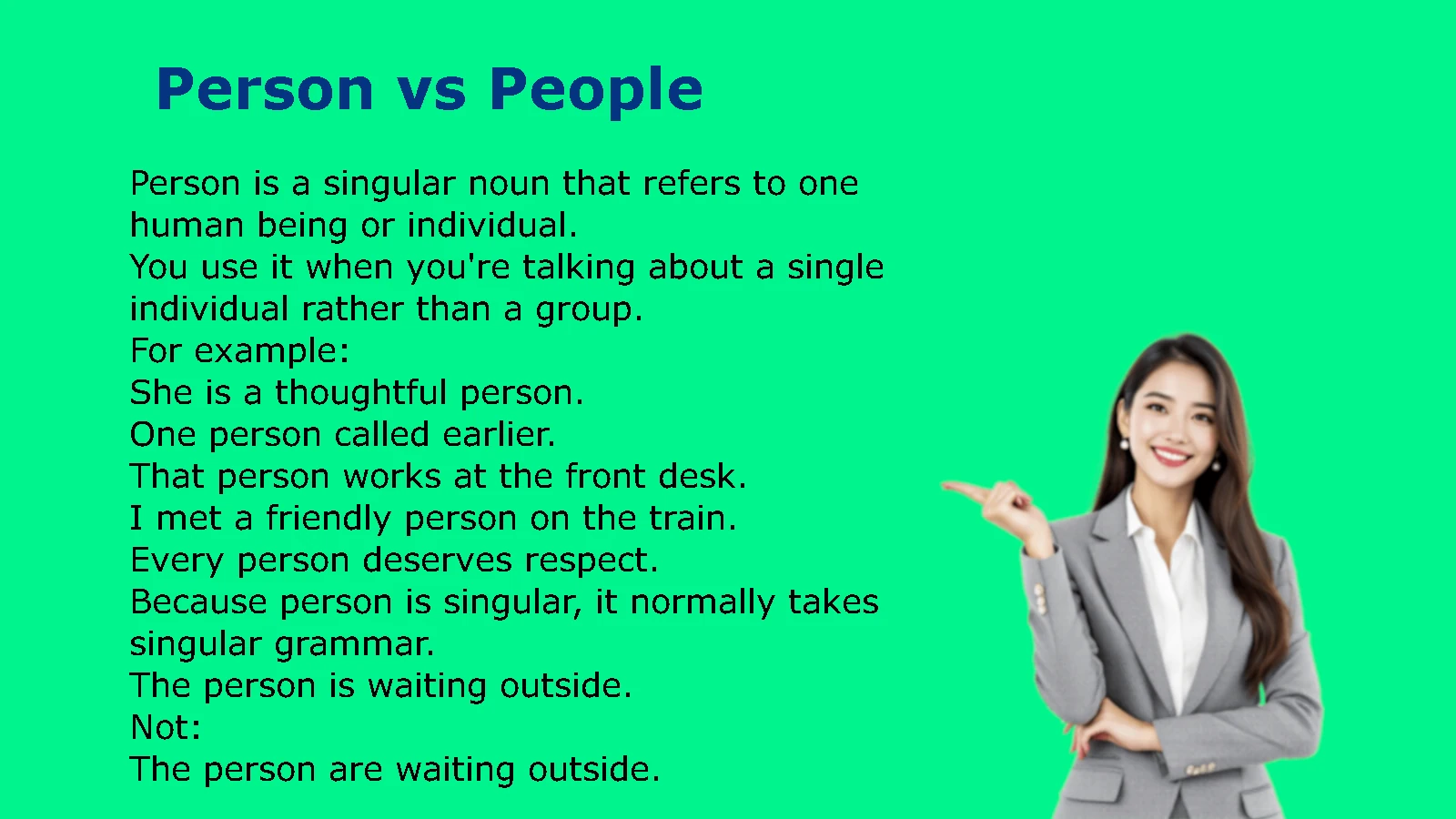
Person is a singular noun that refers to one human being or individual.
You use it when you’re talking about a single individual rather than a group.
For example:
- She is a thoughtful person.
- One person called earlier.
- That person works at the front desk.
- I met a friendly person on the train.
- Every person deserves respect.
Because person is singular, it normally takes singular grammar.
The person is waiting outside.
Not:
The person are waiting outside.
The same rule applies when you use articles and demonstratives.
| Singular form | Example |
| a person | A person is waiting outside. |
| one person | One person answered correctly. |
| this person | This person knows the area well. |
| that person | That person helped me yesterday. |
| each person | Each person received a ticket. |
| every person | Every person must sign the form. |
The word can also appear in expressions such as in person, per person, and person to person.
Merriam-Webster defines person primarily as a human or individual. The word can also have specialized legal and grammatical meanings, but those meanings don’t change its basic everyday use.
What Does “People” Mean?
People is the standard plural form used when referring to more than one person.
For example:
- Two people entered the room.
- Many people enjoy traveling.
- Three people applied for the position.
- People often change their minds.
- The people at the meeting were friendly.
Notice the difference:
One person is waiting.
Two people are waiting.
The noun changes from person to people, and the verb changes from is to are.
Merriam-Webster defines people as human beings or persons and gives examples of its use for groups, segments of humanity, communities, and people linked by a common factor.
Is “People” the Plural of “Person”?
Yes. In modern everyday English, people is the normal plural of person.
You can think of it this way:
one person → two people → ten people → thousands of people
This may seem unusual because people doesn’t look like the plural of person. English contains many irregular plurals, however. For example:
- man → men
- woman → women
- child → children
- mouse → mice
- person → people
The important point isn’t how the word changes. It’s how English speakers actually use it.
Cambridge Dictionary gives examples such as three people and explicitly contrasts that natural form with the much more formal three persons.
Person vs. People With Numbers
Numbers make the distinction especially easy to see.
Use person with one:
- one person
- a single person
- only one person
- each person
Use people with numbers greater than one:
- two people
- three people
- ten people
- fifty people
- 1,000 people
Examples
Correct:
One person called the office.
Correct:
Five people called the office.
Incorrect:
Five person called the office.
The same pattern works with larger quantities:
- Twenty people attended the conference.
- Hundreds of people visited the museum.
- Thousands of people watched the event.
- Millions of people use the service.
You don’t need to replace people with persons simply because the sentence contains a specific number.
That idea comes from older usage preferences. Merriam-Webster notes that older style guides sometimes preferred persons for groups with a definite number, but modern usage has shifted strongly toward people.
A Simple Number Rule
1 = person
2 or more = people
That’s the safest rule for everyday English.
Person vs. People in Everyday Sentences
The difference becomes even clearer when you compare sentences side by side.
| Person | People |
| She is a nice person. | They are nice people. |
| One person called me. | Several people called me. |
| That person lives nearby. | Those people live nearby. |
| A person entered the store. | Several people entered the store. |
| Every person needs food. | Many people need food. |
| The person was waiting. | The people were waiting. |
The key isn’t just the noun. Other words in the sentence often change too.
Compare:
This person is my friend.
with:
These people are my friends.
The shift from singular to plural affects this/these, is/are, and sometimes other nouns and pronouns.
Person vs. People for General Statements
Sometimes people doesn’t refer to a particular group standing in front of you. It can refer to human beings generally.
For example:
People need sleep.
This sentence doesn’t identify a specific group. It makes a general statement about humans.
You can also express the same idea with a person:
A person needs sleep.
Both sentences can work, but they create a slightly different focus.
People presents humans collectively:
People need social interaction.
A person focuses on the individual:
A person needs social interaction.
The distinction matters when you’re trying to make an argument, explain a behavior, or write an informative article.
More Examples
- People learn from experience.
- People make mistakes.
- People respond differently to criticism.
- A person may change their opinion over time.
- A person needs time to recover from a difficult experience.
Merriam-Webster lists people as a plural noun for human beings considered as a group as well as for people who share a characteristic or connection.
Person vs. Persons: What’s the Difference?
Here’s where the grammar gets more interesting.
Persons is a legitimate plural of person, but it isn’t normally the word you want in casual conversation.
For most everyday situations, use people.
Everyday English
Three people were waiting outside.
Formal or legal English
Three persons were identified in the report.
The second sentence isn’t grammatically wrong. It simply sounds more formal.
Cambridge Dictionary describes persons as a “very formal” word and says it’s mainly used in legalistic contexts.
When “Persons” Makes Sense
You may see persons in:
- Legal documents
- Regulations
- Official notices
- Government language
- Police or administrative reports
- Formal contracts
- Certain established expressions
For example:
Unauthorized persons are prohibited from entering.
That sounds like a sign at a restricted facility.
Compare it with:
Unauthorized people can’t enter.
The second sentence sounds much more natural in ordinary conversation.
Neither sentence has a grammatical problem. The difference lies mainly in register, or the level of formality.
Why Does “Persons” Sound So Formal?
English has changed over time.
For centuries, writers used both people and persons as plurals referring to human beings. At various points, some usage guides encouraged persons, particularly when writers referred to a specific number of individuals.
Modern English has moved in the other direction.
Merriam-Webster explains that persons competed with people for centuries, but uses such as “seven persons” have largely become associated with legal contexts or sound old fashioned elsewhere.
Merriam-Webster’s usage discussion also notes that modern style guidance generally favors people for plural references to individuals.
That explains why this sounds natural:
Six people attended the meeting.
While this can sound stiff:
Six persons attended the meeting.
The second sentence isn’t automatically wrong. It simply isn’t the usual choice for modern general writing.
When Should You Use “Persons” Instead of “People”?
Use persons when the context genuinely calls for a formal or legal tone.
Legal language
Legal writing often needs precise, standardized language.
For example:
Any person or persons found violating the regulation may face penalties.
This kind of construction appears in formal rules and legal notices.
Official notices
You might see:
Only authorized persons may enter this area.
The word persons fits the formal tone of the notice.
Established expressions
Some phrases traditionally use persons.
Examples include:
- missing persons
- persons unknown
- displaced persons
- persons of interest
In these expressions, replacing persons with people can sound awkward or change the established wording.
For example:
The police are searching for a missing person.
and:
The missing persons unit released a statement.
Here, persons belongs to an established term.
The Practical Rule
If you’re writing a text message, school essay, blog post, email, or general article, people will usually be the better choice.
If you’re writing a legal notice or working with an established formal expression, persons may be appropriate.
Person vs. People vs. Persons
Putting all three together makes the distinction easier.
| Word | Meaning | Commonness | Example |
| person | One individual | Very common | One person complained. |
| people | Multiple individuals | Very common | Five people complained. |
| persons | Multiple individuals in formal language | Less common | Unauthorized persons may not enter. |
Consider this short example:
One person entered the building. Two people followed. The security report later identified three persons who had entered without permission.
All three forms can work in the right context.
The first sentence needs the singular person.
The second uses the normal plural people.
The third uses persons because the sentence has a formal report style.
What Does “Peoples” Mean?
Peoples is different from people.
It doesn’t simply mean “a lot of people.”
Instead, peoples can refer to multiple distinct groups of people connected by shared culture, traditions, history, language, institutions, or identity.
Merriam-Webster defines this plural sense as groups united by factors such as common culture, tradition, kinship, language, institutions, or beliefs.
For example:
The region has been home to many distinct peoples.
Here, peoples means different groups or communities.
Another example:
The museum explores the histories of Indigenous peoples.
The writer isn’t simply saying that many individual people lived there. The focus is on distinct communities or cultural groups.
People vs. Peoples
Compare these sentences:
Many people attended the festival.
This means many individual human beings attended.
Now compare:
Several peoples have lived in the region.
This refers to distinct communities or cultural groups.
The extra s changes the meaning.
| Word | Meaning |
| people | Individuals collectively |
| peoples | Distinct groups or communities |
Another Example
Imagine a history article discussing several ancient civilizations.
Many people lived in the area.
This focuses on individual inhabitants.
Several peoples lived in the area over the centuries.
This focuses on different cultural or historical groups.
That’s why peoples appears more often in historical, anthropological, cultural, and political writing than in everyday conversation.
Common Person vs. People Mistakes
The most frequent errors are easy to fix.
“Two person” instead of “two people”
Incorrect:
Two person came to my house.
Correct:
Two people came to my house.
Use people when the number is greater than one.
“Many person” instead of “many people”
Incorrect:
Many person use social media.
Correct:
Many people use social media.
Words such as many, several, few, and numerous normally introduce a plural noun.
“People is” instead of “people are”
Incorrect:
People is becoming more aware of the issue.
Correct:
People are becoming more aware of the issue.
When people refers to multiple human beings, it takes plural verb agreement.
“One people” instead of “one person”
Incorrect:
One people was standing outside.
Correct:
One person was standing outside.
Use person for one individual.
Using “persons” unnecessarily
Awkward in ordinary English:
Five persons attended my birthday party.
Natural:
Five people attended my birthday party.
Again, persons isn’t necessarily incorrect. It simply creates a formal tone that a casual situation doesn’t need.
Person vs. People in Questions
Questions follow the same basic rules.
Use person when asking about one individual:
- Who is that person?
- Is there a person outside?
- Which person called you?
- What kind of person is he?
Use people when asking about multiple individuals:
- How many people are coming?
- Who are those people?
- Where did those people go?
- How many people attended?
Why “How Many People?” Is Correct
The phrase how many requires a plural count noun.
That’s why you say:
How many people are coming?
Not:
How many person are coming?
And although how many persons is grammatically possible, it sounds unusually formal in ordinary conversation.
Cambridge specifically uses three people rather than three persons in its explanation of the distinction.
Person vs. People in Common Expressions
Some expressions use person because they focus on the individual.
In person
In person means physically present rather than communicating remotely.
I’d rather discuss it in person.
You need to submit the documents in person.
Per person
Per person means for each individual.
The meal costs $20 per person.
The hotel charges $15 per person.
Person to person
This expression emphasizes direct interaction between individuals.
The message was passed from person to person.
People person
A people person describes someone who enjoys interacting with others or works comfortably with them.
She’s a natural people person.
Here, people functions as part of a compound expression.
People skills
People skills refers to the ability to communicate, cooperate, and interact effectively with others.
Good people skills can help you build strong professional relationships.
These expressions show why choosing between person and people isn’t always about simply counting individuals. The meaning and structure of the phrase matter too.
Person vs. People in Formal and Informal English
The right choice can depend on the situation.
| Context | Better choice | Example |
| Casual conversation | people | A lot of people were there. |
| Blog writing | people | Many people make this mistake. |
| Academic writing | Usually people | People respond differently. |
| News writing | people | Two people were injured. |
| Legal documents | persons may fit | Unauthorized persons are prohibited. |
| Official notices | persons may fit | Authorized persons only. |
| Cultural or historical writing | peoples when referring to distinct groups | Indigenous peoples have diverse traditions. |
The key lesson is simple: don’t use a formal word just because it sounds more sophisticated.
If people works naturally, use it.
Clear writing beats inflated writing.
Case Study: Choosing the Right Word
Consider a workplace announcement.
Version A
Five persons will attend the meeting tomorrow.
This sentence is grammatically possible, but it sounds unusually formal for a normal workplace message.
Version B
Five people will attend the meeting tomorrow.
This sounds natural and direct.
Now imagine a security notice:
Unauthorized persons are prohibited from entering the facility.
Here, persons fits because the notice uses formal administrative language.
Finally, consider a history textbook:
Several Indigenous peoples lived throughout the region before European settlement.
Here, peoples makes sense because the writer is distinguishing different cultural groups.
What the Case Study Shows
The number of individuals doesn’t determine everything.
Context matters.
The three words can all refer to humans, but they organize the idea differently:
- person focuses on one individual.
- people focuses on multiple individuals.
- persons emphasizes individuals in formal language.
- peoples emphasizes distinct groups.
A Useful Quote About Person and People
Cambridge’s grammar guidance makes the central distinction particularly clear:
“To refer to groups of human beings or humans in general, we use people.”
That rule covers most situations you’ll encounter.
Merriam-Webster reaches the same practical conclusion by describing people as the usual modern plural of person.
Person vs. People: A Grammar Cheat Sheet
When you’re unsure, use this quick reference:
| If you mean… | Use | Example |
| One human | person | She is a kind person. |
| Two humans | people | Two people arrived. |
| Many humans | people | Many people agreed. |
| Humans generally | people | People need rest. |
| Formal or legal individuals | persons | Unauthorized persons must leave. |
| Established formal phrase | persons | Missing persons were reported. |
| Different cultural groups | peoples | Several peoples lived there. |
How to Remember Person vs. People
A simple four part rule will handle almost every situation:
One person.
Two or more people.
Formal or legal: persons.
Distinct cultural groups: peoples.
For everyday English, the first two rules matter most.
If you say:
I met one person.
Then the plural becomes:
I met two people.
You don’t need to overthink it.
Frequently Asked Questions About Person vs. People
Is people the plural of person?
Yes. People is the standard plural form of person in modern everyday English. Major dictionaries recognize it as the usual plural.
Is persons also a plural of person?
Yes. Persons is a valid plural form, but modern English uses it mainly in legal, official, and other highly formal contexts.
Is “two persons” grammatically correct?
Yes. Two persons is grammatically possible, but two people sounds more natural in ordinary English.
Should I say “three people” or “three persons”?
In most everyday situations, choose three people.
For example:
Three people attended the interview.
Use persons when the context specifically calls for formal or legal language.
Is “people” singular or plural?
When people means multiple human beings, it is grammatically plural.
For example:
People are waiting outside.
Not:
People is waiting outside.
What is the difference between people and peoples?
People usually refers to multiple individuals. Peoples refers to multiple distinct groups or communities.
For example:
Many people attended the event.
versus:
Several peoples have inhabited the region.
Can “people” refer to one group?
Yes. People can refer collectively to a group or community.
For example:
The people of the village welcomed the visitors.
Here, people refers to the members of that community.
Is “one people” correct?
Usually not if you mean one individual. Say one person.
However, one people can occur in specialized contexts where people means a distinct nation or cultural group. That is a different meaning from the ordinary plural people.
Why doesn’t the plural of person look like persons?
English has many irregular plurals. Person → people developed through the history of English rather than following the simple noun + s pattern.
Interestingly, person and people also come from different Latin roots. Merriam-Webster traces person to Latin persona, while people ultimately comes from Latin populus.
Which is better for everyday writing: people or persons?
People is almost always the better choice for ordinary writing.
Use persons when the context is legal, official, highly formal, or part of an established expression.
Is “people person” correct?
Yes. People person is an established expression for someone who is comfortable interacting with others.
For example:
She’s a great people person.
Can people be used for humans in general?
Yes.
People need food, water, and shelter.
Here, people refers to human beings generally rather than a particular group.
Person vs. People: Final Takeaway
The difference between person vs. people becomes straightforward once you separate everyday usage from specialized forms.
Person means one human being:
One person is waiting outside.
People is the normal plural:
Five people are waiting outside.
Persons is a formal plural that appears mainly in legal, official, and established expressions:
Unauthorized persons may not enter.
Peoples refers to distinct groups of people, often connected by culture, history, language, tradition, or identity:
Several peoples have lived in the region.
The safest everyday rule is still the simplest:
One person. Two or more people.
When persons or peoples appears, don’t automatically treat it as a complicated version of people. Each form has a specific role. Once you understand that role, choosing the right word becomes almost automatic.