Have you ever wondered why the same medical term appears as apnea in some texts and apnoea in others? Apnea vs Apnoea is mainly a difference in spelling conventions, not meaning. The form you use usually depends on the type of English, country, and medical context in which the word appears.
Apnea and apnoea have the same meaning. Both refer to a temporary pause or cessation of breathing, which can occur during sleep or while a person is awake. Apnea is the standard spelling in American English, while apnoea is traditionally used in British English and other varieties influenced by British spelling.
Examples:
- The doctor diagnosed him with sleep apnea.
- The patient was being evaluated for sleep apnoea.
The confusion is understandable. People often search for apnea vs apnoea, apnea or apnoea, which spelling is correct, or apnoea meaning in English because both spellings are accepted, yet they follow different spelling conventions. And here’s the kicker: neither spelling changes the word’s meaning or pronunciation.
In this guide, you’ll learn the complete difference between Apnea vs Apnoea, including their meaning, pronunciation, origin, correct spelling, and usage. You’ll also discover which spelling to use in American English vs British English, along with clear examples to help you choose the right form.
Apnea vs Apnoea: The Quick Answer
The simplest way to remember the difference is:
Apnea = US English
Apnoea = British English
Both refer to a temporary stopping or cessation of breathing. The words can describe breathing pauses generally, although they appear especially often in discussions of sleep-related breathing disorders.
| Word | Standard variety | Meaning | Common example |
| apnea | US English | Temporary cessation of breathing | sleep apnea |
| apnoea | British English | Temporary cessation of breathing | sleep apnoea |
Cambridge gives the same pronunciation for the two forms, /ˈæp.ni.ə/, reinforcing that the spelling difference doesn’t represent a different spoken word.
The key difference
There is one obvious visual difference:
apnea → apnoea
The British form contains oe, while the American form uses e in that position.
That small change can make the words look like separate terms. They aren’t. In standard English usage, they’re regional spelling variants of the same medical word.
What Does Apnea Mean?
Apnea is a medical term for a temporary cessation of breathing. Cambridge Dictionary defines it as a medical condition that causes someone to stop breathing for a short time, particularly during sleep.
The word can be used broadly. However, you’ll most often encounter it when reading about sleep apnea, a condition in which breathing repeatedly stops and starts during sleep.
The National Heart, Lung, and Blood Institute describes sleep apnea as a condition in which breathing stops and restarts many times during sleep. Those interruptions can reduce the amount of oxygen reaching the body and disrupt normal sleep.
For example:
- The doctor evaluated him for sleep apnea.
- Apnea can occur during sleep.
- The patient experienced repeated episodes of apnea.
- Central apnea has a different mechanism from obstructive apnea.
The adjective apneic is also common in medical writing. It means relating to, involving, or characterized by apnea. Merriam-Webster gives apneic the sense of involving a temporary cessation of respiration.
What Does Apnoea Mean?
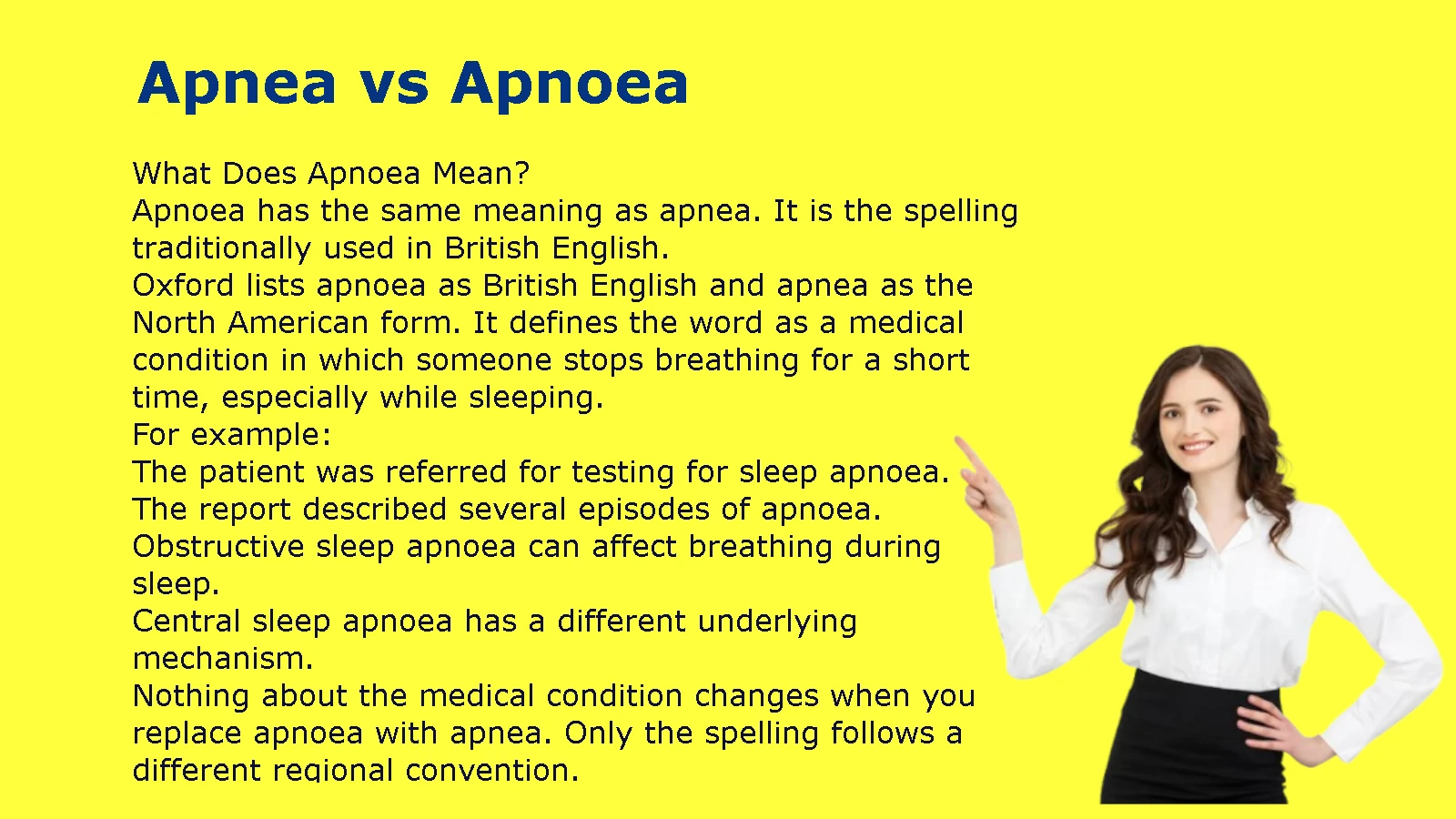
Apnoea has the same meaning as apnea. It is the spelling traditionally used in British English.
Oxford lists apnoea as British English and apnea as the North American form. It defines the word as a medical condition in which someone stops breathing for a short time, especially while sleeping.
For example:
- The patient was referred for testing for sleep apnoea.
- The report described several episodes of apnoea.
- Obstructive sleep apnoea can affect breathing during sleep.
- Central sleep apnoea has a different underlying mechanism.
Nothing about the medical condition changes when you replace apnoea with apnea. Only the spelling follows a different regional convention.
Apnea vs Apnoea Spelling Difference Explained
The spelling difference becomes easier to understand when you put the words side by side:
American English: apnea
British English: apnoea
The British spelling preserves the oe sequence found in the older form of the word, while American English uses the shorter -ea spelling.
This is not an isolated spelling quirk. English has many words whose spelling differs between American and British varieties. Medical vocabulary contains several examples because many medical terms entered English through Greek and Latin.
Still, it would be misleading to treat every -oea versus -ea difference as a simple mechanical rule. English spelling developed over centuries, and individual words followed their own paths.
For practical writing, the important point is much simpler:
Use the form that matches your variety of English.
Is Apnea or Apnoea Correct?
Both are correct.
The right choice depends on the English variety you’re using.
Use “apnea” in US English
Choose apnea when writing for an American audience or following an American style guide.
Examples include:
- sleep apnea
- obstructive sleep apnea
- central sleep apnea
- apnea episodes
US medical sources routinely use this spelling. For example, the National Heart, Lung, and Blood Institute uses sleep apnea throughout its patient information.
Use “apnoea” in British English
Choose apnoea when writing in British English.
Examples include:
- sleep apnoea
- obstructive sleep apnoea
- central sleep apnoea
- apnoea episodes
Oxford and Cambridge both recognize apnoea as the British form.
What if you’re writing for an international audience?
Pick one spelling system and stick with it.
For example, if an article otherwise uses American spellings such as color, center, and analyze, using apnoea in one paragraph can make the article look inconsistent.
Likewise, a British publication that consistently uses British spelling will normally prefer apnoea.
Consistency matters more than trying to use both spellings throughout the same article.
Apnea or Apnoea in American English
In American English, apnea is the standard spelling.
That’s the form you’ll see in American medical information, dictionaries, textbooks, hospital websites, and patient resources.
Cambridge labels apnea as the US spelling of apnoea.
Some common American terms include:
- sleep apnea
- obstructive sleep apnea
- central sleep apnea
- sleep apnea syndrome
- apneic episode
If your audience is primarily in the United States, writing sleep apnea rather than sleep apnoea will sound natural.
Example in US English
My doctor recommended a sleep study because I may have sleep apnea.
The spelling fits standard American usage.
Apnea or Apnoea in British English
British English generally uses apnoea.
That means a British publication will typically write:
My doctor recommended a sleep study because I may have sleep apnoea.
Again, the medical meaning is identical.
Cambridge’s British entry defines apnoea as a medical condition involving a temporary stop in breathing and lists sleep apnoea as a common expression.
Oxford likewise gives apnoea as the British form and apnea as the North American form.
Apnea vs Apnoea Pronunciation
Despite the different spellings, apnea and apnoea are pronounced essentially the same.
Cambridge gives the pronunciation as:
/ˈæp.ni.ə/
A simple pronunciation guide is:
AP-nee-uh
The first syllable receives the main stress.
The spelling can look intimidating at first, especially apnoea, but the pronunciation is much simpler than the written form suggests.
Does the “o” in apnoea create an extra sound?
No.
You don’t pronounce apnoea as though it contained four separate syllables. The oe spelling doesn’t add an extra spoken syllable.
That’s one reason readers who know the word primarily from speech may be surprised when they first see the British spelling.
Why Does Apnoea Have an Extra O?
The history of the word explains why apnoea looks unusual.
The English word comes from Greek apnoia, meaning an absence of respiration or breathing. Its formation combines a Greek element meaning “without” with a root associated with breathing.
The term entered medical English through Modern Latin as apnoea.
The Online Etymology Dictionary dates the English medical word to the early 18th century and traces it through Modern Latin apnoea to Greek apnoia, associated with the idea of an absence of breathing.
That historical spelling helps explain why apnoea contains the oe sequence.
American English later developed the shorter apnea form, while British English retained apnoea as its standard spelling.
So the extra o isn’t random. It reflects the word’s history.
Apnea vs Apnoea in Medical Terms
The difference becomes particularly noticeable in medical compounds.
Consider this comparison:
| US English | British English |
| sleep apnea | sleep apnoea |
| obstructive sleep apnea | obstructive sleep apnoea |
| central sleep apnea | central sleep apnoea |
| apnea episode | apnoea episode |
| apneic | apnoeic |
The terminology follows the spelling system of the larger phrase.
For example, if you’re writing in American English, you would normally write:
obstructive sleep apnea
In British English, you would normally write:
obstructive sleep apnoea
The condition hasn’t changed. The spelling has.
Sleep Apnea vs Sleep Apnoea
Sleep apnea and sleep apnoea are among the most common forms of this spelling difference.
Cambridge lists sleep apnea as the US form and sleep apnoea as the UK form.
The term refers to a sleep disorder in which breathing repeatedly stops and starts during sleep.
The two major types commonly discussed are:
- Obstructive sleep apnea
- Central sleep apnea
The National Heart, Lung, and Blood Institute explains that obstructive sleep apnea occurs when the upper airway becomes blocked during sleep. Central sleep apnea occurs when the brain fails to send the signals needed to breathe.
That distinction is important because apnea itself doesn’t tell you why breathing stopped.
Obstructive sleep apnea
In obstructive sleep apnea, airflow becomes restricted because the upper airway becomes blocked or collapses during sleep.
The person may continue trying to breathe even though airflow is reduced or temporarily stopped.
Common risk factors include things such as age, family history, body characteristics, and certain health conditions.
Central sleep apnea
Central sleep apnea works differently.
Instead of the primary problem being a physical blockage of the upper airway, the brain doesn’t send the normal signals required to maintain breathing.
The National Library of Medicine describes central sleep apnea as involving repeated breathing interruptions without the respiratory effort seen in obstructive events.
So:
obstructive = airflow problem caused by upper-airway obstruction
central = breathing-control problem involving the brain’s signals
Both fall under the broader concept of sleep apnea.
A Real-World Usage Comparison
A useful way to understand apnea vs apnoea is to compare how major reference sources use the terms.
Cambridge Dictionary
Cambridge identifies:
- apnea as the US spelling
- apnoea as the UK spelling
It also gives the same basic definition and pronunciation for the two forms.
Oxford Learner’s Dictionaries
Oxford lists apnoea as British English and apnea as North American English. It also gives the same medical meaning for the two forms.
US medical sources
The National Heart, Lung, and Blood Institute consistently uses sleep apnea in its US medical information.
These sources provide a useful practical lesson: regional spelling isn’t a matter of one form being correct and the other being wrong.
Instead, the form changes according to the variety of English.
Apnea vs Apnoea Examples
Seeing the words in complete sentences makes the distinction much easier.
| US English | British English |
| The doctor diagnosed him with sleep apnea. | The doctor diagnosed him with sleep apnoea. |
| She was tested for obstructive sleep apnea. | She was tested for obstructive sleep apnoea. |
| The patient experienced several episodes of apnea. | The patient experienced several episodes of apnoea. |
| The study examined patients with central sleep apnea. | The study examined patients with central sleep apnoea. |
| The report described an apneic episode. | The report described an apnoeic episode. |
Notice what stays the same: the meaning and grammatical role.
What changes is the spelling convention.
More examples with apnea
- Sleep apnea can cause repeated interruptions in breathing during sleep.
- The specialist recommended testing for obstructive sleep apnea.
- The patient reported symptoms commonly associated with sleep apnea.
- The study investigated the relationship between apnea and sleep quality.
More examples with apnoea
- Sleep apnoea can interrupt normal breathing during sleep.
- The specialist recommended testing for obstructive sleep apnoea.
- The patient reported symptoms associated with sleep apnoea.
- The study investigated the relationship between apnoea and sleep quality.
The sentences communicate the same ideas.
Apnea vs Apnoea: Common Mistakes
The biggest mistake is assuming that the two spellings describe different disorders.
They don’t.
Mistake: Treating them as different conditions
Incorrect idea: Apnea is one condition and apnoea is another.
Correct: They are regional spelling variants of the same term.
Mistake: Calling apnoea an incorrect spelling
For American writers, apnoea may look unfamiliar. That doesn’t make it incorrect.
It is the standard British form.
Mistake: Calling apnea a misspelling in British English
The reverse is also true.
An American medical source using apnea isn’t making a spelling mistake. It is following American English.
Mistake: Mixing both forms randomly
A document that uses apnea in one section and apnoea in another can look inconsistent.
For professional writing, choose one variety and maintain it.
Apnea vs Apnoea: Which One Should You Use?
Your audience should determine your choice.
Choose apnea if:
- You’re writing in US English.
- Your readers are primarily American.
- You’re following an American medical style guide.
- The publication consistently uses American spelling.
- You’re writing terms such as sleep apnea or obstructive sleep apnea for a US audience.
Choose apnoea if:
- You’re writing in British English.
- Your readers are primarily British.
- You’re following a British publication’s spelling conventions.
- The surrounding content uses British medical terminology.
- You’re writing terms such as sleep apnoea or obstructive sleep apnoea.
For academic and medical writing
Follow the style guide required by your institution, journal, publisher, or organization.
This matters because professional writing often requires consistency across terminology, spelling, capitalization, abbreviations, and references.
Don’t switch between forms simply because you’ve encountered both online.
Apnea vs Apnoea and Related Words
The spelling distinction also appears in related terminology.
| US form | British form |
| apnea | apnoea |
| sleep apnea | sleep apnoea |
| obstructive sleep apnea | obstructive sleep apnoea |
| central sleep apnea | central sleep apnoea |
| apneic | apnoeic |
The related adjective is worth noticing because it follows the same regional pattern.
Apneic means relating to or characterized by apnea. Merriam-Webster defines it in connection with a transient cessation of respiration.
In British English, apnoeic is the corresponding spelling.
Is Apnea Always Related to Sleep?
No.
Although sleep apnea is by far one of the most familiar expressions, apnea has a broader medical meaning.
The basic concept is a cessation of breathing. Sleep is simply one important context in which repeated episodes can occur.
Medical literature may therefore use terms such as:
- central apnea
- obstructive apnea
- sleep apnea
- apnea episode
- apneic event
The specific meaning depends on the surrounding terminology.
This is why defining apnea simply as “a sleep disorder” can be too narrow. The word itself describes the breathing interruption. Sleep apnea identifies a particular context in which those interruptions occur.
How Is Sleep Apnea Diagnosed?
Because the article’s spelling question often leads readers to the medical condition itself, it helps to understand what the term actually describes.
Healthcare providers may evaluate symptoms and medical history and may recommend a sleep study when sleep apnea is suspected. The NHLBI notes that sleep studies can be used to diagnose sleep apnea.
Symptoms can include:
- Loud snoring
- Pauses in breathing during sleep
- Gasping or choking during sleep
- Excessive daytime sleepiness
- Poor-quality sleep
- Problems with concentration or memory
Not everyone who snores has sleep apnea, and symptoms can vary. A healthcare professional can determine whether testing is appropriate.
The distinction between apnea and apnoea, meanwhile, remains purely linguistic.
Why Consistency Matters in Your Writing
Imagine an American health article that begins with:
Sleep apnea is a common breathing disorder.
Later, it suddenly says:
Sleep apnoea can interrupt normal breathing.
A reader may wonder if the writer has introduced a new condition.
That’s exactly why spelling consistency matters.
The same principle applies to many American and British spelling pairs:
- color / colour
- center / centre
- analyze / analyse
- behavior / behaviour
- pediatric / paediatric
You don’t need to use both forms to demonstrate knowledge. You need to use the form appropriate to your audience.
Apnea vs Apnoea: Key Differences at a Glance
| Feature | Apnea | Apnoea |
| English variety | American English | British English |
| Meaning | Temporary cessation of breathing | Temporary cessation of breathing |
| Pronunciation | /ˈæp.ni.ə/ | /ˈæp.ni.ə/ |
| Common phrase | sleep apnea | sleep apnoea |
| Related adjective | apneic | apnoeic |
| Origin | Greek via Modern Latin | Greek via Modern Latin |
| Correct? | Yes | Yes |
| Best choice for US writing | Yes | No |
| Best choice for British writing | No | Yes |
The table makes the central point clear: the spelling changes, but the meaning does not.
Frequently Asked Questions About Apnea vs Apnoea
Is apnea and apnoea the same thing?
Yes. Apnea and apnoea are regional spellings of the same medical term. Apnea is standard in US English, while apnoea is standard in British English.
Is apnea American or British?
Apnea is the standard American English spelling. Cambridge identifies it as the US form of apnoea.
Is apnoea British English?
Yes. Apnoea is the standard British English spelling. Oxford also identifies it as the British form and gives apnea as the North American form.
Which is correct, apnea or apnoea?
Both are correct. Use apnea for US English and apnoea for British English.
How do you spell sleep apnea in British English?
In British English, it is spelled sleep apnoea. Cambridge lists sleep apnoea as the UK form of sleep apnea.
How do you spell sleep apnoea in American English?
In American English, it is spelled sleep apnea.
Do apnea and apnoea have different pronunciations?
Generally, no. Both are pronounced /ˈæp.ni.ə/ in the dictionary entries from Cambridge.
Why does British English spell it apnoea?
The apnoea spelling reflects the word’s historical development through Modern Latin from Greek apnoia, a term connected with the absence of breathing.
Is sleep apnea the same as obstructive sleep apnea?
Not exactly. Sleep apnea is the broader term. Obstructive sleep apnea, or OSA, is one specific type caused by repeated upper-airway obstruction during sleep. Central sleep apnea involves a failure of the brain to send the normal signals needed for breathing.
Should I use apnea or apnoea in an American article?
Use apnea. It is the standard US spelling and will be the more natural choice for an American audience.
Should I use apnea or apnoea in a British article?
Use apnoea. It is the standard British spelling.
Final Verdict: Apnea or Apnoea?
The apnea vs apnoea debate has a straightforward answer.
Apnea is the standard US English spelling.
Apnoea is the standard British English spelling.
Both words have the same meaning: they refer to a temporary cessation of breathing. The difference is primarily spelling, not medicine. Cambridge, Oxford, and major medical references consistently support this regional distinction.
If you’re writing for an American audience, choose apnea, as in sleep apnea or obstructive sleep apnea. If you’re writing in British English, choose apnoea, as in sleep apnoea or obstructive sleep apnoea.
The easiest rule to remember is simple:
US English: apnea
British English: apnoea
Once you know that, this particular spelling puzzle is no longer much of a puzzle at all.