Have you ever wondered whether vise and vice mean the same thing? Although Vise vs Vice looks like a simple spelling comparison, these two words have completely different meanings, uses, and even parts of speech. Choosing the right one depends on what you’re trying to say.
Vise usually refers to a tool that holds an object firmly in place while you work on it. In American English, vise is the standard spelling, while vice is traditionally used for the same tool in British English. Vice, however, has another common meaning: a bad habit, immoral behavior, or personal weakness.
Examples:
- He secured the metal pipe in the vise before cutting it.
- Smoking was once considered his worst vice.
The confusion is understandable. People often search for vise vs vice, vise or vice, vise meaning, vice meaning, or which spelling is correct because the two words sound alike but can refer to completely different things. And here’s the kicker: vise and vice are homophones, so their pronunciation doesn’t help you tell them apart.
In this guide, you’ll learn the complete difference between Vise vs Vice, including their meaning, pronunciation, origin, correct spelling, and usage. You’ll also discover when vise and vice refer to the same tool and when vice means a bad habit or immoral behavior, along with clear examples to help you choose the right word.
Vise vs Vice: Quick Difference
The words vise and vice are homophones. In other words, they have the same pronunciation but different spellings and meanings.
| Word | Main meaning | Typical context | Example |
| vise | A tool that holds an object firmly | Workshops, woodworking, metalworking | Put the pipe in the vise. |
| vice | A moral fault or bad habit | Behavior, morality, personal weaknesses | Greed was his greatest vice. |
| vice | A deputy or position directly below another | Job titles and official positions | She became vice president. |
| vice | The workshop tool in British English | British tools/workshop vocabulary | Clamp the wood in the vice. |
The spelling therefore depends on meaning and variety of English.
For American readers, the distinction is particularly useful because vise and vice usually belong to completely separate vocabulary groups. American dictionaries use vise for the tool, while vice covers meanings connected with moral faults and subordinate positions.
What Does Vise Mean?
A vise is a mechanical tool designed to hold an object securely while someone works on it.
A typical vise has two jaws. You place the object between them and tighten a screw or another mechanism to bring the jaws together. Once the object sits firmly in place, you can cut, drill, file, sand, shape, or otherwise work on it without having to hold it with your hands.
Cambridge defines a vise as a tool with two parts that move together as a screw tightens, allowing the tool to hold an object firmly while someone works on it.
Where Do You Use a Vise?
You’ll most often find a vise in places where people need to hold materials securely.
Common settings include:
- Woodworking shops
- Metalworking shops
- Automotive garages
- Machine shops
- Home workshops
- Repair benches
- Manufacturing facilities
- Jewelry-making workspaces
For example, a carpenter might secure a piece of wood in a vise before cutting it. A mechanic could use one to hold a small metal component while repairing it.
The key idea is gripping.
Examples of Vise in a Sentence
Here are several natural examples:
- The mechanic secured the metal bracket in the vise.
- Put the wooden board in the vise before cutting it.
- He tightened the vise around the pipe.
- The machinist used a vise to hold the part steady.
- She loosened the vise and removed the finished piece.
In each sentence, vise refers to the physical tool.
Vise Can Also Be a Verb
Although people most commonly encounter vise as a noun, it can also function as a verb.
As a verb, vise means to hold, squeeze, or force something with a vise or as if with one. Merriam-Webster lists vised and vising as the past and present participle forms of this verb.
For example:
- The machine vised the material tightly into place.
- The metal was vised between two plates.
The verb is much less common in everyday writing than the noun vise, so most learners will primarily need to recognize the noun.
What Does Vice Mean?
Vice has several meanings, but two are especially important.
The first refers to a moral fault, bad habit, or harmful behavior. The second appears in titles such as vice president, where it indicates someone who ranks directly below another person and can act in that person’s place.
Cambridge defines vice as a moral fault or weakness in someone’s character. It also uses the word for illegal or immoral activities in certain contexts.
Vice as a Bad Habit or Moral Fault
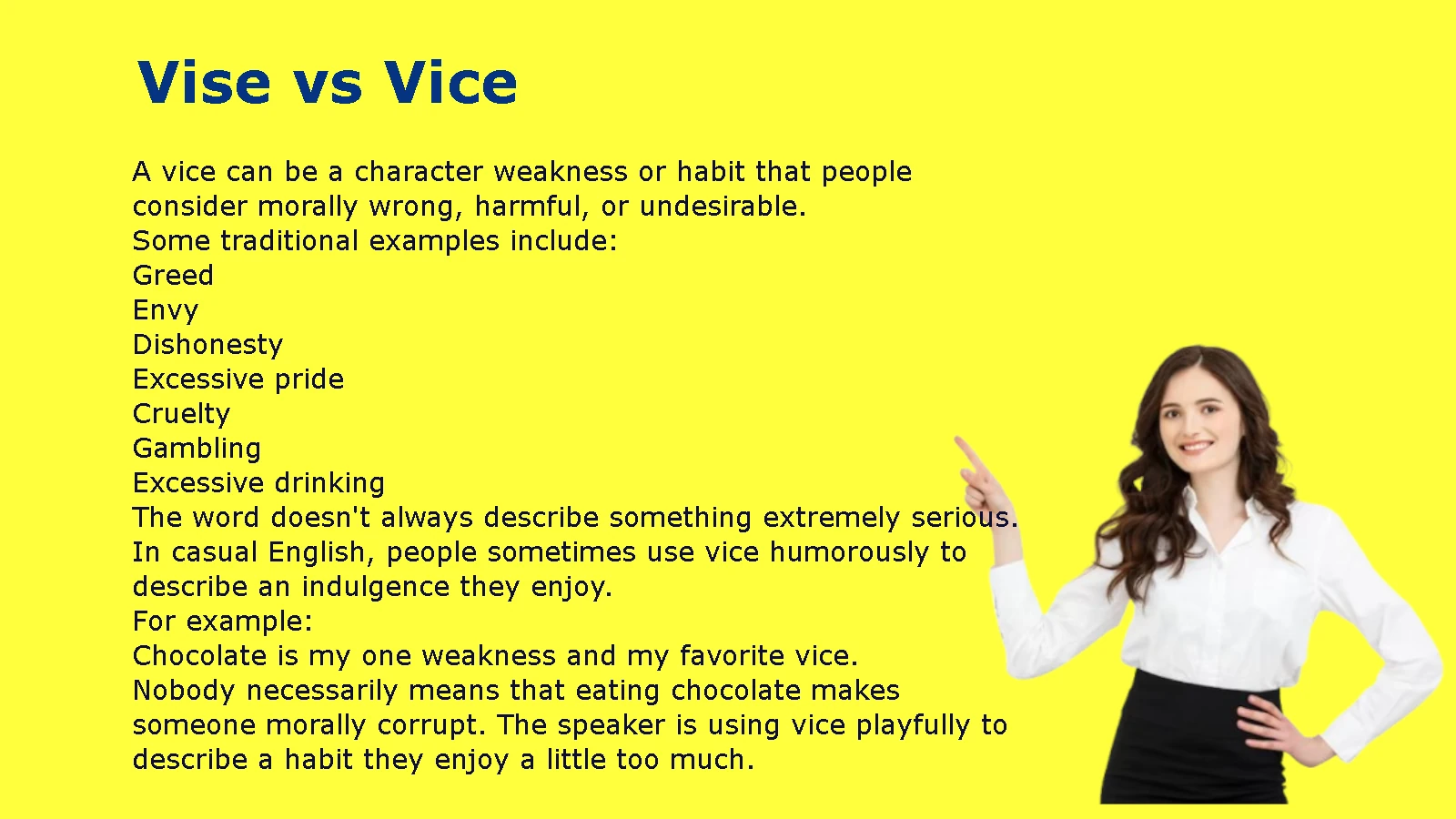
A vice can be a character weakness or habit that people consider morally wrong, harmful, or undesirable.
Some traditional examples include:
- Greed
- Envy
- Dishonesty
- Excessive pride
- Cruelty
- Gambling
- Excessive drinking
The word doesn’t always describe something extremely serious. In casual English, people sometimes use vice humorously to describe an indulgence they enjoy.
For example:
Chocolate is my one weakness and my favorite vice.
Nobody necessarily means that eating chocolate makes someone morally corrupt. The speaker is using vice playfully to describe a habit they enjoy a little too much.
Oxford also gives examples of vice referring to behavior considered evil or immoral and notes that the word can describe a personal weakness.
Examples of Vice in a Sentence
- Greed became his greatest vice.
- The novel explores the relationship between virtue and vice.
- She admitted that impatience was one of her biggest vices.
- The character struggles with several destructive vices.
- He jokingly called chocolate his only vice.
Here, vice has nothing to do with a workshop tool.
Vice as the Opposite of Virtue
One useful way to understand this meaning is to pair vice with virtue.
A virtue is a positive moral quality, while a vice is a negative moral quality or failing.
| Positive quality | Negative quality |
| Honesty | Dishonesty |
| Generosity | Greed |
| Humility | Pride |
| Patience | Impatience |
| Kindness | Cruelty |
| Virtue | Vice |
This contrast appears frequently in literature, philosophy, religion, ethics, and everyday discussions about character.
For example:
The story presents a struggle between virtue and vice.
That sentence clearly uses vice in its moral sense.
Vice in Vice President and Similar Titles
The word vice has another completely different use in official titles.
When vice appears before a position such as president, chairman, captain, or principal, it generally indicates a person who ranks immediately below the person holding the main position and can act on their behalf.
Cambridge describes this use as a prefix in titles for positions where the holder is next below the person with the full position and can act for them.
Common examples include:
- vice president
- vice president-elect
- vice president of sales
- vice president of operations
- vice chairman
- vice chair
- vice principal
- vice captain
- vice admiral
Why Is It Vice President, Not Vise President?
The correct spelling is vice president.
The word vice here doesn’t mean a bad habit. It carries the sense of someone who acts in place of or ranks below another person.
So:
- vice president = correct
- vise president = incorrect
- vice chairman = correct
- vise chairman = incorrect
- vice principal = correct
- vise principal = incorrect
The spelling stays vice because this use comes from a different meaning of the word.
A simple memory trick works well:
A vice president is a deputy, not a workshop tool.
Vise vs Vice: The Key Differences
The fastest way to distinguish the words is to look at what the sentence describes.
| If you’re talking about… | Use |
| A workshop tool | vise in American English |
| A bad habit | vice |
| Immoral behavior | vice |
| A moral failing | vice |
| A deputy or second-in-command | vice |
| A president’s deputy | vice president |
| A workshop tool in British English | vice |
This distinction eliminates most spelling errors.
Vise Example
The carpenter clamped the board in the vise.
The sentence describes a tool, so vise works in American English.
Vice Example
His biggest vice was his obsession with gambling.
The sentence describes a harmful habit, so vice is correct.
Vice President Example
Maria was promoted to vice president of the company.
The word refers to a position below the president, so vice is correct.
Vise or Vice: Which Spelling Is Correct?
The answer depends on what you mean.
Both spellings are correct words. You can’t choose between them simply by asking which spelling is “right.” Instead, you need to identify the meaning first.
Use Vise When You Mean the Tool
In American English, use vise for the device that grips an object.
Correct:
He placed the metal bar in the vise.
Incorrect for standard American English:
He placed the metal bar in the vice.
The second spelling may be completely acceptable in British English, however. That’s an important regional distinction rather than a simple spelling error.
Use Vice for a Bad Habit
Use vice when you’re describing a moral weakness or undesirable habit.
Correct:
Pride was his greatest vice.
Incorrect:
Pride was his greatest vise.
A physical gripping tool doesn’t make sense in that context.
Use Vice for a Deputy Role
Use vice in titles such as vice president and vice chairman.
Correct:
She accepted the position of vice president.
Incorrect:
She accepted the position of vise president.
Common Mistakes With Vise and Vice
Because the words sound identical, writers sometimes choose the wrong spelling without noticing.
Mistake: Using Vice for the American Workshop Tool
A writer might say:
The mechanic placed the bolt in the vice.
In American English, the standard spelling for the tool is vise.
So the preferred version is:
The mechanic placed the bolt in the vise.
British English commonly uses vice for the same tool, which explains why you may encounter the spelling in British books, websites, manuals, and technical writing.
Mistake: Writing Vise President
This is one of the clearest errors.
The correct phrase is:
vice president
Not:
vise president
The reason has nothing to do with the physical tool. Here, vice functions as part of a title meaning a position directly below the main officeholder.
Mistake: Assuming Every Meaning of Vice Relates to Bad Behavior
The moral meaning gets most of the attention, but vice has a separate role in titles.
For example:
- vice president
- vice chairman
- vice captain
- vice principal
None of these expressions refers to immoral behavior.
The meaning comes from the context.
Vise vs Vice Pronunciation
One reason vise and vice cause so much confusion is that they are pronounced the same.
Both are pronounced approximately /vaɪs/ in standard English. Cambridge gives this pronunciation for both vise and the relevant meanings of vice.
The vowel sound is the same one you hear in words such as:
- ice
- price
- twice
- slice
So you generally cannot hear the difference between vise and vice in ordinary speech.
You have to use context to determine which spelling belongs in writing.
This makes the pair a classic example of English homophones: words that share pronunciation but differ in spelling and meaning.
Vise vs Vice in American and British English
Regional English creates an important wrinkle.
In American English, the workshop tool is normally spelled:
vise
In British English, the same tool is normally spelled:
vice
Cambridge explicitly labels vise as US and gives vice as the UK form. Oxford likewise describes vice as the British form and vise as the usual North American form for the tool.
American vs British Usage
| Meaning | American English | British English |
| Workshop gripping tool | vise | vice |
| Moral fault | vice | vice |
| Bad habit | vice | vice |
| Deputy position | vice | vice |
| Vice president | vice president | vice president |
This means a British writer can correctly write:
The wood was secured in the vice.
An American writer would normally write:
The wood was secured in the vise.
Neither writer has necessarily made a spelling mistake. They’re following different standard varieties of English.
The History Behind Vise and Vice
The spelling difference makes more sense when you look at the words’ origins.
The moral vice comes from the Latin vitium, meaning a fault or defect. It entered English through French and developed into the modern word associated with moral weakness, wrongdoing, and bad habits. Oxford traces these meanings through Middle English and Old French back to Latin vitium.
The tool has a different history.
Merriam-Webster traces vise to Middle English vys and related Anglo-French terminology associated with a screw, ultimately connected to Latin vitis, meaning “vine.” The word developed around the idea of a screw mechanism. Merriam-Webster gives 1500 as the first known use of vise in English.
So although vise and vice now sound exactly alike, their histories are separate.
That distinction also explains why their meanings don’t naturally overlap.
Why Do Vise and Vice Sound the Same?
English pronunciation has changed over centuries, and spelling doesn’t always preserve those differences.
Today, vise and vice have the same pronunciation. Their spellings, however, reflect different historical paths.
This creates a familiar English pattern:
- right / write
- flower / flour
- pair / pare
- steel / steal
- vise / vice
The pronunciation alone can’t tell you which written form to choose.
That’s why context matters so much.
Vise vs Vice: Examples in Context
The following examples show how the intended meaning determines the spelling.
| Sentence | Correct word | Reason |
| The carpenter placed the board in the vise. | vise | It refers to a gripping tool. |
| Greed became his greatest vice. | vice | It refers to a moral weakness. |
| She became vice president last year. | vice | It refers to a deputy position. |
| The machinist tightened the vise. | vise | It is a workshop tool. |
| He admitted that impatience was one of his vices. | vice | It refers to character weaknesses. |
| The vice chairman led the meeting. | vice | It forms an official title. |
| The metal was held firmly in the vise. | vise | The tool holds the material. |
| The novel contrasts virtue and vice. | vice | It describes moral behavior. |
A Practical Context Test
When you’re unsure, ask yourself one question:
What does this word refer to?
If the answer is a tool that grips something, choose vise in American English.
That three-part test handles most everyday cases.
Related Words and Forms
Understanding related forms can make the distinction easier to remember.
Words Related to Vise
The most useful forms include:
- vise
- vises
- vised
- vising
- viselike
Merriam-Webster lists vised as the past tense and vising as the present participle of the verb vise. It also lists viselike as an adjective.
For example:
The vise held the piece firmly.
And:
The jaws exerted a viselike grip.
Words Related to Vice
Common forms include:
- vice
- vices
- vicious
- viciousness
The plural of vice is vices.
For example:
The character’s vices eventually caused his downfall.
Don’t treat vicious as simply another spelling of vice. Although the words are historically related, vicious has its own meaning and grammatical role.
A Note About Vice Versa
The phrase vice versa contains vice, not vise.
So the correct expression is:
vice versa
It means that the reverse of what has just been stated is also true. Oxford defines vice versa as indicating that the opposite arrangement or direction also applies.
For example:
You can travel from New York to Boston by train, or vice versa.
You should never write:
vise versa
That is a common spelling mistake caused by the identical pronunciation.
The phrase comes from Latin and has been used in English for centuries. In modern English, it functions as a fixed expression.
Case Study: How Context Solves the Spelling Problem
Consider these three sentences:
The worker tightened the vise.
The worker’s biggest vice was dishonesty.
The worker became vice president.
The pronunciation of vise, vice, and vice doesn’t help you distinguish them when someone says the sentences aloud.
The surrounding words do.
In the first sentence, tightened suggests a physical tool. A tool can be tightened.
In the second, dishonesty identifies a moral weakness. Therefore, vice fits.
In the third, became followed by a leadership title signals an organizational position. Therefore, vice president is correct.
This is a useful lesson about English spelling: meaning often provides the clue when pronunciation doesn’t.
How to Remember Vise vs Vice
A good memory trick doesn’t need to be complicated.
Think Workshop → Vise
Imagine a workbench with a metal tool gripping a piece of wood.
Vise = tool
The spelling with s can remind you of a physical workshop setting.
Think Bad Habit → Vice
If you’re talking about greed, dishonesty, envy, or another character weakness:
Vice = bad habit
Think Deputy → Vice
For titles such as vice president or vice chairman:
Vice = second-in-command
You can reduce the entire distinction to this:
Vise grips. Vice describes a fault or a deputy.
That rule won’t cover every historical or specialized use, but it works extremely well for ordinary American English.
Vise vs Vice: Common Questions
Is it vise or vice?
Both words are correct, but they have different meanings.
Use vise for the workshop tool in American English. Use vice for a moral fault, bad habit, or a deputy position such as vice president. British English commonly uses vice for the workshop tool as well.
What is the difference between vise and vice?
Vise usually means a tool that grips an object. Vice usually means a moral fault or bad habit, but it can also indicate a deputy role in titles such as vice president.
Is vise the American spelling?
Yes. Vise is the standard American spelling for the workshop tool. British English commonly uses vice for the same tool.
Is vice the British spelling of vise?
For the workshop tool, yes. British English commonly spells the tool vice, while American English generally spells it vise.
Is vise pronounced the same as vice?
Yes. They are normally pronounced the same, approximately /vaɪs/.
Is it vice president or vise president?
The correct spelling is vice president.
Here, vice indicates a position immediately below the president or someone who can act on the president’s behalf.
What is the plural of vise?
The plural is vises.
Example:
The workshop has several vises of different sizes.
What is the plural of vice?
The plural is vices.
Example:
The novel examines the characters’ virtues and vices.
Can vice mean the workshop tool?
Yes. Vice is the usual British spelling for the workshop tool. American English normally uses vise.
Is vice always related to immoral behavior?
No. In titles such as vice president, vice has a different meaning. It identifies someone who ranks below another official and can act in that person’s place.
Vise vs Vice: Final Takeaway
Vise and vice sound the same, but their meanings usually make the correct spelling easy to identify.
In American English, remember these three uses:
- Vise = a tool that holds something firmly.
- Vice = a bad habit, moral fault, or immoral behavior.
- Vice = a deputy or subordinate position, as in vice president.
British English adds one important exception: vice is commonly used for the workshop tool too.
So if you’re writing for an American audience, the simplest rule is:
Use a vise in the workshop. Use vice for a bad habit or a deputy.
Once you connect the spelling to the meaning, this pair becomes much easier to keep straight.