Have you ever wondered whether cherries or cherrys is the correct spelling? While Cherries vs Cherrys may seem like a small spelling issue, the difference comes down to a basic English spelling rule for forming the plural of words that end in -y.
Cherries is the correct and standard plural form of cherry. Cherrys is an incorrect spelling in standard English and shouldn’t be used when you mean more than one cherry. When a noun ends in a consonant followed by -y, you usually change the y to i and add -es to form the plural.
Examples:
- The bowl was filled with fresh cherries.
- We picked several cherries from the tree.
The confusion is understandable. People often search for cherries vs cherrys, cherries or cherrys, which spelling is correct, or cherry plural because the spelling change can be easy to overlook. And here’s the kicker: cherrys may look like a natural plural, but standard English requires cherries.
In this guide, you’ll learn the complete difference between Cherries vs Cherrys, including their meaning, correct spelling, plural form, and usage. You’ll also learn why cherry changes to cherries, along with clear examples to help you avoid this common spelling mistake.
Cherries vs Cherrys: Quick Answer
| Spelling | Correct? | What it means |
| cherry | ✅ Yes | Singular form |
| cherries | ✅ Yes | Plural form |
| cherrys | ❌ No | Incorrect standard plural |
| cherry’s | ✅ Sometimes | Singular possessive |
| cherries’ | ✅ Sometimes | Plural possessive |
The basic distinction is straightforward:
- One cherry
- Two cherries
- Three cherries
- A basket of cherries
You wouldn’t normally write:
- ❌ one cherrys
- ❌ two cherrys
- ❌ three cherrys
The correct spelling is always cherries when you’re talking about more than one cherry.
Cherries in a sentence
The bowl was full of fresh cherries.
Here, cherries refers to multiple fruits, so the plural form is required.
Why Is Cherries the Correct Spelling?
The answer lies in the final two letters of cherry.
The word ends in:
r + y
The r is a consonant, so cherry follows the common consonant + y plural pattern.
To form the plural:
- Remove the final y.
- Change it to i.
- Add es.
- The result is cherries.
In simple form:
cherry → cherr + i + es → cherries
English has several spelling rules like this. They can look arbitrary when you encounter them one word at a time, but the pattern becomes much clearer when you compare related words.
For example:
- berry → berries
- cherry → cherries
- story → stories
- city → cities
- lady → ladies
The same basic transformation appears in each case.
Why Doesn’t Cherry Become Cherrys?
The mistake cherrys usually comes from applying the simplest plural rule: add s to the end of a noun.
That works for many English words:
- book → books
- tree → trees
- apple → apples
- car → cars
However, English has several plural spelling patterns. Words ending in consonant + y follow a different pattern.
That’s why:
cherry + s ❌
doesn’t produce the standard plural.
Instead:
cherry → cherries ✅
The important thing isn’t simply that the word ends in y. You need to look at the letter immediately before the y.
The Consonant + Y Plural Rule
The easiest way to understand cherries vs cherrys is to learn the broader rule.
When a noun ends in a consonant + y, the plural generally changes the y to i and adds -es.
Common examples
| Singular | Plural |
| cherry | cherries |
| berry | berries |
| baby | babies |
| city | cities |
| story | stories |
| country | countries |
| family | families |
| party | parties |
| puppy | puppies |
| library | libraries |
Notice the pattern:
y → ies
The spelling changes because the final y follows a consonant.
Another useful example
Take party.
You wouldn’t write:
❌ two partys
Instead:
✅ two parties
The same logic applies to cherry:
❌ two cherrys
✅ two cherries
Once you spot the pattern, you don’t have to memorize every plural separately.
Vowel + Y Words Follow a Different Pattern
Here’s where English spelling gets interesting.
Not every word ending in y changes to ies.
If the y follows a vowel, you normally just add s.
Compare these examples:
| Singular | Letter before Y | Plural |
| cherry | r | cherries |
| berry | r | berries |
| city | t | cities |
| boy | o | boys |
| toy | o | toys |
| day | a | days |
| key | e | keys |
| monkey | e | monkeys |
This gives you a useful shortcut:
Consonant + y → ies
Vowel + y → s
So:
- cherry → cherries
- berry → berries
- boy → boys
- toy → toys
The letter immediately before y makes the difference.
Cherry vs Cherries
The words cherry and cherries aren’t competing spellings. They’re two grammatical forms of the same noun.
Cherry is singular.
Cherries is plural.
| Number | Correct form | Example |
| One | cherry | I ate one cherry. |
| Two | cherries | I ate two cherries. |
| Several | cherries | She bought several cherries. |
| Many | cherries | The tree produced many cherries. |
When to use cherry
Use cherry when you’re referring to one fruit or one cherry tree, depending on context.
Examples:
- I picked a cherry.
- This cherry is sweet.
- A cherry fell from the tree.
- The recipe calls for one cherry.
When to use cherries
Use cherries when you’re referring to two or more.
Examples:
- I bought some cherries.
- These cherries are ripe.
- We washed the cherries before eating them.
- The pie contains fresh cherries.
The spelling isn’t optional. The number of things you’re talking about determines which form you need.
How to Spell Cherries
If you’re searching how to spell cherries, the correct spelling is:
C-H-E-R-R-I-E-S
The most useful way to remember it is to start with the singular form:
CHERRY
Then apply the plural rule:
CHERRY → CHERRIES
A simple three-step method
Step 1: Write cherry.
2: Remove the final y.
Step 3: Add ies.
That gives you:
cherries
The double r stays in the word. The part that changes is the ending.
Don’t write this
❌ cherrys
Write this
✅ cherries
And don’t add an apostrophe
❌ cherry’s
when you simply mean more than one.
✅ cherries
That distinction matters because an apostrophe has a grammatical job. It doesn’t normally create an ordinary plural.
Cherries vs Cherry’s
Cherries and cherry’s can look similar at first glance, but they serve completely different purposes.
| Form | Function | Example |
| cherry | Singular | I ate a cherry. |
| cherries | Plural | I ate three cherries. |
| cherry’s | Singular possessive | The cherry’s stem was removed. |
| cherries’ | Plural possessive | The cherries’ stems were removed. |
Is Cherry’s the Plural of Cherry?
No.
Cherry’s isn’t the standard plural form.
If you’re talking about multiple fruits, use cherries.
❌ There are five cherry’s in the bowl.
✅ There are five cherries in the bowl.
The apostrophe in cherry’s usually indicates possession.
For example:
The cherry’s stem was still attached.
Here, the stem belongs to one cherry.
That’s why cherry’s makes sense in that sentence.
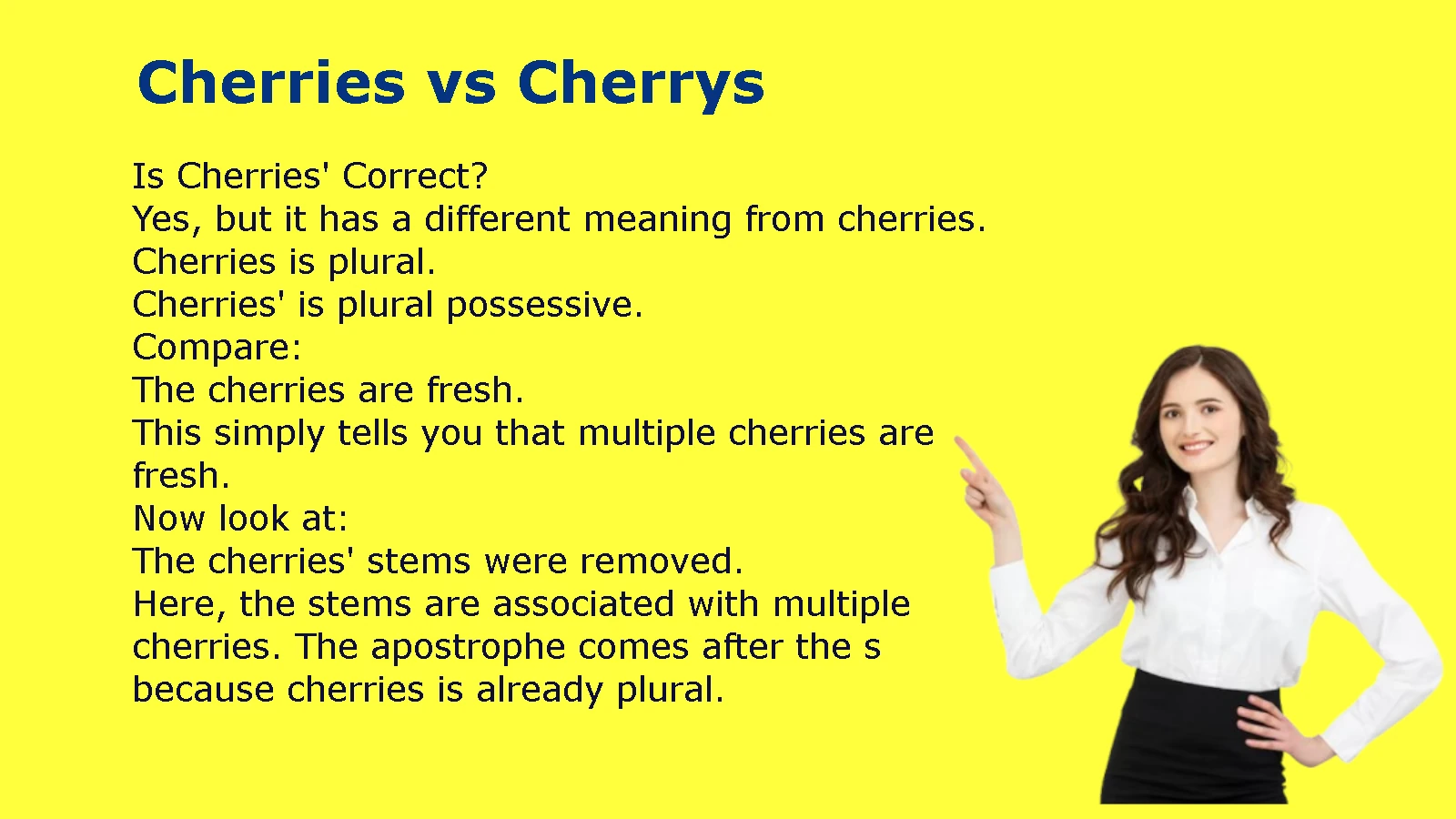
Is Cherries’ Correct?
Yes, but it has a different meaning from cherries.
Cherries is plural.
Cherries’ is plural possessive.
Compare:
The cherries are fresh.
This simply tells you that multiple cherries are fresh.
Now look at:
The cherries’ stems were removed.
Here, the stems are associated with multiple cherries. The apostrophe comes after the s because cherries is already plural.
This creates a useful four-form comparison:
| Form | Meaning |
| cherry | one cherry |
| cherries | more than one cherry |
| cherry’s | belonging to one cherry |
| cherries’ | belonging to multiple cherries |
That distinction is especially useful when proofreading sentences.
Common Cherries Spelling Mistakes
The spelling cherrys isn’t the only form people may accidentally use. Apostrophes create another common source of confusion.
Cherrys
❌ I bought fresh cherrys.
The plural spelling is incorrect.
✅ I bought fresh cherries.
Cherry’s
❌ There are six cherry’s on the plate.
The apostrophe doesn’t make cherry plural.
✅ There are six cherries on the plate.
Cherrie’s
❌ The recipe needs fresh cherrie’s.
This form doesn’t create the ordinary plural.
✅ The recipe needs fresh cherries.
Cherries
✅ We bought two pounds of cherries.
This is the standard plural form.
Cherries in Example Sentences
Seeing the word in different contexts makes the spelling easier to recognize.
Everyday examples
- I bought a bag of cherries.
- She washed the cherries before serving them.
- The cherries were sitting in a bowl.
- We picked several cherries from the tree.
- These cherries are incredibly sweet.
Cooking examples
- Add the pitted cherries to the filling.
- The recipe uses fresh cherries.
- She mixed dried cherries into the salad.
- The dessert was topped with several cherries.
Descriptive examples
- The cherries had dark red skin.
- Ripe cherries hung from the branches.
- The basket was packed with bright red cherries.
Notice how the plural form stays the same regardless of the sentence’s structure.
What Does Cherry Mean?
The word cherry primarily refers to a small, usually round stone fruit with a pit. Oxford also lists cherry as a word for the tree that produces cherries, the wood of that tree, and a bright red color.
From a botanical perspective, cherries belong to the genus Prunus. The USDA notes that this genus includes cherries along with peaches, plums, apricots, and almonds.
The fruit is a drupe, commonly called a stone fruit. Its hard inner structure surrounds the seed.
Cherry can have several meanings
Depending on context, cherry can refer to:
- The fruit
- The tree
- Cherry wood
- A bright red color
- Something associated with cherry varieties or flavor
For the spelling question, however, the important point remains simple:
cherry is singular, cherries is plural.
Do Cherries Come From Trees?
Yes. Cherries grow on cherry trees.
For example, sweet cherries come from Prunus avium. The USDA identifies Prunus avium as the sweet cherry species, while tart or sour cherries are associated with Prunus cerasus.
Sweet cherry trees are deciduous and produce flowers before the fruit develops. The National Park Service describes sweet cherry as a perennial tree with fragrant white flowers that appear in spring.
A simplified cherry life cycle
Cherry tree
↓
Flowers
↓
Pollination
↓
Developing fruit
↓
Ripe cherries
The exact growing process varies by species, cultivar, climate, and growing conditions. Commercial sweet cherries include numerous cultivars, such as Bing, Rainier, Lapins, and Sweetheart.
So if you see the related question “Do cherries come from trees?”, the answer is yes. The fruit develops on cherry trees, although different cherry species and cultivars have different characteristics.
What Are Cherries Botanically?
The word cherries refers to multiple fruits, but those fruits aren’t limited to one single cultivated type.
The genus Prunus contains numerous species. USDA resources identify both sweet cherry (Prunus avium) and tart cherry (Prunus cerasus) among the cherry species.
Sweet cherries
Sweet cherries are commonly eaten fresh. The USDA identifies Prunus avium as the sweet cherry and notes that commercial cultivars include varieties such as Bing, Brooks, Chelan, Lambert, Lapins, Rainier, and Sweetheart.
Tart cherries
Tart or sour cherries are associated with Prunus cerasus. They have a different flavor profile and are commonly used in processed foods, baking, and other culinary applications.
This botanical distinction doesn’t change the spelling.
Whether you’re talking about sweet cherries, tart cherries, wild cherries, or cultivated varieties, the ordinary plural of cherry remains:
cherries
Cherries vs Cherries: Does Capitalization Change the Meaning?
A related search such as “Cherries vs cherries” can look like a comparison between two different words. In ordinary English, however, capitalization doesn’t create a separate plural form.
The lowercase form is:
cherries
The capitalized form can appear when the word starts a sentence:
Cherries are popular in summer.
The same word appears in lowercase later in a sentence:
We bought fresh cherries.
The capitalization changed because of the position in the sentence, not because the word became a different noun.
Compare the two
| Form | Typical use |
| cherries | Normal lowercase form |
| Cherries | Beginning of a sentence or a proper name/title |
So cherries vs cherries isn’t really a spelling contest. In normal writing, they’re the same plural noun with different capitalization.
The History Behind the Word Cherry
The spelling of cherry has an interesting history.
Oxford traces the word through Middle English and Old Northern French to medieval Latin and ultimately Greek.
One particularly interesting detail explains why the modern word doesn’t look exactly like some of its historical forms.
Oxford notes that the final -s in an earlier form was lost because speakers interpreted the ending as a plural.
In other words, the history of cherry itself reflects how English speakers have interpreted word endings over time.
That history doesn’t change the modern spelling rule, but it helps explain why English contains seemingly unusual plural patterns.
Today, dictionaries agree on the practical answer:
cherry → cherries
More Words That Follow the Same Pattern
Learning cherries becomes much easier when you recognize the same pattern elsewhere.
Consonant + Y → IES
| Singular | Plural |
| cherry | cherries |
| berry | berries |
| baby | babies |
| city | cities |
| story | stories |
| party | parties |
| family | families |
| country | countries |
| puppy | puppies |
| lady | ladies |
| library | libraries |
| dictionary | dictionaries |
The spelling transformation is consistent:
final y → ies
Vowel + Y → S
Now compare words where a vowel comes before the final y.
| Singular | Plural |
| boy | boys |
| toy | toys |
| day | days |
| key | keys |
| monkey | monkeys |
| journey | journeys |
Here, you normally keep the y and simply add s.
That contrast is one of the best ways to remember the spelling of cherries.
A Quick Test for Words Ending in Y
When you’re unsure about a plural ending in y, use this quick test.
Look at the letter before Y
If it’s a consonant:
Change y → ies
Examples:
- cherry → cherries
- city → cities
- story → stories
If it’s a vowel:
Keep y and add s
Examples:
- boy → boys
- toy → toys
- key → keys
The shortcut
Consonant + y = ies
Vowel + y = s
This isn’t just a trick for cherry. It gives you a useful spelling pattern that applies to many everyday English nouns.
A Simple Case Study: Cherry, Berry, and Boy
Consider these three words:
cherry
The letter before y is r, a consonant.
cherry → cherries
Now consider:
berry
Again, the letter before y is r.
berry → berries
Finally:
boy
The letter before y is o, a vowel.
boy → boys
The contrast makes the rule much easier to see:
| Word | Before Y | Plural |
| cherry | r | cherries |
| berry | r | berries |
| boy | o | boys |
If you remember that small test, cherrys becomes much easier to catch during proofreading.
Cherries vs Cherrys: Which One Should You Use?
Use cherries whenever you mean more than one cherry.
Correct
- fresh cherries
- two cherries
- a bowl of cherries
- cherry trees produce cherries
- the cherries are ripe
- I bought several cherries
Incorrect in standard English
- ❌ fresh cherrys
- ❌ two cherrys
- ❌ a bowl of cherrys
- ❌ the cherrys are ripe
The spelling cherrys doesn’t follow the standard plural pattern.
How to Remember Cherries vs Cherrys
A quick memory trick can save you from making the same mistake again.
Think of the ending:
CHERRY
Then imagine the final Y flipping into I before the plural ending arrives:
CHERR + I + ES
That creates:
CHERRIES
You can also connect it with familiar words:
berry → berries
cherry → cherries
Both words have the same ending pattern.
Another useful comparison is:
boy → boys
The o before the y changes the rule. That contrast makes the spelling easier to remember.
Frequently Asked Questions About Cherries vs Cherrys
Is Cherrys a correct spelling?
No. Cherrys isn’t the standard plural spelling of cherry. The correct plural is cherries.
What is the plural of cherry?
The plural of cherry is cherries. Both Oxford and Cambridge dictionaries list cherries as the plural form.
How do you spell cherries?
The correct spelling is cherries:
C-H-E-R-R-I-E-S
Is it cherry or cherries?
Use cherry for one and cherries for more than one.
- one cherry
- two cherries
Why does cherry become cherries?
Because cherry ends in a consonant followed by y. The standard plural spelling changes y to i and adds -es.
Is cherry’s the plural of cherry?
No. Cherry’s is generally a singular possessive form. The ordinary plural is cherries.
Is cherries’ correct?
Yes. Cherries’ is the plural possessive form.
For example:
The cherries’ stems were removed.
Do cherries come from trees?
Yes. Cherries grow on cherry trees. Sweet cherries are associated with Prunus avium, while tart cherries are associated with Prunus cerasus.
Are cherries and cherry different words?
They are different forms of the same noun.
Cherry is singular.
Cherries is plural.
Why isn’t the plural cherrys?
Because cherry ends in a consonant + y. The standard plural pattern changes the ending to -ies.
What is the difference between cherries and cherry’s?
Cherries means more than one cherry.
Cherry’s normally means something belonging to one cherry.
For example:
- The cherries are ripe.
- The cherry’s stem is short.
What is the difference between cherries and cherries’?
Cherries is plural.
Cherries’ is plural possessive.
For example:
- The cherries are sweet.
- The cherries’ stems are green.
Final Answer: Cherries vs Cherrys
The correct spelling is cherries.
Cherrys is not the standard plural form of cherry. The spelling changes because cherry ends with a consonant + y. When you make it plural, the y changes to i and -es is added.
cherry → cherries
Remember the broader pattern:
consonant + y → ies
So:
- cherry → cherries
- berry → berries
- city → cities
- story → stories
- baby → babies
But when a vowel comes before the final y, you generally keep the y:
- boy → boys
- toy → toys
- day → days
- key → keys
The key takeaway is simple: write cherries, not cherrys, when you mean more than one cherry.