Have you ever wondered whether Caesar or Ceasar is the correct spelling? While Caesar vs Ceasar may look like a minor spelling mix-up, the difference matters because only one spelling is the standard form of the word.
Caesar is the correct and widely accepted spelling, while Ceasar is a common misspelling. The word Caesar can refer to the Roman family name associated with Julius Caesar, a title used by Roman emperors, or a person named Caesar. Ceasar, on the other hand, is generally used when someone accidentally reverses the a and e in the correct spelling.
Examples:
- Julius Caesar was a famous Roman general and statesman.
- The emperor adopted the title Caesar.
The confusion is understandable. People often search for Caesar vs Ceasar, Caesar or Ceasar, which spelling is correct, or Ceasar meaning because the two spellings look almost identical. The unusual ae combination in Caesar can make the correct spelling surprisingly easy to forget.
In this guide, you’ll learn the complete difference between Caesar vs Ceasar, including their meaning, pronunciation, origin, correct spelling, and usage. You’ll also learn why Ceasar is considered a misspelling, how to remember the correct spelling of Caesar, and see clear examples to help you use the word correctly.
Caesar vs Ceasar: The Quick Answer
Caesar is the standard spelling. Ceasar is generally a misspelling.
Here’s the difference at a glance:
| Spelling | Status | Example |
| Caesar | Correct standard spelling | Julius Caesar |
| Ceasar | Usually a misspelling | Julius Ceasar |
| Caesar salad | Correct | I ordered a Caesar salad. |
| Ceasar salad | Misspelling | I ordered a Ceasar salad. |
| Caesar cipher | Correct | The Caesar cipher shifts letters. |
| Ceasar cipher | Misspelling | The Ceasar cipher shifts letters. |
The main issue is simply the order of the first two vowels. Caesar begins with CAE, while the incorrect form Ceasar begins with CEA.
That distinction matters because Caesar isn’t just a historical name. The spelling appears in food, history, cryptography, medicine, literature, and other established terms.
Is Caesar or Ceasar Correct?
Caesar is correct in standard English when referring to the Roman name, the historical title, or established terms derived from it.
For example:
- Julius Caesar was a Roman general and statesman.
- Caesar salad is a famous salad associated with restaurateur Caesar Cardini.
- A Caesar cipher is a simple substitution cipher.
- Caesar became a title associated with Roman emperors after the lifetime of Julius Caesar.
By contrast, these spellings are normally incorrect:
- Julius Ceasar ❌
- Ceasar salad ❌
- Ceasar cipher ❌
The important word here is normally. A person could intentionally have Ceasar as a surname, business name, username, or other proper name. In that situation, the person’s chosen spelling is its own matter. But when you’re trying to spell the historical name or one of the standard terms derived from it, use Caesar.
Why Do People Spell Caesar as Ceasar?
The mistake is easy to make because Caesar doesn’t look the way an English speaker might expect it to sound.
The opening sequence is unusual:
C-A-E-S-A-R
Many people naturally rearrange the vowels and write:
C-E-A-S-A-R
That produces Ceasar, which looks plausible at first glance.
The pronunciation doesn’t help much either. Modern English pronunciation doesn’t clearly tell you that the written form contains ae. As a result, someone who has heard the word many times but hasn’t seen it written often may spell it phonetically.
There’s another reason the mistake sticks around: Ceasar looks close enough to Caesar that ordinary spell-checking may not immediately make the difference obvious in informal writing.
The easiest solution is to stop thinking of the word as something you need to reconstruct from its sound. Memorize its unusual opening:
CAE + SAR
Once that pattern becomes familiar, the spelling becomes much easier.
How Do You Spell Caesar?
The correct spelling is:
C-A-E-S-A-R
The most important part to remember is the beginning:
CAE
Not:
CEA
Think of the word as two pieces:
CAE + SAR = CAESAR
That gives you a simple visual checkpoint. If you write CEA, you’ve probably made the common mistake.
A Simple Caesar Spelling Trick
Remember:
CAE comes before SAR.
You can also connect the spelling to familiar phrases:
- Caesar salad
- Julius Caesar
- Caesar cipher
Seeing the correct form repeatedly helps lock the vowel order into memory.
Caesar Pronunciation
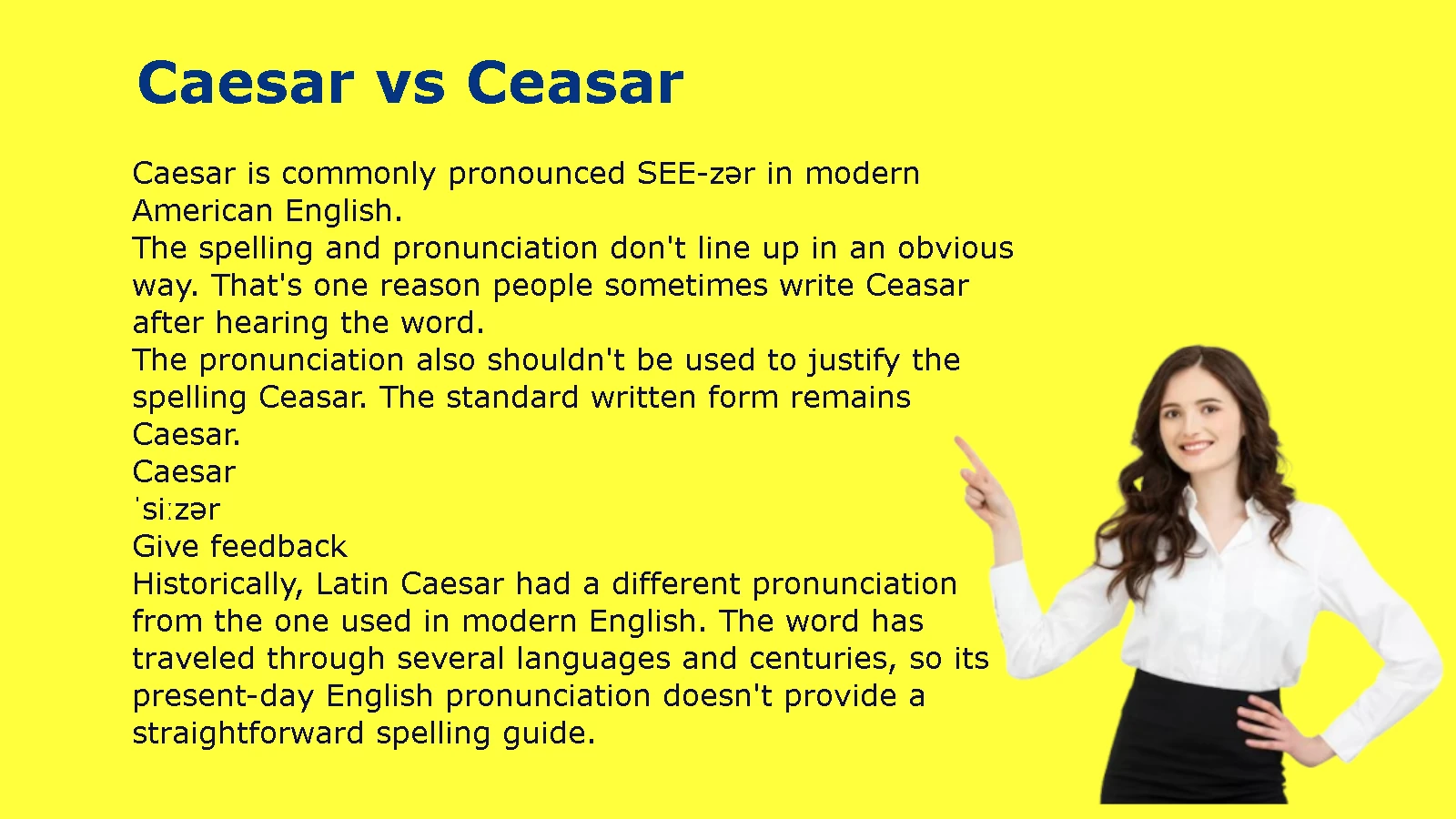
Caesar is commonly pronounced SEE-zər in modern American English.
The spelling and pronunciation don’t line up in an obvious way. That’s one reason people sometimes write Ceasar after hearing the word.
The pronunciation also shouldn’t be used to justify the spelling Ceasar. The standard written form remains Caesar.
Caesar
ˈsiːzər
Give feedback
Historically, Latin Caesar had a different pronunciation from the one used in modern English. The word has traveled through several languages and centuries, so its present-day English pronunciation doesn’t provide a straightforward spelling guide.
That’s a useful general spelling lesson: pronunciation and spelling don’t always evolve together.
What Does Caesar Mean?
The meaning of Caesar depends on the context.
Originally, Caesar was a Roman family name associated with the Julian family. The most famous bearer was Gaius Julius Caesar, the Roman general and statesman who lived from 100 to 44 BCE.
After Julius Caesar’s rise to power, the name acquired a much broader political meaning. Caesar eventually became an imperial title rather than merely a family name. The word continued as a title for Roman emperors and later influenced words for rulers in other languages. Etymonline traces connections between Caesar, German Kaiser, and Russian tsar or czar.
So the word has two closely connected historical layers:
| Use | Meaning |
| Caesar as a name | A Roman family name, most famously associated with Julius Caesar |
| Caesar as a title | A title associated with Roman imperial rule |
| Caesar in modern compounds | A name preserved in terms such as Caesar salad and Caesar cipher |
That history explains why Caesar appears in places that seem unrelated at first.
Julius Caesar and the Origin of the Name
Julius Caesar is the person most people associate with the word.
He was born in 100 BCE and was assassinated in 44 BCE. His career transformed the Roman Republic and helped create the political conditions that led to the Roman Empire.
Although Caesar himself wasn’t the first Roman emperor in the conventional sense, his name became closely connected with imperial power after his death.
The name eventually became so strongly associated with supreme political authority that later rulers used Caesar as a title.
That historical development is also why the spelling appears in languages far beyond Latin and English.
Caesar, Kaiser, and Tsar
The influence of Caesar extends well beyond English.
The name became the source of ruler-related words including:
- Kaiser in German
- tsar or czar in Russian and related usage
These forms don’t look much like Caesar today, but they share a historical connection to the Roman name and title.
That’s a good example of how a person’s name can eventually become a political title and then develop into entirely different-looking words in other languages.
Caesar Salad vs. Ceasar Salad
If you’re wondering whether it’s Caesar salad or Ceasar salad, the standard spelling is:
Caesar salad ✓
Not:
Ceasar salad ✗
The salad takes its name from Caesar Cardini, an Italian immigrant and restaurateur associated with the dish’s creation in Tijuana, Mexico.
The dish is generally dated to 1924, although its exact origin story remains disputed. National Geographic reports that Caesar Cardini is generally credited with creating the salad in Tijuana, while also noting competing claims involving his brother Alex Cardini and others.
The salad therefore has Caesar in its name because of a person named Caesar, not because Julius Caesar invented it.
That’s an important distinction.
Was Caesar Salad Invented by Julius Caesar?
No.
Julius Caesar lived in ancient Rome. The modern Caesar salad appeared nearly two thousand years later.
The salad is generally associated with Caesar Cardini’s restaurant in Tijuana in 1924. The dish’s exact authorship has been debated, but the historical discussion centers on Cardini, his brother Alex, and people connected with his restaurant, not the Roman dictator.
The timeline makes the confusion easy to clear up:
| Person | Period | Connection |
| Julius Caesar | 100–44 BCE | Roman general and statesman |
| Caesar Cardini | 20th century | Restaurateur associated with Caesar salad |
| Caesar salad | 1924 | Dish associated with Cardini’s restaurant in Tijuana |
Why Is It Called Caesar Salad?
The most widely accepted account connects the name to Caesar Cardini, whose restaurant operated in Tijuana.
The salad became increasingly popular in the United States and eventually spread internationally. National Geographic notes that the dish originated in Tijuana and later became known around the world.
The salad also celebrated its 100th anniversary in 2024, reflecting its long history as a recognizable part of North American food culture.
So if you’re writing a menu, recipe, restaurant review, or food article, write:
Caesar salad
Common Caesar Salad Spelling Mistakes
| Incorrect | Correct |
| Ceasar salad | Caesar salad |
| Ceasar dressing | Caesar dressing |
| Ceasar recipe | Caesar recipe |
| Ceasar salad dressing | Caesar salad dressing |
The same vowel-order problem appears every time.
The History of Caesar Salad
The history of the salad makes the spelling even more interesting because Caesar in this context refers to a modern person’s name rather than the Roman leader.
The commonly accepted story places the salad’s creation in Tijuana, Mexico, on July 4, 1924. Caesar Cardini operated a restaurant there during the Prohibition era in the United States. Tijuana attracted American visitors, including people crossing the border for food and entertainment.
According to the familiar account, a busy holiday crowd put pressure on the kitchen. Cardini improvised a dish from available ingredients and prepared it tableside. The dramatic presentation became part of the experience associated with the salad.
However, the exact origin isn’t completely settled.
Other accounts credit:
- Alex Cardini, Caesar Cardini’s brother
- Livio Santini, a cook associated with Cardini’s restaurant
- Other people connected with the restaurant
Historical sources continue to disagree about who deserves sole credit. What remains much less controversial is the salad’s connection to Tijuana and the Cardini family.
What Was in the Original Caesar Salad?
Modern Caesar salads often contain romaine lettuce, Parmesan cheese, croutons, anchovies, and a creamy dressing.
The earliest version attributed to Cardini was different from many restaurant versions today. Historical accounts describe romaine leaves, olive oil, egg, citrus juice, Worcestershire sauce, Parmesan, garlic, and croutons. Contemporary recipes often include anchovies, but historical evidence suggests the original Cardini version may not have contained anchovies directly.
That’s a useful reminder that a dish can evolve dramatically while keeping the same name.
Caesar Cipher vs. Ceasar Cipher
Another common use of the correct spelling is Caesar cipher.
A Caesar cipher is a simple substitution cipher in which each letter is shifted by a fixed number of positions in the alphabet. The technique is traditionally associated with Julius Caesar and is one of the simplest forms of classical cryptography.
For example, with a shift of three:
- A → D
- B → E
- C → F
So a message can be transformed by replacing each letter with another letter a fixed distance away.
The name is written:
Caesar cipher ✓
Not:
Ceasar cipher ✗
The term provides another excellent example of why the spelling matters. Someone might know the cryptographic concept perfectly well yet still type Ceasar cipher because the vowel sequence is easy to reverse.
Is a Caesar Cipher Secure?
Not by modern standards.
A basic Caesar cipher has an extremely small number of possible shifts. Someone analyzing the encrypted text can test the possibilities quickly.
Modern encryption uses much more sophisticated mathematical methods.
The Caesar cipher remains valuable for teaching basic cryptography, understanding substitution ciphers, and illustrating how encryption concepts developed historically. It isn’t suitable for protecting sensitive modern communications.
Caesar in Medical Terminology
The search for Caesar meaning in medical or Caesar disease meaning can lead to an important distinction.
Caesar itself isn’t the ordinary medical name of a disease.
The confusion usually comes from the relationship between Caesar and words such as cesarean or caesarean.
A cesarean section, also called a C-section, is a surgical method of delivering a baby through incisions in the abdomen and uterus. The word’s history has long been connected with the Latin Caesar, but the exact origin of the medical term remains disputed.
Does Cesarean Come From Julius Caesar?
The popular story says that Julius Caesar was born by cesarean section and that the procedure received its name from him.
Historical evidence makes that explanation highly unlikely.
The U.S. National Library of Medicine points out that Caesar’s mother, Aurelia, is traditionally reported to have lived long enough to hear about her son’s invasion of Britain. That would conflict with the usual ancient circumstances surrounding surgical delivery, which was generally performed on a woman who was already dead or dying.
Medical historical literature likewise describes the direct connection between Caesar’s birth and the name as unlikely.
Other proposed explanations connect cesarean with Latin terms related to cutting, while another historical theory involves Roman laws concerning the removal of a fetus from a deceased pregnant woman. The precise origin isn’t settled.
So the safe conclusion is:
Cesarean is historically connected with Caesar in several proposed explanations, but the claim that Julius Caesar himself was born by cesarean section is not supported by the historical evidence.
That distinction matters because the popular story sounds neat, but the historical record is considerably more complicated.
Caesar vs. Cesarean: Don’t Mix Them Up
The words are related historically, but they aren’t interchangeable.
| Word | Meaning |
| Caesar | A Roman family name and later imperial title; also part of several modern names and terms |
| Cesarean | Relating to a cesarean section |
| Caesarean | Another spelling of cesarean, especially common in British English |
| Caesar salad | A salad named after Caesar Cardini |
| Caesar cipher | A letter-shifting substitution cipher |
This distinction helps explain why someone searching for Caesar medical meaning might encounter information about cesarean sections even though Caesar itself isn’t the name of a disease.
Caesar as a Name vs. Caesar as a Title
One of the most interesting facts about Caesar is that it changed grammatical and political roles over time.
At first, Caesar functioned as a Roman family name. After Julius Caesar’s rise to power, it became associated with supreme political authority.
Later Roman rulers used Caesar as part of the imperial system. Over time, the name stopped functioning solely as an individual’s surname and became a title associated with rulers.
This transition resembles what happened with other historical names that eventually became common nouns or titles.
The basic progression looks like this:
Family name → famous ruler → political symbol → imperial title → words in other languages
That history helps explain why Caesar has such a wide semantic footprint today.
Caesar vs Ceasar Examples
The easiest way to see the difference is to put the two spellings side by side.
| Correct | Incorrect |
| Julius Caesar | Julius Ceasar |
| Caesar salad | Ceasar salad |
| Caesar cipher | Ceasar cipher |
| Caesar was a Roman leader. | Ceasar was a Roman leader. |
| She ordered a Caesar salad. | She ordered a Ceasar salad. |
| The Caesar cipher uses letter shifts. | The Ceasar cipher uses letter shifts. |
Correct Sentences With Caesar
- Julius Caesar crossed the Rubicon in 49 BCE.
- The assassination of Caesar occurred in 44 BCE.
- We ordered a Caesar salad with extra Parmesan.
- Students often learn the Caesar cipher when studying classical cryptography.
- The word Caesar eventually became associated with Roman imperial power.
Incorrect Sentences
These examples contain the common spelling mistake:
- Julius Ceasar crossed the Rubicon. ❌
- We ordered a Ceasar salad. ❌
- The Ceasar cipher shifts letters. ❌
In each case, replace Ceasar with Caesar.
Common Caesar Spelling Mistakes
The most common error isn’t a missing letter. It’s a vowel reversal.
Ceasar
Ceasar is the most obvious misspelling.
The writer knows the word but puts E before A instead of A before E.
Julius Ceasar
This error frequently appears when someone writes the historical figure’s name from memory.
The correct form is:
Julius Caesar
Ceasar Salad
Because people often encounter the word in restaurants, menus, and recipes, Ceasar salad is another common misspelling.
The correct form is:
Caesar salad
Ceasar Cipher
The same error carries over into cryptography.
The established term is:
Caesar cipher
How to Remember the Spelling of Caesar
The simplest memory trick is to focus on the first three letters:
CAE
Think:
CAE + SAR
rather than trying to remember the entire six-letter sequence at once.
Another useful trick is to connect the spelling with a familiar phrase:
Caesar salad
If you can remember Caesar in the phrase Caesar salad, you can transfer that spelling to other contexts.
A Quick Visual Memory Test
Before you type the word, ask:
Does it start with CAE or CEA?
The correct answer is:
CAE
So:
CAESAR ✓
Not:
CEASAR ✗
That one-second check can prevent the most common mistake.
Caesar vs Ceasar: A Simple Comparison
| Question | Caesar | Ceasar |
| Standard spelling of Julius Caesar? | Yes | No |
| Standard spelling of the salad? | Yes | No |
| Standard spelling of the cipher? | Yes | No |
| Standard historical name? | Yes | No |
| Could it exist as someone’s chosen proper name? | Yes | Potentially |
| Should you use it as the ordinary spelling? | Yes | No |
The distinction is straightforward: Caesar is the established spelling for the historical name and the standard terms derived from it.
Why the Caesar Spelling Matters
A single vowel can change whether a word looks standard or misspelled.
That’s especially important with proper names and established terms. Search engines may understand what someone means when they type Ceasar, but readers still expect the conventional spelling Caesar.
Correct spelling also matters when you’re:
- Writing about Roman history
- Mentioning Julius Caesar
- Discussing the Roman Empire
- Writing a recipe
- Creating a restaurant menu
- Explaining cryptography
- Writing about a Caesar cipher
- Discussing cesarean terminology
- Editing academic or professional material
The correct form gives your writing credibility and removes unnecessary ambiguity.
Caesar vs Ceasar: Frequently Asked Questions
Is Caesar or Ceasar correct?
Caesar is the standard spelling. Ceasar is generally a misspelling when referring to Julius Caesar or established terms such as Caesar salad and Caesar cipher.
How do you spell Caesar?
Spell it:
C-A-E-S-A-R
The key sequence is CAE, not CEA.
How do you pronounce Caesar?
In modern American English, Caesar is commonly pronounced SEE-zər.
The spelling is not pronounced by simply reading every letter according to ordinary English spelling rules.
Is Ceasar a word?
Ceasar is generally treated as a misspelling of Caesar when it appears in ordinary English writing. However, an individual, company, or other entity could intentionally use Ceasar as a proper name. In that case, the chosen name has its own spelling.
Is it Caesar salad or Ceasar salad?
The standard spelling is Caesar salad.
The dish is generally associated with restaurateur Caesar Cardini and originated in Tijuana, Mexico, in the 1920s.
Is Caesar salad named after Julius Caesar?
No. The salad is associated with Caesar Cardini, not Julius Caesar.
The dish is generally dated to 1924 and is connected with Cardini’s restaurant in Tijuana.
Is Caesar a name or a title?
Both.
It began as a Roman family name. After Julius Caesar’s rise to power, the name became associated with political authority and eventually became an imperial title.
What does Caesar mean in history?
Historically, Caesar refers to the Roman family name most famously associated with Julius Caesar. Later, it became a title associated with Roman emperors and imperial authority.
Does Caesar have a medical meaning?
Caesar itself isn’t normally a medical term for a disease. The medical connection usually involves cesarean or caesarean, as in cesarean section.
The origin of cesarean remains debated. The popular claim that Julius Caesar was born by cesarean section is considered historically unlikely.
Why is Caesar spelled with AE?
The spelling comes from the Latin Cæsar/Caesar tradition. English inherited the form through historical linguistic development, while pronunciation changed over time.
The exact original etymology of the Roman family name itself is uncertain.
Is Caesar related to Kaiser?
Yes. Kaiser developed from the same historical name, Caesar. The Roman name became a model for ruler titles in other languages.
Is Caesar related to tsar?
Yes. Tsar and czar are also historically connected to Caesar. The forms changed substantially as the word passed through different languages.
Is Ceasar an acceptable alternative spelling?
Not for the standard historical name or common established terms. Use Caesar for Julius Caesar, Caesar salad, Caesar cipher, and similar expressions.
An exception can occur when Ceasar is deliberately used as someone’s personal or organizational name. Proper names can have unconventional spellings.
Final Takeaway: Caesar vs Ceasar
When choosing between Caesar vs Ceasar, the answer is straightforward:
Caesar is the standard spelling.
Remember the unusual vowel order:
C-A-E-S-A-R
The common mistake changes the opening from CAE to CEA.
Use Caesar when writing:
- Julius Caesar
- Caesar salad
- Caesar cipher
- Caesar as a Roman title
The word has a surprisingly long history. It began as a Roman family name, became associated with imperial authority, influenced ruler titles such as Kaiser and tsar, and eventually appeared in modern expressions ranging from food to cryptography. Its connection to cesarean terminology is also historically interesting, although the popular story about Julius Caesar’s birth isn’t supported by the historical evidence.
So when that tempting E tries to jump ahead of the A, stop it.
CAE-SAR.
That’s the spelling to remember.