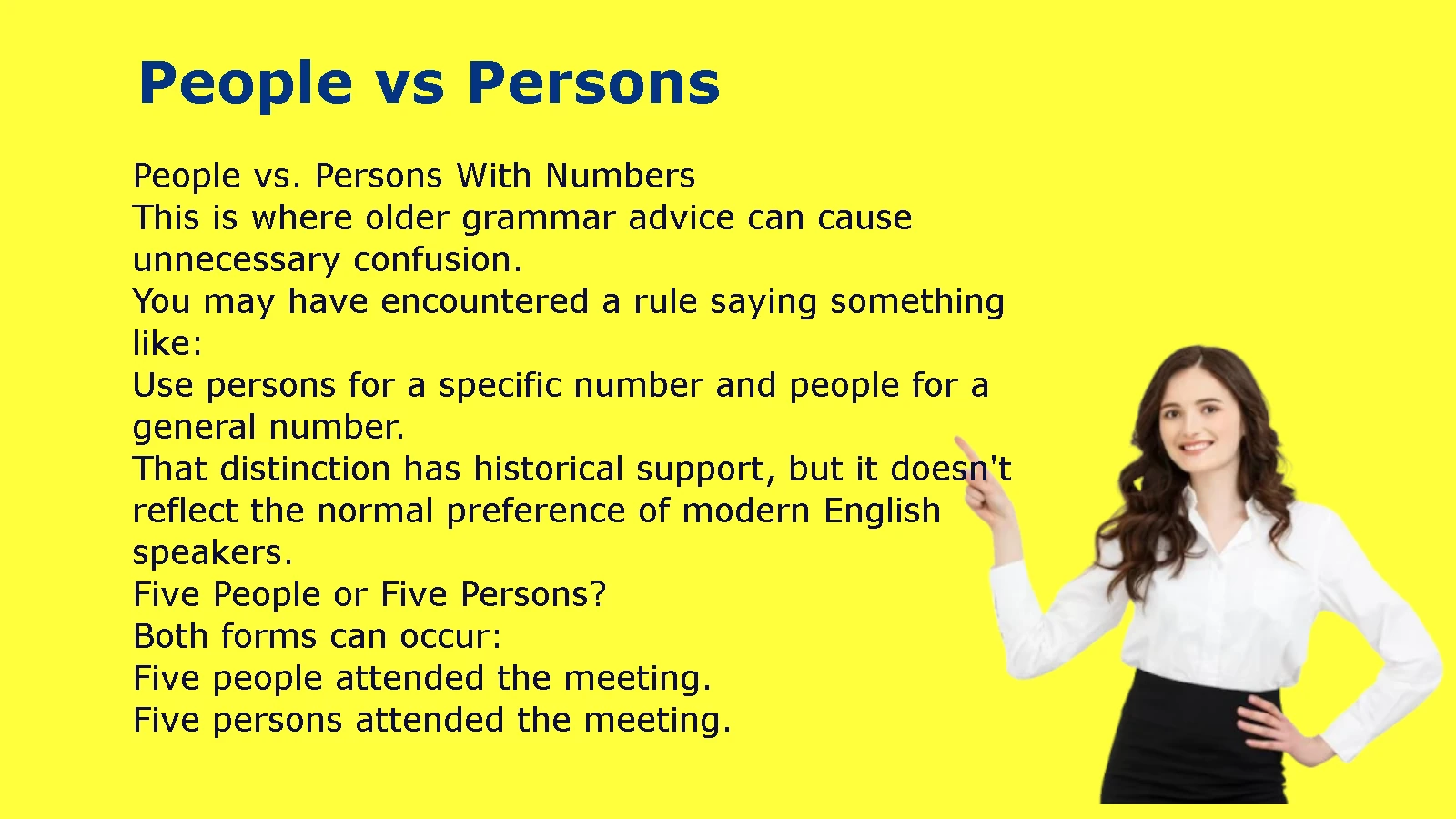
Have you ever wondered whether you should say “people” or “persons” when talking about more than one person? While both People vs Persons can refer to multiple human beings, they are not always used in the same situations.
People is the most common plural form of person and is used in everyday English when referring to a group of individuals. Persons is also grammatically correct, but it is more formal and often appears in legal, official, or technical contexts.
Examples:
- Many people attended the meeting.
- Only authorized persons may enter this area.
The confusion is understandable. People often search for people vs persons, difference between people and persons, people or persons, or is persons grammatically correct because the two words can seem interchangeable. And here’s the kicker: although people is usually the natural choice in everyday conversation, persons can be the better choice in certain formal contexts.
In this guide, you’ll learn the complete difference between People vs Persons, including their meanings, plural forms, grammar, correct usage, and examples in sentences. You’ll also discover when to use people or persons, why persons is common in legal and official writing, and how these words differ from person, peoples, and other related terms.
People vs. Persons at a Glance
| Word | Main use | Tone | Example |
| People | Standard plural of person | Neutral and natural | Five people attended the meeting. |
| Persons | Formal, legal, official, or specialized contexts | Formal and sometimes bureaucratic | Authorized persons may enter. |
| Peoples | Multiple distinct cultural, ethnic, or national groups | Neutral or academic | The Indigenous peoples of the region have diverse traditions. |
The safest general rule is straightforward:
Use “people” when you simply mean more than one person. Use “persons” when a formal, legal, official, or established expression calls for it.
That rule covers most situations you’ll encounter.
Is People the Plural of Person?
Yes. People is the normal plural of person.
The ordinary pattern looks like this:
- One person
- Two people
- Ten people
- Hundreds of people
- Millions of people
Unlike regular nouns such as book → books or car → cars, person doesn’t normally form its everyday plural by adding s. Instead, modern English generally uses the irregular plural people.
Consider these examples:
- One person is waiting outside.
- Three people are waiting outside.
- I spoke with one person yesterday.
- I spoke with several people yesterday.
- The company hired one person last month.
- The company hired 20 people this year.
Cambridge Dictionary lists people as the standard plural of person and gives persons as the formal alternative.
Why Is the Plural Not “Persons”?
English has several irregular plural forms that developed through its long history. Person and people also have different linguistic histories.
Merriam Webster explains that person comes from Latin persona, while people ultimately comes from Latin populus. Although the two words now work together as singular and plural forms in modern English, they don’t come from the same original word.
Historically, persons competed with people for centuries. Earlier English usage sometimes favored persons when writers referred to a definite number or identifiable individuals. Modern English, however, has largely shifted toward people for ordinary plural references. Merriam Webster notes that the older distinction now survives mainly in law related contexts and other formal uses.
So if you learned that persons was once the “proper” plural, you weren’t imagining it. English usage changed.
When to Use People
In most situations, people should be your first choice.
It works naturally in conversations, emails, articles, reports, academic writing, workplace communication, and everyday descriptions. You can use it for a small group, a large group, or humans in general.
Use People for Groups of Humans
When you refer to more than one individual, people usually sounds the most natural.
Examples:
- Three people are waiting outside.
- Five people joined the meeting.
- Several people complained about the noise.
- Many people enjoy traveling.
- A group of people gathered in the park.
Notice that nothing about these sentences requires the formal word persons. Replacing people with persons would make them sound stiff.
Compare:
Natural: Five people attended the conference.
Unusually formal: Five persons attended the conference.
The second sentence isn’t necessarily grammatically incorrect. It simply doesn’t match the ordinary tone of the situation.
Use People With Specific Numbers
One common misconception says that persons should follow an exact number.
That rule doesn’t describe normal modern English.
You can comfortably write:
- Two people
- Four people
- 10 people
- 50 people
- 1,000 people
- 10,000 people
For example:
Twenty people attended the workshop.
That sentence sounds completely normal.
Cambridge specifically gives three people rather than three persons as the ordinary form for referring to a group. Merriam Webster likewise explains that modern usage generally recommends people, particularly for countable groups.
Use People for Humans in General
When you’re making a broad statement about human behavior, people is the natural choice.
Examples include:
- People make mistakes.
- People need time to learn.
- People often remember stories better than statistics.
- People have different opinions.
- People tend to notice unusual things.
Using persons in these sentences would sound unnecessarily formal:
People learn at different speeds.
sounds much more natural than:
Persons learn at different speeds.
The second version isn’t useful simply because it sounds more official. In fact, it distracts from the message.
Use People in Everyday Conversation
If you’re speaking with friends, coworkers, family members, or customers, people will almost always sound better.
You might say:
- “How many people are coming?”
- “I met some interesting people.”
- “There were so many people at the concert.”
- “A lot of people liked the new restaurant.”
- “Do you know those people?”
You generally wouldn’t say:
- “How many persons are coming?”
- “I met some interesting persons.”
- “There were so many persons at the concert.”
The latter examples sound like they belong in a regulation rather than a conversation.
When to Use Persons
Persons is correct, but its use is narrower.
Today, you’ll most often see it in legal language, official notices, regulations, formal documents, and established phrases.
Cambridge describes persons as a “very formal” plural and says it appears mainly in legalistic contexts.
Use Persons in Legal and Regulatory Language
Legal documents often contain wording such as:
- Authorized persons only.
- Unauthorized persons may not enter.
- Persons violating this regulation may be subject to penalties.
- All persons must comply with the applicable requirements.
Here, persons fits the institutional tone.
Imagine a security sign on a restricted facility:
Authorized Persons Only
That wording feels natural because signs and regulations often use established formal language.
Now imagine a friend telling you:
“Only authorized persons came to the party.”
That sounds oddly bureaucratic.
The context changes the best word.
Use Persons in Formal Notices
Official notices sometimes use persons when they establish rules or identify people covered by a requirement.
For example:
Persons under 18 must be accompanied by an adult.
Or:
No unauthorized persons are permitted beyond this point.
The word gives the sentence a formal, administrative tone.
However, formal writing doesn’t automatically require persons. A professional report can still use people perfectly well.
For example:
The survey included 500 people.
There’s no need to replace people with persons just because the report is formal.
Use Persons in Established Expressions
Some expressions have retained persons because they have become fixed or strongly established.
Common examples include:
- missing persons
- persons of interest
- person or persons responsible
- authorized persons
- persons with disabilities in some formal or institutional contexts
- displaced persons
The phrase missing persons is particularly familiar because it appears in the names and terminology of law enforcement and public agencies.
Cambridge also notes the expression person or persons, which can appear when the exact number of individuals involved isn’t known.
People vs. Persons With Numbers
This is where older grammar advice can cause unnecessary confusion.
You may have encountered a rule saying something like:
Use persons for a specific number and people for a general number.
That distinction has historical support, but it doesn’t reflect the normal preference of modern English speakers.
Five People or Five Persons?
Both forms can occur:
- Five people attended the meeting.
- Five persons attended the meeting.
The first is the natural choice in general modern English.
The second sounds formal and may fit an official or legal context.
For example:
Five people were injured in the accident.
is natural news or general writing.
Meanwhile:
Five persons were identified as violating the regulation.
could fit a formal legal or administrative report.
The difference isn’t simply the number five. Context matters more than the number.
Does an Exact Number Require Persons?
No.
You can say:
- Two people
- Three people
- Seven people
- 25 people
- 100 people
- 10,000 people
There is no modern grammar rule that requires persons simply because you know the exact number.
Merriam Webster notes that older usage guides sometimes promoted distinctions based on exact or small numbers. However, modern usage has moved away from that rule, and people is now the usual choice.
People vs. Persons in Legal Writing
Legal English provides one of the clearest reasons persons remains alive.
Law frequently deals with rules that apply to individuals as defined categories. Because legal language has developed its own conventions over centuries, words that sound unusually formal in everyday conversation can remain perfectly normal in legal documents.
For example:
Any person or persons responsible for the damage may be held liable.
The phrase person or persons allows the document to cover one individual or multiple individuals without knowing the exact number.
Likewise:
Unauthorized persons are prohibited from entering the premises.
The sentence establishes a rule. Its formal tone fits the purpose.
Why Does Legal English Favor Persons?
Several factors help explain its continued use:
- Tradition: Legal writing preserves many older expressions.
- Precision: Legal documents often define categories of individuals.
- Consistency: Established terminology gets repeated across regulations and contracts.
- Institutional tone: Formal documents use language that differs from everyday speech.
- Specialized conventions: Some phrases have become standard within legal and administrative writing.
Still, persons isn’t automatically more precise than people.
That’s an important distinction.
A writer shouldn’t replace every occurrence of people with persons just to make a document sound professional. Clear legal drafting often benefits from plain language when no specialized term is necessary.
People vs. Persons in Everyday English
For ordinary communication, people wins by a mile.
Consider a simple conversation:
“How many people are coming to dinner?”
Nobody would find that unusual.
Now change it:
“How many persons are coming to dinner?”
The grammar isn’t the main problem. The tone is.
It sounds as though the dinner invitation came from a government office.
Here are more natural examples:
| Everyday situation | Natural choice |
| Asking about a party | How many people are coming? |
| Talking about friends | I met some great people. |
| Describing a crowd | Hundreds of people gathered. |
| Discussing customers | The store serves many people. |
| Talking about a meeting | Ten people attended. |
| Describing human behavior | People make mistakes. |
In each case, people is the natural modern choice.
People vs. Persons in Formal Writing
Formal writing creates a slightly more complicated picture.
A common mistake is to assume:
Formal writing = persons
That’s not true.
A business report, academic paper, or professional article can use people without becoming informal.
For example:
The study surveyed 2,000 people across five states.
That sentence is both professional and natural.
You could write:
The study surveyed 2,000 persons across five states.
It’s grammatical, but the choice feels more formal and somewhat institutional.
The best writing doesn’t use a complicated word merely because it can. Choose the word that fits the purpose.
If you’re writing a scientific study, people may be the clearest general term. If you’re reproducing the wording of a regulation, persons may be appropriate because the legal terminology matters.
Does the Meaning of People vs. Persons Change?
Usually, the basic reference doesn’t change. Both words can refer to more than one human being.
The bigger difference involves tone, context, and convention.
Think of the two words as wearing different clothes.
People wears everyday clothes. It’s comfortable, familiar, and versatile.
Persons wears a suit. It sounds official and deliberate.
That doesn’t mean one is “better.” It means they have different jobs in modern English.
Compare:
People with valid tickets may enter.
and:
Persons with valid tickets may enter.
Both can communicate essentially the same idea. The second sounds more formal.
In an ordinary announcement, the first may be preferable.
In a regulation that consistently uses formal legal terminology, the second may fit better.
People vs. Persons vs. Peoples
Adding one letter creates another word with a different meaning.
People and peoples aren’t interchangeable.
What Does People Mean?
People can mean:
- Human beings as a group
- Individuals in general
- Members of a community
- People connected by a shared characteristic
Examples:
- People were waiting outside.
- Young people often use social media.
- The people of the town supported the project.
- The American people elected their representatives.
Merriam Webster lists these different meanings and also recognizes peoples as a plural referring to distinct bodies of people connected by culture, tradition, kinship, language, institutions, or similar factors.
What Does Peoples Mean?
Peoples generally refers to multiple distinct groups of people, especially groups with their own cultural, ethnic, linguistic, national, or historical identities.
For example:
The Indigenous peoples of the region have different languages and traditions.
Here, the writer isn’t talking about several individual humans. The writer is talking about multiple distinct groups.
Compare:
- Many people attended the festival.
- Several peoples have lived in the region for centuries.
The first sentence counts individuals.
The second discusses distinct communities or groups.
People vs. Peoples Example
Suppose three cultural groups live in a region.
You could say:
The region is home to many people.
That refers generally to the humans living there.
You could say:
The region is home to several distinct peoples.
That emphasizes separate cultural or historical groups.
The extra s changes the meaning.
Common Mistakes With People and Persons
Understanding the rules is useful. Knowing what to avoid is even better.
Mistake: Assuming Persons Is Wrong
Persons isn’t wrong.
It remains a legitimate plural of person. Cambridge and Merriam Webster both recognize it. The issue is usage, not grammatical possibility.
Better rule:
Persons is correct, but people is usually more natural.
Mistake: Assuming Persons Is Always More Formal and Better
Formal doesn’t mean better.
If you write:
“Three persons were sitting at the table.”
when you’re simply describing dinner guests, the sentence may sound unnatural.
Use:
“Three people were sitting at the table.”
Save persons for contexts where its formal tone actually serves a purpose.
Mistake: Using Persons for Every Exact Number
Knowing the exact number doesn’t force you to use persons.
This is completely natural:
Four people attended the interview.
You don’t need:
Four persons attended the interview.
unless the formal context makes that wording appropriate.
Mistake: Using Persons in Casual Conversation
Try saying:
“I met two interesting persons yesterday.”
It sounds unusual.
Most speakers would say:
“I met two interesting people yesterday.”
The second version is smoother because it matches normal conversational English.
Mistake: Confusing People With Peoples
Don’t use peoples simply because you’re talking about a large number of individuals.
Incorrect for a crowd:
Thousands of peoples attended the concert.
Correct:
Thousands of people attended the concert.
Use peoples when you mean distinct groups:
The region contains several Indigenous peoples.
People vs. Persons Examples
Examples make the distinction much easier to remember.
Everyday Examples
- Two people are waiting outside.
- I spoke with several people yesterday.
- Many people enjoy watching movies.
- How many people are coming?
- The park was full of people.
- Three people joined us for dinner.
Workplace Examples
- The company employs 500 people.
- Several people attended the training session.
- We asked 100 people to complete the survey.
- The manager spoke with the people involved.
- Many people work remotely today.
Academic Examples
- The researchers interviewed 250 people.
- The study examined how people respond to stress.
- Participants included people from five states.
- The survey asked people about their experiences.
Legal and Official Examples
- Authorized persons may enter the building.
- Unauthorized persons are prohibited from entering.
- All persons must comply with the regulation.
- The person or persons responsible may face legal action.
- The police are investigating the persons involved.
The context explains why the final group sounds different from the first three.
A Practical Case Study: Choosing the Right Word
Imagine that a community center wants to announce a new swimming pool rule.
Version A
Only authorized persons may enter the pool area.
This works well on an official sign. The concise, formal language fits the environment.
Version B
Only authorized people may enter the pool area.
This is also understandable and grammatically sound. Depending on the center’s style, it may even be clearer and friendlier.
Now imagine a staff member telling a visitor about the rule:
“Only authorized people can enter that area.”
People sounds much more natural in conversation.
The lesson isn’t that persons belongs only in law. The lesson is that context determines which word sounds appropriate.
Is Persons Grammatically Correct?
Yes.
Persons is grammatically correct.
It functions as a plural form of person, but modern English uses it much less often than people for ordinary references to multiple humans.
A useful way to remember the distinction is:
Correct doesn’t always mean common.
For example, a sentence can be grammatically possible yet stylistically unusual. That’s exactly what happens with many everyday uses of persons.
Cambridge gives persons a formal or legalistic role, while its US dictionary entry lists people as the plural and persons as the formal plural.
Is People or Persons More Common?
People is much more common in general modern English.
That difference matters because frequency affects what sounds natural to readers and listeners.
Merriam Webster describes people as today’s usual plural of person and explains that older uses of persons have largely become associated with law related contexts or sound old fashioned elsewhere.
So if you’re uncertain, don’t overthink it.
When in doubt, choose people.
That simple rule will work in the overwhelming majority of everyday situations.
People vs. Persons in American English
American English generally follows the same broad pattern.
Use people for ordinary plural references:
- Five people
- Many people
- Young people
- Local people
- Working people
- People in the community
Use persons when formal or specialized language makes it appropriate:
- Missing persons
- Persons of interest
- Authorized persons
- Unauthorized persons
- Person or persons responsible
Merriam Webster’s current dictionary entry states that people is today the usual plural of person and notes that persons has become largely associated with law related contexts in situations where older usage once preferred it more broadly.
A Quick Decision Guide for People vs. Persons
When you’re writing and hesitate between the two, ask one question:
Am I simply talking about more than one human being?
If the answer is yes, choose people.
If you’re writing a legal rule, official notice, regulation, or established formal expression, consider persons.
Are you referring to more than one person?
|
v
Use “people”
|
v
Is this a legal, regulatory,
official, or established expression?
/ \
Yes No
| |
v v
Consider “persons” Use “people”
This approach works because it focuses on actual usage, not outdated rules about whether a group has a particular number of members.
Quick Rules to Remember
Keep these rules handy:
- Person is the ordinary singular form.
- People is the standard plural in modern English.
- Persons is also a correct plural form.
- People is the normal choice for everyday writing and speech.
- Persons often appears in legal, official, regulatory, and formal language.
- An exact number does not require persons.
- “Five people” is perfectly correct.
- Don’t use persons simply to make ordinary writing sound more sophisticated.
- Peoples has a different meaning when it refers to multiple distinct cultural or national groups.
- If you’re unsure, people is usually the safest choice.
People vs. Persons Frequently Asked Questions
Is “people” or “persons” correct?
Both are correct, but they don’t have the same level of everyday use. People is the standard plural of person in modern English. Persons is more formal and commonly appears in legal, official, and established expressions.
Is “persons” grammatically correct?
Yes. Persons is grammatically correct as a plural of person. The important issue is whether it fits the context.
For ordinary conversation, people usually sounds better.
Can you say “five persons”?
Yes.
Five persons attended the meeting.
is grammatically possible. However, in ordinary American English, this is more natural:
Five people attended the meeting.
The formal version may fit a legal or administrative document.
Should I say “two people” or “two persons”?
In ordinary English, say two people.
Two people were waiting outside.
Use two persons only when a formal, legal, official, or established context makes that wording appropriate.
Is “persons” more formal than “people”?
Generally, yes.
Persons has a more formal, legalistic, or bureaucratic feel. People is neutral and widely used.
That doesn’t mean persons is always better for formal writing. Professional writing should still favor clarity and natural usage.
Why do legal documents use “persons”?
Legal writing has preserved many formal expressions through long established usage. Persons can also work well when a rule applies to individuals as a defined category.
For example:
Unauthorized persons may not enter the premises.
The formal wording fits a regulation or official notice.
Is “people” informal?
No.
People is standard English, not merely an informal alternative.
You can use it in academic writing, business writing, journalism, government communication, and professional reports.
For example:
The study surveyed 5,000 people.
There’s nothing informal about that sentence.
Is “people” always better than “persons”?
No.
People is the better default, but persons has legitimate uses.
Use persons when you’re dealing with:
- Legal language
- Regulations
- Official notices
- Administrative language
- Established expressions
- Situations where the formal terminology itself matters
What is the difference between “people” and “peoples”?
People normally refers to multiple individuals or humans generally.
Peoples usually refers to multiple distinct groups of people, especially groups connected by culture, language, tradition, ethnicity, nationality, or shared history.
For example:
Many people live in the city.
versus:
Several Indigenous peoples live in the region.
Merriam Webster distinguishes these meanings in its dictionary definition of people.
Should formal writing use “persons”?
Not automatically.
A formal report can use people perfectly well:
The researchers surveyed 1,000 people.
You don’t need to change people to persons just because the document is professional.
Use the word that fits the context, rather than choosing a more formal sounding word for its own sake.
Is “people” correct after a number?
Yes.
You can write:
- Two people
- Ten people
- 50 people
- 500 people
- 10,000 people
Modern English doesn’t require persons after an exact number.
People vs. Persons: Final Verdict
The people vs. persons debate becomes much easier once you stop treating it as a simple right versus wrong question.
People is the standard plural of person in modern English. Use it for everyday speech, general writing, professional communication, academic writing, news writing, and most situations where you refer to multiple human beings.
Persons is also correct, but it carries a more formal tone. You’ll see it most often in legal documents, regulations, official notices, administrative language, and established expressions such as missing persons and persons of interest.
The key difference is context, not correctness.
| If you mean… | Best choice |
| More than one human being | People |
| People in everyday conversation | People |
| A specific number of individuals | People |
| People in academic or professional writing | People |
| A legal or regulatory category | Persons |
| An official warning or notice | Persons |
| An established phrase such as “missing persons” | Persons |
| Multiple distinct cultural groups | Peoples |
So when you’re stuck between people vs. persons, keep the simplest rule in mind:
Use “people” by default. Use “persons” when the context calls for formal, legal, official, or established usage.