Have you ever wondered whether to write spelled or spelt when talking about the past tense of “spell”? The difference in Spelled vs Spelt is mainly connected to English variety, country, and writing style, so both forms can be correct depending on the context.
Spelled and spelt have the same basic meaning. Both are past tense and past participle forms of the verb spell, meaning to write or say the letters of a word in the correct order. Spelled is the more common form in American English, while spelt is widely used in British English and other varieties of English. However, spelled is also accepted in British English.
Examples:
- She spelled my name correctly on the form.
- She spelt my name correctly on the form.
The confusion
Spelled vs Spelt: Quick Answer
| Word | US English | British English | Meaning as a verb |
| spelled | Standard | Correct | Past tense and past participle of spell |
| spelt | Uncommon for the verb | Common and correct | Past tense and past participle of spell |
Both spelled and spelt can describe the act of forming a word with its letters in the correct order.
For example:
- US English: She spelled my name correctly.
- British English: She spelt my name correctly.
- British English: She spelled my name correctly.
The meaning doesn’t change. The regional preference does.
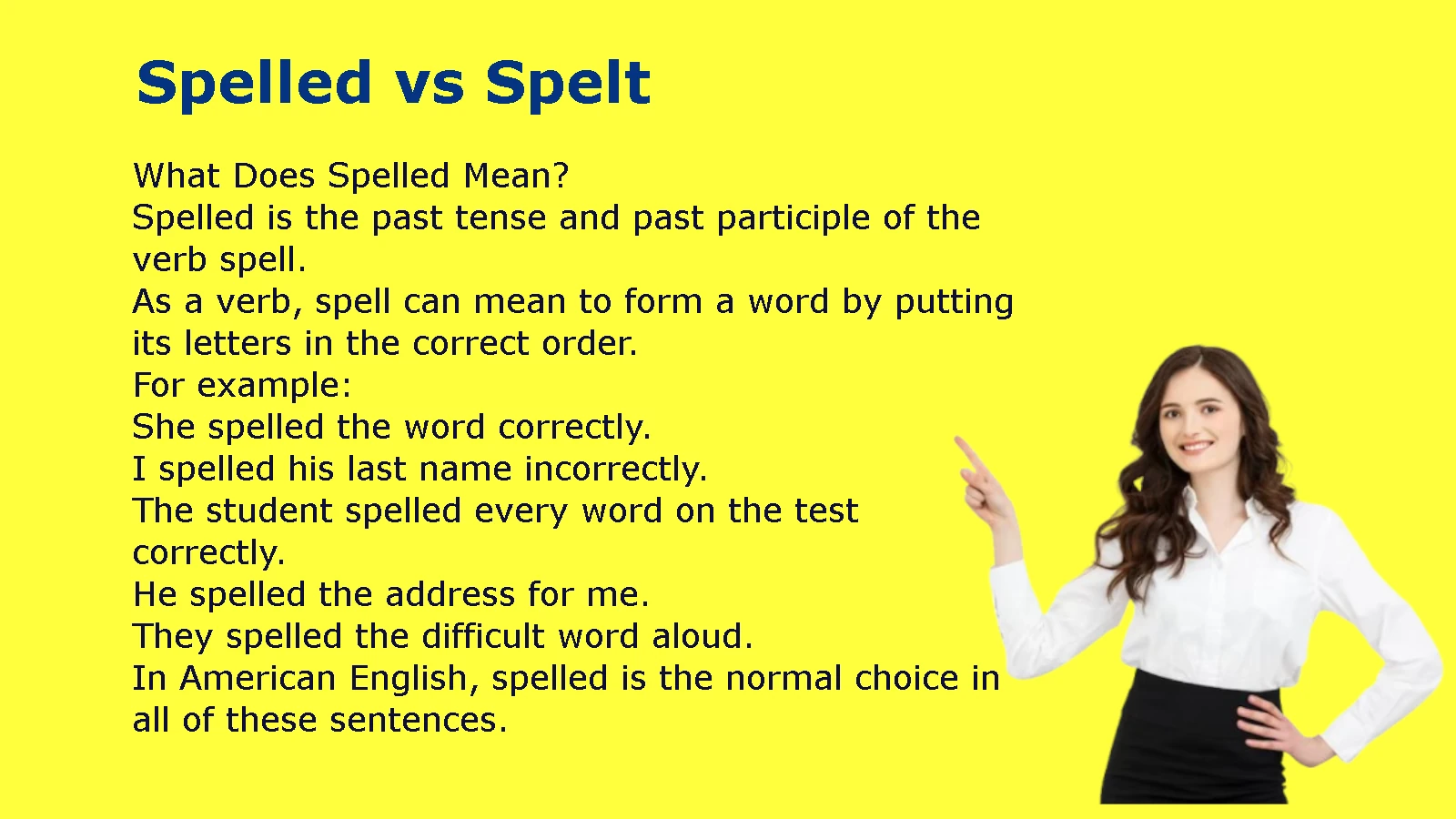
What Does Spelled Mean?
Spelled is the past tense and past participle of the verb spell.
As a verb, spell can mean to form a word by putting its letters in the correct order.
For example:
- She spelled the word correctly.
- I spelled his last name incorrectly.
- The student spelled every word on the test correctly.
- He spelled the address for me.
- They spelled the difficult word aloud.
In American English, spelled is the normal choice in all of these sentences.
What Does Spelt Mean?
Spelt has two important dictionary meanings.
First, it is a past tense and past participle of the verb spell, especially in British English.
Second, spelt is also the name of a type of grain.
For example:
She spelt the word correctly.
Here, spelt is a verb.
But:
The bakery makes bread with spelt flour.
Here, spelt is a noun referring to the grain.
Is Spelled or Spelt the Correct Past Tense of Spell?
Both are correct.
The basic forms are:
spell → spelled / spelt
Both forms can function as the simple past and past participle.
Simple past
She spelled the word correctly.
She spelt the word correctly.
Past participle
She has spelled the word correctly.
She has spelt the word correctly.
The meaning remains the same. The regional preference changes.
Spelled vs Spelt in American English
When writing American English, use spelled.
Examples include:
- I spelled your name correctly.
- She spelled the word wrong.
- He has spelled the answer correctly.
- The address was spelled incorrectly.
- The teacher spelled the word aloud.
American English generally favors the -ed form in verb pairs where British English permits both -ed and -t forms.
Spelled vs Spelt in British English
British English accepts both spelled and spelt.
For example:
She spelt my surname correctly.
Or:
She spelled my surname correctly.
Neither sentence is grammatically wrong.
Spelt simply has a stronger traditional association with British English.
Spelled vs Spelt Examples in Sentences
Examples With Spelled
- She spelled my name correctly.
- I spelled the word incorrectly on the test.
- He spelled out his full address.
- The teacher spelled the difficult word aloud.
- You spelled my last name with one extra letter.
- The sign had the town’s name spelled incorrectly.
- She has spelled every word correctly so far.
- The child’s name was spelled incorrectly on the certificate.
Examples With Spelt
- She spelt my name correctly.
- I spelt the word incorrectly on the test.
- He spelt out his full address.
- The teacher spelt the difficult word aloud.
- You spelt my surname with one extra letter.
- The town’s name was spelt incorrectly.
- She has spelt every word correctly.
- His name was spelt differently on the document.
Is “My Name Is Spelled” or “My Name Is Spelt” Correct?
Both are correct.
American English normally uses:
My name is spelled S-H-E-Y-A-N.
British English can use:
My name is spelt S-H-E-Y-A-N.
British English can also use spelled.
The important point is that the choice doesn’t change the meaning.
Spelled or Spelt Out: Which Form Should You Use?
The phrase spell out can mean to say or write the letters of something clearly.
In American English:
She spelled out her last name.
In British English:
She spelt out her last name.
The phrase can also mean to explain something clearly:
The manager spelled out the company’s new rules.
British English can use:
The manager spelt out the company’s new rules.
Spelled vs Spelt in the Past Participle
Both forms can serve as past participles.
Present perfect
She has spelled the word correctly.
She has spelt the word correctly.
Past perfect
She had spelled the word correctly.
She had spelt the word correctly.
Passive construction
The word was spelled incorrectly.
The word was spelt incorrectly.
Misspelled vs Misspelt
The same regional pattern appears with misspell.
American English normally uses misspelled:
I misspelled her name.
British English can use either:
I misspelt her name.
I misspelled her name.
The same principle applies throughout your writing. If you’re using American English, misspelled is the natural choice.
Spelt the Grain vs Spelt the Verb
Spelt can be either a verb or a noun.
As a verb:
She spelt the word correctly.
As a noun:
The farmer grows spelt for flour.
Context usually makes the meaning obvious.
Phrases such as spelt flour, spelt bread, and spelt grain clearly refer to the grain.
Common Mistakes With Spelled and Spelt
Thinking spelt is always wrong
It isn’t. Spelt is an established English verb form and is particularly common in British English.
Thinking spelled is only American
That’s also incorrect. British English accepts spelled as well as spelt.
Switching forms without a reason
Choose a regional style and stick with it. In American English, consistently use spelled and misspelled.
Confusing spelt with misspelt
The relationship is straightforward:
spell → spelt
misspell → misspelt
In American English:
spell → spelled
misspell → misspelled
A Practical Case Study: Choosing the Right Form
An American school assignment
I spelled the word incorrectly during the test.
Best choice: spelled.
A British newspaper
The witness spelt the unusual surname correctly.
Best choice: spelt.
An international company using US English
Enter your name exactly as it is spelled on your identification.
Best choice: spelled.
The lesson is simple: match the form to the English variety and keep the style consistent.
How to Choose Between Spelled and Spelt
| Your situation | Best choice |
| Writing for US readers | spelled |
| American academic writing | spelled |
| American business writing | spelled |
| British writing | spelled or spelt |
| Traditional British style | spelt |
| International publication using US style | spelled |
| International publication using UK style | spelled or spelt |
| Referring to the grain | spelt |
Why English Has Both Spelled and Spelt
English has several verbs with competing -ed and -t past forms.
Examples include:
- learned / learnt
- burned / burnt
- dreamed / dreamt
- smelled / smelt
- spilled / spilt
- spelled / spelt
British English continues to use many of these -t forms alongside their -ed counterparts. American English tends to favor the -ed versions.
That broader pattern helps explain why spelt exists alongside spelled.
Above all, stay consistent.
Spelled vs Spelt: Side-by-Side Comparison
| Feature | Spelled | Spelt |
| Base verb | spell | spell |
| Past tense | Yes | Yes |
| Past participle | Yes | Yes |
| US English | Preferred | Less common for the verb |
| British English | Correct | Common |
| Meaning as a verb | Form a word with letters | Form a word with letters |
| “Out” form | spelled out | spelt out |
| Related form | misspelled | misspelt |
| Separate noun meaning | No | Yes, a type of grain |
Frequently Asked Questions About Spelled vs Spelt
Is spelt correct English?
Yes. Spelt is correct English as the past tense and past participle of spell, especially in British English. It is also a noun referring to a type of grain.
Is spelled correct in British English?
Yes. Spelled is correct in British English. British English commonly permits both spelled and spelt.
Is spelt correct in American English?
For the verb spell, American English normally uses spelled. Spelt also exists in American English as a noun referring to the grain.
Which is more common, spelled or spelt?
Spelled is the preferred form in American English and is also accepted in British English. Spelt is especially common in British English.
Is it spelled or spelt in a sentence?
Both can be correct.
American English:
The word is spelled correctly.
British English:
The word is spelt correctly.
Is it misspelled or misspelt?
Use misspelled in American English. British English accepts both misspelled and misspelt.
Is “spelled out” correct?
Yes. Spelled out is correct and widely used. Spelt out is also correct, particularly in British English.
Does spelled mean something different from spelt?
Not when they are forms of the verb spell. Both refer to forming a word with its letters in the correct order.
Should I use spelled or spelt in American English?
Use spelled. It is the standard American form.
Should I use spelled or spelt in British English?
You can use either. Spelt is a common British form, while spelled is also correct.
Final Verdict on Spelled vs Spelt
The difference between spelled vs spelt comes down mainly to regional preference.
Spelled is the standard choice in American English.
Spelt is a common and correct form in British English, while spelled is also accepted there.
Both forms can serve as the past tense and past participle of spell, and they carry the same meaning in that role.
One extra detail is worth remembering: spelt can also mean a type of grain.
So if you’re writing for a US audience, choose spelled. If you’re following British English, spelled and spelt are both available.
The simplest rule is the best one: know your audience, choose your English variety, and use the form consistently.