Have you ever wondered whether Wholistic vs. Holistic is a real distinction or simply a spelling variation? If you’ve seen both words used in articles, wellness discussions, or professional writing, you’re not alone in feeling confused.
The challenge is that these terms look different but are often used to describe the same idea—considering something as a complete system rather than focusing on individual parts. And here’s the kicker: while many people use them interchangeably, some writers and organizations prefer one spelling over the other.
This confusion shows up frequently in health, education, business, and personal development content, making it difficult to know which version is correct for your situation.
But don’t worry—there’s a straightforward answer.
In this guide, you’ll learn the difference between Wholistic vs. Holistic, their origins, meanings, and proper usage. You’ll also discover which spelling is more widely accepted, when each term might be appropriate, and examples that make the distinction easy to understand.
So if you’ve ever been unsure about which word to use, keep reading—this guide will clear up the confusion once and for all.
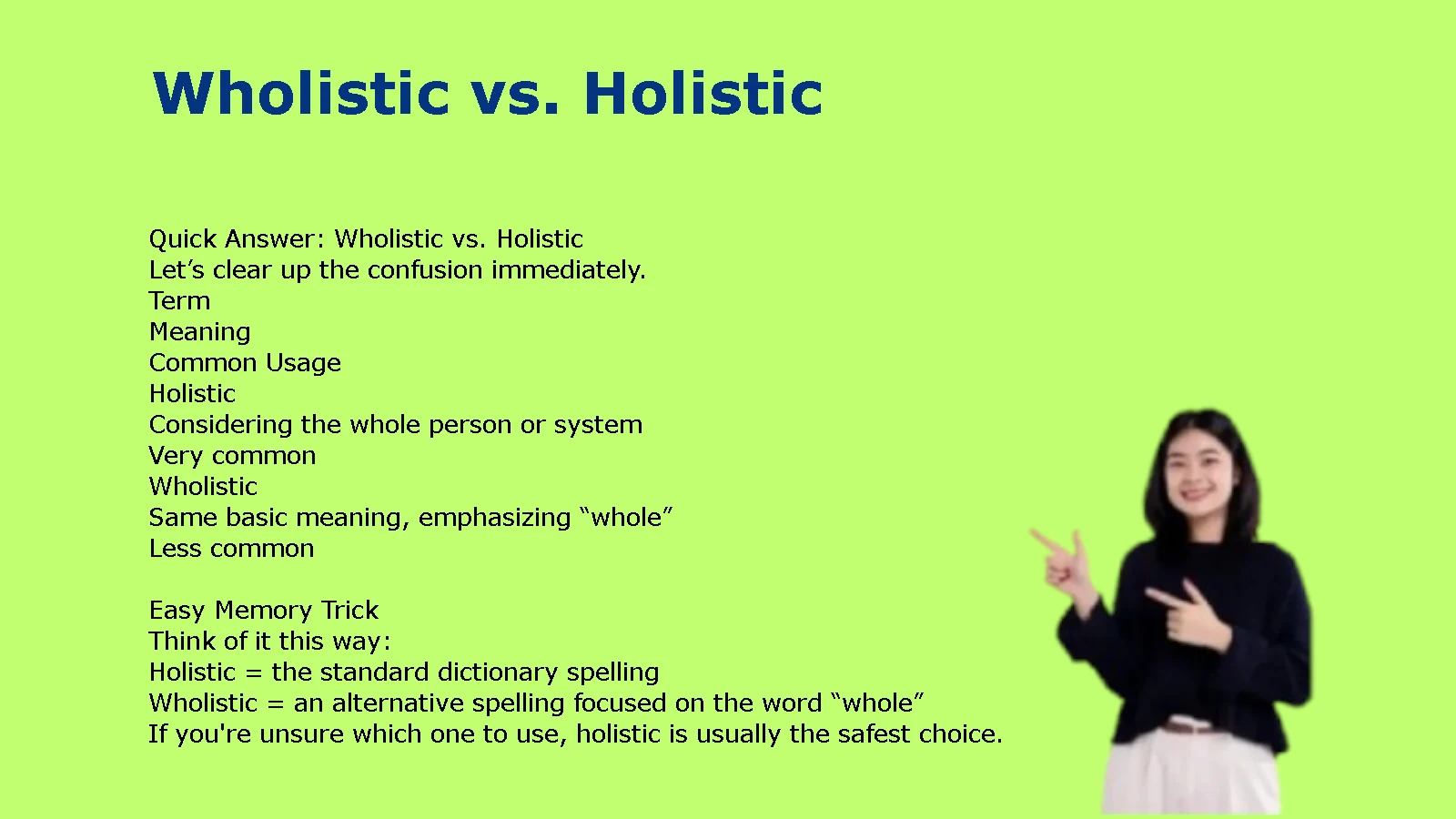
Quick Answer: Wholistic vs. Holistic
Let’s clear up the confusion immediately.
| Term | Meaning | Common Usage |
|---|---|---|
| Holistic | Considering the whole person or system | Very common |
| Wholistic | Same basic meaning, emphasizing “whole” | Less common |
Easy Memory Trick
Think of it this way:
- Holistic = the standard dictionary spelling
- Wholistic = an alternative spelling focused on the word “whole”
If you’re unsure which one to use, holistic is usually the safest choice.
What Does “Holistic” Mean?
The word holistic refers to viewing something as a complete system rather than focusing on individual parts.
Simple Definition
A holistic approach considers:
- Physical factors
- Emotional factors
- Mental factors
- Social influences
- Environmental conditions
Instead of treating one issue in isolation, a holistic perspective looks at how everything connects.
Examples of Holistic
- The doctor recommended a holistic treatment plan.
- The school uses a holistic approach to student development.
- Successful businesses often take a holistic view of customer experience.
Key Idea
Holistic thinking focuses on the big picture rather than individual pieces.
What Does “Wholistic” Mean?
The term wholistic generally carries the same meaning as holistic.
Some practitioners and organizations use it because they believe it more clearly reflects the concept of treating the “whole” person.
Examples of Wholistic
- The clinic offers wholistic wellness programs.
- She follows a wholistic lifestyle.
- The coach teaches a wholistic method of personal growth.
Key Idea
The meaning remains largely identical to holistic. The main difference is the spelling preference.
The History Behind Holistic and Wholistic
Understanding the origin helps explain why both words exist.
Origin of Holistic
The word holistic comes from the concept of holism, which emphasizes that systems should be viewed as complete entities rather than separate parts.
Over time, holistic became the accepted spelling in dictionaries, academic writing, and professional communication.
Where Wholistic Came From
Some people felt that the connection between holistic and whole wasn’t obvious enough.
As a result, the spelling wholistic gained popularity in certain wellness, health, and spiritual communities.
Important Fact
Most major dictionaries recognize holistic as the standard spelling.
Wholistic vs. Holistic: The Main Difference
Here’s the distinction most people need to know.
Meaning
There is virtually no difference in meaning.
Both words describe:
- Whole-person care
- Whole-system thinking
- Integrated approaches
- Looking beyond individual components
Acceptance
This is where the real difference appears.
| Feature | Holistic | Wholistic |
|---|---|---|
| Dictionary Standard | Yes | Less common |
| Academic Writing | Preferred | Rare |
| Professional Use | Very common | Less common |
| Wellness Communities | Common | Common |
| Search Popularity | Higher | Lower |
Bottom Line
The difference is primarily spelling, not meaning.
Why “Holistic” Is More Common
You’ll encounter holistic far more often in books, articles, schools, and workplaces.
Reasons It Dominates
- Recognized by major dictionaries
- Widely used in education
- Preferred in healthcare publications
- Common in professional writing
- Familiar to most readers
Practical Result
When people see “holistic,” they immediately understand what you mean.
Why Some People Prefer “Wholistic”
Despite being less common, wholistic still has loyal supporters.
Common Reasons
People choose wholistic because:
- It highlights the word “whole”
- It feels more intuitive
- It emphasizes complete wellness
- It aligns with certain health philosophies
Common Industries
You may see wholistic used in:
- Alternative medicine
- Wellness coaching
- Spiritual practices
- Personal development programs
Key Insight
The choice is often stylistic rather than grammatical.
Real-Life Examples of Holistic
Here are some everyday examples.
Healthcare
“The hospital promotes a holistic approach to patient care.”
Meaning:
Doctors consider physical, mental, and emotional health together.
Education
“The university uses holistic admissions.”
Meaning:
Applicants are evaluated using multiple factors, not just test scores.
Business
“The company adopted a holistic strategy.”
Meaning:
The organization considers all departments and processes together.
Real-Life Examples of Wholistic
Now compare these examples.
Wellness Center
“The center offers wholistic healing services.”
Meaning:
Care focuses on the entire person.
Life Coaching
“She teaches a wholistic growth framework.”
Meaning:
Personal development includes multiple aspects of life.
Nutrition
“They promote a wholistic nutrition philosophy.”
Meaning:
Diet is viewed as part of overall well-being.
The Biggest Mistake People Make
Many people assume one spelling is completely wrong.
That isn’t entirely true.
What Happens
Some people say:
- Holistic is correct.
- Wholistic is incorrect.
Others say:
- Wholistic is the “real” version.
- Holistic misses the meaning of whole.
Reality
Both forms exist, but holistic remains the dominant and preferred spelling.
Which One Should You Use?
The answer depends on your audience.
Use “Holistic” When
- Writing professionally
- Creating academic content
- Publishing articles
- Writing business communications
- Speaking to a broad audience
Use “Wholistic” When
- Matching a brand’s preferred spelling
- Writing for audiences familiar with the term
- Referring to organizations that use it officially
Safe Rule
If you’re uncertain, choose holistic.
Holistic vs. Wholistic in SEO and Online Content
For content creators, spelling matters.
Search Trends
Most users search for:
- Holistic health
- Holistic wellness
- Holistic medicine
- Holistic approach
The spelling holistic generally receives much more search traffic.
SEO Recommendation
If your goal is visibility and readability:
Use holistic as the primary term.
You can mention wholistic as a recognized alternative spelling.
Quick Comparison Table
| Aspect | Holistic | Wholistic |
|---|---|---|
| Meaning | Whole-system approach | Same meaning |
| Popularity | Very high | Lower |
| Professional Acceptance | High | Moderate |
| Academic Preference | Strongly preferred | Rare |
| Reader Familiarity | High | Lower |
| Best General Choice | Yes | Sometimes |
FAQ: Wholistic vs. Holistic
Is wholistic a real word?
Yes. Wholistic is a recognized alternative spelling, although it is less common than holistic.
Which spelling is correct?
Both exist, but holistic is considered the standard spelling in most contexts.
Do they mean different things?
Not significantly. Both refer to considering the whole person or system.
Which spelling should businesses use?
Most businesses choose holistic because it is more familiar to customers.
Is wholistic outdated?
No. It is still used today, especially in wellness and alternative health communities.
Case Study: Choosing the Right Word for a Wellness Brand
A wellness coach launched a website using the term:
“Wholistic Wellness Coaching.”
The Challenge
New visitors frequently asked whether the word was a typo.
What Happened
The coach tested:
- Wholistic Wellness Coaching
- Holistic Wellness Coaching
The holistic version was understood more quickly by visitors.
Result
The brand kept its philosophy but switched most public-facing content to holistic.
Lesson
Sometimes the most familiar spelling creates the clearest communication.
Key Facts to Remember
- Holistic is the standard spelling.
- Wholistic is an alternative spelling.
- Both words have nearly identical meanings.
- Holistic is more common in professional writing.
- Wholistic is often used to emphasize the concept of “whole.”
- Most readers recognize holistic immediately.
- Academic and business settings usually prefer holistic.
Final Takeaway: Holistic Is Usually the Better Choice
When comparing wholistic vs. holistic, the difference is mostly about spelling rather than meaning.
Both words describe viewing a person, process, or system as a complete whole. However, holistic has become the accepted standard in education, healthcare, business, and everyday communication.
A simple rule to remember:
- Holistic = standard and widely accepted
- Wholistic = alternative spelling emphasizing “whole”
If clarity is your goal, holistic is usually the best option. It’s familiar, professional, and instantly understood by most readers. When in doubt, choose holistic and you’ll rarely go wrong.