Have you ever wondered whether Curb vs. Kerb is simply a spelling variation or whether the two words have different meanings? This common English grammar and vocabulary question often confuses writers, students, travelers, and even native speakers because the correct choice depends on American English, British English, regional spelling conventions, and the context in which the word is used.
If you’ve ever paused while writing an email, blog post, school assignment, or road safety document, you’re not alone. The confusion usually comes from the fact that both words refer to the raised edge separating a road, street, or sidewalk (pavement), yet each spelling is considered standard in a different variety of English. Using the wrong version can make your writing appear inconsistent or unfamiliar to your intended audience.
The good news? Once you understand the difference, choosing the correct spelling becomes easy.
In this guide, you’ll learn the meaning of Curb vs. Kerb, when each spelling is correct, how they differ in US English and UK English, and why both words exist. You’ll also discover practical examples, common spelling mistakes, pronunciation tips, regional language differences, and simple memory tricks to help you use the right word with confidence in both formal and everyday writing.
So, if you’re ready to master this commonly confused pair and improve your English vocabulary, let’s dive in.
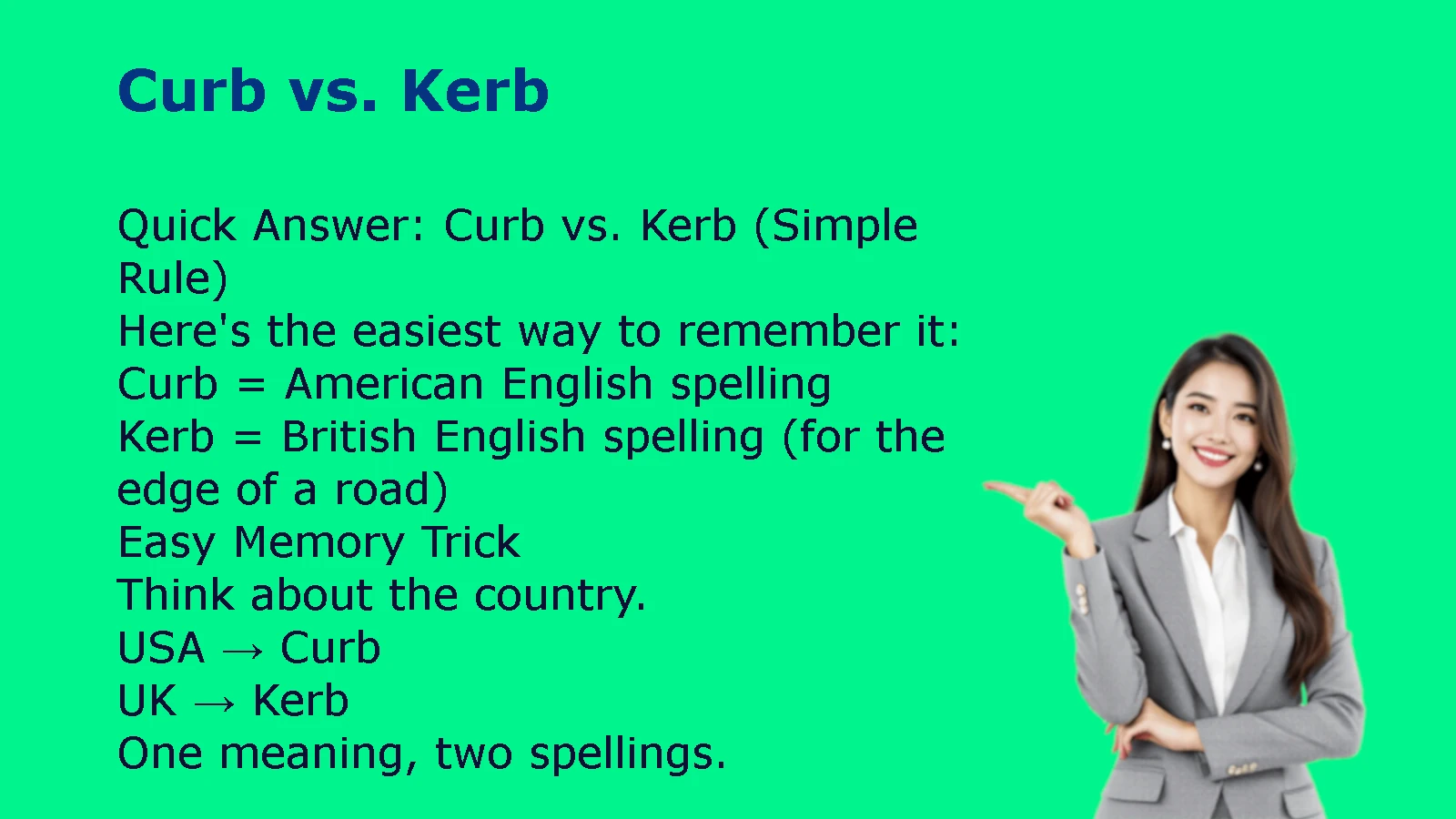
Quick Answer: Curb vs. Kerb (Simple Rule)
Here’s the easiest way to remember it:
- Curb = American English spelling
- Kerb = British English spelling (for the edge of a road)
Easy Memory Trick
Think about the country.
USA → Curb
UK → Kerb
One meaning, two spellings.
What Do “Curb” and “Kerb” Mean?
Both words refer to the raised edge separating a road from a sidewalk or pavement.
For example:
- The car stopped beside the curb. (American English)
- The taxi pulled up beside the kerb. (British English)
The object is exactly the same.
Only the spelling changes depending on which variety of English you’re using.
How People Actually Use “Curb” and “Kerb”
This is where many English learners become confused.
In American English
People almost always write:
- curb
- curbside parking
- curb appeal
You’ll rarely see kerb in American publications.
In British English
People write:
- kerb (road edge)
But they still use:
- curb your enthusiasm
- curb bad habits
- curb inflation
Notice something interesting?
When curb is used as a verb meaning “to control or restrain,” British English keeps the spelling curb, not kerb.
The Main Difference Between “Curb” and “Kerb”
The distinction is based on regional spelling rather than meaning.
| Word | Meaning | Used In |
| Curb | Edge of a road; also means control or restrain | American English |
| Kerb | Edge of a road | British English |
Key Insight
Kerb is only a noun.
Curb is both a noun and a verb.
That’s the biggest difference beyond spelling.
“Curb” Explained Clearly
In American English, curb has two common uses.
As a Noun
It means the raised edge along a street.
Examples:
- Please park near the curb.
- The bicycle hit the curb.
As a Verb
It means to control, limit, or reduce something.
Examples:
- We must curb pollution.
- She tried to curb her spending.
- The government introduced new policies to curb inflation.
Key Takeaway
If you’re writing in American English, curb is always the correct spelling.
“Kerb” Explained Clearly
In British English, kerb refers only to the raised edge of a road.
Examples:
- Mind the kerb when crossing.
- The driver parked next to the kerb.
- The child sat on the kerb.
Notice that British writers do not write:
❌ Kerb your anger.
Instead they write:
✅ Curb your anger.
The Biggest Mistake People Make
Here’s the most common error.
People assume that kerb is simply the British spelling in every situation.
It isn’t.
What Goes Wrong
Someone writes:
❌ The government hopes to kerb crime.
This is incorrect.
The correct sentence is:
✅ The government hopes to curb crime.
Why?
Because curb as a verb keeps the same spelling in both American and British English.
Side-by-Side Comparison Table
Here’s a quick reference you can use anytime.
| Feature | Curb | Kerb |
| American English road edge | ✅ | ❌ |
| British English road edge | Sometimes | ✅ |
| Means “control or limit” | ✅ | ❌ |
| Used as a verb | ✅ | ❌ |
| Used as a noun | ✅ | ✅ |
Real-Life Examples of “Curb”
Let’s see how Americans typically use it.
Road Edge
- The taxi stopped at the curb.
- Don’t park too far from the curb.
- Leaves collected along the curb after the storm.
Control or Limit
- Parents should curb excessive screen time.
- The city wants to curb traffic congestion.
- New laws aim to curb illegal dumping.
Real-Life Examples of “Kerb”
Now compare British usage.
Road Edge
- The bus pulled up beside the kerb.
- Watch your step near the kerb.
- The cyclist clipped the kerb while turning.
- Rainwater flowed along the kerb.
Notice that every example refers to the side of the road.
Regional Differences
English changes across countries.
In the United States
People write:
- curb
- curbside pickup
- curb parking
In the United Kingdom
People write:
- kerb (road edge)
- curb (control or restrain)
In Australia and New Zealand
Usage generally follows British English.
You’ll usually see:
- kerb (road edge)
- curb (verb)
Key Tip
Match your spelling to your audience.
If you’re writing for Americans, choose curb.
If you’re writing for a British audience, use kerb when referring to the roadside edge.
Common Expressions
Here are some phrases you’ll often encounter.
American English
- curb appeal
- curbside pickup
- curb parking
Both American and British English
- curb spending
- curb inflation
- curb crime
- curb your enthusiasm
British English
- stand on the kerb
- park near the kerb
- step off the kerb
How to Avoid Confusion Every Time
Follow these simple rules.
If you’re talking about a road edge:
- American English → curb
- British English → kerb
If you’re talking about controlling something:
Always write:
curb
No matter whether you’re using American or British English.
What to Say Instead (Clear Alternatives)
Sometimes you can avoid regional spelling differences altogether.
Instead of:
- curb
- kerb
You could say:
- roadside edge
- edge of the sidewalk
- street edge
- pavement edge
These alternatives are especially useful when writing for an international audience.
Quick Decision Guide (Use This Instantly)
If you’re unsure, follow this simple checklist.
Road edge in American English → Curb
Road edge in British English → Kerb
Control, reduce, or limit → Curb
Still unsure? Think about your audience first.
FAQ: Curb vs. Kerb
Are curb and kerb the same thing?
Yes. Both refer to the raised edge along a road. The difference is mainly regional spelling.
Which spelling is correct?
Both are correct.
Use curb in American English and kerb in British English when referring to the roadside edge.
Is “kerb your enthusiasm” correct?
No.
The correct phrase is:
Curb your enthusiasm.
Why does British English still use “curb” as a verb?
Because curb is the standard spelling for the verb meaning to control or restrain, even in British English.
Case Study: A Writing Mistake
A travel blogger was writing a guide for visitors to London.
They wrote:
“Be sure to stay close to the curb while waiting for the bus.”
British readers immediately noticed the American spelling.
After editing, the sentence became:
“Be sure to stay close to the kerb while waiting for the bus.”
However, another sentence remained:
“The city is trying to curb traffic congestion.”
This was already correct because curb is the proper verb in British English.
Key Facts You Should Remember
- Curb is the American spelling for the roadside edge.
- Kerb is the British spelling for the roadside edge.
- Curb also means to control or limit something.
- Kerb is generally used only as a noun.
- Always consider whether you’re writing in American or British English.
Final Takeaway: The One Rule That Never Fails
The difference between curb vs. kerb is easier than it first appears. Most of the confusion comes from regional spelling, not meaning.
Keep this simple rule in mind:
- Road edge in American English → Curb
- Road edge in British English → Kerb
- Control or limit something → Always Curb
Once you know whether you’re writing for an American or British audience, choosing the correct spelling becomes effortless. And if you’re talking about reducing, limiting, or controlling something, remember that curb is always the right choice.