Ever wondered why Ware vs Wear confuses so many people in writing, even though they look almost identical? One refers to products or goods, while the other relates to clothing or putting something on your body—yet they’re constantly mixed up in emails, essays, and everyday messages.
That’s where the problem starts. You’re not alone if you’ve ever typed the wrong word and only noticed it later. And here’s the kicker: even a small spelling mistake like this can make your writing look careless or change the meaning completely.
But don’t worry—this is easy to fix once you understand it properly.
In this guide, you will clearly learn the difference between Ware vs Wear, including how each word is used in real sentences, simple memory tricks to avoid confusion, and common mistakes people make with them. You’ll also see practical examples that make the distinction instantly clear.
So, let’s break it down and finally clear up the confusion for good.
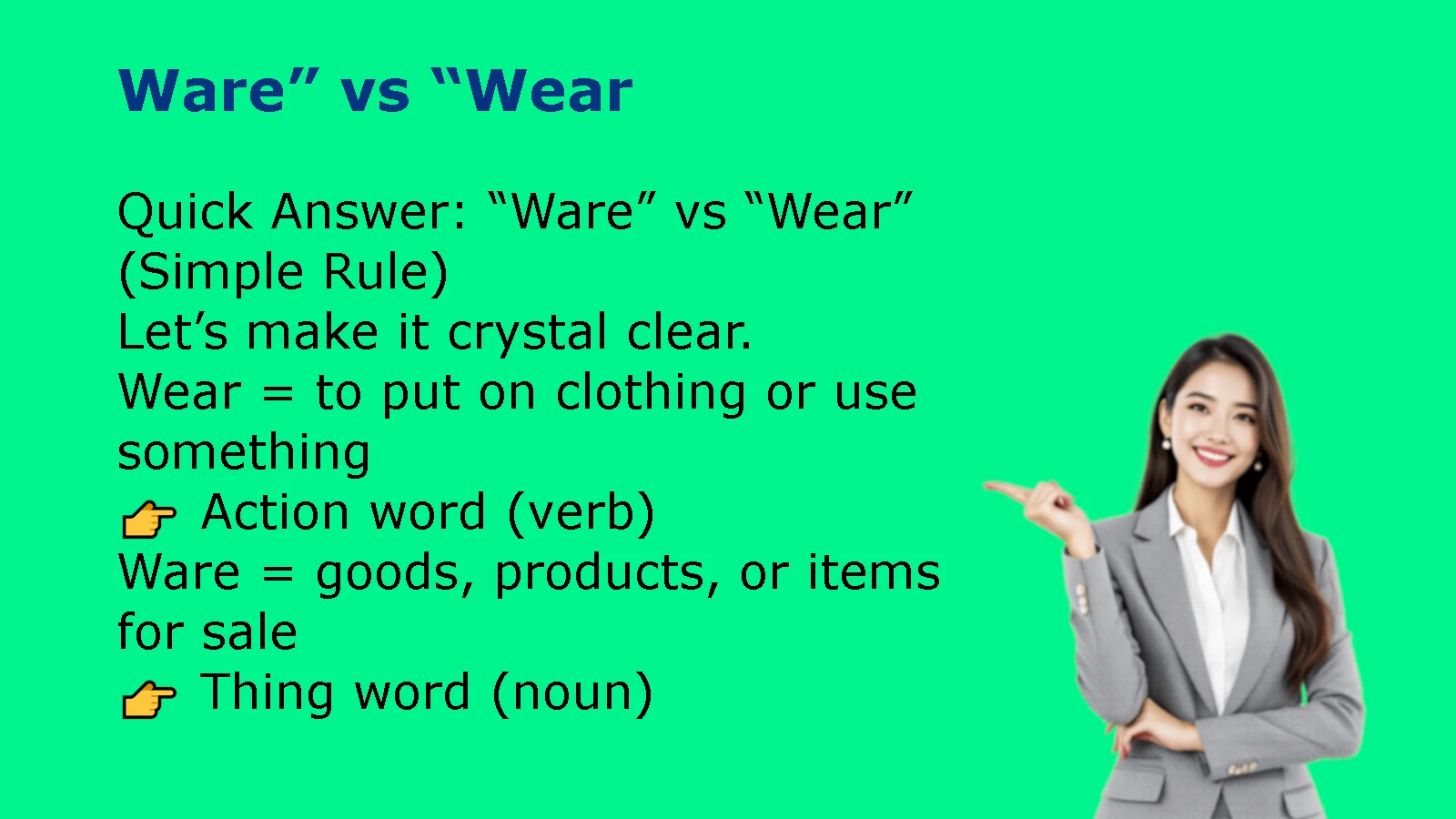
Quick Answer: “Ware” vs “Wear” (Simple Rule)
Let’s make it crystal clear.
Wear = to put on clothing or use something
👉 Action word (verb)
Ware = goods, products, or items for sale
👉 Thing word (noun)
Easy Memory Trick
Think like this:
- If you do it → wear
- If you sell it → ware
Or even simpler:
- You wear clothes
- You buy ware in a store
Why “Ware” vs “Wear” Confuses So Many People
This mistake happens for a very simple reason:
👉 They are homophones (same sound, different meaning)
But there’s more:
- English spelling is not always phonetic
- Autocorrect doesn’t always help
- People rely on pronunciation instead of meaning
So “wear” and “ware” get mixed up easily in writing.
“Wear” Explained Clearly (With Real Meaning)
Let’s start with the more common word.
Core Meaning of Wear
Wear = to have clothing, accessories, or items on your body
It is an action verb.
Everyday Examples of “Wear”
- I wear glasses every day.
- She wears a black jacket to work.
- They wore traditional clothes at the wedding.
- You should wear a helmet while riding.
Extended Uses of “Wear”
“Wear” is not only about clothes:
- Wear makeup → apply makeup
- Wear perfume → apply scent
- Wear a smile → expression
- Wear out → become damaged over time
Edge Case: “Wear” in Expressions
- “He wears many hats” → has many roles
- “Tiredness is wearing me down” → slowly affecting
👉 Key idea: Wear = action or usage on the body or condition
“Ware” Explained Clearly (With Real Meaning)
Now let’s switch to the tricky one.
Core Meaning of Ware
Ware = goods, products, or merchandise
It is a noun (thing).
Everyday Examples of “Ware”
- Kitchen ware includes plates and bowls.
- Glass ware is fragile.
- Software ware refers to programs (short for software/hardware context).
- The store sells handmade wares.
Plural Form: “Wares”
- Street vendor selling wares
- Market full of traditional wares
- Handmade artisan wares
👉 “Wares” = multiple goods/items
Where You Commonly See “Ware”
- Cookware
- Tableware
- Software
- Hardware
- Glassware
👉 Notice the pattern: types of products
The Biggest Difference (Simple Breakdown)
Here’s the core idea:
| Word | Meaning | Type | Example |
| Wear | To put on or use | Verb (action) | I wear shoes |
| Ware | Goods or products | Noun (thing) | Kitchen ware |
The Most Common Mistake People Make
Here’s where things go wrong:
❌ Incorrect:
- I like your new ware
- You should ware a jacket
✅ Correct:
- I like your new wear (wrong word actually—should be “clothes/outfit”)
- You should wear a jacket
Real Reason for Confusion
People assume:
“Same sound = same spelling logic”
But English does NOT work that way.
So pronunciation tricks the brain into spelling errors.
Real-Life Examples of “Wear” vs “Ware”
Everyday Use of “Wear”
- “What are you going to wear today?”
- “He always wears casual clothes.”
- “She wore a red dress.”
👉 Always about clothing or using something
Everyday Use of “Ware”
- “The kitchen ware section is upstairs.”
- “They sell handmade wares at the market.”
- “This software is open-source ware.”
👉 Always about items or products
Side-by-Side Comparison (Quick Scan Table)
| Feature | Wear | Ware |
| Part of speech | Verb | Noun |
| Meaning | To put on/use | Goods/items |
| Category | Action | Object |
| Example | wear a shirt | kitchen ware |
| Plural form | wears (rare) | wares |
Quick Trick to Never Confuse Them Again
Use this mental shortcut:
🧠 If you can DO it → WEAR
- wear clothes
- wear shoes
- wear glasses
🧠 If you can BUY it → WARE
- tableware
- cookware
- software
Real-World Confusion Example (Case Study)
A student wrote:
“I bought new fashion ware.”
The problem?
- “Ware” is incorrect here
- Correct sentence should be:
👉 “I bought new fashion wear.”
But even that is tricky—because the best version is:
👉 “I bought new clothes.”
Lesson:
When unsure, avoid “ware/wear” entirely and use a clearer word.
Professional Writing Tip
In formal writing:
- Prefer clear nouns
- clothes instead of wear
- products instead of ware
👉 This removes ambiguity completely.
FAQ: Ware vs Wear
Is “ware” ever used as a verb?
No. “Ware” is a noun only.
Is “wear” always about clothing?
Mostly yes, but it can also mean:
- wear makeup
- wear expression
- wear down (become weaker)
Why do people mix them up so often?
Because they sound identical but have different meanings and spellings.
Which one is more common?
“Wear” is far more common in everyday English.
Key Facts You Should Remember
- Wear = action (put on/use)
- Ware = product (thing/items)
- They sound the same but are unrelated
- Context decides meaning
- “Wear” is used much more often
Final Takeaway: The One Rule That Never Fails
Here’s the simplest way to remember it:
👉 If you are talking about clothing or using something → WEAR
👉 If you are talking about goods or products → WARE
And if you’re ever stuck?
Just replace the word in your head:
- If “put on” fits → wear
- If “items/products” fits → ware
Because in English, clarity always beats guesswork—and this small difference between “ware” vs “wear” can completely change your meaning.