Have you ever wondered whether Fair vs. Just means the same thing? These two words are often used interchangeably, but they represent different ideas when discussing equality, justice, and ethical decision-making.
The confusion is easy to understand. Both terms relate to treating people properly and making reasonable decisions. But here’s the kicker: a decision can be fair by applying the same rules to everyone, yet not be just if it fails to consider individual circumstances.
Many people struggle with this distinction in everyday language, workplace communication, legal discussions, and moral reasoning. Understanding the difference can help you express your thoughts more accurately and avoid common misunderstandings.
But don’t worry—it’s simpler than it sounds.
In this guide, you’ll learn the key differences between Fair vs. Just, how these concepts apply to fairness, equity, impartiality, and social justice, and when each word is the better choice. You’ll also see clear examples and practical comparisons that make the distinction easy to remember.
So if you’ve ever been unsure whether something should be described as fair or just, keep reading—this guide will help you use both terms with confidence.
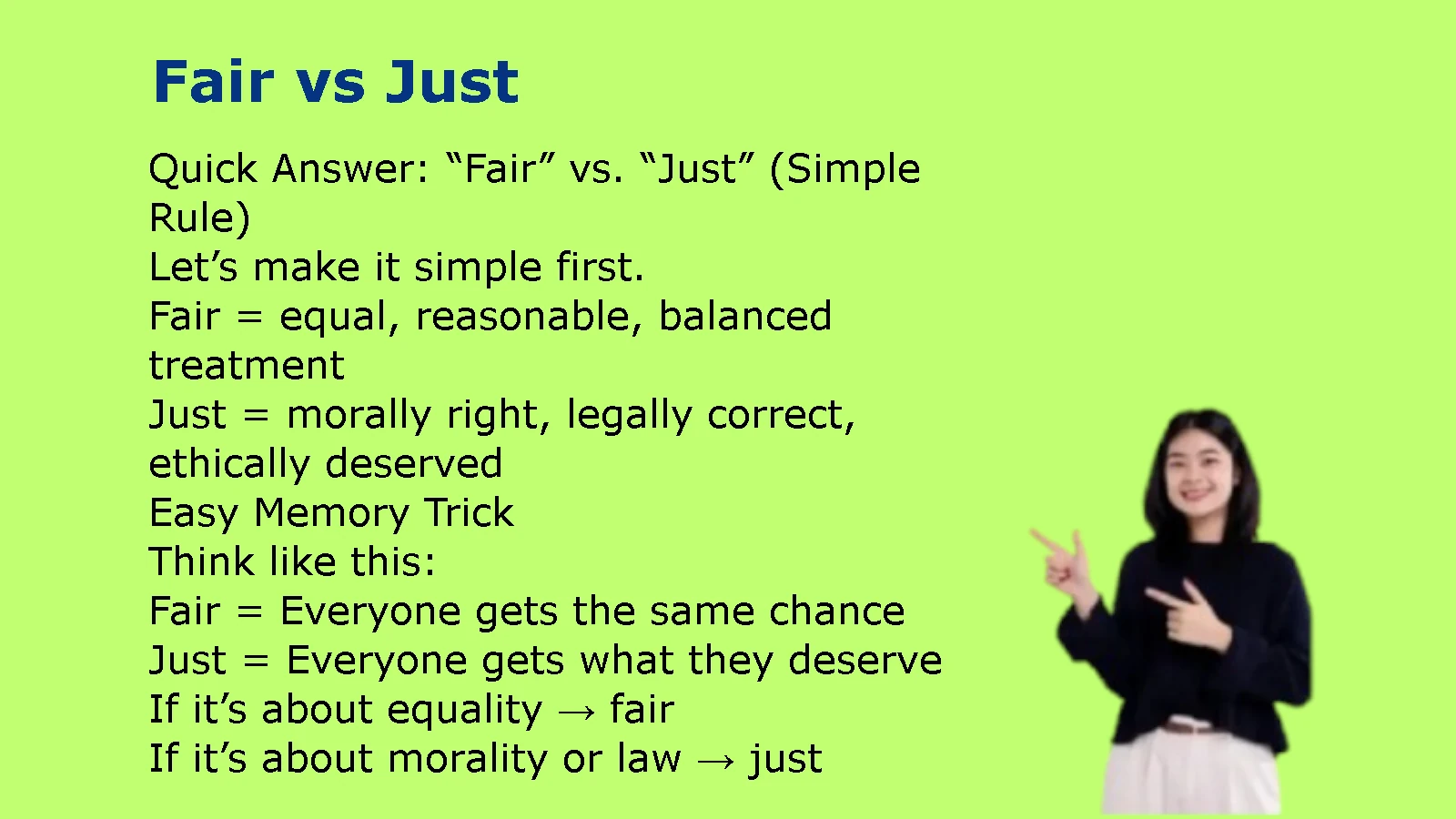
Quick Answer: “Fair” vs. “Just” (Simple Rule)
Let’s make it simple first.
Fair = equal, reasonable, balanced treatment
Just = morally right, legally correct, ethically deserved
Easy Memory Trick
Think like this:
- Fair = Everyone gets the same chance
- Just = Everyone gets what they deserve
If it’s about equality → fair
If it’s about morality or law → just
How People Actually Use “Fair” and “Just”
Here’s where things get interesting. In real life, people don’t separate these words cleanly.
Everyday Talk
- “That’s not fair!” → emotional reaction
- “That’s a just decision.” → more formal, serious tone
Arguments
People often say “fair” when they actually mean “just”
And they say “just” when they mean something feels morally correct
Why This Happens
- Both relate to “rightness”
- Context decides meaning more than grammar
- Emotional vs. logical thinking blends them together
The Core Idea Behind “Fair” vs. “Just”
To really understand this, you need to separate two systems of thinking.
Fair = Equality System
Focuses on balance and equal treatment.
Example idea:
Everyone gets the same portion, same chance, same rules.
Just = Moral System
Focuses on what is deserved or right.
Example idea:
Someone may get more or less depending on their actions.
“Fair” Explained Clearly (With Edge Cases)
At its core, fair means treating people equally or reasonably.
Standard Meaning
- Equal treatment
- No bias
- Balanced outcome
Real-Life Examples
- “It’s fair to split the bill equally.”
- “The teacher is fair to all students.”
- “Rules should be fair for everyone.”
Edge Case: Equal vs Fair Isn’t Always the Same
Sometimes equal treatment is NOT fair.
Example:
Two students:
- One studies 2 hours
- One studies 10 hours
Giving them identical rewards may feel “unfair” emotionally.
Key Insight
Fairness depends on perspective, not just math.
“Just” Explained Clearly (With Edge Cases)
Now let’s move to the stronger, heavier word.
Just = morally right or legally correct
Standard Meaning
- Based on justice
- Ethically right
- Legally proper
Real-Life Examples
- “It was a just punishment.”
- “The court made a just ruling.”
- “She fought for a just cause.”
Edge Case: What Is “Just” Isn’t Always “Fair”
A punishment can be:
- Just (deserved by law)
- But feel unfair emotionally
Example:
A strict law may punish someone harshly, even if circumstances feel sympathetic.
Key Insight
Just = system-based correctness, not emotional balance.
The Biggest Mistake People Make
Here’s the real confusion point:
People assume fair = just = same thing
But they are not.
What Goes Wrong
- Fair is emotional + social
- Just is moral + legal
- People mix them in debates
Real Scenario
A student says:
- “It’s not fair I got detention.”
Teacher replies:
- “It’s just because you broke the rule.”
Both are correct in their own system.
Side-by-Side Comparison Table
| Word | Core Meaning | Focus | Example Use | Risk of Confusion |
|---|---|---|---|---|
| Fair | Equal or reasonable | Balance & treatment | “That’s a fair deal.” | Medium |
| Just | Morally or legally right | Justice & ethics | “That was a just decision.” | High |
Real-Life Examples of “Fair”
Let’s make it practical.
Common Situations
- “It’s fair to share equally.”
- “That’s a fair price.”
- “The game was fair.”
What It Implies
- No bias
- Equal treatment
- Reasonable outcome
Real-Life Examples of “Just”
Now the stronger tone.
Common Situations
- “A just society protects the weak.”
- “The judge gave a just sentence.”
- “It was a just cause.”
What It Implies
- Moral correctness
- Ethical reasoning
- Legal justification
Philosophical and Real-World Difference
This is where things get deeper.
Fairness
- Social concept
- Based on equality
- Can change depending on situation
Justice
- Moral/legal concept
- Based on right vs wrong
- More fixed and principle-driven
How to Avoid Confusion Every Time
Here’s a simple system you can use.
Ask Yourself:
- Is this about equality? → Use fair
- Is this about morality or law? → Use just
Quick Test
- Splitting money → fair
- Court ruling → just
- School rules → depends on context
What to Say Instead (Clear Alternatives)
Instead of “fair”
- reasonable
- equal
- balanced
Instead of “just”
- morally right
- legally correct
- justified
Quick Decision Guide
When unsure:
- Equal treatment → fair
- Moral correctness → just
- Legal context → just
- Everyday balance → fair
If still unsure → explain the situation instead of using the word alone.
FAQ: “Fair” vs. “Just”
Are “fair” and “just” the same?
No. They overlap but are not identical.
Can something be fair but not just?
Yes—if it’s equal but morally wrong.
Can something be just but not fair?
Yes—if it’s legally correct but feels unequal.
Which is more formal?
“Just” is more formal and serious.
Case Study: Workplace Conflict
A company divides bonuses equally among employees.
- Some worked harder than others
- Everyone gets the same amount
Reaction
- Employees say: “That’s not fair.”
- Management says: “It’s a just policy.”
Outcome
- Fairness questioned (effort ignored)
- Justice defended (policy applied equally)
Key Facts You Should Remember
- Fair = equality and balance
- Just = morality and justice
- Fair is flexible
- Just is principle-based
- Context decides usage
Final Takeaway: The One Rule That Never Fails
Here’s the simplest way to lock it in:
Fair is about treating people the same.
Just is about doing what is morally right.
They often overlap, but they don’t always match.
So next time you’re stuck, don’t guess—ask:
Am I talking about equality or justice?
That one question will keep you from mixing them up again.