Have you ever paused mid-sentence wondering whether to use Nobody vs. No One? These two words look interchangeable, but in reality, they carry subtle differences that can affect tone, clarity, and even writing style.
The confusion is completely normal. Both words mean “not a single person,” yet they are used differently in casual speech, formal writing, and stylistic contexts. And here’s the kicker: choosing the wrong one doesn’t usually break grammar rules—but it can make your writing feel less natural.
Many writers, students, and English learners struggle with this because both nobody and no one appear in similar contexts. However, understanding their usage helps you sound more fluent, confident, and precise in communication.
But don’t worry—this becomes easy once you see the pattern.
In this guide, you’ll learn the key differences between Nobody vs. No One, when to use each expression, and how tone and formality influence your choice. You’ll also get simple examples and usage tips to make everything crystal clear.
So if you’ve ever hesitated between these two words, keep reading—this guide will clear the confusion once and for all.
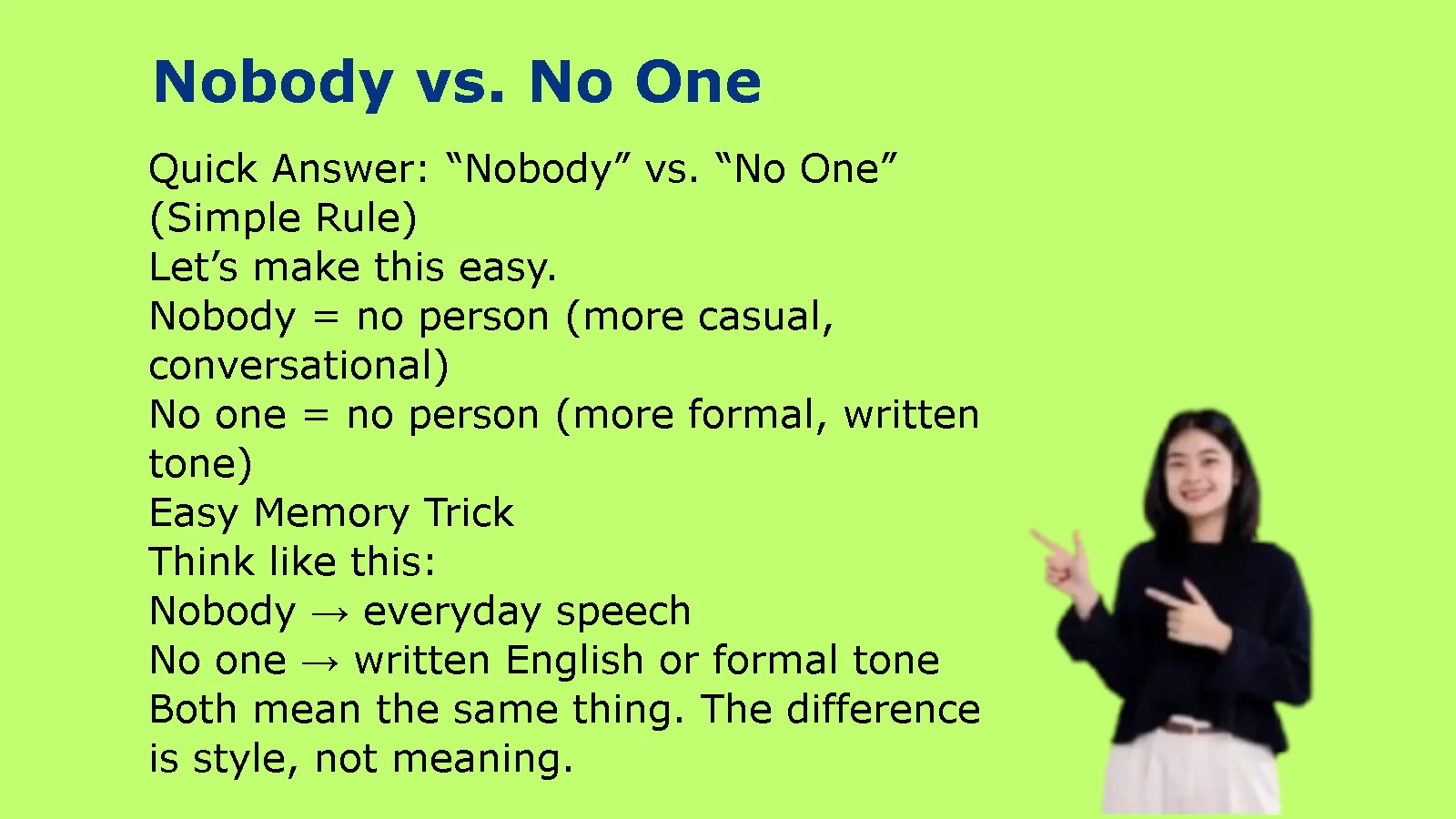
Quick Answer: “Nobody” vs. “No One” (Simple Rule)
Let’s make this easy.
Nobody = no person (more casual, conversational)
No one = no person (more formal, written tone)
Easy Memory Trick
Think like this:
- Nobody → everyday speech
- No one → written English or formal tone
Both mean the same thing. The difference is style, not meaning.
How People Actually Use “Nobody” and “No One”
This is where things start to feel less strict.
English doesn’t force a hard rule here. Instead, usage depends on tone, region, and personal preference.
In Casual Conversations
People almost always say:
- “Nobody knows.”
- “Nobody came.”
Why? It’s shorter and smoother in speech.
In Writing or Formal Contexts
You’ll often see:
- “No one was available.”
- “No one responded to the email.”
Why? It looks cleaner and slightly more formal on paper.
Why This Happens
- Spoken English prefers shorter, punchier words
- Written English often leans toward slightly more formal structure
- Both forms are equally grammatically correct
The Grammar Logic Behind “Nobody” vs. “No One”
Let’s break it down simply.
Both words are indefinite pronouns meaning “zero people.”
Core Meaning
- Nobody = not any person
- No one = not a single person
Important Insight
There is no difference in quantity or meaning—only in style and rhythm.
“Nobody” Explained Clearly (With Edge Cases)
“Nobody” is the more informal, conversational version.
Standard Meaning
- “Nobody came to the party.” → Zero people came
- “Nobody understands me.” → No person understands
Why It Feels More Natural in Speech
- Shorter word (2 syllables vs 2 words)
- Easier flow in conversation
- Common in storytelling and dialogue
Edge Case: Emphasis
“Nobody” can sound slightly stronger or more emotional:
- “Nobody cares!” → feels expressive, dramatic
Key Takeaway
Use “nobody” when speaking naturally or writing casually.
“No One” Explained Clearly (With Edge Cases)
Now let’s look at the more structured version.
Standard Meaning
- “No one was home.”
- “No one answered the question.”
Why Writers Like It
- Looks cleaner in formal writing
- Slightly more neutral tone
- Preferred in academic or professional contexts
Edge Case: Spacing Matters
- “No one” (correct)
- “Noone” (incorrect in standard English)
Key Insight
“No one” feels more precise and slightly more formal, even though meaning stays the same.
The Biggest Mistake People Make
Here’s where confusion usually happens.
People think “nobody” and “no one” have different meanings.”
They don’t.
What Goes Wrong
- Writers try to assign different logic to each
- Learners overthink usage differences
- Result: hesitation and inconsistency
Real Example
Both of these are correct:
- “Nobody came to the meeting.”
- “No one came to the meeting.”
There is no difference in meaning—only tone.
Side-by-Side Comparison Table
Here’s a quick visual guide:
| Word | Meaning | Tone Level | Best Use Case |
|---|---|---|---|
| Nobody | No person | Casual | Speech, informal writing |
| No one | No person | Neutral/Formal | Emails, essays, reports |
Real-Life Examples of “Nobody”
Let’s make it practical.
Common Situations
- “Nobody called me today.”
- “Nobody knows the answer.”
- “Nobody showed up.”
What It Feels Like
Natural, emotional, conversational.
Mini Scenario
You’re talking to a friend:
“Guess what? Nobody remembered my birthday.”
This feels completely natural in spoken English.
Real-Life Examples of “No One”
Now compare the formal tone.
Common Situations
- “No one was available for the interview.”
- “No one responded to the survey.”
- “No one entered the room.”
What It Feels Like
Neutral, structured, slightly formal.
Mini Scenario
In an email:
“No one from the team has replied yet.”
This fits professional communication better.
Regional and Style Differences
English usage can vary slightly by region and context.
American English
- “Nobody” is more common in speech
- “No one” is common in writing
British English
- Both are used frequently
- “No one” may appear slightly more formal
Global English
- Both are universally understood
- Choice depends on tone, not grammar rules
How to Avoid Confusion Every Time
Here’s a simple decision system.
Use “Nobody” when:
- Speaking
- Writing casually
- Creating dialogue or storytelling
Use “No one” when:
- Writing emails
- Writing essays or reports
- Keeping a neutral tone
Quick Rule
If it sounds like speech → nobody
If it looks like writing → no one
What to Say Instead (Style Alternatives)
If you want variety or precision, try these:
Alternatives
- “Not a single person”
- “No person”
- “Not anyone”
Example Rewrites
- “Nobody came.” → “Not a single person came.”
- “No one knows.” → “Not anyone knows.”
When to Use Them
- Emphasis
- Formal writing
- Creative writing
Quick Decision Guide (Use This Instantly)
Still unsure? Use this:
- Talking or casual writing → Nobody
- Formal writing → No one
- Want maximum neutrality → No one
Simple. Clean. No stress.
FAQ: “Nobody” vs. “No One”
Are “nobody” and “no one” exactly the same?
Yes. They have identical meanings.
Is “no one” more formal than “nobody”?
Slightly, yes—but not dramatically.
Can I use both in one article?
Yes. Many writers do for style variation.
Is “noone” correct?
No. It is considered incorrect in standard English.
Key Facts You Should Remember
- “Nobody” = casual, spoken English
- “No one” = slightly formal, written English
- Meaning is identical
- Choice depends on tone, not grammar rules
- Both are fully correct
Final Takeaway: The One Rule That Never Fails
Here’s the truth.
English often gives you multiple correct options—and this is one of them. The difference between “nobody” and “no one” isn’t about correctness. It’s about style.
So keep it simple:
- If it feels natural in speech → Nobody
- If it looks better in writing → No one
Because in real communication, clarity matters more than overthinking small differences.