Ever wondered why some people use Protagonist vs. Antagonist interchangeably, even though they play completely different roles in a story? Understanding the difference between these two literary terms is essential for anyone studying literature, writing fiction, or analyzing characters.
The confusion is understandable. Both characters are central to the plot, and many readers struggle to identify who is driving the story and who is creating the conflict. And here’s the kicker: an antagonist isn’t always a villain, and a protagonist isn’t always a hero.
But don’t worry—once you understand their roles, the distinction becomes much clearer.
In this guide, you’ll learn the key differences between Protagonist vs. Antagonist, how each contributes to character development, story structure, and plot conflict, and why they are both essential to compelling storytelling. You’ll also discover examples from literature, movies, and popular fiction that make these concepts easy to understand.
Whether you’re a student, writer, or book lover, this breakdown will help you confidently identify the main character, understand the opposing force, and analyze stories like a pro. Let’s dive in.
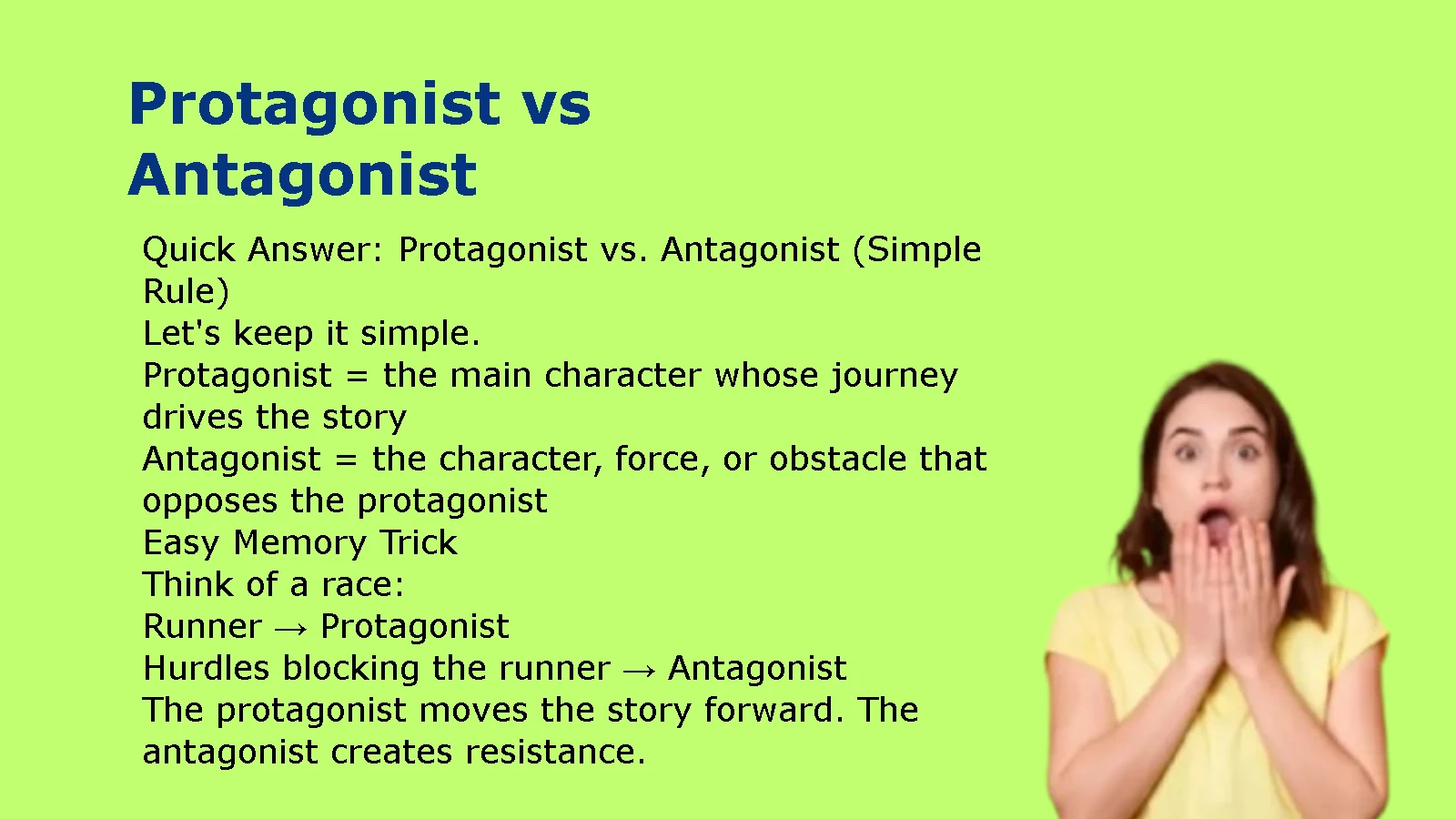
Quick Answer: Protagonist vs. Antagonist (Simple Rule)
Let’s keep it simple.
Protagonist = the main character whose journey drives the story
Antagonist = the character, force, or obstacle that opposes the protagonist
Easy Memory Trick
Think of a race:
- Runner → Protagonist
- Hurdles blocking the runner → Antagonist
The protagonist moves the story forward. The antagonist creates resistance.
How People Actually Use “Protagonist” and “Antagonist”
This is where confusion begins.
Many people use these terms as synonyms for:
- Hero = Protagonist
- Villain = Antagonist
While that sometimes works, it’s not always correct.
In Everyday Discussions
People often say:
- “The protagonist is the good guy.”
- “The antagonist is the bad guy.”
This oversimplifies storytelling.
In Literature and Film
Writers define these roles based on function, not morality.
A protagonist can be morally flawed.
An antagonist can be morally justified.
Why This Happens
People naturally connect:
- Main character with heroism
- Opposition with villainy
But stories are often more complex than that.
The Story Logic Behind Protagonist vs. Antagonist
To understand the difference, focus on roles rather than personality.
Think in Terms of Conflict
Story Begins
↓
Protagonist Wants Something
↓
Antagonist Creates Resistance
↓
Conflict Develops
↓
Story Resolves
Key Insight
The protagonist creates the goal.
The antagonist creates the challenge.
Without either one, there is no meaningful story.
What Is a Protagonist?
A protagonist is the central character whose actions and decisions drive the narrative.
Standard Definition
The protagonist:
- Receives the most focus
- Has major goals
- Experiences the main character arc
- Influences the story’s outcome
Common Traits
Many protagonists are:
- Determined
- Ambitious
- Relatable
- Dynamic
However, these traits are not required.
Key Takeaway
The protagonist is simply the story’s primary focus.
Being good is optional.
What Is an Antagonist?
An antagonist is the force that stands in the way of the protagonist’s goals.
Standard Definition
The antagonist:
- Creates obstacles
- Generates conflict
- Challenges the protagonist
- Raises the stakes
Important Detail
An antagonist isn’t always a person.
It can be:
- Nature
- Society
- A system
- Fear
- Illness
- The protagonist’s own mind
Key Takeaway
An antagonist is whatever prevents the protagonist from achieving their objective.
The Biggest Mistake People Make
Here’s the most common misunderstanding.
People assume:
Protagonist = Hero
Antagonist = Villain
That’s not always true.
What Goes Wrong
Stories can feature:
- Criminal protagonists
- Noble antagonists
- Morally gray characters
Example
A thief trying to pull off a heist may be the protagonist.
The police officer trying to stop the crime may be the antagonist.
Who is morally right?
Probably the officer.
Who is the protagonist?
Still the thief.
Lesson
Story role and moral alignment are different things.
Side-by-Side Comparison Table
| Feature | Protagonist | Antagonist |
|---|---|---|
| Main role | Drives the story | Creates resistance |
| Story focus | Primary focus | Secondary focus |
| Goal | Wants something | Blocks or challenges that goal |
| Screen/page time | Usually more | Usually less |
| Must be good? | No | No |
| Can be a force? | Rarely | Yes |
Real-Life Examples of Protagonists
Let’s look at familiar examples.
Common Examples
- Harry Potter in the Harry Potter books
- The Hunger Games protagonist Katniss Everdeen
- The Wolf of Wall Street protagonist Jordan Belfort
What They Share
They are the characters whose journeys audiences primarily follow.
Real-Life Examples of Antagonists
Now compare.
Common Examples
- Lord Voldemort opposes Harry Potter
- President Snow opposes Katniss
- The ocean in The Old Man and the Sea acts as a major opposing force
What They Share
Each creates conflict that the protagonist must overcome.
Can a Story Have Multiple Antagonists?
Absolutely.
Many stories contain several opposing forces.
Example Structure
Main Character
↓
Primary Antagonist
↓
Secondary Antagonists
↓
Environmental Challenges
Example
A character might face:
- A rival
- A corrupt government
- Personal fears
All three can function as antagonistic forces.
Key Insight
Stories often use layers of conflict rather than a single enemy.
Can the Protagonist Be the Villain?
Yes.
This is one of the most misunderstood aspects of storytelling.
Examples
Some stories focus on:
- Criminals
- Con artists
- Dictators
- Antiheroes
These characters drive the narrative despite questionable morality.
Why Writers Do This
It creates:
- Complexity
- Tension
- Psychological depth
Key Takeaway
The protagonist is not automatically the “good guy.”
Types of Antagonists
Not all antagonists look the same.
Villain Antagonist
A traditional enemy.
Example:
- Voldemort
Society Antagonist
The protagonist battles cultural norms or institutions.
Nature Antagonist
Storms, disasters, wilderness, or survival situations.
Internal Antagonist
Fear, guilt, addiction, or self-doubt.
Key Insight
Sometimes the greatest enemy exists inside the protagonist.
Why Every Story Needs Conflict
Conflict is the engine of storytelling.
Without conflict:
- No tension
- No growth
- No stakes
- No suspense
Simple Formula
Protagonist + Goal + Obstacle = Story
Remove the obstacle and the narrative becomes flat.
How to Identify the Protagonist Instantly
Ask yourself these questions:
Who Gets the Most Attention?
That person is usually the protagonist.
Whose Goal Drives the Plot?
The answer is often the protagonist.
Whose Perspective Matters Most?
Stories generally prioritize the protagonist’s viewpoint.
Quick Tip
Follow the journey, not the morality.
How to Identify the Antagonist Instantly
Now ask:
Who Opposes the Main Goal?
That’s usually the antagonist.
What Creates the Most Conflict?
That force likely serves as the antagonist.
What Must Be Overcome?
The answer often reveals the antagonist.
Common Protagonist vs. Antagonist Examples
| Story | Protagonist | Antagonist |
|---|---|---|
| Harry Potter | Harry Potter | Voldemort |
| The Hunger Games | Katniss Everdeen | President Snow |
| The Lion King | Simba | Scar |
| Cinderella | Cinderella | Stepmother |
| Sherlock Holmes Stories | Sherlock Holmes | Various opposing forces |
Quick Decision Guide (Use This Instantly)
When you’re unsure:
Ask Question #1
Who is the story mainly about?
Answer = Protagonist
Ask Question #2
Who or what opposes that character?
Answer = Antagonist
Still Unsure?
Ignore good versus evil.
Focus only on conflict.
FAQ: Protagonist vs. Antagonist
Is the protagonist always the hero?
No. A protagonist can be morally flawed, selfish, or even criminal.
Is the antagonist always the villain?
No. An antagonist may have noble motives and still oppose the protagonist.
Can there be more than one antagonist?
Yes. Stories often include multiple antagonistic forces.
Can nature be an antagonist?
Absolutely. Storms, oceans, deserts, and disasters frequently serve as antagonists.
Can someone be both protagonist and antagonist?
In stories involving self-conflict, a character’s own flaws can act as an internal antagonist.
Case Study: Why Understanding the Difference Matters
Imagine a film about a hacker exposing government corruption.
The hacker breaks laws.
The government agent tries to stop them.
What Many Viewers Assume
- Hacker = hero
- Agent = villain
Story Reality
- Hacker = protagonist
- Agent = antagonist
The labels come from their narrative roles, not their morality.
Lesson
The protagonist drives the story.
The antagonist creates resistance.
Everything else is secondary.
Key Facts You Should Remember
- The protagonist is the main character.
- The antagonist opposes the protagonist.
- Neither role depends on morality.
- A protagonist can be a villain.
- An antagonist can be a hero.
- Conflict defines these roles.
- Stories often include multiple antagonists.
- Antagonists can be people, systems, nature, or internal struggles.
Final Takeaway: The One Rule That Never Fails
Here’s the simplest way to remember protagonist vs. antagonist.
The protagonist is the character whose journey you follow.
The antagonist is the force standing in that character’s way.
That’s it.
Don’t focus on who’s good or bad. Focus on who drives the story and who creates the conflict.
Think of it like a road trip. The protagonist is the driver heading toward a destination. The antagonist is the traffic, detour, storm, or rival trying to stop that journey.
Once you understand that idea, you’ll never confuse a protagonist and antagonist again.