You’ve probably seen both words a thousand times: breath and breathe. They look almost identical, so it’s no surprise people mix them up. Even fluent English speakers pause for a second sometimes—“Is it breathe or breath here?”
The confusion is normal. The difference is actually very simple, but English makes it tricky because one is a noun and the other is a verb, and the spelling change is subtle but important.
In this guide, you’ll learn the difference clearly, with examples, memory tricks, and real-life usage so you never mix them up again.
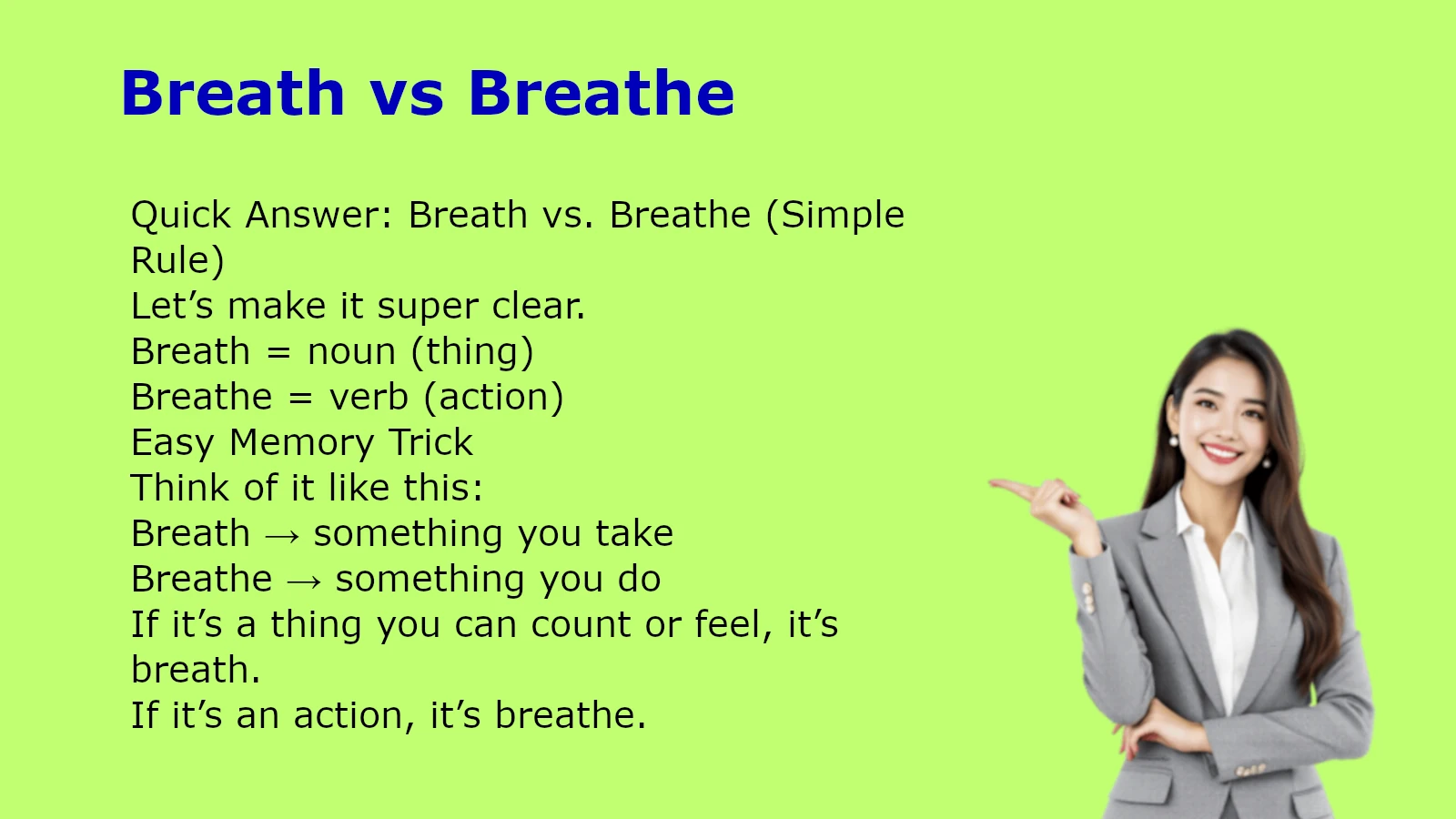
Quick Answer: Breath vs. Breathe (Simple Rule)
Let’s make it super clear.
Breath = noun (thing)
Breathe = verb (action)
Easy Memory Trick
Think of it like this:
- Breath → something you take
- Breathe → something you do
If it’s a thing you can count or feel, it’s breath.
If it’s an action, it’s breathe.
Why “Breath” and “Breathe” Are So Confusing
The main problem is pronunciation and spelling.
They look similar, but:
- “Breath” ends with a soft “th”
- “Breathe” has a long “ee” sound
But in fast speech, they sound very close, so people rely on spelling—and that’s where mistakes happen.
Another reason:
English often creates noun/verb pairs that are nearly identical (like advice/advise, practice/practise).
“Breath” Explained Clearly (Noun)
Breath = the air you take in and let out
It is a thing, not an action.
Simple Examples
- “Take a deep breath before speaking.”
- “His breath smelled like coffee.”
- “Hold your breath for 10 seconds.”
What it represents
Think of breath as a single unit of air.
You can:
- take a breath
- hold a breath
- lose your breath
But you don’t “do breath”—you use it.
“Breathe” Explained Clearly (Verb)
Breathe = the action of taking air in and out
It is something you do, not something you “have.”
Simple Examples
- “Don’t forget to breathe slowly.”
- “She couldn’t breathe underwater.”
- “Just breathe and relax.”
What it represents
Think of breathe as a process happening over time.
You:
- breathe in
- breathe out
- breathe deeply
It always involves action.
The Spelling Trick That Makes It Easy Forever
Here’s the simplest way to never confuse them again:
Trick 1: The “E = Action” Rule
Words ending in -e often show action:
- breathe → action (verb)
Trick 2: The “Extra E = Extra Effort”
The extra “e” in breathe reminds you:
👉 it takes effort → it’s something you do
Trick 3: Drop the E Test
Try removing the final “e”:
- breathe → breath (noun form appears)
So:
- breathe = action
- breath = thing
Side-by-Side Comparison Table
| Word | Type | Meaning | Example |
|---|---|---|---|
| Breath | Noun | Air you take in/out | Take a breath |
| Breathe | Verb | To take air in/out | Breathe deeply |
Real-Life Examples of “Breath”
Let’s see how breath is used naturally:
Everyday Situations
- “I need a moment to catch my breath.”
- “Her breath froze in the cold air.”
- “He took one last breath before diving.”
Key Idea
It always refers to something physical—air as a “thing.”
Real-Life Examples of “Breathe”
Now compare with breathe:
Everyday Situations
- “Just breathe and stay calm.”
- “He learned how to breathe properly during meditation.”
- “I can’t breathe in this crowded room.”
Key Idea
It always refers to an action or process.
The Biggest Mistake People Make
Here’s where most confusion happens:
People write breath when they mean breathe.
Common Errors
❌ “I can’t breath properly.”
✔ “I can’t breathe properly.”
❌ “Take a deep breathe.”
✔ “Take a deep breath.”
Why it happens
Because pronunciation is similar, people guess the spelling.
Quick Scenario (Real-Life Confusion)
Imagine a gym trainer saying:
“Focus on your breath.”
He means:
👉 the air you are taking in (noun)
Now compare:
“Focus on how you breathe.”
He means:
👉 the way you are doing the action (verb)
Same situation. Different meaning. Small spelling change. Big difference.
Medical & Fitness Context (Important Usage)
This is where the distinction really matters.
In Fitness
- “Control your breath during exercise.” (noun)
- “Learn to breathe properly while running.” (verb)
In Medicine
- “His breath is shallow.” (noun)
- “He struggles to breathe.” (verb)
Incorrect usage here can cause real misunderstanding.
Quick Decision Guide (Use Instantly)
When you’re stuck, ask:
- Is it a thing? → breath
- Is it an action? → breathe
Still unsure? Replace it with:
- “air” → breath
- “to inhale/exhale” → breathe
FAQ: Breath vs. Breathe
Is “breath” a verb?
No. “Breath” is always a noun.
Why is “breathe” spelled with an “e” at the end?
To show it is an action (verb form).
Can I use them interchangeably?
No. They have different grammar roles and meanings.
Which one is more common?
“Breathe” is more commonly used because it describes an action.
Final Takeaway: The One Rule That Never Fails
Here’s the simplest way to lock it in:
Breath = thing (noun)
Breathe = action (verb)
If you can do it, it’s breathe.
If you can take it, it’s breath.
And when in doubt, slow down and think:
Is this something I do or something I take?
Because when it comes to breath vs. breathe, one extra letter changes everything.