Have you ever wondered whether Bacteriums vs Bacteria refers to two different types of microorganisms or simply different forms of the same word? This is a common confusion in English vocabulary, especially because both terms relate to tiny living organisms studied in biology, microbiology, and health sciences. Although they look similar, understanding the difference between bacteriums and bacteria helps improve scientific accuracy, writing clarity, and proper word usage.
In simple terms, bacteria is the correct and widely accepted plural form of bacterium, which refers to a single microscopic organism. The word bacterium describes one individual member of a group of prokaryotic microorganisms, while bacteria refers to two or more of these organisms. For example, a scientist may observe one bacterium under a microscope but study millions of bacteria in a sample.
The term bacteriums is rarely used and is generally considered an incorrect plural form in standard English. This confusion happens because many English words form plurals by adding “s”, but words borrowed from Latin often follow different plural patterns. Similar examples include criterion and criteria or phenomenon and phenomena, where the original language influences modern English usage.
Understanding the difference between bacterium, bacteria, and the uncommon form bacteriums is important for students, researchers, writers, and anyone interested in science terminology. Whether you are writing a biology report, reading a scientific article, or learning medical vocabulary, using the correct term makes your communication more precise.
In this guide, you will learn the clear difference between bacteriums vs bacteria, their meanings, grammar rules, correct usage examples, and easy memory tips to help you avoid this common English mistake.
Quick Answer: Bacteriums vs Bacteria
If you’re in a hurry, here’s the answer.
- Bacterium = One microscopic organism
- Bacteria = More than one microscopic organism
- Bacteriums = A rare English plural that is generally avoided in modern writing
The word bacteria comes directly from Latin and has remained the accepted plural in biology, medicine, education, and everyday English. While English often forms plurals by adding -s or -es, many scientific terms retain their original Latin or Greek endings.
Quick Comparison
| Feature | Bacteriums | Bacteria |
| Standard English | ❌ Generally nonstandard | ✅ Yes |
| Scientific Writing | ❌ Almost never used | ✅ Always preferred |
| Academic Papers | ❌ Avoid | ✅ Correct |
| Medical Writing | ❌ Avoid | ✅ Correct |
| Everyday English | ❌ Rare | ✅ Common |
| Recommended Usage | ❌ No | ✅ Yes |
Quick Example
✅ Correct: The bacteria spread quickly across the surface.
❌ Incorrect: The bacteriums spread quickly across the surface.
What Does “Bacteria” Mean?
The word bacteria refers to a group of tiny, single-celled microorganisms that exist almost everywhere on Earth. Some bacteria help humans stay healthy, while others can cause disease.
These microscopic organisms are among the oldest forms of life on the planet. Scientists estimate that bacteria have existed for more than 3.5 billion years, long before plants, animals, or humans appeared.
Definition of Bacteria
Bacteria are microscopic organisms that consist of a single cell and reproduce primarily through binary fission. They inhabit soil, water, air, food, and living organisms.
Despite their reputation for causing illness, most bacteria are either harmless or beneficial.
For example:
- Helpful bacteria aid digestion.
- Some bacteria produce vitamins inside your body.
- Others help recycle nutrients in nature.
- Certain bacteria are used to make yogurt and cheese.
Without bacteria, many ecosystems simply wouldn’t function.
Is Bacteria Singular or Plural?
This is one of the biggest grammar questions people ask.
Traditionally, bacteria is plural.
The singular form is bacterium.
Think of it like these word pairs:
| Singular | Plural |
| bacterium | bacteria |
| criterion | criteria |
| datum | data |
| medium | media |
| curriculum | curricula |
Each follows a similar Latin pattern that English has preserved.
Correct Examples
- The bacterium was visible under the microscope.
- Scientists identified one harmful bacterium.
- The bacteria multiplied overnight.
- Helpful bacteria improve soil quality.
- The patient’s gut contains billions of bacteria.
Notice how bacterium always refers to one organism, while bacteria refers to two or more.
Everyday Examples of Bacteria
You probably encounter bacteria every day without realizing it.
For example:
- Your skin hosts millions of harmless bacteria.
- Your mouth contains hundreds of bacterial species.
- Your intestines contain trillions of beneficial bacteria.
- Fresh soil is packed with bacteria that help plants grow.
- Fermented foods rely on bacteria during production.
Even a clean kitchen contains naturally occurring bacteria. Good hygiene helps control harmful species, but it doesn’t eliminate every bacterium.
What Does “Bacterium” Mean?
The word bacterium refers to one individual bacterial cell.
Scientists use this term whenever they discuss a single microorganism instead of a population.
Definition
A bacterium is a microscopic, single-celled organism that lacks a nucleus and belongs to the domain Bacteria.
Unlike human or plant cells, bacterial cells don’t contain membrane-bound organelles. Instead, their genetic material floats freely inside the cell.
Although they’re incredibly small, bacteria perform essential roles in nearly every ecosystem.
When Should You Use Bacterium?
Use bacterium whenever you’re talking about only one organism.
Common situations include:
- Biology textbooks
- Laboratory reports
- Scientific research
- Medical discussions
- Classroom assignments
Correct Examples
- The scientist isolated one bacterium from the sample.
- Each bacterium divided into two new cells.
- The harmful bacterium infected the wound.
- This bacterium survives in extremely hot environments.
- A single bacterium can reproduce rapidly under favorable conditions.
Notice that each sentence refers to one organism.
Why Scientists Prefer Precision
Science depends on precision.
Imagine a doctor writing:
“One bacteria caused the infection.”
That statement is grammatically incorrect because bacteria is plural.
Instead, the report should say:
“One bacterium caused the infection.”
Even small grammar mistakes can change the meaning of scientific writing. That’s why textbooks and research papers consistently distinguish between bacterium and bacteria.
Is “Bacteriums” a Real Word?
This is where many people become confused.
Technically, bacteriums has appeared in English writing over the years. Some dictionaries acknowledge it as a possible English plural, but they also note that it is rare and far less common than bacteria.
In modern English, especially in science, medicine, education, and journalism, writers almost always choose bacteria instead.
Why Do People Say “Bacteriums”?
English speakers naturally expect plurals to end in -s.
For example:
- Dog → Dogs
- Cat → Cats
- Computer → Computers
- Student → Students
Following that familiar pattern, some people assume:
- Bacterium → Bacteriums
The logic makes sense, but English includes many borrowed words that keep their original plural forms.
Examples include:
| Singular | Standard Plural |
| fungus | fungi |
| nucleus | nuclei |
| alumnus | alumni |
| syllabus | syllabi (or syllabuses) |
| bacterium | bacteria |
Because bacteria has been the accepted plural for centuries, there’s little reason to replace it with bacteriums.
Is Bacteriums Wrong?
In everyday conversation, most people will understand what you mean if you say bacteriums.
However, understanding isn’t the same as correctness.
If you’re writing:
- a school paper
- a research article
- a business report
- a healthcare document
- a website
- educational content
you should choose bacteria.
Doing so aligns your writing with modern dictionaries, scientific literature, style guides, and reader expectations.
Why English Uses “Bacteria” Instead of “Bacteriums”
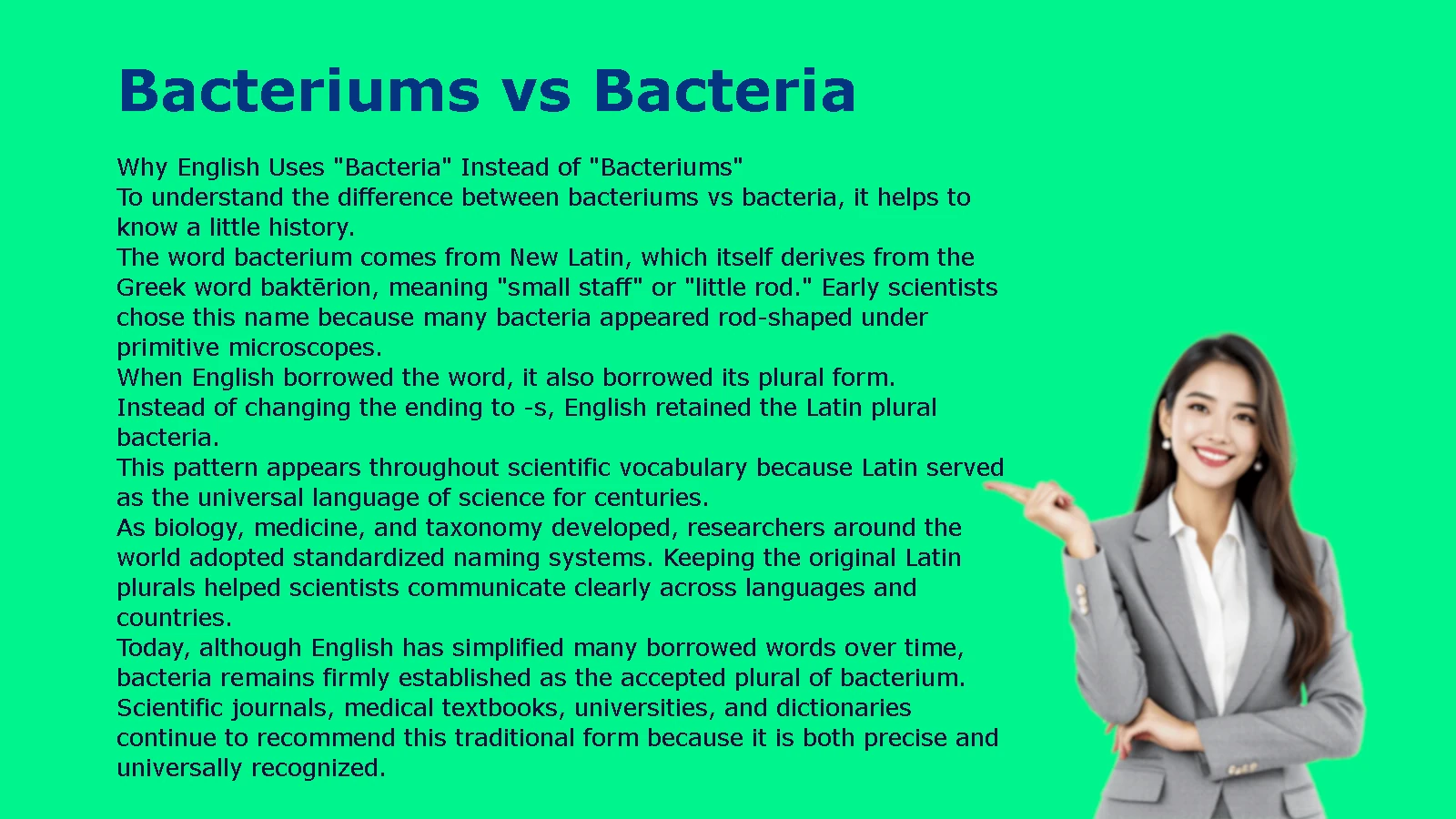
To understand the difference between bacteriums vs bacteria, it helps to know a little history.
The word bacterium comes from New Latin, which itself derives from the Greek word baktērion, meaning “small staff” or “little rod.” Early scientists chose this name because many bacteria appeared rod-shaped under primitive microscopes.
When English borrowed the word, it also borrowed its plural form.
Instead of changing the ending to -s, English retained the Latin plural bacteria.
This pattern appears throughout scientific vocabulary because Latin served as the universal language of science for centuries.
As biology, medicine, and taxonomy developed, researchers around the world adopted standardized naming systems. Keeping the original Latin plurals helped scientists communicate clearly across languages and countries.
Today, although English has simplified many borrowed words over time, bacteria remains firmly established as the accepted plural of bacterium. Scientific journals, medical textbooks, universities, and dictionaries continue to recommend this traditional form because it is both precise and universally recognized.
Continue with Part 2, where we’ll cover Bacterium vs Bacteria Explained Simply, a detailed side-by-side comparison, dictionary definitions, scientific usage, common mistakes, real-world examples, and an easy memory trick to help you remember the difference forever.
Continue with Part
Bacterium vs Bacteria Explained Simply
If you only remember one rule from this guide, make it this:
- Bacterium = one
- Bacteria = more than one
Think about these sentences:
- There is one bacterium in the microscope slide.
- There are millions of bacteria in the sample.
The pattern is straightforward once you know that bacteria is an irregular plural borrowed from Latin.
A Simple Analogy
Imagine you’re talking about apples.
- One apple
- Two apples
Now replace apple with bacterium.
- One bacterium
- Two bacteria
Although the plural looks different, the idea is exactly the same.
Singular and Plural at a Glance
| Number | Correct Word | Example |
| One | Bacterium | One bacterium was identified. |
| Two | Bacteria | Two bacteria were isolated. |
| Many | Bacteria | Billions of bacteria live in the human gut. |
Bacteriums vs Bacteria: Side-by-Side Comparison
Choosing between bacteriums and bacteria becomes much easier when you compare them directly.
| Feature | Bacteriums | Bacteria |
| Standard English | Rare and generally nonstandard | Standard plural |
| Scientific Acceptance | Not recommended | Universally accepted |
| Used in Medical Literature | Rare | Yes |
| Found in Biology Textbooks | Almost never | Yes |
| Preferred by Editors | No | Yes |
| Safe Choice for Writing | No | Yes |
The Verdict
If you’re writing for school, work, or publication, bacteria is the clear winner.
Using bacteria demonstrates that you understand both the grammar and the scientific convention behind the word.
Why the Difference Matters
At first glance, this might seem like a small grammar issue. In reality, using the correct form improves both clarity and credibility.
Imagine reading these two sentences.
The scientist examined several bacteriums.
The scientist examined several bacteria.
The second sentence sounds natural because it follows accepted scientific and grammatical conventions.
Readers often judge the quality of writing based on details like these. Using the correct plural shows attention to detail and strengthens your authority.
How Scientists Use These Terms
Scientists don’t choose words randomly. They use precise terminology because accuracy matters.
Whether researchers are studying infectious diseases, developing antibiotics, or analyzing soil samples, they consistently distinguish between bacterium and bacteria.
In a Laboratory
Suppose a microbiologist discovers a previously unknown microorganism.
If only one organism is being described, the report might say:
“The bacterium measured approximately two micrometers in length.”
If the study discusses thousands of organisms, it would read:
“The bacteria formed colonies after twenty-four hours.”
This distinction helps readers understand whether the discussion concerns an individual organism or an entire population.
In Medicine
Doctors and laboratory technicians also rely on these terms every day.
Examples include:
- The bacterium was resistant to several antibiotics.
- The patient’s blood contained harmful bacteria.
- Certain bacteria naturally inhabit healthy skin.
- This bacterium produces a dangerous toxin.
Precise wording becomes especially important when diagnosing infections or reporting laboratory findings.
In Environmental Science
Bacteria play essential roles in nature.
Scientists study bacteria that:
- Break down dead plants and animals
- Recycle nutrients
- Improve soil fertility
- Clean polluted environments
- Produce renewable energy
- Support marine ecosystems
Researchers may isolate one bacterium with unusual abilities before studying millions of related bacteria in the environment.
The Surprising Truth About Bacteria
Many people associate bacteria only with disease.
That idea tells only part of the story.
In fact, most bacteria are beneficial or harmless.
Here are a few fascinating facts.
Helpful Facts About Bacteria
- Your body contains trillions of bacteria, especially in the digestive system.
- Beneficial bacteria help digest food.
- Some produce vitamins such as vitamin K and certain B vitamins.
- Soil bacteria help plants absorb nutrients.
- Certain bacteria naturally remove pollutants from contaminated water.
- Fermented foods depend on bacteria to develop their flavor and texture.
Without bacteria, life on Earth would look dramatically different.
Common Mistakes People Make
Many grammar mistakes happen because people assume bacteria is singular.
Here are the errors to avoid.
Mistake: Using “a bacteria”
❌ A bacteria was discovered.
✅ A bacterium was discovered.
Why?
The article a refers to one object, so the singular noun bacterium is required.
Mistake: Treating Bacteria as Singular
❌ The bacteria is dangerous.
✅ The bacteria are dangerous.
Since bacteria is plural, it takes a plural verb.
Mistake: Using “Many Bacterium”
❌ Many bacterium were present.
✅ Many bacteria were present.
The plural noun should match the plural quantity.
Mistake: Saying “Several Bacteriums”
❌ Several bacteriums were isolated.
✅ Several bacteria were isolated.
Although bacteriums occasionally appears, bacteria is overwhelmingly preferred.
Mistake: Mixing Singular and Plural
❌ Each bacteria reproduces rapidly.
✅ Each bacterium reproduces rapidly.
The word each always refers to one item.
Correct vs Incorrect Examples
The following examples show how these words should appear in real writing.
| Incorrect | Correct |
| One bacteria | One bacterium |
| A bacteria | A bacterium |
| Many bacterium | Many bacteria |
| Several bacteriums | Several bacteria |
| The bacteria is harmful. | The bacteria are harmful. |
| Every bacteria grows differently. | Every bacterium grows differently. |
These small changes make your writing sound more polished and professional.
How Dictionaries Define These Words
Leading dictionaries agree on one important point.
Bacterium is the singular form.
Bacteria is the standard plural form.
Some dictionaries acknowledge bacteriums as a possible English plural, but they consistently identify bacteria as the preferred and far more common choice.
Dictionary Comparison
| Dictionary | Bacterium | Bacteria | Bacteriums |
| Merriam-Webster | Singular noun | Standard plural | Listed but uncommon |
| Cambridge Dictionary | Singular form | Standard plural | Rarely used |
| Oxford English Dictionary | Singular form | Standard plural | Rare or nonstandard in most contexts |
| Collins Dictionary | Singular form | Preferred plural | Recognized but uncommon |
Although wording varies slightly, the overall recommendation remains the same across these trusted references.
“Bacteria” is the accepted plural form used in standard English and scientific writing.
Examples in Real Sentences
Seeing the words in context makes the difference easier to remember.
Scientific Examples
- The bacterium survived extreme temperatures.
- Scientists classified the newly discovered bacterium last year.
- Harmful bacteria can contaminate drinking water.
- Beneficial bacteria improve soil health.
Medical Examples
- The doctor identified the bacterium causing the infection.
- Some bacteria have become resistant to antibiotics.
- The laboratory isolated a single bacterium for testing.
- Friendly bacteria help maintain digestive health.
Food Safety Examples
- Raw chicken may contain harmful bacteria.
- Refrigeration slows the growth of many bacteria.
- One bacterium entered the sample during collection.
- Proper cooking destroys most dangerous bacteria.
Everyday Examples
- Good bacteria are found in yogurt.
- This bacterium lives naturally in freshwater.
- The kitchen sponge contained thousands of bacteria.
- Researchers examined one bacterium under a microscope.
A Practical Case Study
Consider a biology student writing a laboratory report.
Original Draft
The scientist observed one bacteria. The bacteria divided into two bacteriums after several hours.
The report contains multiple grammar mistakes.
Revised Draft
The scientist observed one bacterium. The bacterium divided into two bacteria after several hours.
The corrected version is grammatically accurate and follows accepted scientific terminology.
This example shows how a few small word choices can significantly improve the quality of academic writing.
Easy Memory Trick
Grammar becomes easier when you connect new information with something familiar.
Here’s a simple way to remember the difference.
Think “One Ends in -um”
Many Latin-derived singular nouns end in -um.
Examples include:
- Datum
- Curriculum
- Bacterium
Their plurals often change to -a.
- Data
- Curricula
- Bacteria
Another Helpful Trick
Remember this short phrase:
One bacterium. Many bacteria.
Repeat it a few times, and the pattern quickly becomes second nature.
You can also picture a microscope.
- One tiny cell under the lens equals one bacterium.
- A crowded microscope slide equals many bacteria.
Simple visual associations like this make the rule much easier to recall during writing or exams.
Quote: “Precision in scientific language isn’t optional. It ensures that every reader understands exactly what the writer means.”
*Continue with Part 3, where we’ll cover frequently asked questions, related grammar rules, key takeaways, and a comprehensive conclusion that ties everything together.
Continue with Part 3,
Frequently Asked Questions About Bacteriums vs Bacteria
Is “bacteriums” grammatically correct?
The word bacteriums exists in English, and some dictionaries acknowledge it as a possible plural. However, it is rare and generally considered nonstandard in modern writing. Scientists, educators, editors, and style guides overwhelmingly prefer bacteria as the correct plural of bacterium.
If you’re writing an essay, research paper, article, or business document, choose bacteria. It is the accepted and expected form.
Is bacteria singular or plural?
Traditionally, bacteria is plural.
The singular form is bacterium.
Here are a few examples:
- Correct: One bacterium was found in the sample.
- Correct: Several bacteria were detected.
- Incorrect: One bacteria was found.
Although people sometimes use bacteria as a singular noun in casual conversation, this usage is not accepted in formal or scientific writing.
What is the singular form of bacteria?
The singular form is bacterium.
Use bacterium whenever you’re referring to one microscopic organism.
Examples:
- The bacterium survived the experiment.
- Scientists examined one bacterium under the microscope.
- A single bacterium can multiply rapidly under favorable conditions.
Why doesn’t English use “bacteriums” more often?
English borrows thousands of words from other languages. Many scientific terms come from Latin or Greek, and some retain their original plural forms.
For example:
| Singular | Standard Plural |
| Bacterium | Bacteria |
| Datum | Data |
| Criterion | Criteria |
| Medium | Media |
| Nucleus | Nuclei |
| Fungus | Fungi |
Because scientists and educators have used bacteria for generations, the irregular plural became the accepted standard.
Can I say “a bacteria”?
No.
The article a always introduces a singular noun.
Since bacteria is plural, the correct phrase is:
- ✅ A bacterium
- ❌ A bacteria
This mistake is common among English learners because the plural form doesn’t end with -s.
Do scientists ever use “bacteriums”?
In modern scientific literature, bacteriums is extremely uncommon.
Researchers almost always write:
- One bacterium
- Many bacteria
This convention appears consistently in microbiology textbooks, peer-reviewed journals, laboratory manuals, and medical publications.
Which word should students use?
Students should learn and use the standard forms:
- Bacterium for one organism
- Bacteria for more than one organism
Using these forms correctly demonstrates a strong understanding of both grammar and scientific terminology.
Is bacteria always harmful?
No. This is one of the biggest misconceptions about bacteria.
While some bacteria cause diseases, most are harmless or beneficial.
Helpful bacteria:
- Support digestion
- Produce essential vitamins
- Protect against harmful microbes
- Improve soil fertility
- Help decompose organic matter
- Play a role in food production
Without beneficial bacteria, many natural ecosystems and human biological processes wouldn’t function properly.
Related Grammar Rules Worth Knowing
Once you understand bacterium and bacteria, other irregular Latin plurals become much easier to recognize.
Common Latin Singular and Plural Forms
| Singular | Plural | Meaning |
| Bacterium | Bacteria | Microscopic organisms |
| Datum | Data | Individual piece of information |
| Criterion | Criteria | Standard for judgment |
| Medium | Media | Means of communication or storage |
| Curriculum | Curricula | Course of study |
| Alumnus | Alumni | Graduate |
| Nucleus | Nuclei | Central part of a cell |
| Fungus | Fungi | Group of organisms including molds and mushrooms |
Learning these patterns can improve both your grammar and your academic writing.
Bacteriums vs Bacteria in Everyday Writing
Most people won’t need to use these words every day. However, when they do appear, they often show up in:
- School assignments
- Science articles
- Health websites
- Medical reports
- News stories
- Product labels
- Biology textbooks
Using the correct term makes your writing clearer and more trustworthy.
For example:
Everyday Conversation
Yogurt contains beneficial bacteria that support gut health.
Classroom
The student observed one bacterium under the microscope.
Medical Report
Laboratory tests identified harmful bacteria in the sample.
Research Paper
The bacterium demonstrated resistance to multiple antibiotics.
Each sentence uses the correct singular or plural form based on the context.
Quick Reference Guide
If you ever forget the difference, use this table as a quick reminder.
| If You Mean… | Use This Word |
| One microorganism | Bacterium |
| Two microorganisms | Bacteria |
| Hundreds of microorganisms | Bacteria |
| Scientific writing | Bacterium/Bacteria |
| Academic essays | Bacterium/Bacteria |
| Medical writing | Bacterium/Bacteria |
| The word “bacteriums” | Generally avoid it |
Key Takeaways
Before you finish, let’s review the most important points.
- Bacterium is the singular form.
- Bacteria is the standard plural form.
- Bacteriums is recognized by some dictionaries but is rare and generally nonstandard.
- Scientists, educators, and professional writers use bacteria almost exclusively.
- Never write a bacteria. Instead, write a bacterium.
- Use plural verbs with bacteria because it refers to more than one organism.
- Most bacteria are beneficial or harmless, not dangerous.
- Understanding irregular Latin plurals improves both grammar and scientific accuracy.
Common Usage Cheat Sheet
| Question | Correct Answer |
| One bacterium or one bacteria? | ✅ One bacterium |
| Many bacterium or many bacteria? | ✅ Many bacteria |
| A bacteria? | ❌ Incorrect |
| A bacterium? | ✅ Correct |
| Is bacteria plural? | ✅ Yes |
| Is bacterium singular? | ✅ Yes |
| Should I use bacteriums? | ❌ Usually no |
Final Thoughts on Bacteriums vs Bacteria
The debate over bacteriums vs bacteria is easier to resolve than it first appears. Although bacteriums has occasionally appeared in English, it has never become the preferred plural. Today, bacteria remains the accepted plural form in standard English, scientific research, medicine, education, and professional writing.
The rule is simple:
- One bacterium
- Many bacteria
Remembering this distinction will help you write with greater confidence and accuracy. It also ensures that your work aligns with modern grammar conventions and scientific standards.
Whenever you’re unsure which form to use, think about the number of organisms you’re describing. If it’s one, write bacterium. If it’s more than one, write bacteria.
That single rule will help you avoid one of the most common mistakes people make when discussing microorganisms.