In learning Have You Seen vs. Did You See, I often noticed how Have You Seen vs. Did You See – Mastering the Subtleties in English creates confusion in similar pairs and phrases where meanings depend on the present perfect tense and simple past tense, using correct verb tense use in the real context of conversation. Many English learners struggle with time reference between past, present, and completed action, especially when the exact time is not important or a specific time in the past, like last night, a movie, or keys connected to a speaker in everyday use. These grammar differences improve English communication skills, spoken English fluency, and grammar accuracy, while handling English tenses, subtle grammar differences, daily conversation, spoken practice, formal writing, and informal everyday conversations where sentence structure, context, and speaker intention often lead to mistakes in English if forms are not understood and result still matters through practical example sentences, real-life usage, clear explanations, studying, guide, and technique to understand language.
In real communication, especially professional communication, improving confidence and confidently using language comes from mastering patterns, mastering English, and building structure, insights, and correct tone. Many learners improve accuracy, overall accuracy, and skills by teaching others, navigating, and their journey while preparing for exams. Real-life past events, events tied to the past, or a particular moment in a short timeframe show finished action, zeroes in, and duration already completed, like a shooting star observed by a student as an instance teaching tense, comparison, and natural communication more than a lesson. This builds tense awareness, improves tenses, similar forms, choosing tense correctly, and trusting instinct, while understanding continuing time, freshly recent, lately, until now, or long over situations, strengthening past focus, grammatical distinction, and better ability to observe, recall, and communicate experiences.
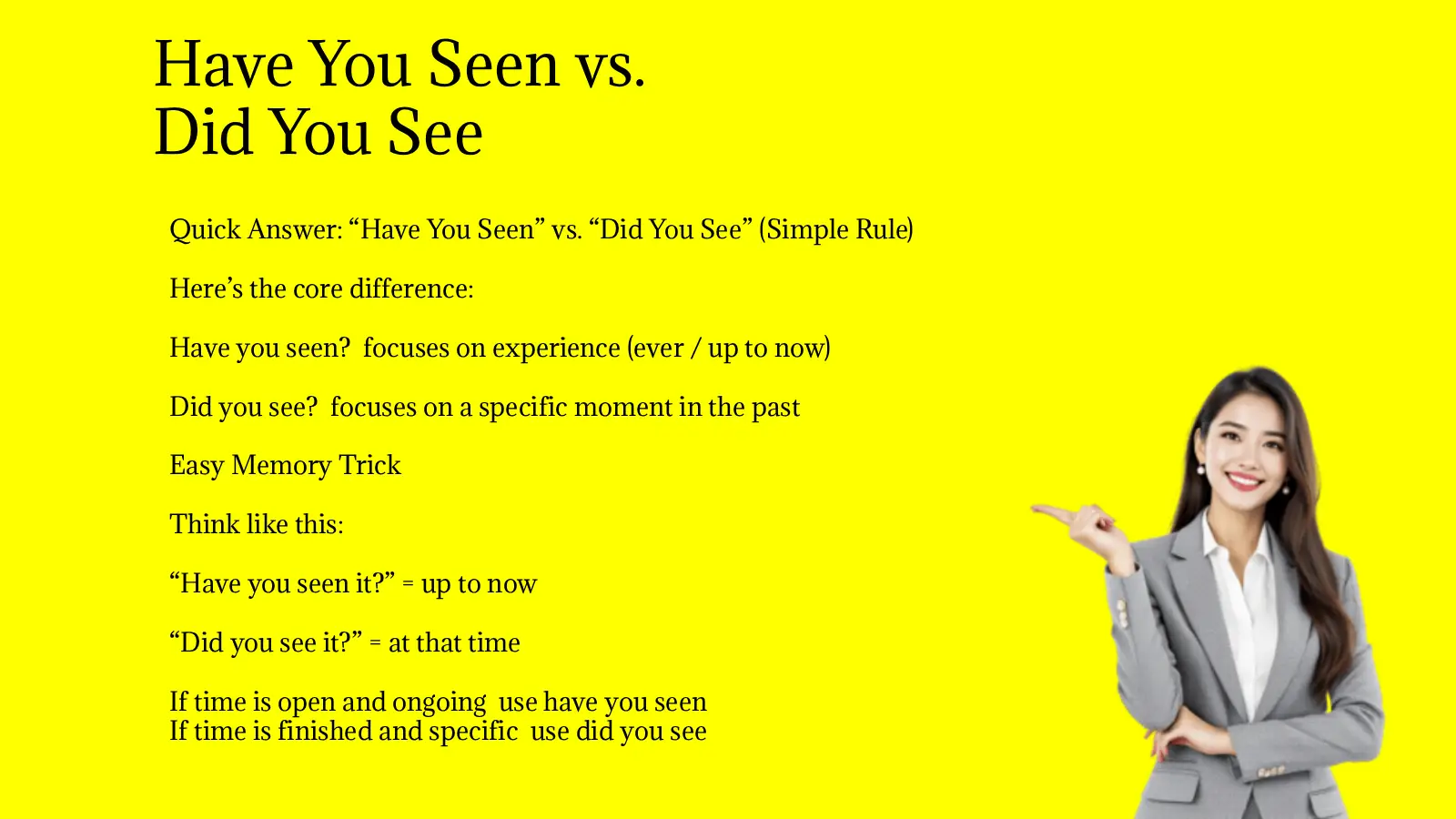
Quick Answer: “Have You Seen” vs. “Did You See” (Simple Rule)
Here’s the core difference:
- Have you seen…? → focuses on experience (ever / up to now)
- Did you see…? → focuses on a specific moment in the past
Easy Memory Trick
Think like this:
- “Have you seen it?” = up to now
- “Did you see it?” = at that time
If time is open and ongoing → use have you seen
If time is finished and specific → use did you see
Do They Mean the Same Thing?
Not exactly—but they often overlap in casual speech.
Both can ask about whether someone saw something. However, the speaker’s focus changes.
- One checks experience
- The other checks a past event
That small shift matters more than people realize.
Why This Confuses So Many People
English doesn’t always stay strict in everyday conversation.
People mix tenses when:
- Speaking quickly
- Texting casually
- Reacting emotionally
So you’ll hear both versions in similar situations. However, grammar still gives each one a slightly different job.
“Have You Seen” Explained Clearly
This phrase uses the present perfect tense, which connects the past to now.
When You Should Use It
Use “have you seen” when:
- You’re talking about life experience
- The time is not important
- The result still matters now
Real Examples
- “Have you seen this movie?”
- “Have you seen my keys?”
- “Have you seen the new update?”
What It Really Means
You’re asking:
“At any point up to now, did this happen?”
How It Feels
It sounds:
- Natural
- Open-ended
- Slightly more conversational in modern English
“Did You See” Explained Clearly
This phrase uses the simple past tense, which locks the action into a finished moment.
When You Should Use It
Use “did you see” when:
- You refer to a specific time
- The moment is clearly in the past
- The event is completed
Real Examples
- “Did you see that movie last night?”
- “Did you see what happened earlier?”
- “Did you see my message yesterday?”
What It Really Means
You’re asking:
“At that specific time, did it happen or not?”
How It Feels
It sounds:
- Direct
- Time-specific
- Straight to the point
The Biggest Difference People Miss
Here’s where most confusion comes from.
People focus on meaning instead of time framing.
The Key Distinction
- “Have you seen” → no fixed time
- “Did you see” → fixed time
That’s it. Everything else follows from that.
Side-by-Side Comparison Table
| Feature | Have You Seen | Did You See |
|---|---|---|
| Tense | Present perfect | Simple past |
| Time focus | Unfinished / general | Finished / specific |
| Meaning style | Experience-based | Event-based |
| Example | “Have you seen this?” | “Did you see it yesterday?” |
| Tone | Softer, ongoing | Direct, past-focused |
Real-Life Examples of “Have You Seen”
Let’s make it feel real.
Everyday Situations
- “Have you seen my email?”
- “Have you seen this video?”
- “Have you seen the new design?”
Mini Scenario
You’re at work and send a message:
“Have you seen the latest report?”
You’re not asking when. You just want to know if they’ve checked it at all.
Real-Life Examples of “Did You See”
Now shift the timing.
Everyday Situations
- “Did you see my message this morning?”
- “Did you see that match last night?”
- “Did you see what happened earlier today?”
Mini Scenario
A friend asks:
“Did you see the game last night?”
They’re not asking about life experience. They’re talking about a specific event.
The Subtle Tone Difference
This part matters more than grammar books admit.
- “Have you seen” feels softer and more open
- “Did you see” feels sharper and more anchored in time
In conversation, that changes how your message lands.
The Biggest Mistake People Make
Here’s the common problem.
People think both are interchangeable in all cases.
That leads to awkward phrasing like:
“Did you see this movie?” (when asking in general conversation)
It’s not wrong, but it sounds slightly off in some contexts.
The Fix
Ask yourself one question:
Am I talking about a specific time or just experience?
Regional and Real-World Usage
English speakers don’t always follow strict rules in speech.
In American English
- “Have you seen” is very common in daily talk
- “Did you see” is used for past events or storytelling
In British English
Both are common, but “have you seen” often appears in everyday conversation.
In Global Communication
People mix both forms depending on tone and habit.
How to Choose the Right One Every Time
Use this simple system:
1: Check the time
- No time mentioned → Have you seen
- Specific time mentioned → Did you see
2: Check your intent
- Asking about experience → Have you seen
- Asking about a moment → Did you see
3: Keep it natural
Don’t overthink it in conversation. Go with what sounds right after practice.
What to Say Instead (Natural Variations)
If you want variety, try these:
- “Have you checked this out?”
- “Did you catch that?”
- “Have you come across this?”
- “Did you notice that?”
These add tone without changing meaning too much.
Quick Decision Guide (Use This Instantly)
When in doubt:
- No time mentioned → Have you seen it?
- Past event mentioned → Did you see it?
- Still unsure → default to Have you seen it?
It works in most situations.
FAQ: “Have You Seen” vs. “Did You See”
Are both grammatically correct?
Yes. Both are correct, but they serve different time contexts.
Which one is more common in conversation?
“Have you seen” is slightly more common in general questions.
Can I use them interchangeably?
In casual speech, sometimes yes. But in precise writing, no.
Which sounds more natural?
It depends on context. “Have you seen” often feels smoother in general questions.
Case Study: A Small Miscommunication
A manager messaged:
“Did you see the updated document?”
The employee replied:
“I didn’t check it yesterday.”
But the manager meant:
“Have you seen it at all?”
What went wrong?
The question focused on a specific moment instead of general awareness.
Fix
They changed it to:
“Have you seen the updated document yet?”
Problem solved instantly.
Key Facts You Should Remember
- “Have you seen” = experience, no time limit
- “Did you see” = specific past moment
- Both are correct in English
- Context decides which one fits
- Clarity matters more than perfection
Final Takeaway: The One Rule That Never Fails
Here’s the simplest way to remember it.
If time is open, use have you seen.
If time is closed, use did you see.
Think of it like this:
One asks about life experience.
The other asks about a moment in time.
And once you see that difference, you’ll stop mixing them up completely.