Ever wondered why Grisly vs Grizzly trips up so many writers, even though the only difference is a single letter? One describes something horrifying, while the other refers to a powerful bear—and here’s the kicker: mixing them up can completely change the meaning of your sentence.
The problem is easy to see. These two words sound similar, and in fast writing, it’s tempting to treat them as interchangeable. But they’re not even close in meaning, and using the wrong one can make your message confusing or unintentionally funny.
But don’t worry—this is simpler than it looks.
In this guide, you’ll clearly understand Grisly vs Grizzly, including what each word means, how to use them correctly, and real examples that make the difference instantly clear. You’ll also learn quick memory tricks so you never confuse them again.
So if you want to improve your vocabulary and write with more confidence, keep reading—you’re in the right place.
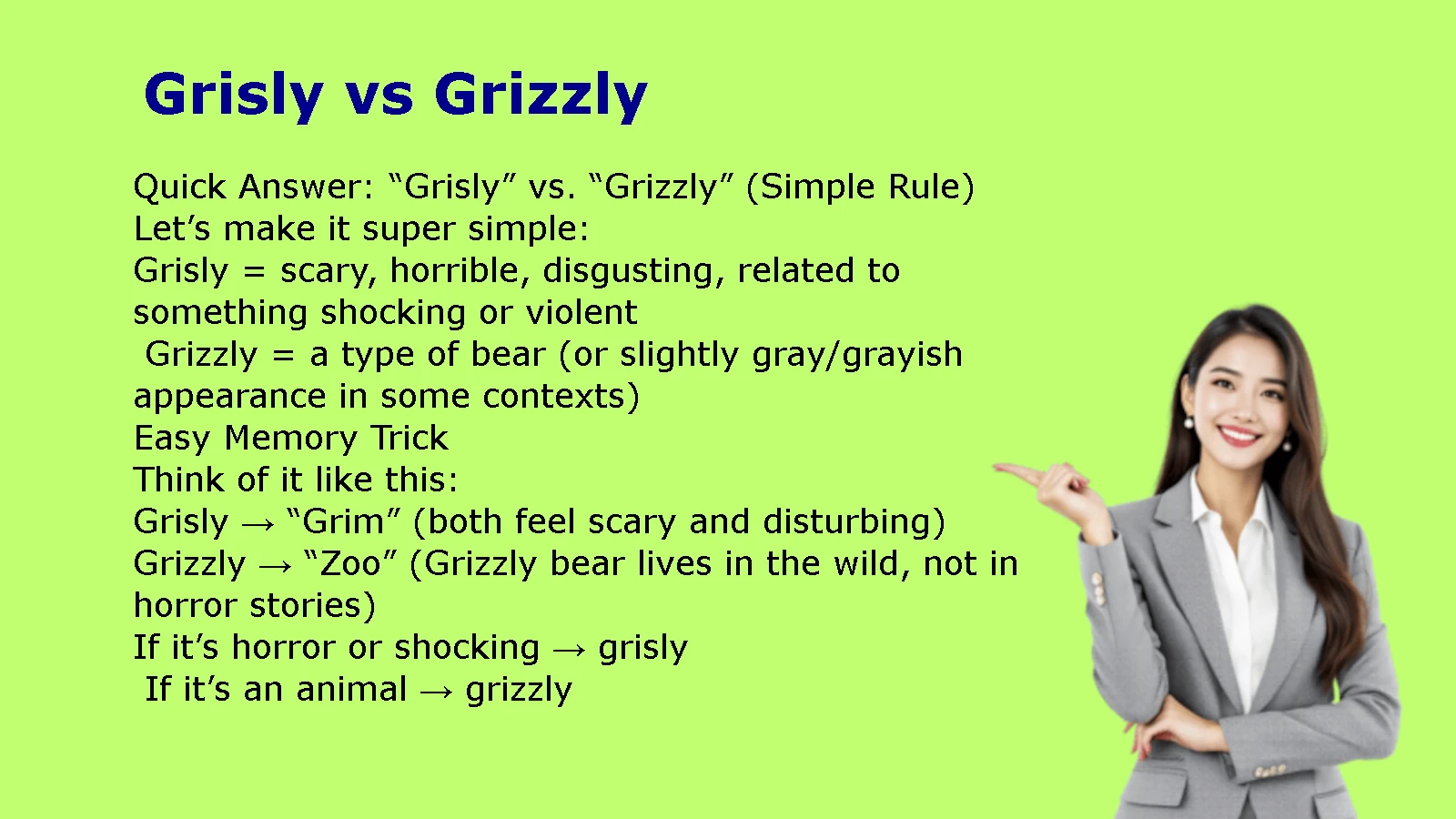
Quick Answer: “Grisly” vs. “Grizzly” (Simple Rule)
Let’s make it super simple:
Grisly = scary, horrible, disgusting, related to something shocking or violent
Grizzly = a type of bear (or slightly gray/grayish appearance in some contexts)
Easy Memory Trick
Think of it like this:
- Grisly → “Grim” (both feel scary and disturbing)
- Grizzly → “Zoo” (Grizzly bear lives in the wild, not in horror stories)
If it’s horror or shocking → grisly
If it’s an animal → grizzly
Why “Grisly” and “Grizzly” Get Confused So Easily
The confusion happens for three main reasons:
- They are almost identical in spelling
- They sound very similar when spoken
- Auto-correct sometimes doesn’t catch the mistake
But meaning-wise, they live in totally different worlds.
One belongs to fear and violence, the other belongs to nature and animals.
“Grisly” Explained Clearly (With Real Meaning)
Grisly is an adjective used when something is extremely unpleasant, horrifying, or disturbing.
Standard Meaning
- Shocking and bloody
- Extremely unpleasant or violent
- Causing horror or disgust
Real-Life Examples
- “The news reported a grisly crime scene.”
- “It was a grisly accident on the highway.”
- “The movie showed a grisly murder scene.”
Simple Idea
If it makes you uncomfortable, scared, or shocked → it’s grisly.
Mini Scenario
You’re reading a crime report:
“The police discovered a grisly scene inside the building.”
That means: something disturbing happened there.
“Grizzly” Explained Clearly (With Real Meaning)
Grizzly has two main uses, but the most common one is a bear.
Meaning 1: The Animal (Most Common)
A grizzly bear is a large, powerful bear found in North America.
Real-Life Examples
- “A grizzly bear was spotted near the forest trail.”
- “Grizzlies are known for their strength and size.”
- “The hikers saw a mother grizzly with cubs.”
Meaning 2: Gray or Flecked with Gray (Less Common)
Sometimes “grizzly” describes hair or appearance mixed with gray.
- “He had grizzly hair and a long beard.”
Simple Idea
If it lives in the wild or looks grayish → it’s grizzly.
Side-by-Side Comparison Table
| Word | Meaning | Category | Example Use |
| Grisly | Horrifying, shocking, violent | Emotion/Event | Grisly crime scene |
| Grizzly | Bear or grayish appearance | Animal/Look | Grizzly bear in the forest |
The Biggest Mistake People Make
Here’s where most confusion happens:
People assume “grizzly” = scary like horror movies because it sounds intense.
But in reality:
- Grisly is scary (violence, horror)
- Grizzly is natural (animal, wilderness)
Real-World Mix-Up
Wrong:
- “Grizzly accident at the scene” ❌
Correct:
- “Grisly accident at the scene” ✔
Wrong:
- “A grisly bear was seen in the forest” ❌
Correct:
- “A grizzly bear was seen in the forest” ✔
Quick Memory System (Never Forget Again)
Use this simple logic:
Step 1: Ask “Is it scary or an animal?”
- Scary → Grisly
- Animal → Grizzly
Step 2: Break the words
- Grisly = “Grim + ugly situation”
- Grizzly = “Zoo + fuzzy bear”
Step 3: Visual trick
- Grisly → think blood-freezing horror scene
- Grizzly → think big brown bear in the wild
Real-Life Examples of “Grisly”
Let’s make it crystal clear:
- “The detective described a grisly murder case.”
- “There was a grisly discovery in the abandoned house.”
- “The accident left a grisly scene on the road.”
- “Witnesses reported grisly details of the crime.”
👉 Always related to horror, violence, or disturbing events.
Real-Life Examples of “Grizzly”
Now the safe one:
- “A grizzly bear crossed the river.”
- “The hikers avoided a grizzly in the forest.”
- “He photographed a grizzly catching fish.”
- “The old man had grizzly gray hair.”
👉 Always related to animals or appearance.
Case Study: A Simple but Funny Mistake
A student once wrote in an essay:
“The forest was dangerous because of grisly bears.”
The teacher corrected it immediately.
Why?
Because:
- “Grisly bears” sounds like horror monsters ❌
- The correct term is “grizzly bears” ✔
This tiny spelling mistake changed the entire meaning of the sentence.
When to Use Each Word (Practical Guide)
Use grisly when:
- Talking about crime
- Describing violence
- Writing horror or news reports
Use grizzly when:
- Talking about wildlife
- Describing bears
- Referring to gray or streaked hair
FAQ: “Grisly” vs. “Grizzly”
Is “grisly” the same as “grizzly”?
No. They are completely different words with unrelated meanings.
What does “grisly bear” mean?
Nothing correct. It’s a common spelling mistake.
Can “grizzly” mean scary?
Not usually. The scary meaning belongs to “grisly.”
Which one is used in horror writing?
Always grisly, not grizzly.
Key Facts You Should Remember
- Grisly = horror, shock, violence
- Grizzly = bear or gray appearance
- They are NOT interchangeable
- One letter changes the entire meaning
Final Takeaway: The One Rule That Never Fails
Here’s the simplest way to never confuse them again:
If it belongs in a crime scene or horror story → grisly
If it belongs in a forest or wildlife documentary → grizzly
Think of it like this:
One word makes you shudder (grisly)
The other makes you think of a bear in the wild (grizzly)
And once you lock that difference in your mind, you’ll never mix them up again.