Ever stumbled across the words Collocate vs. Colocate and wondered if they mean the same thing—or if one is simply a typo? You’re not alone, and this small spelling difference confuses even experienced writers, editors, and English learners.
The problem is simple. Both words look almost identical, but only one is widely accepted in standard English usage. And here’s the kicker: using the wrong version in academic writing, SEO content, or professional communication can instantly reduce credibility.
Many people struggle with this distinction when working with grammar rules, linguistics, or even technical writing. That’s why they search for clear explanations of Collocate vs. Colocate, along with usage rules, meanings, and real examples.
But don’t worry—this confusion is easy to clear up.
In this guide, you’ll learn the exact difference between Collocate vs. Colocate, which term is correct in modern English, and how each is used in real contexts. You’ll also see simple examples that make the distinction crystal clear so you never mix them up again.
So if you’re ready to fix this common language confusion once and for all, keep reading—you’re in the right place.
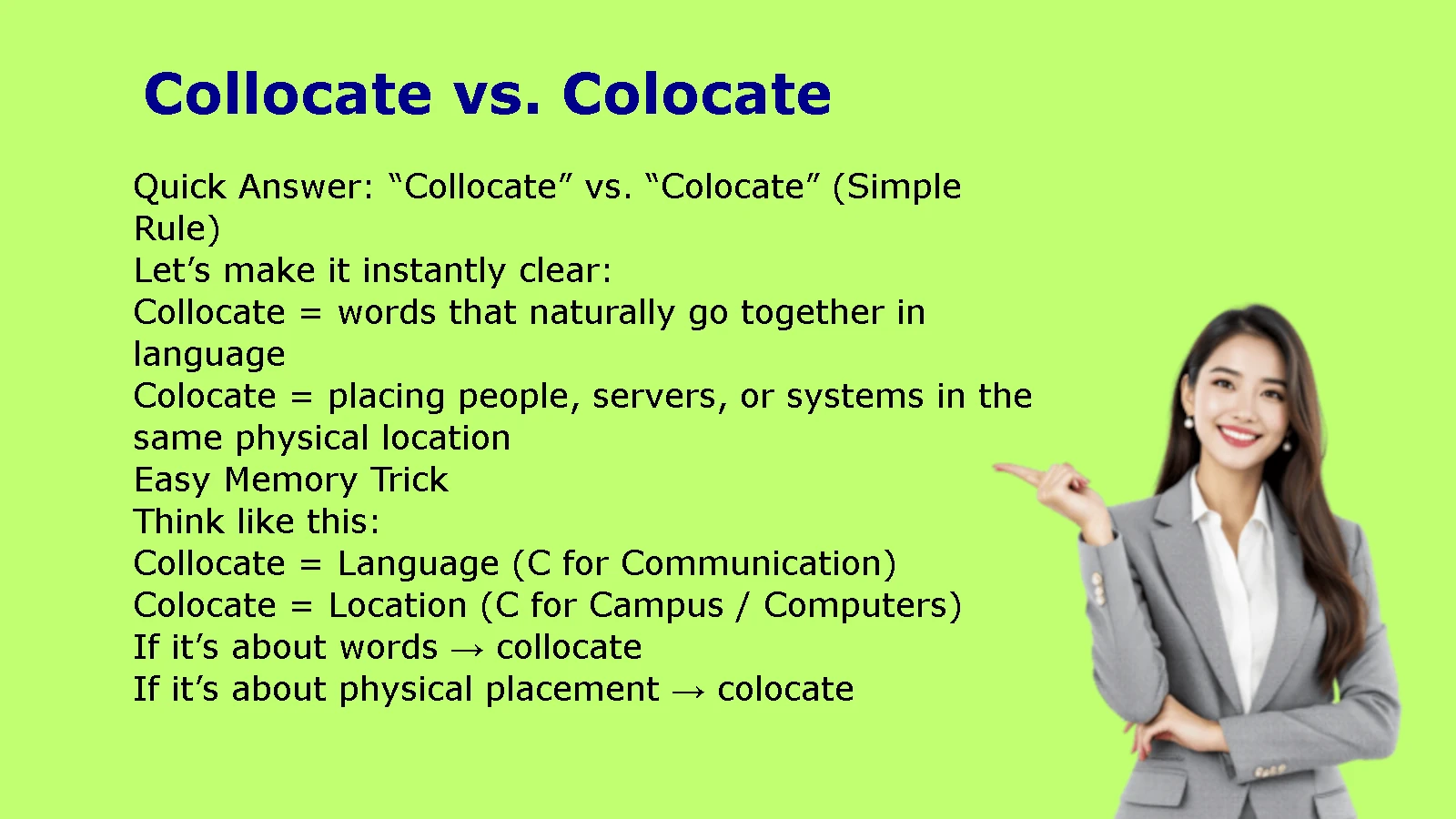
Quick Answer: “Collocate” vs. “Colocate” (Simple Rule)
Let’s make it instantly clear:
Collocate = words that naturally go together in language
Colocate = placing people, servers, or systems in the same physical location
Easy Memory Trick
Think like this:
- Collocate = Language (C for Communication)
- Colocate = Location (C for Campus / Computers)
If it’s about words → collocate
If it’s about physical placement → colocate
Why People Confuse “Collocate” and “Colocate”
The confusion happens for three main reasons:
1. They look almost identical
Only one “l” separates them.
2. Both relate to “things coming together”
But one is abstract (language), the other is physical.
3. Different industries use them
- Linguistics → collocate
- IT / real estate / business → colocate
So unless you know the context, they feel interchangeable—but they’re not.
What Does “Collocate” Mean?
Collocate is a term used in linguistics.
It refers to words that naturally appear together more often than expected.
Simple Definition
A collocation is a pair or group of words that are commonly used together.
Common Examples of Collocation
- Make a decision
- Strong coffee
- Fast food
- Heavy rain
- Take a break
We don’t usually say:
- “Do a decision” ❌
- “Powerful rain” ❌
Because English “prefers” certain word combinations.
Why Collocation Matters
Collocation improves:
- Fluency
- Natural writing
- Speaking accuracy
- Academic writing scores
Real-Life Example
Instead of saying:
“I did a big mistake.”
Native speakers say:
“I made a big mistake.”
That’s collocation in action.
What Does “Colocate” Mean?
Now let’s switch to the business and tech world.
Colocate means placing multiple systems, teams, or equipment in the same physical or operational location.
Simple Definition
To colocate means to share the same space or facility.
Common Uses of Colocation
In IT (Most Common Use)
- Servers colocated in a data center
- Cloud infrastructure hosted together
In Business
- Teams colocated in one office
- Departments working from the same building
In Real Estate
- Companies sharing office space for efficiency
Real-Life Example
A company might say:
“We decided to colocate our servers in a secure data center.”
This means:
- Instead of keeping servers in multiple places
- They are placed together in one controlled location
Why Companies Use Colocation
- Better security
- Lower cost
- Easier maintenance
- Faster connectivity
Collocate vs. Colocate: Side-by-Side Comparison
| Feature | Collocate | Colocate |
| Field | Linguistics | IT / Business / Infrastructure |
| Meaning | Words that naturally go together | Placing things in the same physical location |
| Type | Language pattern | Physical arrangement |
| Example | “Make a decision” | “Servers colocated in a data center” |
| Usage risk | Low confusion in linguistics | High confusion in tech writing |
Real-Life Examples of “Collocate”
Let’s make it even clearer:
- “Bright future” is a collocation
- “Pay attention” is a collocation
- “Deep sleep” is a collocation
- “Catch a cold” is a collocation
These are natural word pairings that sound correct to native speakers.
Real-Life Examples of “Colocate”
Now for physical placement:
- “The startup colocated its development team in one office.”
- “Our servers are colocated in Europe for faster performance.”
- “Several companies colocate in shared tech hubs.”
Each example involves physical or operational positioning.
The Biggest Mistake People Make
Here’s the real issue:
People assume both words are spelling variations of the same concept.
What Goes Wrong
- Writers use “collocate” when they mean “colocate”
- Tech articles get confusing
- Grammar learners misunderstand the concept
Real Scenario
A tech blog writes:
“We collocated our servers in the cloud facility.”
This is incorrect usage.
Correct version:
“We colocated our servers in the cloud facility.”
Why This Confusion Happens So Often
- Both words come from Latin roots
- Both involve “placing things together”
- Spellcheck tools don’t always flag the error
- Non-native speakers rarely encounter both in context
So the mistake is understandable—but avoidable.
How to Use Them Correctly Every Time
Use this simple decision system:
Ask yourself:
- Is it about words and language? → Collocate
- Is it about physical placement? → Colocate
Still unsure?
Replace it with a simpler phrase:
- “words that go together” → collocate
- “placed together in one location” → colocate
Clear Alternatives You Can Use
Instead of “collocate”:
- word pairings
- natural combinations
- commonly used expressions
Instead of “colocate”:
- place together
- host in one location
- share the same facility
- centralize infrastructure
Quick Decision Guide
- Words in language → Collocate
- Servers, teams, systems → Colocate
- Still confused → rewrite sentence in simple English
FAQ: Collocate vs. Colocate
Is “collocate” used in everyday English?
Not really. It’s mostly used in linguistics and education.
Is “colocate” a common business term?
Yes, especially in IT, cloud computing, and corporate infrastructure.
Can they ever mean the same thing?
No. They belong to completely different contexts.
Which one is more formal?
Both are formal, but in different fields.
Final Takeaway: The One Rule That Never Fails
Here’s the simplest way to remember:
Collocate = words that belong together in language
Colocate = things that are placed together in real space
If you ever get confused, just ask:
“Am I talking about language or location?”
That one question will save you from 99% of mistakes.
Because in the end, precision matters more than similarity—especially in English