Ever wondered why Feet vs. Feat confuses so many English learners, even though the words sound exactly the same? One refers to a body part (feet), while the other means an achievement or accomplishment (feat)—yet this simple difference often leads to spelling mistakes in writing.
That’s where the confusion begins. You’re not alone if you’ve mixed these up while writing essays, captions, or professional content. These are classic homophones, and they are one of the most common causes of English grammar confusion. And here’s the kicker: using the wrong one can completely change your sentence meaning.
But don’t worry—this is easier to fix than it looks.
In this guide, you will clearly understand the difference between Feet vs. Feat, including their correct meanings, usage examples, and simple memory tricks to avoid spelling mistakes forever. You’ll also explore how word meaning, pronunciation, and context play a key role in choosing the right term.
So if you want to stop second-guessing similar-looking words and improve your English vocabulary, this breakdown will make everything crystal clear. Let’s get started.
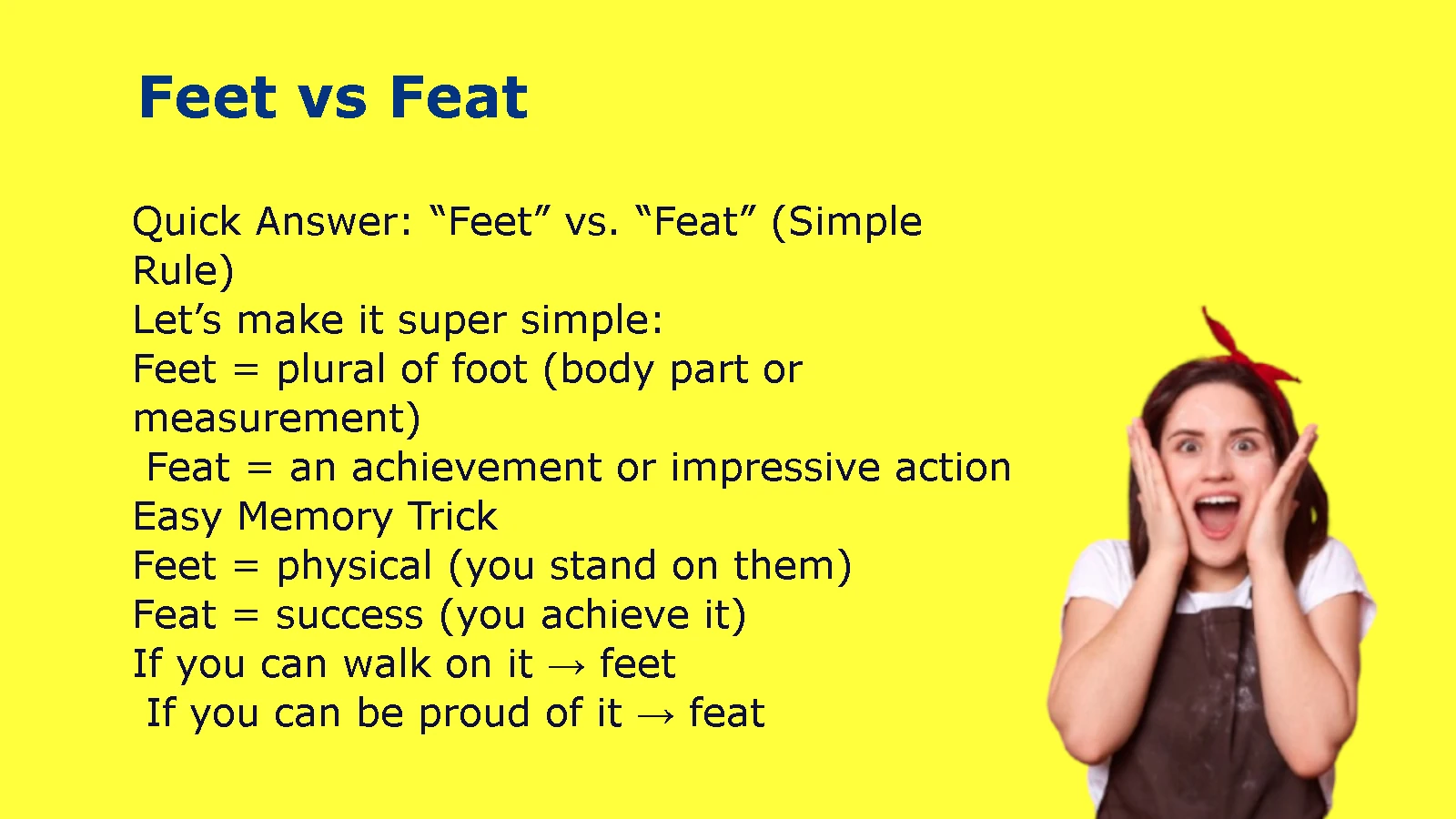
Quick Answer: “Feet” vs. “Feat” (Simple Rule)
Let’s make it super simple:
Feet = plural of foot (body part or measurement)
Feat = an achievement or impressive action
Easy Memory Trick
- Feet = physical (you stand on them)
- Feat = success (you achieve it)
If you can walk on it → feet
If you can be proud of it → feat
Why “Feet” vs. “Feat” Is So Confusing
At first glance, they look almost identical. Only one letter changes—but that one letter completely changes meaning.
The confusion happens because:
- They are homophones in some accents (sound similar)
- Spelling difference is very small
- Both appear in everyday English
- Auto-correct doesn’t always help learners
So people often mix them up in writing even when they know the meaning.
“Feet” Explained Clearly (With Meaning)
Let’s break down feet properly.
1. Body Part Meaning
“Feet” is the plural of foot, the part of your body you stand and walk on.
Examples:
- My feet are tired after walking all day.
- He hurt both feet during the game.
- She washed her feet before bed.
2. Measurement Meaning
“Feet” is also a unit of length in the imperial system.
Examples:
- The room is 10 feet wide.
- The wall is 6 feet tall.
- He jumped 8 feet in the air.
Key Insight
If you can measure it or stand on it, it’s always feet.
“Feat” Explained Clearly (With Meaning)
Now let’s look at the tricky one: feat.
Meaning: An Achievement
A feat is something impressive, difficult, or admirable that someone accomplishes.
Examples:
- Climbing that mountain was an incredible feat.
- Winning three matches in a row is no small feat.
- It was a feat of strength and determination.
Key Idea
If it requires effort, skill, or bravery, it’s a feat.
The Biggest Mistake People Make
Here’s where most errors happen:
People accidentally write:
- ❌ “an amazing feet”
Instead of: - ✅ “an amazing feat”
Why this mistake happens:
- “Feet” is more common in daily language
- People rely on sound instead of spelling
- They don’t connect “feat” with “achievement”
Real Impact
This small mistake can:
- Change meaning completely
- Make writing look unprofessional
- Confuse readers instantly
Side-by-Side Comparison Table
| Word | Meaning | Type | Example | Risk of Confusion |
| Feet | Body part / measurement | Noun (plural) | My feet are cold | Medium |
| Feat | Achievement / accomplishment | Noun | A heroic feat | High |
Real-Life Examples of “Feet”
Let’s make it practical.
Everyday Usage
- My feet are sore after running.
- He slipped and injured his feet.
- The baby’s feet are so small.
Measurement Usage
- The building is 100 feet tall.
- The pool is 20 feet long.
Simple Understanding
Always physical. measurable. “feet.”
Real-Life Examples of “Feat”
Now compare:
Everyday Usage
- Completing a marathon is a great feat.
- It was a remarkable feat of engineering.
- Escaping that situation was no easy feat.
Mini Scenario
You’re watching a sports match:
“Winning without losing a single game is a rare feat.”
That means it’s impressive—not physical.
Why “Feat” Feels More Formal
Unlike “feet,” which is everyday language, feat often appears in:
- News articles
- Academic writing
- Sports commentary
- Historical descriptions
It carries a tone of achievement and respect.
The Easiest Way to Never Confuse Them Again
Use this simple test:
Ask Yourself:
- Can I walk on it or measure it? → Feet
- Is it something impressive or difficult? → Feat
Quick Shortcut:
- Feet = physical world
- Feat = achievement world
If you keep this separation in mind, mistakes disappear instantly.
Common Mistakes (And Fixes)
Mistake 1:
❌ “A great feet of strength”
✅ “A great feat of strength”
Mistake 2:
❌ “His feet was impressive”
✅ “His feat was impressive”
Mistake 3:
❌ “Climbing it was a feet”
✅ “Climbing it was a feat”
Quick Decision Guide
When writing, pause and ask:
- Talking about body or measurement? → Feet
- Talking about achievement? → Feat
- Still unsure? → Replace with “achievement” and see if it fits
Simple. Fast. Reliable.
FAQ: “Feet” vs. “Feat”
Is “feet” ever used for achievement?
No. “Feet” only refers to body parts or measurement.
What is a synonym for “feat”?
Achievement, accomplishment, or success.
Why do people mix them up?
Because they look similar and sound close in casual speech.
Which one is more common?
“Feet” is more common in daily life, but “feat” appears in formal writing.
Final Takeaway: The One Rule That Never Fails
Here’s the simplest truth:
If it’s something you stand on or measure → feet
If it’s something impressive you achieve → feat
They may differ by just one letter, but their meanings live in completely different worlds.
So next time you write, don’t rely on guesswork. Just ask:
Am I talking about body or achievement?
Because when it comes to feet vs. feat, clarity isn’t optional—it’s everything.