Conform With vs. Conform To – Which Is Correct? (+Examples) It is often confusing in everyday grammar choice, especially when we weave through a maze of words trying to pick the right ones that fit snugly into sentences. At first, it feels like choosing a perfect outfit for an occasion—you want to look your best—but you are not sure whether it is a black tie or a casual affair. However, this uncertainty appears clearly when deciding between conform with and conform to, because both sound good, but only one truly makes a sentence shine in real grammar usage, clarity, expression, meaning, correctness, and sentence structure.
Moreover, in real writing situations, I’ve often noticed even strong learners face a common scene: typing confidently, then suddenly hitting a snag when the cursor blinks and they second-guess a choice that seemed straightforward. As a result, they struggle with fluency, hesitation, editing, correction, grammar awareness, language processing, and self-correction, which affects overall style and sentence flow. In addition, this uncertainty grows when cognitive load increases, making even simple preposition choices feel complex.
Therefore, the key lies in understanding how to conform to and conform with work differently in context. Specifically, conform to usually relates to rules, standards, or authority, while conform with is more about agreement, harmony, or matching ideas. Consequently, once learners stop rushing and start noticing how each phrase behaves in language selection, context, and nuance, they gain precision, improve correctness, and build stronger writing control naturally.
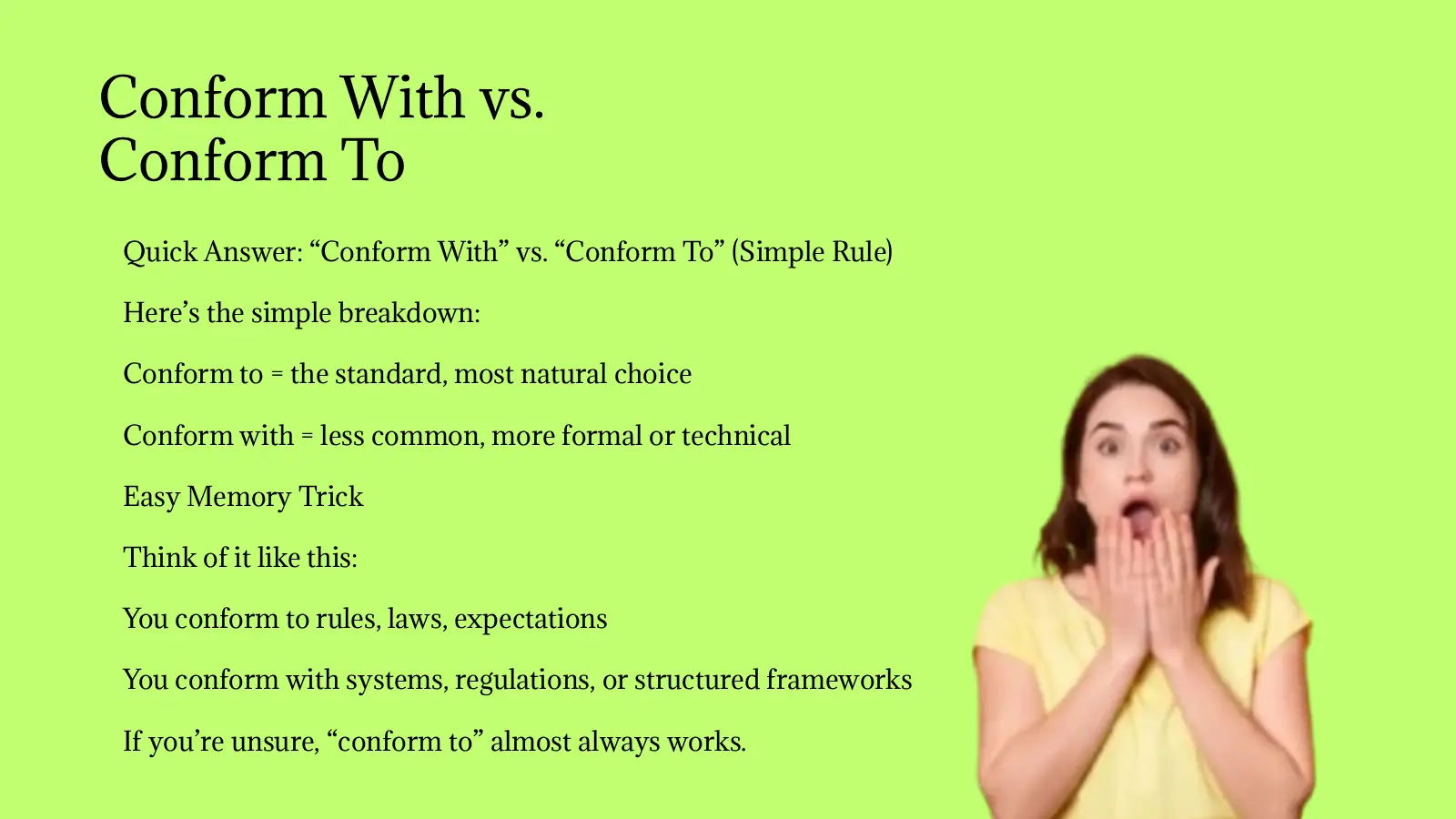
Quick Answer: “Conform With” vs. “Conform To” (Simple Rule)
Here’s the simple breakdown:
- Conform to = the standard, most natural choice
- Conform with = less common, more formal or technical
Easy Memory Trick
Think of it like this:
- You conform to rules, laws, expectations
- You conform with systems, regulations, or structured frameworks
If you’re unsure, “conform to” almost always works.
Do “Conform With” and “Conform To” Mean the Same Thing?
Yes—and no.
Both phrases involve the idea of matching or obeying a standard. However, English speakers don’t use them equally.
The Core Idea
- “Conform to” focuses on behavior fitting a rule
- “Conform with” often sounds like alignment between systems or formal standards
So the meaning overlaps, but usage differs.
Why Are There Two Versions?
English doesn’t always stick to one rigid structure. Instead, it evolves through usage.
The Simple Reason
- “Conform to” became the dominant everyday form
- “Conform with” survived in formal writing, legal texts, and technical language
That’s why you still see both today.
How People Actually Use Them
Let’s move away from theory and into real life.
In Everyday English
People almost always say:
- “Conform to rules”
- “Conform to expectations”
- “Conform to standards”
It sounds natural and smooth.
In Formal or Technical Contexts
You might see:
- “The system conforms with international regulations”
- “The design conforms with ISO standards”
It feels slightly more structured and bureaucratic.
“Conform To” Explained Clearly
This is your default option in most situations.
When to Use “Conform To”
Use it when someone or something follows a rule, law, or expectation.
Real Examples
- “Employees must conform to company policy.”
- “Students must conform to school rules.”
- “The product conforms to safety standards.”
How It Feels
“Conform to” sounds:
- Natural
- Direct
- Widely accepted
It’s the safer choice in almost every case.
“Conform With” Explained Clearly
Now let’s look at the less common version.
When to Use “Conform With”
You’ll usually see it in:
- Legal documents
- Technical writing
- Formal compliance statements
Real Examples
- “The device conforms with federal regulations.”
- “The software conforms with industry standards.”
- “The system conforms with ISO requirements.”
How It Feels
“Conform with” sounds:
- Formal
- Slightly technical
- Less conversational
It’s correct, but not as natural in daily speech.
The Biggest Mistake People Make
Here’s where confusion really happens.
People assume one form is wrong.
That’s not true.
What Goes Wrong
- Learners avoid “conform with” completely
- Writers overuse it in casual writing
- People switch randomly within the same paragraph
That creates inconsistency and awkward flow.
Side-by-Side Comparison Table
Here’s a quick breakdown:
| Phrase | Usage Frequency | Tone | Best Use |
| Conform to | Very common | Natural, standard | Everyday writing, speech |
| Conform with | Less common | Formal, technical | Legal, regulatory, academic |
Real-Life Examples of “Conform To”
Let’s make it practical.
Common Situations
- “You must conform to safety guidelines.”
- “The app conforms to user expectations.”
- “He refused to conform to social pressure.”
Mini Scenario
You’re writing instructions for a website:
“All users must conform to the terms of service.”
Clear. Direct. No confusion.
Real-Life Examples of “Conform With”
Now compare.
Common Situations
- “The building conforms with fire regulations.”
- “This process conforms with international standards.”
- “The report conforms with auditing requirements.”
Mini Scenario
You’re writing a compliance document:
“The system conforms with GDPR requirements.”
It sounds formal and regulatory.
Why “Conform To” Feels More Natural
Here’s the interesting part.
English tends to prefer “to” when showing direction or alignment.
Think of it like this:
- Adapt to change
- Respond to feedback
- Conform to rules
It feels smoother because it follows a natural language pattern.
When “Conform With” Works Better
Even though it’s less common, it still has its place.
Use it when:
- You want a formal tone
- You’re writing legal or technical content
- You’re referring to systems or frameworks
However, even in these cases, many writers still prefer “conform to.”
How to Choose the Right One Every Time
No need to guess. Use this simple guide.
Step 1: Check Your Context
- Casual or general writing → conform to
- Legal or technical document → either works, but “conform with” may appear
Step 2: Check Your Audience
- General readers → conform to
- Industry professionals → both acceptable
Step 3: Stay Consistent
Don’t mix both in the same paragraph unless necessary.
What to Say Instead (If You Want Simpler Options)
Sometimes “conform” sounds stiff. You can replace it with:
- “Follow” → “Follow the rules”
- “Comply with” → “Comply with regulations”
- “Meet” → “Meet the requirements”
- “Stick to” → casual tone
These often feel more natural in everyday English.
Quick Decision Guide
When you’re unsure, follow this:
- Default choice → Conform to
- Formal/legal writing → Conform with (or still conform to)
- Still unsure → Use “conform to” safely
Simple. Reliable. No stress.
FAQ: “Conform With” vs. “Conform To”
Is “conform with” wrong?
No. It’s grammatically correct. It’s just less common.
Which one sounds more natural?
“Conform to” sounds more natural in everyday English.
Can I use both interchangeably?
You can, but it may sound inconsistent. Choose one style and stick with it.
Which is better for exams or writing tests?
“Conform to” is usually the safer and more expected choice.
Case Study: Why Word Choice Matters
A compliance report used both phrases:
- “The system conforms to safety standards.”
- “The system conforms with regulatory requirements.”
What happened?
Reviewers flagged inconsistency in tone.
Fix
They standardized everything to:
“The system conforms to all applicable standards and regulations.”
Result
Cleaner, more professional document.
Key Facts You Should Remember
- Both phrases are correct
- “Conform to” is more common and natural
- “Conform with” is more formal and technical
- Context decides which one fits best
- Consistency matters more than variation
Final Takeaway: The One Rule That Never Fails
Here’s the simplest truth.
English doesn’t punish either choice—but it rewards clarity.
So keep it easy:
- Everyday English → conform to
- Formal or technical tone → conform with (sometimes)
- When in doubt → always choose to conform to
Think of it like walking paths. One is smooth and well-worn. The other exists, but fewer people take it.
And in writing, the smoother path almost always wins.