In my early days of English, the phrase about Foul vs Fowl and the difference between them often felt very puzzling and full of confusion. These words are homophones and homonyms, showing identical sound, same sound, and sound the same, but they carry different meanings and different spellings. As a result, this creates a clear twist in language, a message shift, and difficulty in pronunciation, language, and overall understanding and learning, often shaped by personal trial and error.
Additionally, in sports, sport usage, and sport context, I learned that a foul is closely linked with rules, not in accordance with the rules, unfair play, a referee, and a game. It can describe something offensive, disgusting, bad, revolting, or distasteful, and even a foul move during play. In real-life usage, I noticed a tomato can taste foul, like something dirty or smelly near a dock or water, during foul weather or fair weather, as described by Thomas Fuller.
On the other hand, fowl is a noun for birds, especially bird types like gamefowl, landfowl, waterfowl, and poultry, including chickens, turkeys, and ducks. These are birds raised for eggs and meat, often served at dinner from a farm or in a fowl on a farm setting.
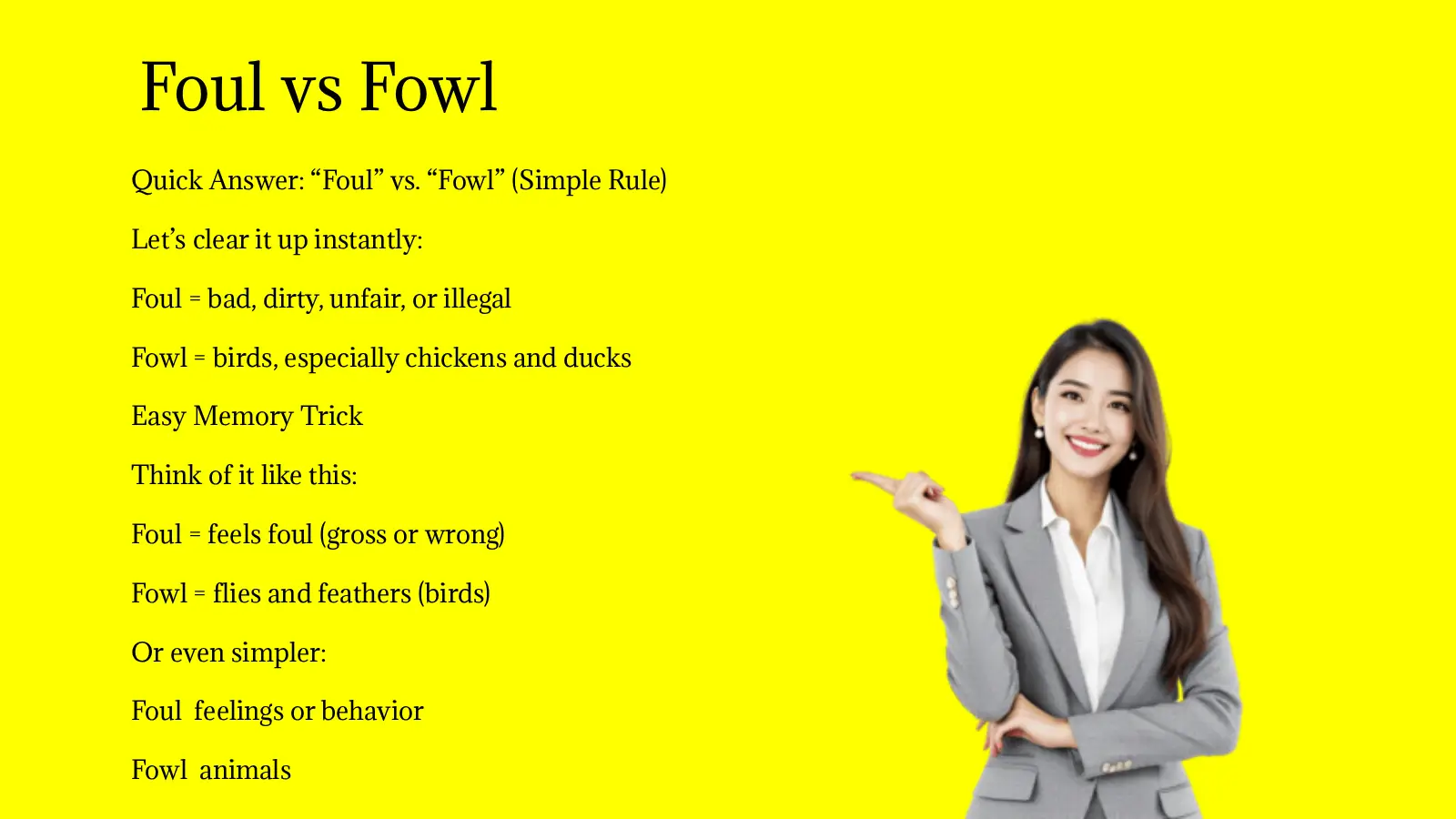
Quick Answer: “Foul” vs. “Fowl” (Simple Rule)
Let’s clear it up instantly:
- Foul = bad, dirty, unfair, or illegal
- Fowl = birds, especially chickens and ducks
Easy Memory Trick
Think of it like this:
- Foul = feels foul (gross or wrong)
- Fowl = flies and feathers (birds)
Or even simpler:
- Foul → feelings or behavior
- Fowl → animals
Do “Foul” and “Fowl” Mean the Same Thing?
Not even close.
They sound similar, but they live in totally different worlds.
- One belongs to behavior, sports, and language
- The other belongs to animals and food
Mixing them up can completely change your sentence.
Why These Two Words Get Confused So Easily
This is where most mistakes happen.
The Sound Problem
Both words:
- Sound identical in most accents
- Use the same “ow” vowel sound
- Appear in similar contexts in writing
So your brain guesses instead of analyzing.
The Spelling Trap
One letter changes everything:
- foul → “u”
- fowl → “w”
That’s it. One swap, two meanings.
“Foul” Explained Clearly
“Foul” is all about something unpleasant, wrong, or unfair.
It shows up in emotions, sports, and descriptions.
When to Use “Foul”
Use it when you mean:
- Dirty or disgusting smell
- Unfair behavior or cheating
- Rule violations in sports
Real Examples
- “The kitchen smelled foul after the garbage leaked.”
- “That was a foul move during the negotiation.”
- “The referee called a foul on the defender.”
How It Feels
The word “foul” carries a strong negative tone:
- Gross
- Unfair
- Violating rules or standards
It often signals something went wrong.
“Fowl” Explained Clearly
Now shift from behavior to biology.
“Fowl” refers to birds, especially domesticated ones used for food or farming.
When to Use “Fowl”
Use it when talking about:
- Chickens
- Ducks
- Geese
- Poultry in general
Real Examples
- “The farmer raised fowl for eggs and meat.”
- “Wild fowl migrated south for the winter.”
- “The recipe uses roasted fowl with herbs.”
How It Feels
“Fowl” sounds:
- Agricultural
- Natural
- Food-related
It belongs in nature, farms, and kitchens.
The Biggest Mistake People Make
Here’s where confusion gets expensive.
People assume both words relate to “something bad.”
That’s not true.
What Goes Wrong
- Writers use “foul” when they mean birds
- Learners confuse spelling under pressure
- Auto-correct sometimes makes it worse
Example of a Mistake
❌ “The chef prepared roasted foul.”
✔ “The chef prepared roasted fowl.”
One letter completely changes meaning.
Side-by-Side Comparison Table
Here’s a quick breakdown you can scan anytime:
| Feature | Foul | Fowl |
|---|---|---|
| Meaning | Bad, unfair, dirty | Birds (chicken, duck, etc.) |
| Category | Behavior, sports, language | Animals, food |
| Tone | Negative | Neutral |
| Usage | “foul play,” “foul smell” | “roast fowl,” “wild fowl” |
| Confusion Risk | High | High |
Real-Life Examples of “Foul”
Let’s make it practical.
Common Situations
- “That’s a foul odor coming from the drain.”
- “He committed a foul during the match.”
- “The deal was stopped due to foul play.”
Mini Scenario
You’re watching a football game:
“The referee called a foul after the tackle.”
Clear. No confusion.
Real-Life Examples of “Fowl”
Now compare.
Common Situations
- “They raised fowl on the farm.”
- “Roasted fowl is a traditional dish.”
- “Wild fowl gather near the lake.”
Mini Scenario
You’re reading a recipe:
“Season the fowl before roasting it slowly.”
Here, it clearly means poultry.
Regional and Language Notes
English doesn’t always behave the same everywhere.
Everyday American English
- “Foul” is very common in sports and slang
- “Fowl” is mostly used in cooking or farming
In British English
- Same meanings apply
- “Fowl” may appear more in formal or culinary contexts
In Global English
Context matters more than region here.
Both words are widely understood.
How to Avoid Confusion Every Time
Here’s a simple system you can rely on.
Step 1: Ask Yourself “Is this about behavior or birds?”
- Behavior, smell, sports → foul
- Animals or food → fowl
Step 2: Visual Trick
Picture it:
- “Foul” → something you don’t want near you
- “Fowl” → something you might see on a farm or plate
Step 3: Read It Out Loud
If it sounds like a rule violation or insult → foul
If it sounds like poultry → fowl
What to Say Instead (Clear Alternatives)
If you want to avoid confusion entirely:
For “Foul”
- “Unfair”
- “Dirty”
- “Offensive”
- “Wrong play”
For “Fowl”
- “Chicken” (when specific)
- “Poultry” (general term)
- “Birds” (casual reference)
Quick Decision Guide (Use This Instantly)
When you’re stuck, follow this:
- Bad smell or unfair action → Foul
- Bird or food → Fowl
- Still unsure → Replace with “bird” or “bad” and test meaning
Simple. Fast. Reliable.
FAQ: “Foul” vs. “Fowl”
Why do these words sound the same?
They share similar vowel sounds in English pronunciation, which makes them easy to mix up.
Is “foul” always negative?
Yes. It usually signals something unpleasant or against the rules.
Is “fowl” plural or singular?
It can be both. It refers to a category of birds.
Can I use “fowl” for wild birds?
Yes. It often includes wild birds like ducks and geese.
Case Study: A Costly Spelling Mistake
A restaurant menu once advertised:
“Grilled foul with herbs.”
Customers got confused and joked about “rotten meat.”
What Went Wrong
The menu meant:
✔ “Grilled fowl”
Impact
- Confusion among customers
- Reduced trust in branding
- Unnecessary embarrassment
Fix
They corrected the spelling and added clarity:
“Grilled poultry (fowl) with herbs.”
Key Facts You Should Remember
- “Foul” = bad, unfair, or unpleasant
- “Fowl” = birds or poultry
- One letter changes meaning completely
- Context always decides usage
- Spelling accuracy matters in professional writing
Final Takeaway: The One Rule That Never Fails
Here’s the simplest way to remember it.
If it feels wrong, dirty, or unfair → foul
If it has feathers or comes from a farm → fowl
Think of it like this:
One word describes a problem.
The other describes dinner.
And once you lock that in, you’ll never confuse “foul vs. fowl” again.