Ever confused Accept vs. Except while writing an email, assignment, or even a simple text? You’re not alone—these two words look and sound similar, but they have completely different meanings, and mixing them up can instantly change what you’re trying to say.
The problem is simple. Accept means to agree to or receive something, while Except means to exclude or leave something out. And here’s the kicker: even experienced writers sometimes slip up when using them in a hurry.
Many people struggle with this in everyday writing, especially when dealing with commonly confused English words, grammar mistakes in writing, or word choice errors in communication.
But don’t worry—this is easy to fix.
In this guide, you’ll clearly understand Accept vs. Except, learn the difference with simple examples, and discover easy memory tricks so you never confuse them again. You’ll also see how each word is used in real sentences so it finally clicks.
So if you want to improve your grammar and avoid common writing mistakes, keep reading—you’re in the right place.
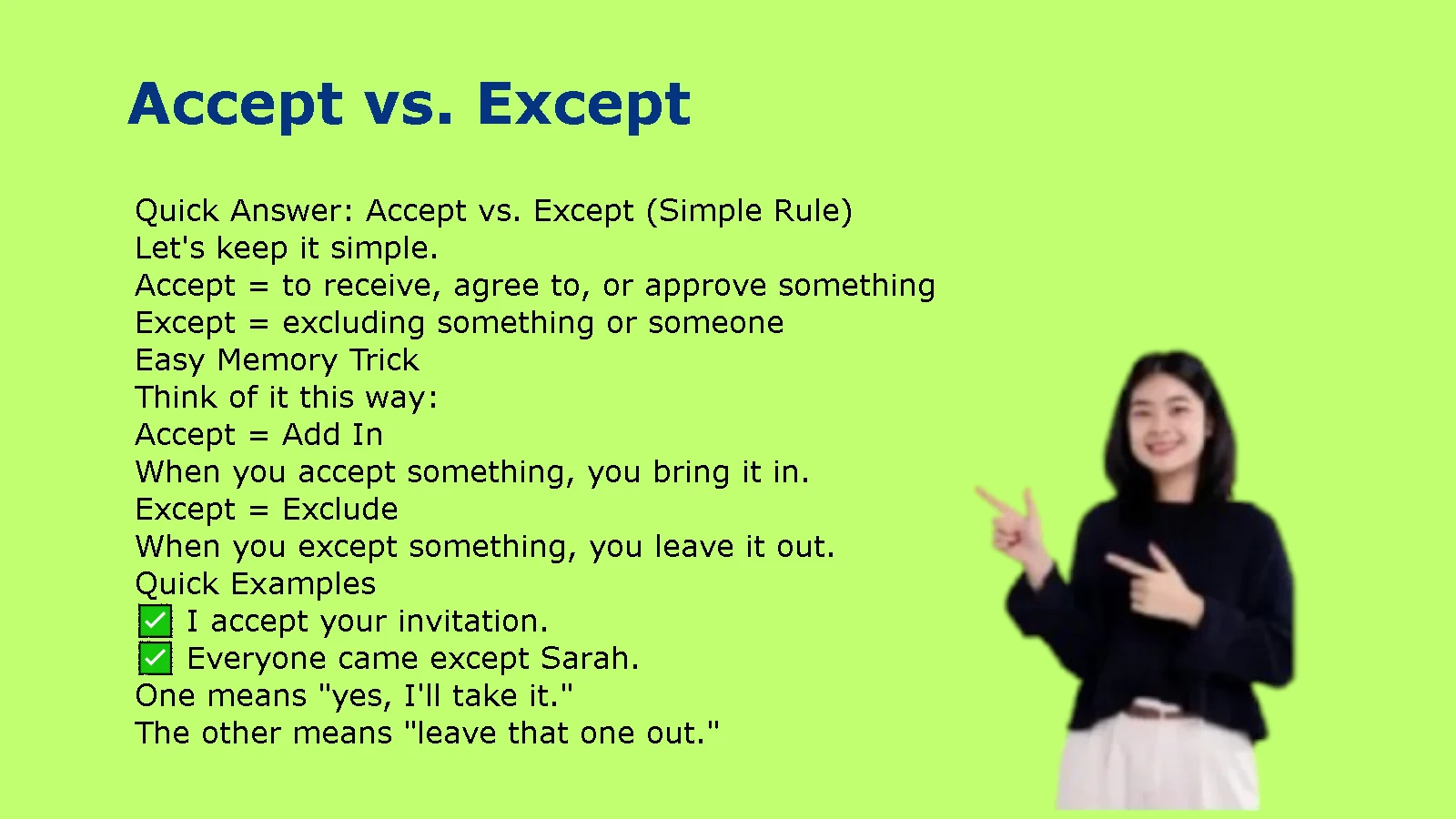
Quick Answer: Accept vs. Except (Simple Rule)
Let’s keep it simple.
Accept = to receive, agree to, or approve something
Except = excluding something or someone
Easy Memory Trick
Think of it this way:
Accept = Add In
When you accept something, you bring it in.
Except = Exclude
When you except something, you leave it out.
Quick Examples
✅ I accept your invitation.
✅ Everyone came except Sarah.
One means “yes, I’ll take it.”
The other means “leave that one out.”
How People Actually Use Accept and Except
This confusion happens because the words sound very similar.
In fast speech, many people barely notice the difference in pronunciation.
In Everyday Conversations
People often hear the word correctly but spell it incorrectly.
Examples:
- “I except your offer.”
- “Everyone accept Jake attended.”
Both are common mistakes.
In Writing
The confusion becomes more noticeable because readers can immediately spot the wrong word.
Why This Happens
- The words sound alike.
- They differ by only one letter.
- Both appear frequently in English.
- Spell-check doesn’t always catch the mistake if the word itself exists.
The Core Difference Between Accept and Except
The easiest way to remember these words is by understanding what each one does.
Accept Means Taking Something In
When you accept something, you receive it, agree to it, or approve it.
Examples:
- Accept a gift
- Accept an apology
- Accept a job offer
- Accept responsibility
Except Means Leaving Something Out
When you use except, you’re creating an exclusion.
Examples:
- Everyone except me
- All stores except one
- Every day except Sunday
Key Insight
Accept adds.
Except removes.
That’s the entire difference in one sentence.
“Accept” Explained Clearly (With Examples)
Let’s look deeper at how accept works.
Meaning 1: Receive Something
Examples:
- I accepted the package.
- She accepted the award.
- They accepted the donation.
Meaning 2: Agree to Something
Examples:
- He accepted the contract.
- We accepted the proposal.
- She accepted the invitation.
Meaning 3: Admit Something Is True
Examples:
- I accept that I made a mistake.
- They accepted the evidence.
- The committee accepted the findings.
Mini Scenario
A company offers you a position.
You say:
“I happily accept the offer.”
You are agreeing to receive it.
“Except” Explained Clearly (With Examples)
Now let’s examine except.
Meaning 1: Excluding Someone or Something
Examples:
- Everyone came except Tom.
- All rooms were clean except one.
- Every student passed except Jack.
Meaning 2: Leaving Out an Item
Examples:
- I eat everything except mushrooms.
- The store opens daily except holidays.
- She likes all colors except orange.
Mini Scenario
Ten friends are invited.
Nine arrive.
You say:
“Everyone came except Liam.”
Liam is the excluded person.
The Grammar Difference
One reason these words cause confusion is that they belong to different grammatical categories.
Accept Is Usually a Verb
It describes an action.
Examples:
- I accept.
- She accepted.
- They will accept.
Except Is Usually a Preposition
It introduces an exclusion.
Examples:
- Everyone except me.
- All except one.
- Every day except Sunday.
Key Insight
Accept = action
Except = exclusion
Knowing their grammar makes choosing the correct word much easier.
The Biggest Mistake People Make
The most common error happens because people focus on pronunciation instead of meaning.
What Goes Wrong
People hear:
“Everyone except Jake.”
But write:
“Everyone accept Jake.”
Why It’s Wrong
The sentence isn’t talking about receiving something.
It’s excluding Jake.
Therefore:
✅ Everyone except Jake.
❌ Everyone accept Jake.
Lesson
Ask yourself:
“Am I taking something in or leaving something out?”
The answer usually reveals the correct word immediately.
Side-by-Side Comparison Table
| Word | Meaning | Part of Speech | Example |
| Accept | Receive, agree to, approve | Verb | I accept your apology. |
| Except | Excluding, leaving out | Usually a preposition | Everyone except me attended. |
Real-Life Examples of Accept
Let’s see how accept appears in everyday situations.
Common Situations
- “I accept your apology.”
- “She accepted the promotion.”
- “They accepted my application.”
- “We accept credit cards.”
What They Mean
Each example involves receiving, agreeing, or approving something.
Mini Scenario
A university sends an admission letter.
You reply:
“I gladly accept admission.”
You are agreeing to receive the opportunity.
Real-Life Examples of Except
Now compare these examples.
Common Situations
- “Everyone except Anna arrived.”
- “All items except milk are available.”
- “The office is open every day except Sunday.”
- “I like every subject except math.”
What They Mean
Something is being excluded from the group.
Mini Scenario
Five team members join a meeting.
One is absent.
You say:
“Everyone attended except Daniel.”
Daniel is the exception.
Accept vs. Except in Professional Writing
Business communication demands precision.
Correct Examples
- We accept your proposal.
- The company accepts online payments.
- All departments except accounting attended.
Why It Matters
Using the wrong word can make professional writing appear careless.
Compare:
❌ We except your proposal.
✅ We accept your proposal.
Only the second sentence makes sense.
Memory Tricks That Actually Work
Need a quick way to remember?
Trick 1: Accept = Approval
The word accept starts with “A.”
Think:
A = Approve
Trick 2: Except = Exclude
The word except starts with “Ex.”
Think:
Ex = Exclude
Trick 3: Add vs. Exclude
Accept = add it
Except = exclude it
Simple and effective.
Common Sentences People Get Wrong
Let’s fix some frequent mistakes.
Incorrect
❌ I except your apology.
Correct
✅ I accept your apology.
Incorrect
❌ Everyone accept John was present.
Correct
✅ Everyone except John was present.
Incorrect
❌ The school excepts new students.
Correct
✅ The school accepts new students.
How to Avoid Confusion Every Time
Want a foolproof method?
Ask One Question
“Am I receiving something?”
If yes:
Use accept.
Ask Another Question
“Am I excluding something?”
If yes:
Use except.
Why This Works
Almost every sentence involving these words can be solved with these two questions.
What to Say Instead
Sometimes alternative words make your meaning clearer.
Alternatives for Accept
- Receive
- Approve
- Agree to
- Admit
- Welcome
Alternatives for Except
- Excluding
- Leaving out
- Other than
- Apart from
- With the exception of
Using synonyms can help you double-check your meaning.
Quick Decision Guide (Use This Instantly)
Follow this simple rule:
Receiving or agreeing → Accept
Leaving out or excluding → Except
Still unsure?
Replace the word with:
- “Receive” → accept
- “Excluding” → except
Problem solved.
FAQ: Accept vs. Except
Are accept and except homophones?
They are near-homophones. Their pronunciation is very similar, which is why many people confuse them.
Is accept always a verb?
Most of the time, yes. It usually describes receiving, approving, or agreeing.
Is except always a preposition?
Usually, but not always. However, it’s most commonly used to show exclusion.
Which mistake is more common?
Writing “accept” when “except” is needed is one of the most frequent grammar errors in English.
How can I remember the difference?
Think:
Accept = approve
Except = exclude
Case Study: An Embarrassing Email Mistake
A manager sent a team-wide message:
“Everyone is required to attend except the interns.”
But autocorrect was ignored, and the email went out as:
“Everyone is required to attend accept the interns.”
What Happened
Several employees were confused.
Some interpreted the sentence incorrectly.
Others questioned whether it was a typo.
The Fix
The corrected email stated:
“Everyone is required to attend except the interns.”
The meaning became instantly clear.
Lesson
One letter can completely change the meaning of a sentence.
Key Facts You Should Remember
- Accept means receive, agree, or approve.
- Except means exclude or leave out.
- Accept is usually a verb.
- Except usually introduces an exception.
- The words sound similar but have very different meanings.
- Most mistakes happen because people focus on pronunciation instead of meaning.
Final Takeaway: The One Rule That Never Fails
Here’s the simplest way to remember accept vs. except.
If you’re receiving, agreeing, approving, or taking something in, use accept.
If you’re excluding, leaving out, or identifying an exception, use except.
Think of it like this:
Accept welcomes something in.
Except keeps something out.
Whenever you’re unsure, ask yourself one question:
“Am I adding something or excluding something?”
If you’re adding it, choose accept.
If you’re excluding it, choose except.
That’s the rule that works every time.