Ever wondered whether Criteria vs. Criterion is the correct phrase to use in your writing? You’re not alone. These two grammar terms are frequently confused because they look similar, yet they serve different purposes in English grammar, academic writing, and professional communication.
The problem is that using the wrong word can make your writing seem less polished or even grammatically incorrect. Many students, writers, and professionals struggle with this singular and plural noun distinction, especially when discussing standards, requirements, evaluation factors, or decision-making processes.
But here’s the good news: the difference is much simpler than it appears.
In this guide, you’ll learn the meaning of Criteria vs. Criterion, when to use each term correctly, and how they relate to assessment standards, selection requirements, evaluation methods, and grading rubrics. And it gets better—you’ll also discover practical examples and easy memory tricks that make choosing the right word effortless.
So whether you’re writing an essay, preparing a report, or improving your vocabulary and word usage, this article will help you use these commonly confused words with confidence.
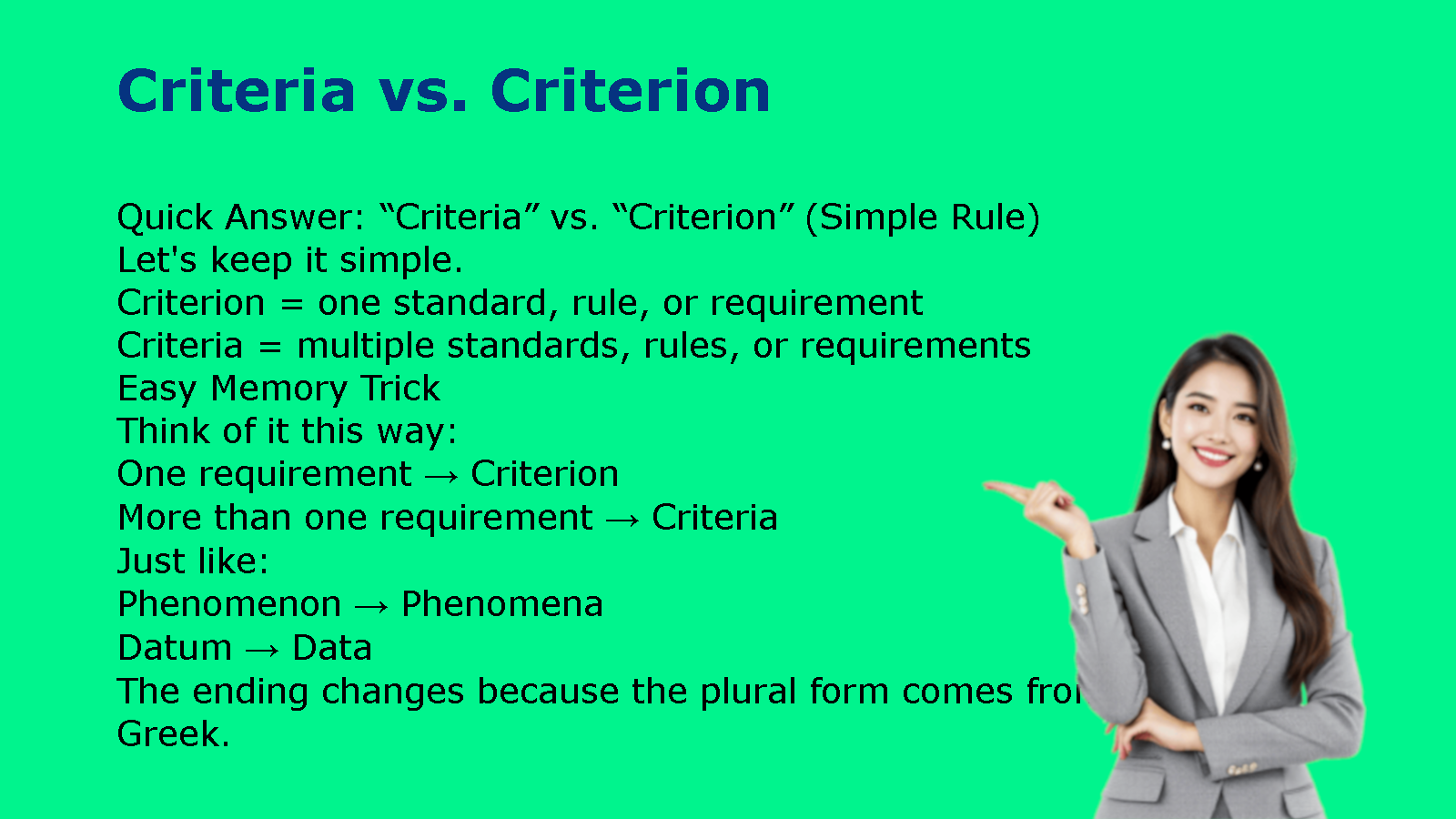
Quick Answer: “Criteria” vs. “Criterion” (Simple Rule)
Let’s keep it simple.
Criterion = one standard, rule, or requirement
Criteria = multiple standards, rules, or requirements
Easy Memory Trick
Think of it this way:
- One requirement → Criterion
- More than one requirement → Criteria
Just like:
- Phenomenon → Phenomena
- Datum → Data
The ending changes because the plural form comes from Greek.
How People Actually Use “Criteria” and “Criterion”
Here’s where confusion begins.
Many people use criteria for both singular and plural situations.
For example:
❌ “The main criteria is cost.”
While this phrase is common in everyday speech, it’s technically incorrect.
The correct version is:
✅ “The main criterion is cost.”
In Casual Conversations
People often say “criteria” regardless of the number involved.
In Professional Writing
Editors, professors, and employers typically expect the distinction to be correct.
Why This Happens
- “Criteria” is heard more often.
- “Criterion” sounds formal and less familiar.
- Many speakers never learn that one is singular.
The Grammar Logic Behind “Criteria” vs. “Criterion”
The easiest way to understand these words is through number.
Think in Terms of Quantity
| Number | Correct Word |
| One | Criterion |
| Two or More | Criteria |
Example
One hiring requirement:
✅ Experience is an important criterion.
Several hiring requirements:
✅ Experience, communication skills, and leadership are important criteria.
Key Insight
The difference has nothing to do with importance.
It only depends on whether you’re talking about one standard or multiple standards.
“Criterion” Explained Clearly (With Examples)
At its core, criterion means a single standard used to judge, evaluate, or decide something.
Standard Meaning
A criterion is one factor that helps determine an outcome.
Examples
✅ Price is an important criterion when buying a car.
✅ Accuracy was the primary criterion for selecting the winner.
✅ Safety is the most important criterion in this evaluation.
Academic Example
A professor might say:
“The final project will be graded using one main criterion: originality.”
Here, only one standard is being discussed.
Key Takeaway
Whenever you can replace the word with “one requirement” or “one standard,” use criterion.
“Criteria” Explained Clearly (With Examples)
Now let’s look at the plural form.
Standard Meaning
Criteria refers to multiple standards or requirements.
Examples
✅ The hiring criteria include education, experience, and communication skills.
✅ Our selection criteria were fairness, quality, and reliability.
✅ The judging criteria have been announced.
Business Example
A company might evaluate job candidates based on:
- Experience
- Skills
- Education
- Leadership
Together, these form the hiring criteria.
Key Insight
If more than one factor is involved, criteria is usually the correct choice.
The Biggest Mistake People Make
The most common error is treating criteria as singular.
What Goes Wrong
People hear the plural form more often and assume it can be used for everything.
Incorrect Examples
❌ The criteria is customer satisfaction.
❌ My only criteria is price.
Correct Versions
✅ The criterion is customer satisfaction.
✅ My only criterion is price.
Lesson
If there’s only one requirement, use criterion.
Side-by-Side Comparison Table
Here’s a quick reference guide.
| Word | Meaning | Number | Example |
| Criterion | A standard or requirement | Singular | Cost is a key criterion. |
| Criteria | Multiple standards or requirements | Plural | Cost and quality are key criteria. |
Real-Life Examples of “Criterion”
Let’s see how it works in everyday situations.
Job Interviews
“The most important criterion is relevant experience.”
Buying a House
“Location was our primary criterion.”
School Admissions
“Academic performance is one admission criterion.”
Competition Judging
“Creativity was the deciding criterion.”
In every example, only one standard is being discussed.
Real-Life Examples of “Criteria”
Now compare these examples.
Job Applications
“The hiring criteria include experience, education, and communication skills.”
College Admissions
“The admission criteria vary between universities.”
Product Reviews
“Our review criteria include performance, durability, and value.”
Employee Evaluations
“The evaluation criteria were clearly explained.”
Notice that multiple factors are involved each time.
Why “Criteria” Sounds More Common
Many people rarely use the singular form.
What Happens
Instead of saying:
“The main criterion is quality.”
People often say:
“The main criteria is quality.”
Over time, this mistake becomes common enough that many speakers stop noticing it.
The Result
You hear incorrect usage frequently, even in workplaces and online content.
Key Tip
Popularity does not equal correctness.
Formal writing still expects the traditional distinction.
Academic and Professional Usage
In schools, universities, and businesses, the difference matters more.
Academic Writing
Professors often expect precise grammar.
Example:
✅ “One assessment criterion was originality.”
Business Reports
Managers and executives frequently use both forms correctly.
Example:
✅ “The selection criteria were agreed upon during the meeting.”
Research Papers
Researchers often discuss numerous evaluation criteria.
Using the wrong form can make otherwise strong writing appear less professional.
How to Avoid Confusion Every Time
Want a foolproof method?
Step 1: Count the Standards
Ask yourself:
“Am I talking about one requirement or several?”
Step 2: Choose the Correct Form
One → Criterion
Several → Criteria
Step 3: Check the Verb
Singular:
✅ The criterion is important.
Plural:
✅ The criteria are important.
Why This Works
The verb immediately reveals whether you’re using the correct form.
What to Say Instead (Clear Alternatives)
If you’re worried about mixing them up, use simpler words.
Alternatives for Criterion
- Standard
- Requirement
- Measure
- Factor
Alternatives for Criteria
- Standards
- Requirements
- Factors
- Guidelines
Example
Instead of:
“The admission criteria are strict.”
You could say:
“The admission requirements are strict.”
Both are correct.
Quick Decision Guide (Use This Instantly)
When you’re unsure, use this simple rule:
One requirement → Criterion
More than one requirement → Criteria
Check the verb:
- Criterion → is
- Criteria → are
Still uncertain?
Replace the word with “requirement” or “requirements” and see which sounds right.
FAQ: “Criteria” vs. “Criterion”
Is “criteria” singular or plural?
Criteria is plural.
The singular form is criterion.
Can I say “one criteria”?
No.
The correct phrase is:
✅ One criterion
Why do people use “criteria” as singular?
Because it’s far more common in everyday speech, and many people don’t realize it is technically plural.
Which form should I use in professional writing?
Use criterion for singular and criteria for plural.
Formal writing generally expects the distinction.
Case Study: A Small Grammar Mistake With Big Consequences
A company was creating a hiring policy.
The draft stated:
“The main hiring criteria is communication skills.”
The HR director immediately flagged the sentence.
What Happened
The policy referred to only one requirement.
The correct wording should have been:
“The main hiring criterion is communication skills.”
Why It Mattered
The document was being reviewed by executives and legal advisors.
Small grammar mistakes can affect professionalism and credibility.
Fix
The company revised the document before publication.
Problem solved.
Key Facts You Should Remember
- Criterion is singular.
- Criteria is plural.
- Criterion means one standard or requirement.
- Criteria means multiple standards or requirements.
- Criterion takes singular verbs.
- Criteria takes plural verbs.
- Many people incorrectly use criteria as singular.
- Formal writing still expects the traditional distinction.
Final Takeaway: The One Rule That Never Fails
Here’s the truth.
The difference between criteria and criterion is much simpler than it looks.
You don’t need to memorize complicated grammar rules or study Greek word origins.
Just remember:
One standard = Criterion
Multiple standards = Criteria
Whenever you’re unsure, count the number of requirements you’re discussing. If there’s only one, use criterion. If there are several, use criteria.
It’s a small distinction, but getting it right instantly makes your writing clearer, more accurate, and more professional.
Because when it comes to “Criteria” vs. “Criterion,” the easiest rule is also the most reliable: one equals criterion, many equals criteria.