Ever wondered why people get confused between Knob vs Nob even though they look almost identical at first glance? One small letter changes everything—and here’s the kicker: these two words have completely different meanings depending on context and usage.
The problem is simple. They sound similar, they look similar, and in fast writing or speech, it’s easy to mix them up. That confusion can lead to awkward misunderstandings, especially in informal conversation or writing where clarity matters.
But don’t worry—this is actually easy to fix.
In this guide, you’ll clearly understand Knob vs Nob, what each word means, how they are used in different contexts, and simple examples that make the difference crystal clear. You’ll also learn how to avoid common mistakes so you never confuse them again.
So if you want to clean up your vocabulary and use both words correctly with confidence, keep reading—you’re in the right place.
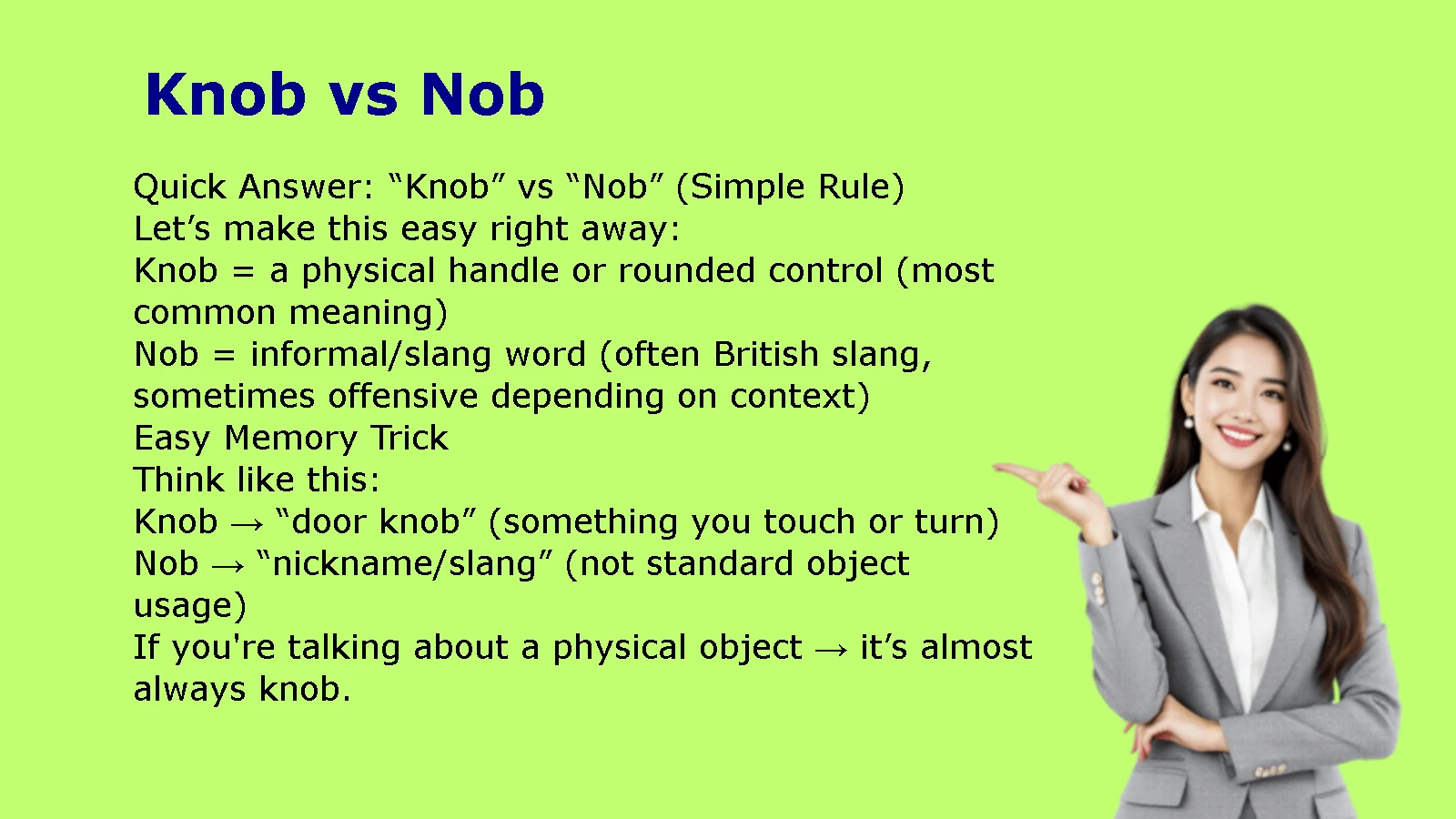
Quick Answer: “Knob” vs “Nob” (Simple Rule)
Let’s make this easy right away:
- Knob = a physical handle or rounded control (most common meaning)
- Nob = informal/slang word (often British slang, sometimes offensive depending on context)
Easy Memory Trick
Think like this:
- Knob → “door knob” (something you touch or turn)
- Nob → “nickname/slang” (not standard object usage)
If you’re talking about a physical object → it’s almost always knob.
“Knob” Explained Clearly (Most Common Usage)
The word “knob” is widely used in everyday English. It usually refers to a rounded handle or control that you turn or push.
Common Meanings of “Knob”
- Door handle you twist to open a door
- Control on a machine or device
- Rounded decorative bump or handle
Real-Life Examples
- “Turn the knob to increase the volume.”
- “The door knob is loose.”
- “Adjust the stove knob carefully.”
Why “Knob” Is Standard English
- Used in technical writing
- Common in household vocabulary
- Universally understood in English-speaking countries
👉 Key Insight: If it’s a physical object you can touch or rotate, it’s almost always knob.
“Nob” Explained Clearly (Less Common & Context-Specific)
Now let’s talk about “nob.” This is where confusion really starts.
Standard Usage
“Nob” is not commonly used in modern standard English for objects. Instead, it appears in:
- British slang
- Informal speech
- Old-fashioned or regional expressions
Possible Meanings
Depending on context, “nob” can mean:
- A person of high status (old slang: “a nob”)
- A foolish or unpleasant person (informal/offensive in some contexts)
- A casual variant in dialect writing
Important Warning
In many modern contexts, “nob” can sound rude or insulting, especially in British slang usage.
Example Usage
- “He thinks he’s some kind of nob.” (slang/negative tone)
- Rare historical usage: “a local nob of importance”
👉 Key Insight: “Nob” is not a replacement for “knob” when talking about objects.
Biggest Confusion Between “Knob” and “Nob”
Here’s where most people go wrong:
The Mistake
People assume:
“Nob” is just a different spelling of “knob”
❌ Wrong.
Why This Happens
- They sound slightly similar in speech
- Typing errors (especially on mobile)
- Autocorrect confusion
- Lack of awareness of slang meanings
Real-World Confusion Example
Someone writes:
- “Turn the nob on the radio”
Correct version:
- “Turn the knob on the radio”
👉 One letter changes the meaning completely.
Knob vs Nob: Side-by-Side Comparison Table
| Word | Meaning | Usage Type | Common Context | Risk of Confusion |
|---|---|---|---|---|
| Knob | Physical handle/control | Standard English | Doors, machines, devices | Low |
| Nob | Slang / informal insult or old term | Non-standard | British slang, informal speech | High |
Real-Life Examples of “Knob”
Let’s lock in the correct usage.
Everyday Situations
- “The knob on the drawer is missing.”
- “Press the knob to start the machine.”
- “Rotate the knob clockwise.”
Technical Context
- “Adjust the temperature knob.”
- “Volume knob controls sound output.”
👉 In all normal cases: knob = correct choice
Real-Life Examples of “Nob”
Now let’s see when “nob” appears.
Slang Usage
- “Don’t be a nob.” (informal insult)
- “He acted like a complete nob at the party.”
Old/Regional Usage
- “A local nob of influence” (historical/rare)
👉 Important: Avoid using it unless you fully understand the tone.
Why People Mix Them Up
There are three main reasons:
1. Pronunciation Similarity
They sound almost identical in casual speech.
2. Typing Errors
“b” and “n” are often confused in fast typing.
3. Lack of Context Awareness
Many learners only hear the word, not see it written correctly.
Quick Memory Trick to Never Confuse Them Again
Use this simple rule:
- Knob = K for “Key object” (something you turn or use)
- Nob = N for “Negative slang” (usually people-related)
Or even simpler:
If you can touch it → Knob
If it refers to a person/slang → Nob
Common Mistakes People Make
Here are frequent errors:
❌ “Turn the nob of the door”
✔ “Turn the knob of the door”
❌ “Volume nob is broken”
✔ “Volume knob is broken”
❌ Using “nob” instead of “knob” in instructions
✔ Always use “knob” for objects
When to Use Each Word (Simple Guide)
Use Knob when:
- Talking about objects
- Describing controls or handles
- Writing instructions or technical content
Avoid using Nob unless:
- You are using British slang intentionally
- You understand the tone and audience
- You are referring to historical/colloquial usage
FAQ: Knob vs Nob
Is “nob” a correct spelling of “knob”?
No. They are completely different words with different meanings.
Can I use “nob” instead of “knob”?
No, especially in formal or technical writing.
Why does “nob” exist in English?
It comes from slang and older usage, not modern standard English for objects.
Which word should I use in daily life?
Always use knob when referring to physical objects.
Final Takeaway: The One Rule That Never Fails
Here’s the simplest way to remember everything:
“Knob” is the object. “Nob” is slang (and often not needed).
If you’re ever unsure, just ask yourself:
- Am I talking about something I can touch or turn? → Knob
- Am I using slang about a person? → maybe Nob
When in doubt, stick with “knob”—it’s the safe, correct, and widely accepted choice.
Because in the end, clarity matters more than clever spelling—and this is one of those cases where one small letter changes everything.