Ever wondered why Role vs Roll confuses so many people, even in everyday writing? One refers to a job or function, while the other is about turning, spinning, or a type of bread—yet they sound exactly the same.
That’s where the problem starts. You’re not alone if you’ve mixed them up in emails, essays, or conversations. And here’s the kicker: even a small mistake can completely change your meaning and make your writing look unpolished.
But don’t worry—this is easier to fix than it seems.
In this guide, you will clearly understand the difference between Role vs Roll, when to use each word correctly, and how to remember them without second-guessing yourself again. You’ll also see simple examples that make everything click instantly.
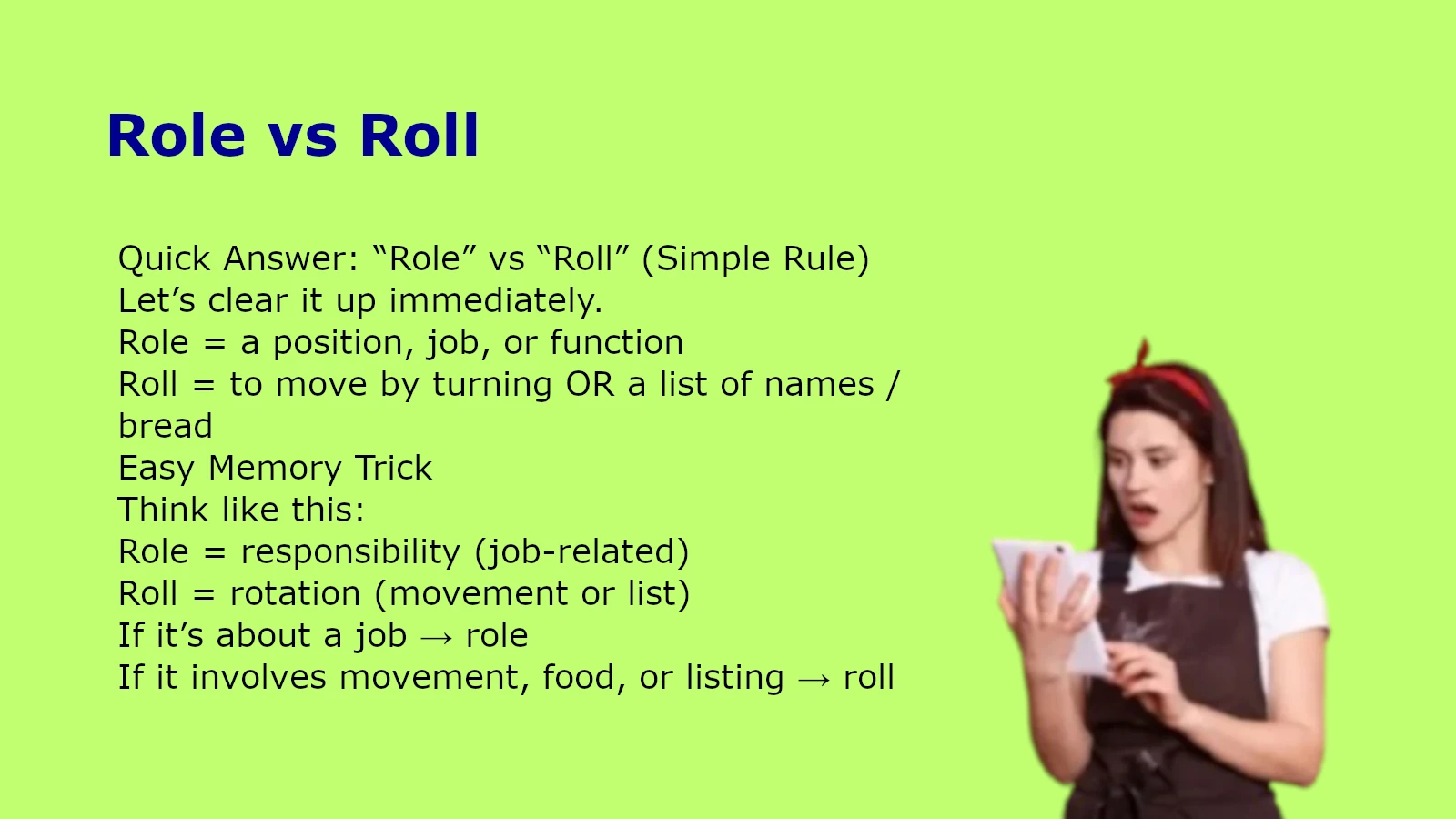
Quick Answer: “Role” vs “Roll” (Simple Rule)
Let’s clear it up immediately.
Role = a position, job, or function
Roll = to move by turning OR a list of names / bread
Easy Memory Trick
Think like this:
- Role = responsibility (job-related)
- Roll = rotation (movement or list)
If it’s about a job → role
If it involves movement, food, or listing → roll
Why “Role” vs “Roll” Is So Confusing
This confusion happens for one main reason: they are homophones in many accents.
That means:
- They sound the same when spoken
- Only spelling and context reveal meaning
Common Mistake Pattern
People write:
- “What is your roll in the company?” ❌
- “He played an important roll in the project.” ❌
Instead of:
- “What is your role in the company?” ✅
- “He played an important role in the project.” ✅
“Role” Explained Clearly (Meaning + Usage)
Role refers to a function, position, or responsibility someone has.
Core Meaning
A role = what someone does or is expected to do.
Real-Life Examples
- “She has a leadership role in the team.”
- “What is your role in this project?”
- “Teachers play an important role in shaping society.”
Simple Understanding
If you can replace it with job / function / responsibility, you need role.
“Roll” Explained Clearly (Meaning + Usage)
Now let’s look at the tricky twin.
Roll has multiple meanings, but they are all unrelated to job positions.
1. Movement (to turn over)
- “The ball will roll down the hill.”
- “He rolled onto his side.”
2. Food (bread roll)
- “I had a butter roll for breakfast.”
3. List of names
- “The teacher called the roll.”
- “Attendance roll was taken.”
Simple Understanding
If it involves:
- movement
- food
- listing names
→ you need roll
Side-by-Side Comparison Table
| Word | Meaning | Category | Example |
|---|---|---|---|
| Role | Job or responsibility | Work / Function | “She has a key role in the team.” |
| Roll | Movement / list / food | Action / Object | “The ball will roll fast.” |
The Biggest Mistake People Make
Here’s where most confusion happens.
People think:
“They sound the same, so they must be interchangeable.”
But they are not.
What Goes Wrong
- Writers accidentally use “roll” in professional emails
- Students lose marks in grammar tests
- Job descriptions become unclear
Real Example
❌ “He played an important roll in the company’s success.”
✅ “He played an important role in the company’s success.”
One letter completely changes meaning.
Real-Life Examples of “Role”
Let’s make it practical.
Workplace
- “My role is to manage marketing campaigns.”
- “She took on a senior role last year.”
Education
- “Teachers play a vital role in student development.”
Everyday Life
- “Parents have a big role in shaping habits.”
👉 If it sounds like responsibility, it’s always role.
Real-Life Examples of “Roll”
Now compare.
Movement
- “The tire started to roll down the street.”
- “He rolled the dice.”
Food
- “I bought a chicken roll from the bakery.”
Attendance
- “The teacher took the roll.”
👉 If it moves, is eaten, or is listed, it’s roll.
Quick Memory Hacks (Never Confuse Again)
Hack 1: The Job Test
Ask:
“Is it about a job or responsibility?”
Yes → role
Hack 2: The Movement Test
Ask:
“Is something moving or rotating?”
Yes → roll
Hack 3: The Food Test
If it’s edible and bread-like → roll
Common Confusion Sentences (Fixed)
❌ “What is your roll in the company?”
✅ “What is your role in the company?”
❌ “He played a big roll in the project.”
✅ “He played a big role in the project.”
❌ “The manager roll is important.”
✅ “The manager role is important.”
Why This Confusion Matters in Real Life
This isn’t just grammar—it affects communication.
In Work Emails
Wrong word = unprofessional impression
In Exams
Small spelling error = lost marks
In Job Applications
Mistakes = reduced credibility
Quick Decision Guide (Use This Instantly)
When stuck, ask:
- Job or responsibility? → role
- Movement, food, or list? → roll
Still unsure? Replace the word:
- If “job” fits → role
- If “turn/move/bread/list” fits → roll
FAQ: “Role vs Roll”
Is “role” and “roll” pronounced the same?
Yes, in many accents they sound identical, which causes confusion.
What is the easiest way to remember?
Role = responsibility
Roll = movement
Can “roll” ever mean responsibility?
No. That is always “role.”
Why do people mix them up?
Because they are homophones and look very similar.
Final Takeaway: The One Rule That Never Fails
Here’s the simplest truth:
- If it’s about work, position, or responsibility → ROLE
- If it’s about movement, food, or a list → ROLL
Think of it like this:
A role is something you play.
A roll is something that moves or you eat.
Once you see the difference, you’ll never confuse “role vs roll” again.