Collaborate vs. Corroborate is a common confusion in English, but their meanings are clearly different. To begin with, Collaborate means to work together with someone to create, plan, or achieve something, and it usually involves teamwork. For example, people may collaborate on a project, report, design, or presentation where shared effort is required.
In contrast, Corroborate is used to support a statement, story, or claim with evidence or confirming details. Moreover, it is commonly used in journalism, law, research, and formal writing. While collaboration focuses on people working together, corroboration focuses on proving or confirming information.
Therefore, the key difference becomes easy to understand. Collaboration is about joint effort between people, whereas corroboration is about strengthening facts with evidence. For instance, scientists may collaborate across labs, while multiple sources may corroborate a timeline in an article, confirming its accuracy.
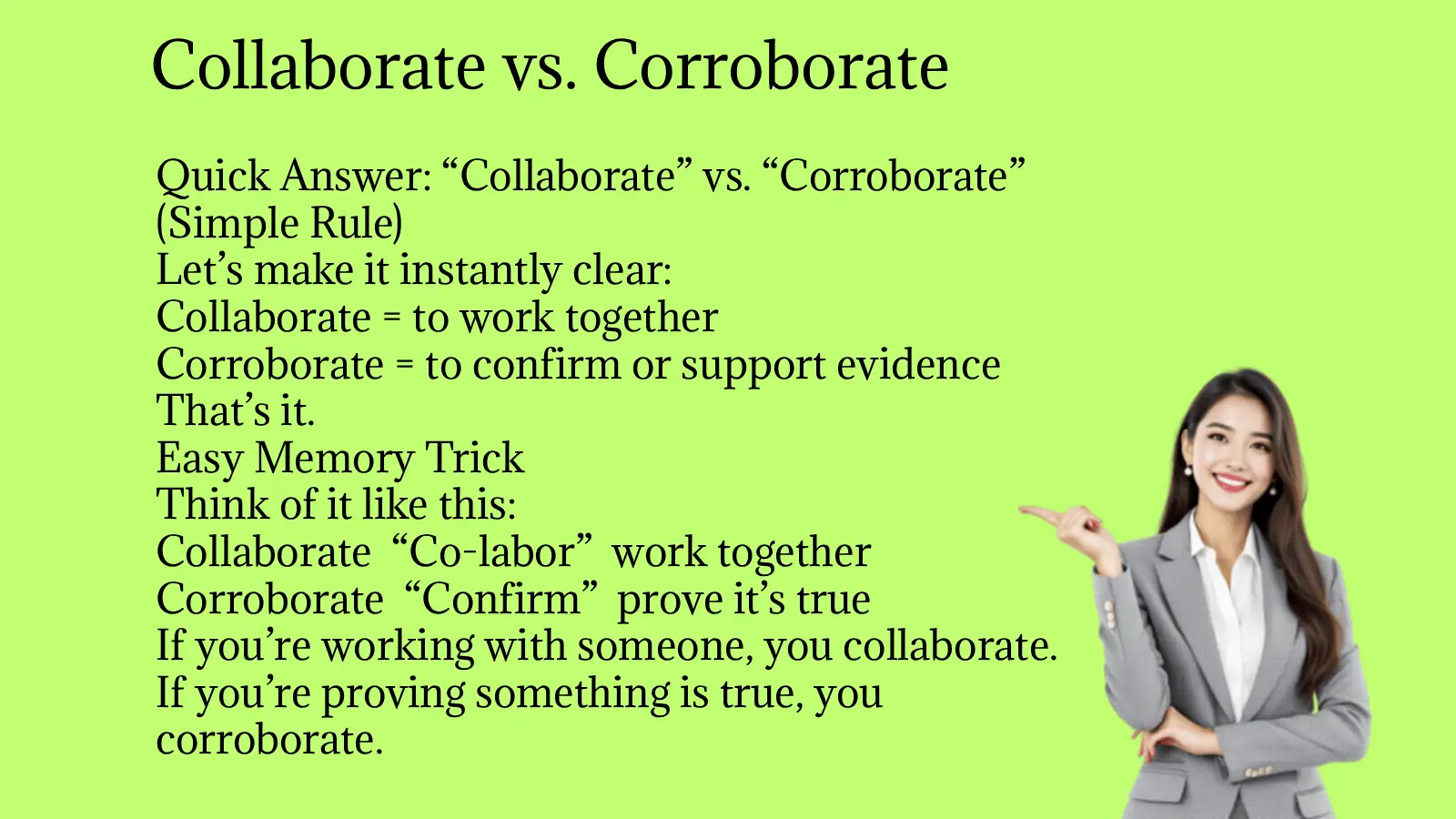
Quick Answer: “Collaborate” vs. “Corroborate” (Simple Rule)
Let’s make it instantly clear:
Collaborate = to work together
Corroborate = to confirm or support evidence
That’s it.
Easy Memory Trick
Think of it like this:
- Collaborate → “Co-labor” → work together
- Corroborate → “Confirm” → prove it’s true
If you’re working with someone, you collaborate.
If you’re proving something is true, you corroborate.
Why People Confuse “Collaborate” and “Corroborate”
The confusion happens for three simple reasons:
- They look similar on paper
- Both sound formal and academic
- Both are common in professional writing
But in reality, they belong to totally different worlds:
- One is about people working together
- The other is about truth and evidence
“Collaborate” Explained Clearly
At its core, collaborate means to work jointly with others toward a goal.
Simple Definition
To collaborate = to cooperate and create something together.
Real-Life Examples
- “We collaborated on a marketing campaign.”
- “The two companies are collaborating on a new product.”
- “Students collaborated on the group project.”
Where You’ll See It
- Business projects
- School assignments
- Creative work (music, design, writing)
- Tech and startups
Key Idea
If more than one person is building, creating, or working together, you are collaborating.
“Corroborate” Explained Clearly
Now let’s switch gears completely.
Corroborate means to confirm, support, or strengthen a statement or evidence.
Simple Definition
To corroborate = to provide proof or supporting evidence.
Real-Life Examples
- “The witness corroborated his story.”
- “Data from the study corroborates the findings.”
- “Her email corroborates what he said.”
Where You’ll See It
- Legal cases
- Journalism
- Research and science
- Investigations
Key Idea
If you are proving something is true using evidence, you are corroborating it.
The Biggest Difference (Simple Breakdown)
Here’s the cleanest way to see it:
| Word | Meaning | Category | Action Type |
|---|---|---|---|
| Collaborate | Work together | Teamwork | Creating |
| Corroborate | Confirm truth | Evidence | Proving |
The Most Common Mistake People Make
Here’s where things go wrong:
People assume both words mean “support.”
But support means two different things here:
- Collaborate = support by participating
- Corroborate = support by proving
Real-World Confusion Example
❌ “The scientist collaborated the theory with data.”
✔ “The scientist corroborated the theory with data.”
❌ “We corroborated on the project.”
✔ “We collaborated on the project.”
One is teamwork. The other is evidence. Mixing them breaks the meaning.
Side-by-Side Comparison (Quick Scan Table)
| Phrase | Correct Use | Example |
|---|---|---|
| Collaborate | Working together | “We collaborated on the app design.” |
| Corroborate | Confirming truth | “The evidence corroborates the claim.” |
Real-Life Examples of “Collaborate”
Let’s make it practical:
- “The artists collaborated on a song.”
- “Our team collaborated with engineers.”
- “They collaborated across departments.”
What’s happening here?
People are actively working together to create something.
Real-Life Examples of “Corroborate”
Now compare:
- “The footage corroborates the witness statement.”
- “His alibi was corroborated by security logs.”
- “Research data corroborates the hypothesis.”
What’s happening here?
Evidence is being used to confirm truth or accuracy.
Why Using the Wrong Word Can Be a Big Problem
This isn’t just grammar—it affects clarity.
Example in Professional Context
❌ “We collaborated the report with data.”
Sounds like people worked together with data (nonsense).
✔ “We corroborated the report with data.”
Now it means data supports the report.
In business, law, or research, this difference matters a lot.
Memory Trick That Always Works
Use this mental shortcut:
- Collaborate = “Let’s create together”
- Corroborate = “Let’s confirm it’s true”
Or even simpler:
👉 Collaborate = people
👉 Corroborate = proof
When to Use Each Word
Use “Collaborate” when:
- Working in a team
- Building something
- Sharing tasks
- Doing group work
Use “Corroborate” when:
- Checking facts
- Supporting evidence
- Verifying claims
- Strengthening arguments
Quick Decision Guide
Not sure which one to use?
Ask yourself:
- Am I talking about people working together? → Collaborate
- Am I talking about proof or evidence? → Corroborate
Still unsure? You’re probably trying to say collaborate.
FAQ: “Collaborate” vs. “Corroborate”
Is “corroborate” used in everyday English?
Not much. It’s more common in formal writing, journalism, and legal contexts.
Can people collaborate on evidence?
Yes—but then “collaborate” refers to people working together, not the evidence itself.
What’s the easiest way to remember the difference?
- Collaborate = Co-work
- Corroborate = Confirm
Why do they sound so similar?
Because they come from Latin roots and evolved with formal English vocabulary, but their meanings diverged completely.
Final Takeaway: The One Rule That Never Fails
Here’s the simplest way to lock it in:
If people are working together → Collaborate
If something is being proven true → Corroborate
And if you’re ever unsure in real life, slow down and think:
👉 “Am I talking about teamwork or truth?”
Because when it comes to collaborate vs. corroborate, clarity always wins over guesswork.