Have you ever paused while writing and wondered whether you should use shudder or shutter? You’re not alone. The confusion between Shudder vs. Shutter is surprisingly common because the two words look and sound similar, yet they have completely different meanings in English grammar and vocabulary.
Many English learners, writers, students, and even native speakers accidentally mix up these commonly confused words. A simple spelling mistake can change the entire meaning of a sentence. For example, someone might shudder with fear after hearing a loud noise, while a homeowner might shutter a window before a storm. Although the words differ by only one letter, they belong to different parts of speech and are used in very different contexts.
Understanding the difference between shudder meaning and shutter meaning is essential for clear communication, professional writing, academic work, and everyday conversations. This confusion often appears in emails, blog posts, social media content, and creative writing, making it an important grammar topic to master.
In this guide, you’ll learn the exact meanings of shudder and shutter, how each word is used in sentences, common grammar mistakes to avoid, pronunciation tips, real-life examples, and simple memory tricks that make the distinction easy to remember. We’ll also explore related concepts such as homophones, commonly confused words, English vocabulary, word usage, and spelling differences to help strengthen your overall language skills.
So if you’ve ever asked yourself, “Is it shudder or shutter?” or “What is the difference between shudder and shutter?”, you’re in the right place. Let’s break down this frequently confused word pair and make sure you never mix them up again.
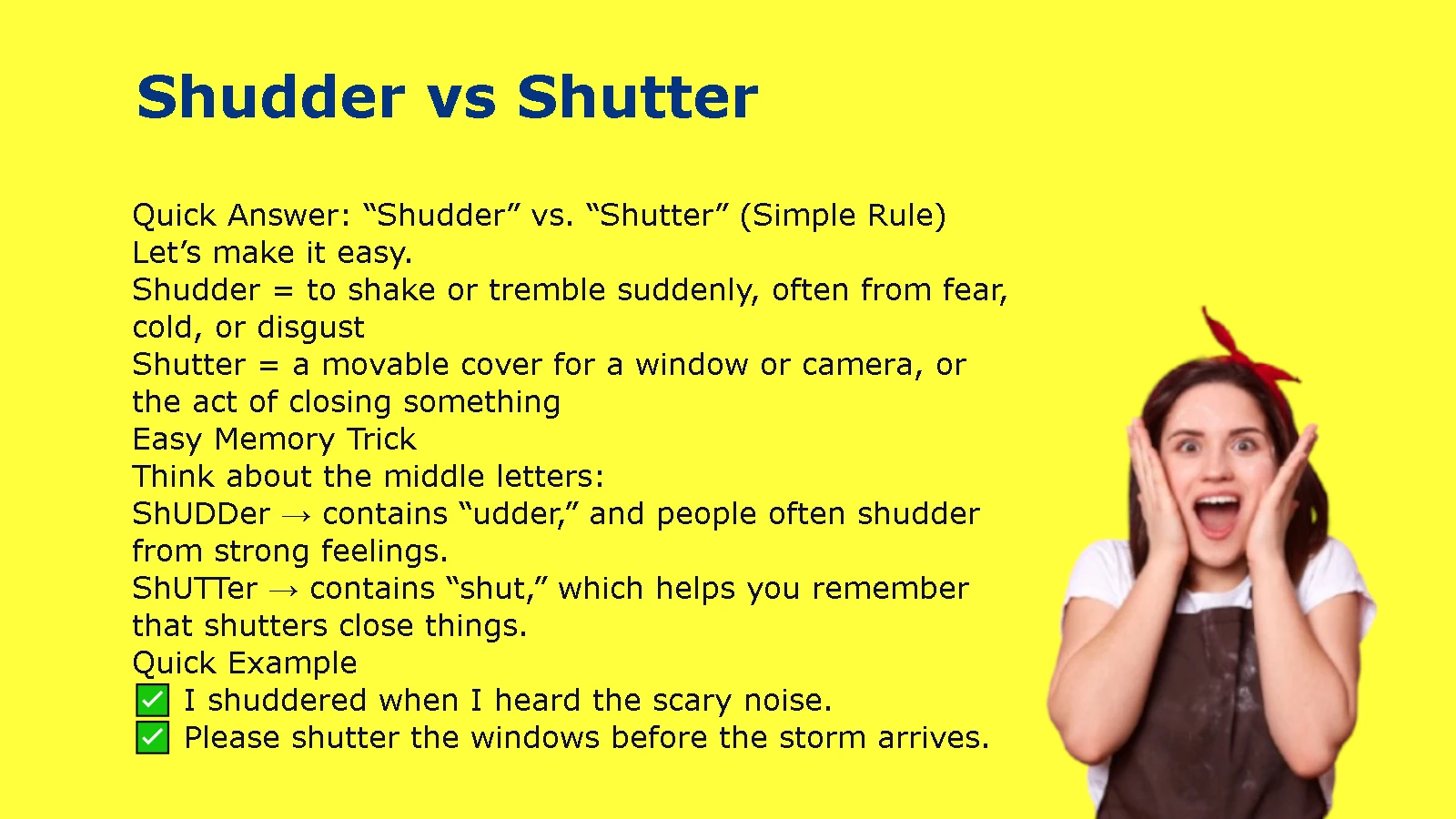
Quick Answer: “Shudder” vs. “Shutter” (Simple Rule)
Let’s make it easy.
Shudder = to shake or tremble suddenly, often from fear, cold, or disgust
Shutter = a movable cover for a window or camera, or the act of closing something
Easy Memory Trick
Think about the middle letters:
ShUDDer → contains “udder,” and people often shudder from strong feelings.
ShUTTer → contains “shut,” which helps you remember that shutters close things.
Quick Example
✅ I shuddered when I heard the scary noise.
✅ Please shutter the windows before the storm arrives.
How People Actually Use “Shudder” and “Shutter”
These words are confused because they sound similar when spoken quickly.
In Everyday Conversations
People sometimes type shutter when they mean shudder.
Others accidentally write shudder when talking about windows or cameras.
In Writing
The mistake becomes more noticeable because the meanings are completely different.
Why This Happens
- Similar spelling
- Similar pronunciation
- Fast typing
- Spell-check doesn’t always catch the error
The Core Difference Between “Shudder” and “Shutter”
The easiest way to understand the difference is to focus on what each word describes.
| Word | Meaning | Related To |
| Shudder | Tremble or shake suddenly | Feelings, reactions, movement |
| Shutter | Window cover or closing something | Buildings, cameras, businesses |
Key Insight
If something is shaking, use shudder.
If something is closing, use shutter.
“Shudder” Explained Clearly (With Examples)
At its core, shudder means to shake briefly because of a strong emotion or sensation.
Common Reasons People Shudder
- Fear
- Cold temperatures
- Disgust
- Anxiety
- Shock
Examples
- I shuddered at the thought of touching the spider.
- She shuddered when the icy wind hit her face.
- The memory made him shudder.
- We all shuddered after hearing the ghost story.
Figurative Use
Writers often use shudder to create emotion.
Example:
The entire town seemed to shudder after the earthquake.
Key Takeaway
Whenever someone or something trembles from emotion, fear, cold, or shock, shudder is usually the correct word.
“Shutter” Explained Clearly (With Examples)
Now let’s look at shutter.
A shutter is typically a cover placed over a window. It can also refer to closing a business, building, or operation.
As a Noun
Examples:
- The storm damaged several window shutters.
- The wooden shutters were painted blue.
- She opened the shutters to let sunlight in.
As a Verb
Examples:
- The company decided to shutter its old factory.
- They shuttered the store after years of declining sales.
- Please shutter the cabin before leaving.
Camera Meaning
Photographers also use the term shutter.
Examples:
- Adjust the camera shutter speed.
- The shutter clicked as the picture was taken.
Key Takeaway
If you’re talking about windows, cameras, or closing something, use shutter.
The Biggest Mistake People Make
The most common error is using shutter when describing an emotional reaction.
Incorrect
❌ I shuttered when I saw the horror movie.
Correct
✅ I shuddered when I saw the horror movie.
Another Example
❌ The cold air made me shutter.
✅ The cold air made me shudder.
Why It Happens
People often remember the sound of the word but forget its meaning.
Side-by-Side Comparison Table
Here’s a quick reference guide.
| Word | Part of Speech | Meaning | Example |
| Shudder | Verb/Noun | Tremble from emotion or sensation | I shuddered with fear. |
| Shutter | Noun/Verb | Window cover or act of closing | They shuttered the store. |
Real-Life Examples of “Shudder”
Let’s see the word in action.
Common Situations
- I shudder whenever I watch horror movies.
- The child shuddered during the thunderstorm.
- She shuddered at the smell.
- His voice made me shudder.
Mini Scenario
A friend describes a haunted house attraction:
“I actually shuddered when someone jumped out from the darkness.”
The reaction is emotional and physical, so shuddered is correct.
Real-Life Examples of “Shutter”
Now compare.
Common Situations
- The owner decided to shutter the restaurant.
- Strong winds damaged the shutters.
- The camera shutter opened and closed quickly.
- They shuttered the office for renovations.
Mini Scenario
A weather report warns residents:
“Please shutter your windows before the hurricane arrives.”
Because the action involves closing protective panels, shutter is correct.
Common Expressions Using “Shudder”
Popular Examples
- Shudder with fear
- Shudder at the thought
- Shudder in disgust
- Make someone shudder
Example Sentences
- I shudder at the thought of speaking in front of thousands of people.
- The scene made viewers shudder.
- He shuddered with anxiety before the interview.
Common Expressions Using “Shutter”
Popular Examples
- Shutter the business
- Window shutters
- Shutter speed
- Shutter the operation
Example Sentences
- Rising costs forced the company to shutter several locations.
- The photographer adjusted the shutter speed.
- New shutters improved the home’s appearance.
How to Avoid Confusion Every Time
Want a foolproof method?
Ask Yourself One Question
Is someone shaking or trembling?
→ Use shudder
Is something being closed or covered?
→ Use shutter
Visual Test
Imagine:
- A frightened person trembling → shudder
- A window being closed → shutter
Why This Works
The meanings are completely different, making identification easy once you focus on context.
What to Say Instead
If you’re still unsure, use alternatives.
Alternatives to “Shudder”
- Tremble
- Shake
- Quiver
- Shiver
Alternatives to “Shutter”
- Close
- Seal
- Cover
- Board up
Example
Instead of:
The company shuttered the building.
You could say:
The company closed the building.
Quick Decision Guide (Use This Instantly)
When choosing between the two:
Use “Shudder” If:
- Someone trembles
- Fear is involved
- Disgust is involved
- Cold causes shaking
Use “Shutter” If:
- Windows are involved
- Cameras are involved
- A business closes
- Something is being shut
Simple. Reliable. Done.
FAQ: “Shudder” vs. “Shutter”
Is “shudder” a feeling?
Not exactly. It is the physical reaction to a strong feeling such as fear, disgust, or shock.
Can “shutter” mean close a business?
Yes. Companies often use “shutter” when permanently or temporarily closing operations.
Which word relates to cameras?
Shutter. Cameras have a shutter that controls light exposure.
Why do people confuse these words?
Because they look and sound similar despite having very different meanings.
Case Study: A Costly Writing Mistake
A travel blogger wrote:
“I shuttered when I looked over the edge of the cliff.”
Readers quickly pointed out the error.
What Happened
The writer meant:
“I shuddered when I looked over the edge of the cliff.”
Why It Matters
Using the wrong word changes the meaning and can make professional writing appear less polished.
Fix
Remember:
Shudder = shake
Shutter = shut
Problem solved.
Key Facts You Should Remember
- Shudder means to tremble or shake suddenly.
- Shutter refers to a window cover or closing something.
- Fear, disgust, and cold often cause people to shudder.
- Businesses, windows, and cameras are associated with shutters.
- The words sound similar but have completely different meanings.
- Context usually reveals the correct choice.
Final Takeaway: The One Rule That Never Fails
Here’s the simplest way to remember the difference.
If someone reacts physically to fear, cold, disgust, or shock, use shudder.
If you’re talking about windows, cameras, or closing a business or building, use shutter.
Think of it this way:
Shudder = Shake
Shutter = Shut
That one memory trick will help you choose the correct word almost every time.
Because when it comes to “Shudder” vs. “Shutter,” the difference is small in spelling but huge in meaning.