Have you ever come across Tinder vs. Tender and wondered whether they are simply spelling variations or two completely different words? You’re not alone. These commonly confused words often cause mistakes in English grammar, vocabulary, writing, and everyday communication because they look and sound somewhat similar but carry entirely different meanings.
The confusion usually happens when people are typing quickly, relying on spell check, or learning English as a second language. While tender is a well-established word with meanings related to kindness, softness, care, and formal offers, Tinder is widely recognized as a popular dating app used for online dating and social connections. Mixing them up can change the meaning of a sentence completely and sometimes create embarrassing misunderstandings.
Understanding the difference between Tinder and Tender is important for improving your English vocabulary, avoiding common grammar mistakes, and communicating more clearly in both personal and professional situations. Whether you’re writing an email, creating content, posting on social media, or simply expanding your language skills, knowing when to use each term can help you sound more confident and accurate.
In this guide, you’ll learn the exact meanings of Tinder vs. Tender, how they are used in modern English, their pronunciation differences, real-life examples, common usage mistakes, and practical tips to remember the correct word every time. We’ll also explore related concepts such as word choice, homophones and near-homophones, English language usage, online dating terminology, and formal communication vocabulary.
So if you’ve ever paused before writing Tinder or Tender, this complete comparison will help you understand the difference and use both words correctly with confidence.
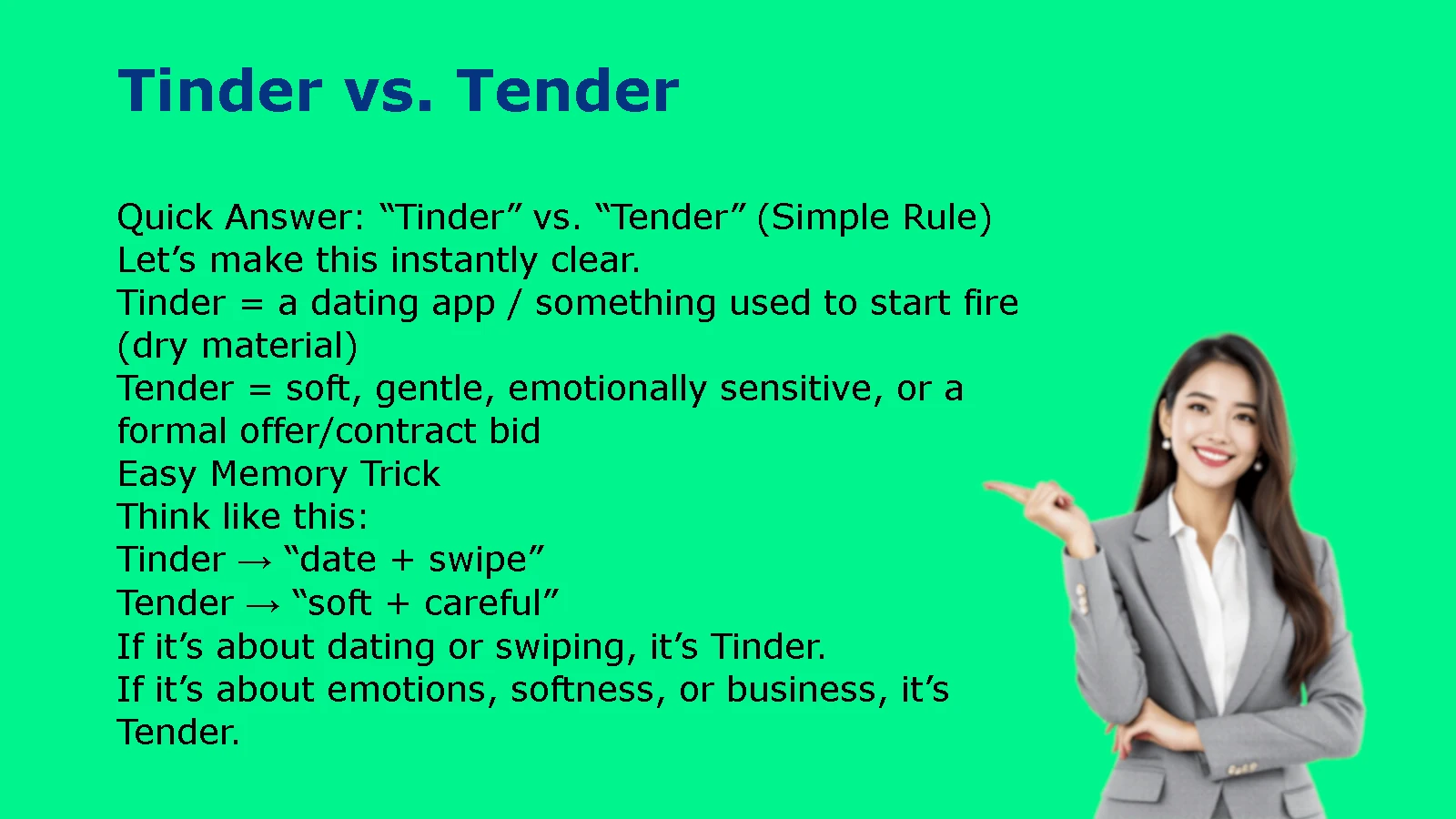
Quick Answer: “Tinder” vs. “Tender” (Simple Rule)
Let’s make this instantly clear.
- Tinder = a dating app / something used to start fire (dry material)
- Tender = soft, gentle, emotionally sensitive, or a formal offer/contract bid
Easy Memory Trick
Think like this:
- Tinder → “date + swipe”
- Tender → “soft + careful”
If it’s about dating or swiping, it’s Tinder.
If it’s about emotions, softness, or business, it’s Tender.
Why People Confuse “Tinder” and “Tender”
This confusion is more common than you think.
1. They Sound Similar
In fast speech, “tinder” and “tender” can sound almost identical.
2. Autocorrect Problems
Typing quickly often leads to:
- “tender profile” instead of “Tinder profile”
- “Tinder moment” instead of “tender moment”
3. No Context Awareness
Without context, your brain tries to guess meaning based on sound—not logic.
4. Mixed Exposure
People see both words in completely different settings:
- Dating apps (Tinder)
- Emotional writing or cooking (tender)
“Tinder” Explained Clearly (With Real Meaning)
The word Tinder has two main meanings today.
1. Tinder (Dating App)
The most popular modern meaning.
It is a dating app where users:
- Swipe right to like
- Swipe left to pass
- Match with other users
Example Sentences
- “I matched with someone on Tinder.”
- “She deleted Tinder last month.”
- “They met through Tinder.”
2. Tinder (Old Meaning – Fire Starting Material)
Before apps existed, tinder meant:
Dry material used to start a fire.
Example Sentences
- “He used dry leaves as tinder.”
- “Tinder catches fire easily.”
Key Insight
Modern usage = dating app
Traditional usage = fire-starting material
“Tender” Explained Clearly (With Real Meaning)
Now let’s break down Tender, which has multiple meanings depending on context.
1. Tender (Emotionally Soft / Gentle)
Used to describe feelings or behavior.
Example
- “She has a tender heart.”
- “That was a tender moment.”
It means:
- gentle
- soft
- emotionally sensitive
2. Tender (Physically Soft)
Often used in food or physical touch.
Example
- “The meat is tender.”
- “Her skin is tender after sunburn.”
It means:
- soft texture
- easy to chew or touch
3. Tender (Business / Formal Offer)
In business, a “tender” is a bid or proposal.
Example
- “The company submitted a tender for the project.”
- “Government contracts go through tendering.”
It means:
- official offer
- competitive bid
Side-by-Side Comparison Table
| Word | Meaning | Category | Example |
| Tinder | Dating app / fire starter | Technology / Nature | “I met her on Tinder.” |
| Tender | Soft, gentle, or formal bid | Emotion / Food / Business | “The meat is tender.” |
Real-Life Examples of “Tinder”
Let’s see it in everyday use.
Dating Context
- “He’s active on Tinder again.”
- “They met on Tinder last year.”
Casual Conversation
- “I deleted Tinder because I needed a break.”
What It Always Refers To
- Online dating or matching people
Real-Life Examples of “Tender”
Now compare it with real usage.
Emotional Meaning
- “That was a tender goodbye.”
- “She spoke in a tender voice.”
Food Meaning
- “This chicken is tender and juicy.”
- “Cook until the meat is tender.”
Business Meaning
- “They won the tender for construction work.”
The Biggest Mistake People Make
Here’s where confusion becomes real.
People mix up meanings like this:
- “He is very Tinder-hearted” ❌
- “I had a tender match” ❌
- “That meat is Tinder” ❌
These mistakes happen because:
- Sound similarity
- Fast typing
- Lack of context
Quick Fix Rule (Never Get Confused Again)
Use this simple system:
- Tinder = App or fire
- Tender = Everything soft, emotional, or formal business offers
If it involves swiping → Tinder
If it involves feelings, texture, or official proposals → Tender
Regional Usage Notes
English-Speaking Countries
- Tinder is widely known as a dating app
- Tender is used in emotional, food, and business contexts
Global Learners
- Most confusion happens in spoken English
- Speech recognition often mixes them up
Digital Communication
- Autocorrect increases mistakes in typing
How to Avoid Confusion Every Time
Here are practical tips:
1. Check Context First
Ask:
- Is this about dating? → Tinder
- Is this about softness or emotion? → Tender
2. Look at Surrounding Words
- “Swipe” → Tinder
- “Soft / emotional / meat / contract” → Tender
3. Use Full Phrases
Instead of just “Tinder,” write:
- “Tinder app”
- “Tender moment”
- “tender meat”
Quick Decision Guide
Use this anytime:
- Dating app → Tinder
- Emotional softness → Tender
- Food texture → Tender
- Business bid → Tender
- Fire-starting material → Tinder
FAQ: “Tinder” vs. “Tender”
Is Tinder and tender the same word?
No. They are completely different words with unrelated meanings.
Why do they sound similar?
Because of similar pronunciation patterns in fast speech.
Can tender mean love?
Yes, in emotional context it means gentle affection or care.
Is Tinder only a dating app?
Mostly yes today, though it originally referred to fire-starting material.
Final Takeaway: The One Rule That Never Fails
Here’s the simplest way to remember it:
If it’s about swiping or dating → Tinder
If it’s about softness, emotions, or formal offers → Tender
Confusion happens when words sound alike—but meaning always depends on context.
So instead of guessing, just pause and ask:
“Am I talking about dating, or everything else?”
Because when it comes to “Tinder” vs. “Tender,” clarity is what saves you from the biggest mix-ups.