Have you ever come across Pendant vs. Pendent and wondered whether they’re simply alternative spellings or two completely different words? You’re not alone. These commonly confused words look almost identical, share the same linguistic roots, and even sound similar in everyday conversation. Because of this, many English learners, writers, students, and professionals struggle to know which term is correct in a particular context.
The confusion becomes even more noticeable when discussing jewelry, English vocabulary, legal terminology, grammar rules, or formal writing. While pendant is most often associated with a decorative necklace accessory or fashion jewelry, pendent is primarily used as an adjective meaning hanging, suspended, or pending. Using the wrong word can make your writing appear inaccurate, especially in academic, legal, or professional settings.
The good news is that the distinction is easier to understand than many people think. Once you learn the meanings, usage patterns, and grammatical functions of each word, choosing between pendant and pendent becomes straightforward.
In this guide, you’ll discover the exact difference between Pendant vs. Pendent, their definitions, pronunciation, origins, and real-world usage. You’ll also learn how these terms appear in English grammar, jewelry terminology, fashion accessories, legal documents, and everyday communication. Along the way, we’ll cover practical examples, common mistakes, memory tricks, and expert tips to help you use both words confidently and correctly.
So, if you’re ready to master this frequently confused word pair and strengthen your English vocabulary, let’s dive in.
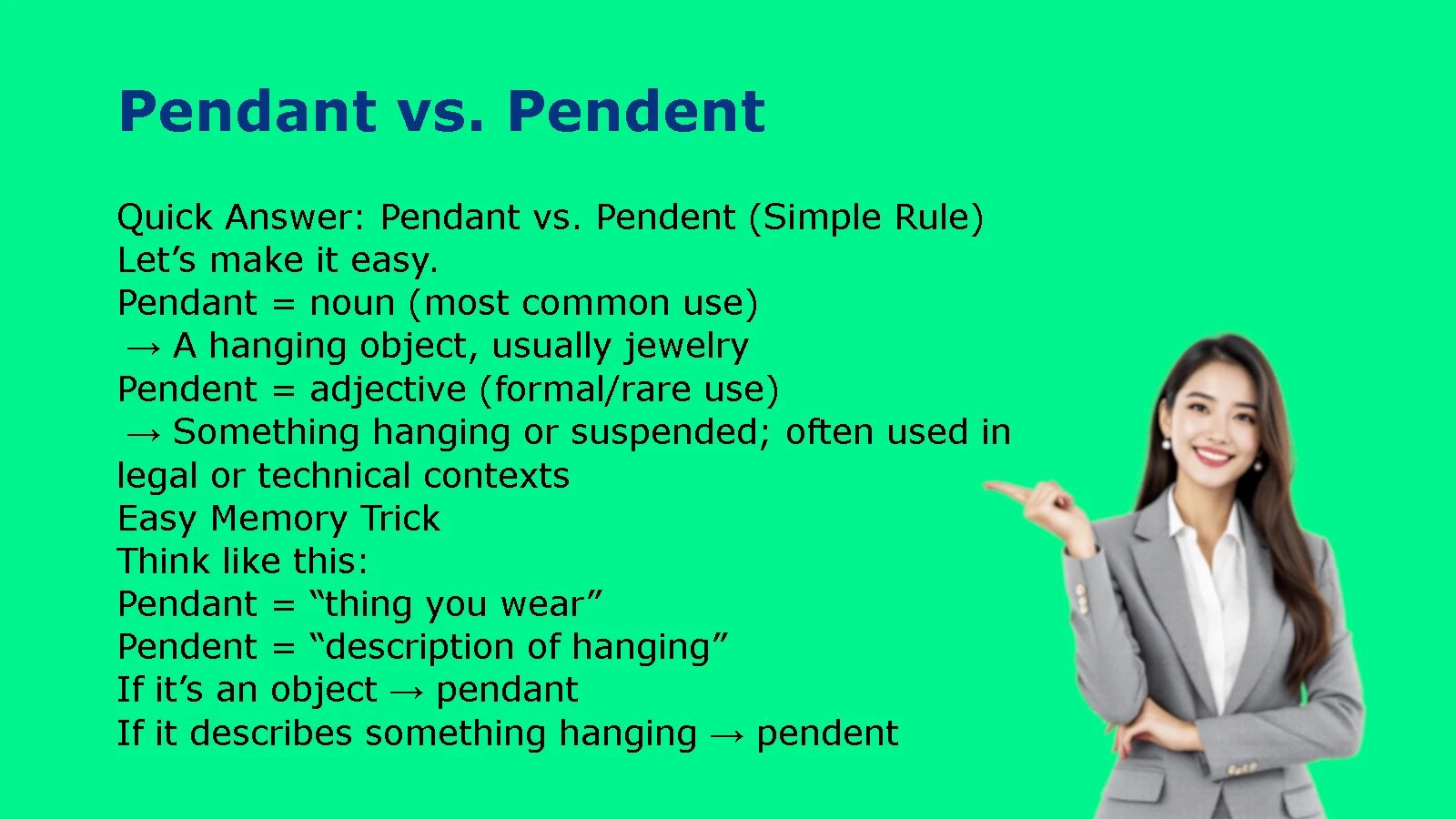
Quick Answer: Pendant vs. Pendent (Simple Rule)
Let’s make it easy.
Pendant = noun (most common use)
→ A hanging object, usually jewelry
Pendent = adjective (formal/rare use)
→ Something hanging or suspended; often used in legal or technical contexts
Easy Memory Trick
Think like this:
- Pendant = “thing you wear”
- Pendent = “description of hanging”
If it’s an object → pendant
If it describes something hanging → pendent
The Core Difference (In One Line)
- Pendant = physical item that hangs
- Pendent = state of hanging or awaiting completion
“Pendant” Explained Clearly (Most Common Meaning)
The word pendant is what you’ll see almost everywhere in daily English.
1. Jewelry Meaning (Most Important Use)
A pendant is a piece of jewelry that hangs from a chain.
Examples:
- She wore a gold pendant around her neck.
- The diamond pendant sparkled in the light.
- He gifted her a heart-shaped pendant.
👉 This is the meaning 95% of people use.
2. Decorative Object Meaning
Sometimes used for hanging decorations or objects.
Examples:
- The lamp had a glass pendant design.
- The room was lit by hanging pendants.
“Pendent” Explained Clearly (Rare but Important)
Now comes the confusing one.
Pendent is mostly used as an adjective and is less common in everyday speech.
1. Meaning: Hanging or Suspended
Examples:
- A pendent drop of water formed on the leaf.
- The stone was left pendent from the cliff edge.
2. Legal / Formal Use
In legal language, “pendent” often relates to something awaiting decision.
Example:
- A case is pendent in court (still unresolved).
This is where you may also see phrases like:
- pendent jurisdiction (legal term)
Side-by-Side Comparison Table
| Word | Type | Meaning | Usage Level |
| Pendant | Noun | Hanging object (especially jewelry) | Very common |
| Pendent | Adjective | Hanging / suspended / pending | Rare/formal |
Real-Life Examples (Easy Understanding)
Pendant in Real Life
- “I bought a silver pendant online.”
- “Her necklace has a crystal pendant.”
- “The shop sells handmade pendants.”
👉 Always an object you can touch.
Pendent in Real Life
- “The branch held a pendent leaf.”
- “The issue remains pendent before the court.”
- “A pendent structure hung from the ceiling.”
👉 Describes a condition or state.
The Biggest Mistake People Make
Here’s where confusion happens:
People assume both words mean the same thing because they look similar.
What Goes Wrong:
- Using pendent when talking about jewelry ❌
- Using pendant in legal/technical writing incorrectly ❌
Correct Thinking:
- Jewelry = pendant
- Technical description = pendent
Why This Confusion Happens
There are three reasons:
- They look almost identical
- Both relate to “hanging” ideas
- “Pendent” is rarely taught in everyday English
So most people default to “pendant” for everything.
Simple Usage Guide (Quick Decision Rule)
Use this every time:
- Talking about jewelry → Pendant
- Talking about something hanging (formal/technical) → Pendent
- Still unsure → use pendant (it’s safer in modern English)
Clear Alternatives You Can Use
Instead of confusing words, use:
- “Hanging necklace piece” → pendant
- “Suspended object” → pendent description
- “Still pending” → use “pending” instead of pendent in most cases
FAQ: Pendant vs. Pendent
Is “pendent” wrong?
No, but it is rare and formal. Most modern usage prefers “pendant” or “pending.”
Can I use “pendent” for jewelry?
No. Always use pendant for jewelry.
Why does “pendent” still exist?
It survives in legal, architectural, and technical writing.
Final Takeaway: The One Rule That Never Fails
Here’s the simplest way to remember it:
👉 If you can wear it → it’s a pendant
👉 If it describes hanging → it’s pendent
And in most real-world situations, you’ll only ever need pendant.
Because when it comes to pendant vs. pendent, clarity always beats complexity.