E.g. vs I.e. is one of the most confusing grammar pairings in writing—but have you ever used them in an email or essay and felt unsure if you got it right? You’re not alone. Many writers, students, and professionals mix up these two abbreviations, even though they serve completely different purposes.
But here’s the kicker: using the correct one instantly makes your writing clearer and more professional. And it gets better… once you understand the simple difference, you’ll never confuse them again. In this guide, you’ll learn e.g. vs i.e., what each one means, when to use them, and easy tricks to remember the difference so your writing always stays precise and confident.
Quick Answer: “e.g.” vs. “i.e.” (Simple Rule)
Let’s make this easy.
- e.g. = for example
- i.e. = in other words
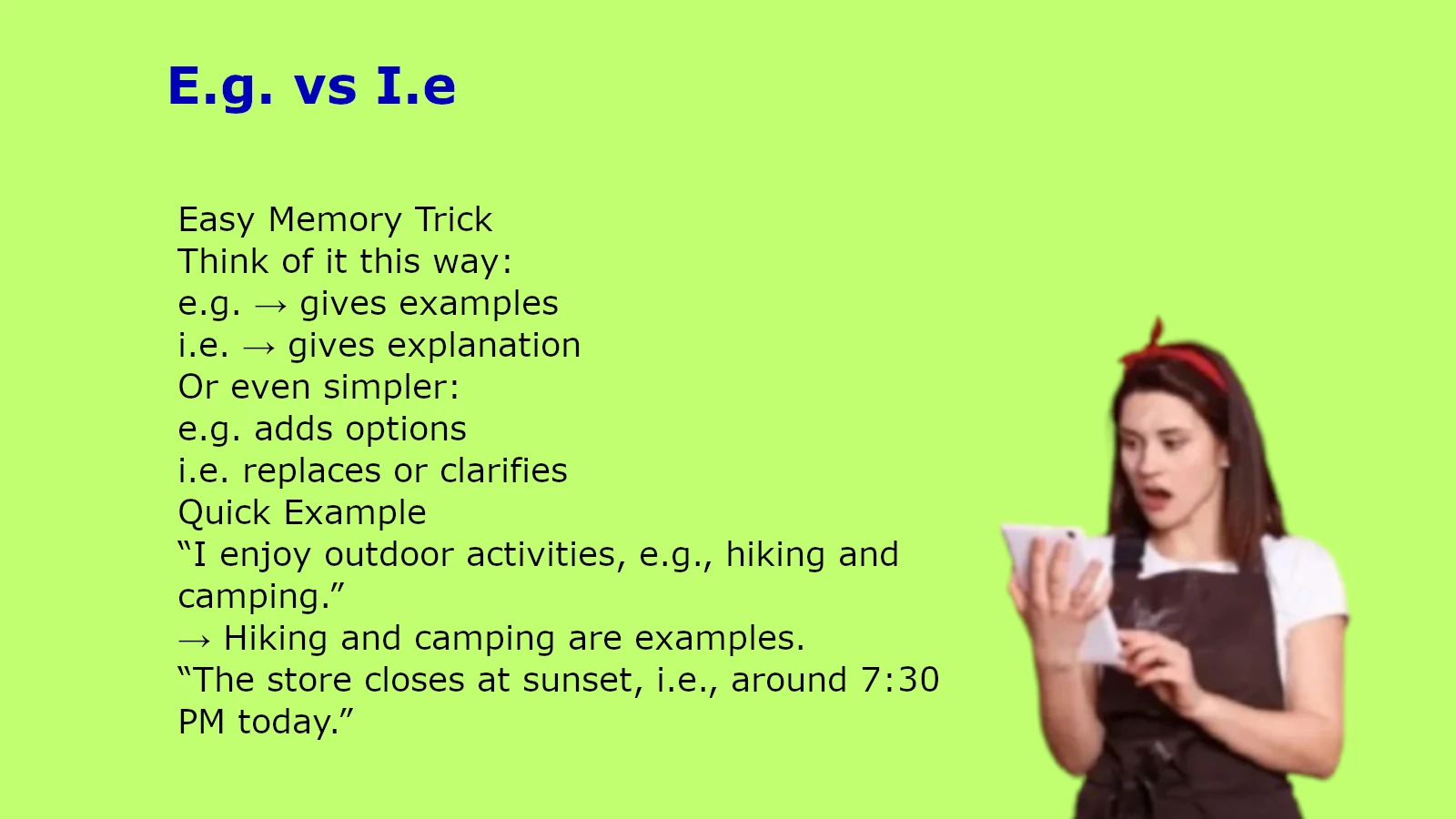
Easy Memory Trick
Think of it this way:
- e.g. → gives examples
- i.e. → gives explanation
Or even simpler:
- e.g. adds options
- i.e. replaces or clarifies
Quick Example
“I enjoy outdoor activities, e.g., hiking and camping.”
→ Hiking and camping are examples.
“The store closes at sunset, i.e., around 7:30 PM today.”
→ 7:30 PM explains the exact meaning.
What Do “e.g.” and “i.e.” Actually Mean?
These abbreviations come from Latin, which is why they confuse so many people.
Meaning of “e.g.”
“e.g.” stands for the Latin phrase:
exempli gratia → “for the sake of example”
What It Does
It introduces one or more examples.
Example
“You should eat more fruits, e.g., apples, bananas, and oranges.”
This means apples, bananas, and oranges are examples — not the complete list.
Meaning of “i.e.”
“i.e.” stands for:
id est → “that is”
What It Does
It clarifies or restates something more precisely.
Example
“She works the night shift, i.e., from 10 PM to 6 AM.”
The second part explains exactly what “night shift” means.
The Core Difference Between “e.g.” and “i.e.”
This is the rule that solves almost every confusion.
“e.g.” Gives Examples
It means:
“Here are some possibilities.”
Example
“You need office supplies, e.g., pens and notebooks.”
Pens and notebooks are only examples. Other supplies are possible too.
“i.e.” Gives Exact Meaning
It means:
“Here’s exactly what I mean.”
Example
“He’s visiting the largest city in France, i.e., Paris.”
Paris is not an example. It’s the exact answer.
The Simple Logic Behind “e.g.” vs. “i.e.”
Here’s the easiest way to think about it.
Ask Yourself One Question
Are you:
- giving examples?
OR - explaining something exactly?
If You’re Giving Examples → Use “e.g.”
If You’re Clarifying Meaning → Use “i.e.”
That’s the entire system.
“e.g.” Explained Clearly (With Examples)
Let’s break it down further.
When to Use “e.g.”
Use “e.g.” when you want to mention sample items from a larger group.
Standard Structure
General statement → examples
Examples
“Many countries, e.g., Japan and Canada, have strong public transportation.”
“Bring something to read, e.g., a novel or magazine.”
Important Detail
The examples are NOT the full list.
That’s what makes “e.g.” different from “i.e.”
Wrong Understanding
“e.g.” does NOT mean:
“These are the only options.”
Edge Case: Long Lists
Sometimes writers overuse “e.g.” in long sentences.
Confusing Version
“We sell electronics, e.g., phones, tablets, laptops, chargers, headphones, smartwatches…”
Too messy.
Better Version
“We sell electronics, e.g., phones and laptops.”
Keep examples short and clear.
“i.e.” Explained Clearly (With Examples)
Now let’s tackle “i.e.”
When to Use “i.e.”
Use it when you want to restate something in a more specific or exact way.
Standard Structure
General idea → exact clarification
Examples
“The conference begins in the afternoon, i.e., at 1 PM.”
“She’s bilingual, i.e., fluent in two languages.”
Key Insight
Everything after “i.e.” should match the meaning exactly.
Example
“He lives in the capital of Italy, i.e., Rome.”
Rome completely explains the phrase.
Common Mistake
People often use “i.e.” when they really mean “for example.”
Incorrect
“You should learn a programming language, i.e., Python.”
This sounds like Python is the ONLY language.
Better
“You should learn a programming language, e.g., Python.”
Now Python is just one example.
The Biggest Mistake People Make
Most confusion comes from one issue:
People treat “e.g.” and “i.e.” as interchangeable.
They’re not.
What Goes Wrong
Using “i.e.” accidentally limits meaning
Using “e.g.” accidentally weakens meaning
Real Example
Incorrect:
“Employees must wear protective gear, i.e., helmets and gloves.”
This implies ONLY helmets and gloves count.
Better:
“Employees must wear protective gear, e.g., helmets and gloves.”
Now they’re examples.
Side-by-Side Comparison Table
| Phrase | Meaning | Purpose | Easy Translation |
| e.g. | for example | Gives examples | “such as” |
| i.e. | that is | Clarifies meaning | “in other words” |
Real-Life Examples of “e.g.”
Let’s make this practical.
Common Situations
“You should avoid sugary drinks, e.g., soda and energy drinks.”
“Some skills, e.g., communication and leadership, improve career growth.”
“I enjoy winter sports, e.g., skiing.”
What They Mean
The items mentioned are examples — not the full category.
Real-Life Examples of “i.e.”
Now compare them with “i.e.”
Common Situations
“The office opens at the same time daily, i.e., 8 AM.”
“He completed the marathon distance, i.e., 42.2 kilometers.”
“They moved to the largest state in the U.S., i.e., Alaska.”
What They Mean
The second part precisely explains the first part.
Punctuation Rules Most People Forget
This part trips up many writers.
Comma Usage
In American English, commas usually follow both abbreviations.
Correct
“Bring snacks, e.g., chips and fruit.”
“The store closes early, i.e., before sunset.”
Parentheses Usage
Both are commonly used inside parentheses.
Example
“Some animals (e.g., dolphins and whales) are highly intelligent.”
Formal Writing Tip
In highly formal writing, some style guides prefer:
- “for example”
- “that is”
instead of abbreviations.
How to Remember the Difference Forever
Here are memory tricks that actually work.
Memory Trick #1
e.g. = Example Given
Both start with “e.”
Memory Trick #2
i.e. = In Essence
It explains the essence or exact meaning.
Memory Trick #3
Replace the phrase mentally.
If “for example” fits → use “e.g.”
If “in other words” fits → use “i.e.”
What to Say Instead (Clear Alternatives)
Sometimes abbreviations feel too formal or confusing.
Here are cleaner alternatives.
Instead of “e.g.”
- for example
- such as
- including
Example
“You should eat healthy foods, such as vegetables and fish.”
Instead of “i.e.”
- in other words
- specifically
- that is
Example
“She arrives early, specifically at 7 AM.”
Quick Decision Guide (Use This Instantly)
When you’re unsure, follow this:
Are you giving examples?
→ Use e.g.
Are you explaining exact meaning?
→ Use i.e.
Still unsure?
Replace it mentally:
- “for example” → e.g.
- “in other words” → i.e.
Simple. Reliable. Done.
FAQ: “e.g.” vs. “i.e.”
Is “e.g.” the same as “etc.”?
No.
- “e.g.” introduces examples
- “etc.” means the list continues
Example
“We sell stationery, e.g., pens and notebooks.”
“We sell pens, notebooks, folders, etc.”
Can I use “i.e.” to give examples?
Usually no.
“i.e.” gives exact clarification, not sample items.
Are these abbreviations formal?
Yes, especially in academic and business writing.
But many modern writers prefer plain English for clarity.
Should I capitalize them?
Normally no.
Use lowercase:
- e.g.
- i.e.
Case Study: A Small Writing Mistake That Changed Meaning
A company handbook stated:
“Employees may work remotely on weekdays, i.e., Monday and Wednesday.”
Workers became confused.
Did that mean:
- only Monday and Wednesday?
OR - Monday and Wednesday are examples?
The company actually meant examples.
The Fix
“Employees may work remotely on weekdays, e.g., Monday and Wednesday.”
One small abbreviation completely changed the meaning.
Key Facts You Should Remember
- e.g. means “for example”
- i.e. means “that is”
- “e.g.” gives sample possibilities
- “i.e.” gives exact clarification
- They are NOT interchangeable
- Wrong usage can change meaning entirely
Final Takeaway: The One Rule That Never Fails
Here’s the simplest way to remember everything.
If you’re adding examples:
→ use e.g.
If you’re explaining exactly what you mean:
→ use i.e.
That’s it.
Think of “e.g.” as opening the door to possibilities.
Think of “i.e.” as narrowing everything down to one exact meaning.
And when clarity matters most — especially in work, school, or professional writing — using the right one makes your message instantly clearer.
Because with “e.g.” vs. “i.e.”, small punctuation can create a very big difference.