Have you ever wondered whether “Fewer vs Less” is just a simple grammar choice or one of those confusing English rules that even native speakers sometimes get wrong? This is a very common area of confusion in English grammar, especially for learners who often encounter these words in writing, exams, and everyday communication.
In simple terms, “fewer” is used with countable nouns—things you can individually count, such as books, apples, or students. On the other hand, “less” is used with uncountable nouns—things that cannot be counted one by one, such as water, time, sugar, or money. Although both words express a smaller amount or quantity, their usage depends on whether the noun is countable or uncountable in English grammar.
This confusion frequently appears in searches like fewer vs less difference, when to use fewer and less, grammar rules for fewer and less, and how to use fewer in a sentence, showing how many learners struggle with this rule while improving their writing skills and vocabulary.
For example, we say “fewer mistakes in your essay,” but “less time to complete the task.” Similarly, “fewer students attended the class,” but “less water is available today.” These small differences play a big role in making your English more accurate, professional, and fluent.
In this guide, you’ll learn the clear difference between fewer and less, along with grammar rules, real-life examples, and simple memory tricks to help you use them correctly every time you write or speak English.
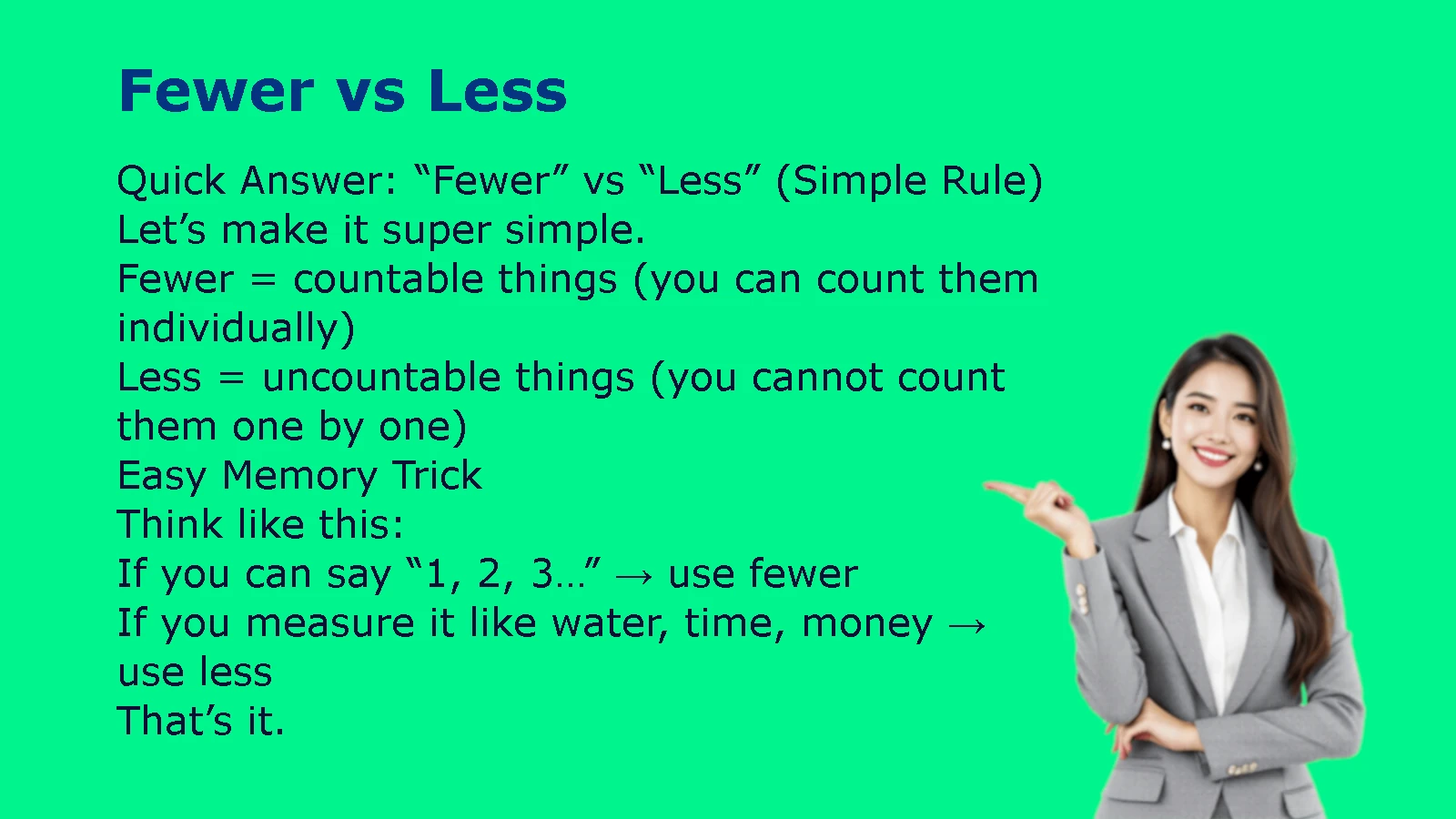
Quick Answer: “Fewer” vs “Less” (Simple Rule)
Let’s make it super simple.
Fewer = countable things (you can count them individually)
Less = uncountable things (you cannot count them one by one)
Easy Memory Trick
Think like this:
- If you can say “1, 2, 3…” → use fewer
- If you measure it like water, time, money → use less
That’s it.
The Core Difference Between Fewer and Less
At the heart of it, this rule is about countability vs quantity.
| Word | Type of Noun | Example |
| Fewer | Countable nouns | cars, books, people |
| Less | Uncountable nouns | water, money, time |
Key Insight
- Fewer = individual items
- Less = total amount or mass
“Fewer” Explained Clearly (With Real Examples)
We use fewer when we can count items one by one.
Common Examples
- “There are fewer students in class today.”
- “I have fewer assignments this week.”
- “We need fewer chairs in the room.”
Why It Works
You can count:
- 1 student, 2 students, 3 students
- 1 chair, 2 chairs, 3 chairs
So the word fewer fits perfectly.
Real-Life Scenario
You walk into a library and notice:
- 20 people yesterday
- 12 people today
You say:
👉 “There are fewer people today.”
“Less” Explained Clearly (With Real Examples)
We use less when we talk about something as a whole amount.
Common Examples
- “I have less money than before.”
- “Drink less water at night.”
- “There is less time left.”
Why It Works
You don’t count:
- water in individual units (you measure it)
- time in separate pieces (you measure duration)
- money as single objects in everyday use
Real-Life Scenario
You check your schedule:
- 5 hours free yesterday
- 2 hours free today
You say:
👉 “I have less time today.”
The Biggest Mistake People Make
Here’s where things go wrong.
Many people use “less” for everything in casual speech.
Incorrect but Common:
- “Less people came to the party.”
- “Less books are on the shelf.”
Correct Versions:
- “Fewer people came to the party.”
- “Fewer books are on the shelf.”
Why This Happens
- Spoken English is flexible
- People think in speed, not grammar rules
- “Less” feels easier and smoother
But in formal writing, this mistake stands out.
Side-by-Side Comparison Table
Here’s a quick reference you can always return to:
| Feature | Fewer | Less |
| Type | Countable nouns | Uncountable nouns |
| Focus | Individual items | Total amount |
| Example | fewer apples | less sugar |
| Common error | less people (wrong) | fewer water (wrong) |
Real-Life Examples of “Fewer”
Let’s make it practical.
Everyday Use
- “There are fewer cars on Sunday.”
- “I made fewer mistakes in the exam.”
- “We have fewer options now.”
Mini Scenario
You compare two days:
- Monday: 50 emails
- Tuesday: 20 emails
You say:
👉 “I received fewer emails today.”
Real-Life Examples of “Less”
Now compare.
Everyday Use
- “There is less noise today.”
- “Spend less time on social media.”
- “Use less salt in cooking.”
Mini Scenario
You check your phone usage:
- 6 hours yesterday
- 3 hours today
You say:
👉 “I used less screen time today.”
The Trick That Makes It Instantly Easy
Here’s a simple mental shortcut:
👉 If you can add “s” to make it plural → use fewer
👉 If you can’t count it directly → use less
Test it:
- Apples → apples (countable) → fewer apples
- Milk → cannot count → less milk
Special Case: Money, Time, and Distance
These often confuse people.
Even though you can count numbers, we usually treat them as a single measurement unit.
Correct Usage:
- “Less money”
- “Less time”
- “Less distance”
Why?
Because we see them as whole quantities, not individual items.
Common Everyday Mistakes
Wrong:
- Less students in class
- Less problems today
- Less bottles on the table
Correct:
- Fewer students in class
- Fewer problems today
- Fewer bottles on the table
Why This Confusion Happens So Often
English doesn’t always behave logically in everyday speech.
Three Main Reasons:
- Spoken English ignores strict grammar rules
- “Less” is more commonly used in conversation
- People focus on meaning, not structure
So mistakes spread naturally.
How to Never Confuse Them Again
Use this simple system:
Step 1: Ask “Can I count it?”
- Yes → fewer
- No → less
2: Double-check in writing
- Formal email? Be strict
- Casual talk? People may still understand you either way
3: When unsure, simplify
- Rephrase sentence if needed
FAQ: Fewer vs Less
Can “less” ever be used with countable nouns?
Yes, in casual speech. But it is considered incorrect in formal writing.
Is “less people” ever correct?
No. The correct form is fewer people.
Why do native speakers still say it?
Because spoken English often ignores strict grammar rules.
Key Facts You Should Remember
- Fewer = countable things
- Less = uncountable things
- Money, time, and distance usually take less
- “Less people” is incorrect in formal writing
- Context matters, but clarity matters more
Final Takeaway: The One Rule That Never Fails
Here’s the simplest way to remember it:
👉 If you can count it, use fewer
👉 If you measure it, use less
That’s it.
Language becomes easy when you stop guessing and start classifying.
Because in the end, “fewer vs less” isn’t about memorizing rules—it’s about understanding what you’re actually describing.”