Insight vs Incite is a clear example of how language can easily confuse readers when words look similar but carry very different meanings. At first glance, incite is a verb that works as an incentive for action, often used to encourage, provoke, or trigger a behavior or reaction, sometimes leading to unrest, riot, or even the phrase incite a riot in a specific context. On the other hand, insight is a noun that represents clear perception, deep perception, and strong intellectual clarity, helping build understanding, awareness, and comprehension through analysis and interpretation, as seen in examples like she had insight or valuable insight.
Moreover, this difference highlights how language usage depends heavily on clarity, because just a small change like one letter can completely shift meaning from calm understanding to emotional action. As a result, spelling differences, phonetic similarity, and semantic differences often create a mix-up between these terms, especially in real-world usage among writers, students, marketers, journalists, and professionals. Therefore, understanding this contrast helps avoid misuse, confusion, and communication failure.
In addition, improving awareness of Insight vs Incite strengthens overall language mastery and ensures better communication. While insight supports analysis, comprehension, and situational awareness, incite focuses on behavioral activation and external motivation that may influence actions. Hence, recognizing this difference not only improves writing strength but also builds more trustworthy writing through accurate usage, proper context, and clear language guidance.
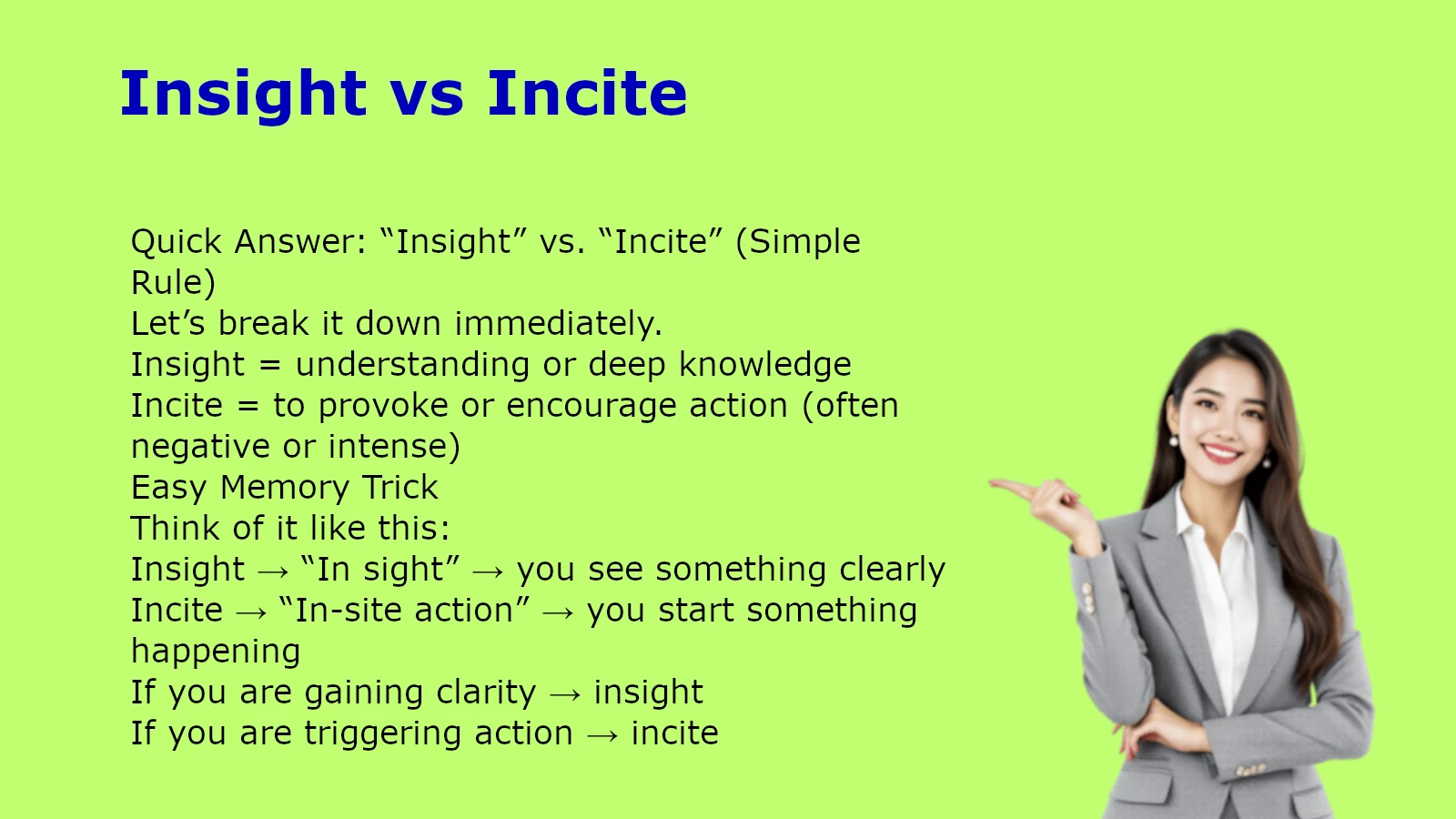
Quick Answer: “Insight” vs. “Incite” (Simple Rule)
Let’s break it down immediately.
Insight = understanding or deep knowledge
Incite = to provoke or encourage action (often negative or intense)
Easy Memory Trick
Think of it like this:
- Insight → “In sight” → you see something clearly
- Incite → “In-site action” → you start something happening
If you are gaining clarity → insight
If you are triggering action → incite
Why People Confuse “Insight” and “Incite”
This confusion happens for three main reasons:
1. They sound similar
Both start with “in-” and have a sharp “sight/site” sound.
2. They are used in serious contexts
Both appear in news, business, psychology, and debates.
3. One is abstract, one is action-based
So people mix “thinking” with “doing.”
But their meanings are actually opposites in function.
“Insight” Explained Clearly
Insight means understanding something deeply or clearly.
It is about awareness, clarity, or perception.
Simple Meaning
Insight = seeing the truth about something
Real-Life Examples
- “The report gave us insight into customer behavior.”
- “She has great insight into human psychology.”
- “This data provides insight into market trends.”
What “Insight” Feels Like
Think of:
- A light turning on in your mind
- Suddenly understanding a problem
- Seeing patterns others miss
It is mental clarity, not action.
“Incite” Explained Clearly
Now let’s look at the troublemaker word.
Incite means to encourage, provoke, or stir up action—often something intense or disruptive.
Simple Meaning
Incite = to trigger or start something (usually behavior or reaction)
Real-Life Examples
- “The speech may incite violence.”
- “They were accused of inciting the crowd.”
- “His comments incited public outrage.”
What “Incite” Feels Like
Think of:
- Sparking a fire
- Stirring a crowd
- Triggering strong emotions or actions
It is action-driven and often emotional or risky.
Side-by-Side Comparison Table
| Word | Meaning | Type | Example Use |
|---|---|---|---|
| Insight | Deep understanding | Mental / cognitive | “Insight into data” |
| Incite | To provoke action | Behavioral / action | “Incite a protest” |
The Biggest Mistake People Make
Here’s where things go wrong.
People accidentally use:
- “Incite” when they mean “insight”
- Especially in writing or formal communication
Example of the mistake:
❌ “This article gives incite into the topic.”
This is incorrect and confusing.
Correct version:
✔ “This article gives insight into the topic.”
Real-Life Confusion Scenario
Imagine this:
A student writes in an essay:
“The study provides incite into climate change.”
The teacher reads it and immediately spots the error.
Why?
Because “incite” means provoke action, not explain anything.
So the meaning completely breaks.
Why This Confusion Happens in Writing
Three main reasons:
1. Spellcheck doesn’t always catch it
Both words are valid English words.
2. Autocorrect assumptions
Phones often guess incorrectly.
3. Fast typing
People rely on sound instead of meaning.
Quick Memory Trick (Very Effective)
Use this:
INSIGHT = “I see it”
- Think: in sight = I understand it clearly
INCITE = “I ignite it”
- Think: incite = ignite emotions or actions
If it helps you visualize it:
- Insight = flashlight in the dark
- Incite = matchstick in dry grass
When to Use “Insight”
Use insight when talking about:
- Understanding
- Analysis
- Knowledge
- Clarity
Example Situations
- Reports
- Research
- Psychology
- Business analytics
When to Use “Incite”
Use incite when talking about:
- Reactions
- Emotions
- Crowds
- Conflict
Example Situations
- Politics
- Social movements
- Legal cases
- Public speeches
Quick Decision Guide
Still unsure? Use this:
- Need understanding → Insight
- Need action or reaction → Incite
- Still confused → stop and rethink meaning
Simple. Reliable. Safe.
FAQ: “Insight vs. Incite”
Are “insight” and “incite” related?
No. They come from different roots and mean completely different things.
Can “incite” ever be positive?
Rarely. It usually has a negative or aggressive tone (like inciting violence or unrest).
What is the most common mistake?
Using “incite” instead of “insight” in writing.
Which one is more common?
“Insight” is far more common in everyday language.
Key Facts You Should Remember
- Insight = understanding or clarity
- Incite = provoking or triggering action
- They sound similar but are unrelated
- Context completely changes meaning
- One is mental, the other is behavioral
Final Takeaway: The One Rule That Never Fails
Here’s the simplest way to lock it in your memory:
If you’re talking about thinking or understanding → Insight
If you’re talking about starting reactions or actions → Incite
Think of it this way:
Insight helps you see clearly
Incite makes things heat up
And in writing, especially professional communication, getting this right is not optional—it’s essential.