Have you ever stopped mid-sentence and wondered whether “Conscious vs Concious” is just a spelling mistake or two different words? You’re not alone—this is one of the most common confusions in English spelling, especially among learners who often encounter similar-looking words in reading, writing, and everyday communication.
In reality, “conscious” is the correct spelling, while “concious” is simply a common misspelling. The word conscious refers to being aware, awake, and able to think or perceive what is happening around you. It is widely used in psychology, health, decision-making, and everyday conversation to describe awareness of thoughts, actions, and surroundings.
This confusion often appears in searches like conscious meaning, concious vs conscious difference, how to spell conscious correctly, and commonly misspelled English words, especially among students trying to improve their grammar, vocabulary, and writing accuracy.
If you’ve ever written a sentence like “I was fully conscious during the meeting” and paused to double-check the spelling, you’re not alone—this is exactly the kind of English trap that even fluent speakers sometimes struggle with.
In this guide, you’ll learn the correct spelling, clear meaning, real-life usage examples, and simple memory tricks to never confuse conscious again in writing or speech.
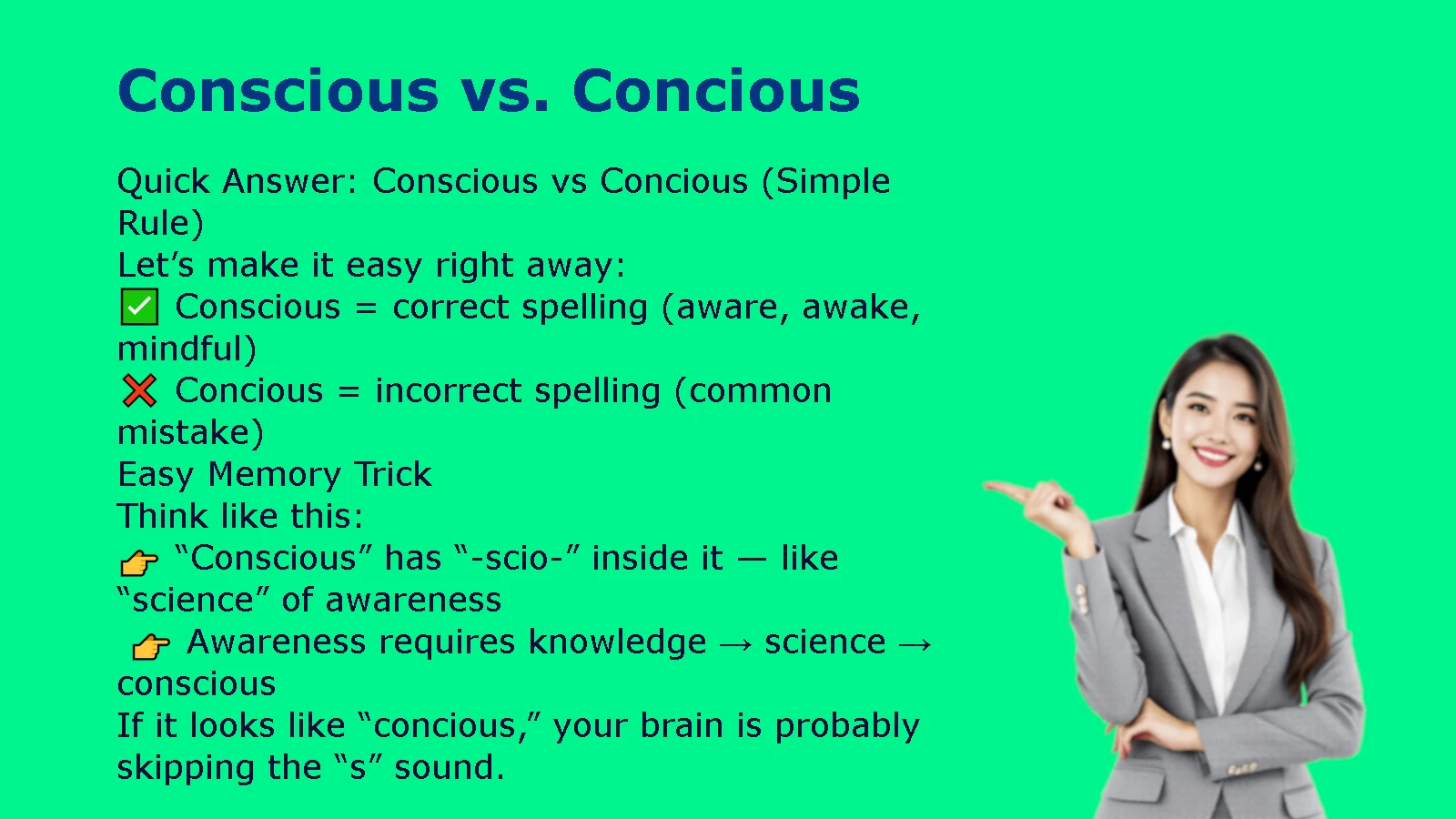
Quick Answer: Conscious vs Concious (Simple Rule)
Let’s make it easy right away:
- ✅ Conscious = correct spelling (aware, awake, mindful)
- ❌ Concious = incorrect spelling (common mistake)
Easy Memory Trick
Think like this:
👉 “Conscious” has “-scio-” inside it — like “science” of awareness
👉 Awareness requires knowledge → science → conscious
If it looks like “concious,” your brain is probably skipping the “s” sound.
What Does “Conscious” Mean? (Simple Explanation)
The word conscious refers to being aware of yourself, your thoughts, surroundings, or actions.
Basic Meaning
- Awake and not unconscious
- Mentally aware
- Thinking clearly
- Intentional or deliberate
Simple Examples
- “She was conscious during the entire operation.”
- “He made a conscious decision to quit social media.”
- “Try to stay conscious of your spending habits.”
Why “Concious” Is Wrong
Let’s be clear:
👉 “Concious” is not a word in English.
It is simply a spelling error caused by how the word is pronounced.
Why People Mistake It
- The “s” sound in the middle is subtle
- People write it the way they hear it
- Fast typing leads to skipped letters
- It visually looks “correct” at first glance
Important Truth
Even if you see “concious” online, in texts, or notes—it is still incorrect.
The Structure of “Conscious” (Break It Down)
Understanding the structure makes it easier to remember:
Con-scious
- Con- → together / fully
- -scious → related to awareness (from Latin scire, to know)
Key Insight
“Conscious” literally connects to knowing and awareness.
So if knowledge is involved, the correct spelling always keeps the “s” sound inside.
Simple Comparison Table
| Word | Correct? | Meaning | Usage |
| Conscious | ✅ Yes | Aware, alert, mindful | Correct spelling in all contexts |
| Concious | ❌ No | — (not a word) | Common misspelling |
Different Uses of “Conscious” (With Examples)
Let’s understand how the word works in real life.
1. Physical Awareness
- “After the accident, he remained conscious.”
- “The patient is fully conscious now.”
2. Mental Awareness
- “She is conscious of her strengths and weaknesses.”
- “He became more conscious of his behavior.”
3. Intentional Actions
- “It was a conscious effort to improve health.”
- “They made a conscious decision to reduce waste.”
4. Social Awareness
- “She is environmentally conscious.”
- “The brand is socially conscious.”
Common Mistakes People Make
Here are the most frequent errors:
❌ Writing “concious”
This is the biggest mistake.
❌ Dropping the “s”
People often type too fast and miss it.
❌ Confusing pronunciation with spelling
English pronunciation does not always match spelling directly.
Why This Word Is So Confusing
There are three main reasons:
1. Silent or Soft Sounds
The “s” blends into the word when spoken.
2. Similar-looking structure
“Concious” feels like it should exist.
3. Fast digital typing
Auto-thinking while typing leads to skipped letters.
Memory Tricks to Never Misspell It Again
Here are simple tricks that actually work:
1. Science Trick
👉 Conscious = awareness = knowledge = science
So remember: science has an “s” → conscious has an “s”
2. Stress the “S”
Say it slowly:
👉 Con-SCIOUS
Force your brain to notice the “s”
3. Break It Visually
Write it like this:
👉 Con + sci + ous
That hidden “sci” reminds you it’s real and correct.
Real-Life Examples of “Conscious”
Daily Life
- “Be conscious of your time.”
- “Stay conscious while driving.”
Workplace
- “We are conscious of deadlines.”
- “This is a conscious strategy shift.”
Health
- “She became more health-conscious.”
- “Avoid unconscious snacking.”
Mini Scenario (To Make It Clear)
Imagine this situation:
A teacher tells students:
“Be conscious of your grammar.”
One student writes:
“Be concious of your grammar.”
Now the meaning is correct—but the spelling is wrong.
👉 This is exactly how most real-world mistakes happen.
The Biggest Mistake Learners Make
The real issue is not confusion—it’s assumption.
People think:
“If it sounds right, it must be right.”
But English doesn’t always work that way.
Result
- Misspelled essays
- Unprofessional emails
- Lower writing confidence
Quick Decision Guide
When you’re unsure:
- Thinking of awareness or mind → Conscious
- Unsure spelling → always choose Conscious
- Thinking “Concious” → STOP, it’s wrong
FAQ: Conscious vs Concious
Is “concious” ever correct?
No. It is always incorrect in English.
Why do people write “concious”?
Because of pronunciation and fast typing habits.
What is the easiest way to remember it?
Link it with science → conscious → awareness.
Does “conscious” have different meanings?
Yes—awareness, intentional action, and alertness.
Final Takeaway: One Rule That Never Fails
Here’s the simplest truth:
👉 There is no such word as “concious”
👉 The only correct spelling is “conscious”
If you ever feel unsure, remember this:
Awareness requires clarity—and clarity always includes the “s.”
So next time you write it, don’t guess. Just go with:
✔ Conscious
Because in English, small letters make a big difference.