Have you ever wondered whether you should use dish or dishes in a sentence? Both words are correct, but they are used differently depending on whether you are talking about one item or more than one.
Dish refers to a plate or container used for serving food, a prepared food item, or a particular type of food. Dishes is the plural form of dish and can refer to multiple plates, food items, or types of food.
Dish is the singular form, while dishes is the plural form. A dish can refer to a container used for serving food, a particular type of prepared food, or, in some contexts, a shallow container or object used for a specific purpose. Dishes refers to two or more dishes.
The basic difference is simple:
| Word | Number | Meaning | Example |
| Dish | Singular | One dish or one type of prepared food | This dish tastes delicious. |
| Dishes | Plural | Two or more dishes or types of food | The restaurant serves several dishes. |
The confusion usually comes from the fact that dish has more than one meaning. It can describe a physical plate or bowl, a prepared food item, or even a type of meal. The plural dishes can therefore refer to multiple plates or containers, several prepared foods, or multiple examples of something described as a dish.
In this guide, you’ll learn the complete difference between Dish vs Dishes, including their meaning, singular and plural forms, grammar, pronunciation, usage, and examples. You’ll also learn when to use dish and when to use dishes, along with common mistakes and easy examples to help you choose the correct form.
Quick Answer: Dish vs Dishes
The difference between dish and dishes is mainly grammatical:
- Dish = singular
- Dishes = plural
- One dish = one item or one prepared food
- Two dishes = two items or two prepared foods
- This dish = singular
- These dishes = plural
- The dish is = singular subject
- The dishes are = plural subject
For example:
This dish is spicy.
But:
These dishes are spicy.
The word dish can describe a container used for serving or cooking food, as well as a particular type of prepared food. The plural dishes can refer to multiple food preparations or multiple pieces of tableware.
There is also a special plural expression:
I need to wash the dishes.
Here, the dishes does not necessarily mean several individual objects that the speaker has counted. It is a conventional expression for the plates, bowls, cups, and other items used during a meal.
What Does Dish Mean?
Dish is a singular countable noun with several related meanings.
One common meaning is a container used for serving or cooking food. It can be shallow and relatively flat, although the exact shape varies. Examples include a baking dish, serving dish, casserole dish, and pet food dish.
Another important meaning is a particular type of food prepared as part of a meal.
For example:
- a chicken dish
- a vegetarian dish
- a rice dish
- a pasta dish
- a traditional dish
- a side dish
- a main dish
Cambridge defines this food-related sense as food prepared in a particular way as part of a meal.
Examples of Dish as a Container
- Put the vegetables in a dish.
- She baked the lasagna in a glass dish.
- The salad was placed in a serving dish.
- The dog has a food dish.
- Use a shallow dish for the dessert.
In each sentence, dish refers to one container.
Examples of Dish as Food
- This is my favorite dish.
- She prepared a delicious chicken dish.
- The restaurant has a vegetarian dish.
- Curry is a popular dish in many cuisines.
- The chef introduced a new dish.
Here, dish refers to a prepared food rather than the physical container.
What Does Dishes Mean?
Dishes is the plural form of dish.
You use it when referring to more than one dish.
For example:
- The restaurant serves several dishes.
- We ordered three dishes for the table.
- These dishes are ready to serve.
- She prepared several traditional dishes.
- The kitchen has many serving dishes.
The meaning depends on context.
If you say:
The restaurant offers several dishes.
You probably mean several prepared foods.
But if you say:
The cabinet contains several dishes.
You probably mean physical containers or pieces of tableware.
Oxford also records dishes as the plural term for plates, bowls, cups, and similar items that have been used for a meal and need washing.
Dish vs Dishes: The Main Difference
The easiest way to remember dish vs dishes is to think about number.
| Word | Number | Basic use | Example |
| dish | Singular | One dish | This dish is delicious. |
| dishes | Plural | More than one dish | These dishes are delicious. |
Consider these pairs:
| Singular | Plural |
| a dish | two dishes |
| one dish | several dishes |
| this dish | these dishes |
| that dish | those dishes |
| the dish is ready | the dishes are ready |
| a new dish | new dishes |
The spelling also changes from dish to dishes, rather than dishs. This happens because nouns ending in -sh normally form their plural with -es. Oxford’s grammar guidance gives dish → dishes as an example of this plural pattern.
When to Use Dish
Use dish when you are referring to one item or one prepared food.
Talking About One Food
Use the singular form when one particular food preparation is being discussed.
Examples:
- This dish contains potatoes.
- The chef recommended a seafood dish.
- I ordered a vegetarian dish.
- That dish tastes excellent.
- Her signature dish is chicken curry.
Notice the words that often accompany the singular noun:
- a dish
- one dish
- this dish
- that dish
- each dish
- every dish
Talking About One Container
You can also use dish for one physical container.
Examples:
- Put the butter in the dish.
- I need a baking dish.
- She bought a ceramic dish.
- The food is in a large dish.
- Please pass me that dish.
The exact object can vary. A dish might be used for cooking, serving, holding food, or another related purpose.
When to Use Dishes
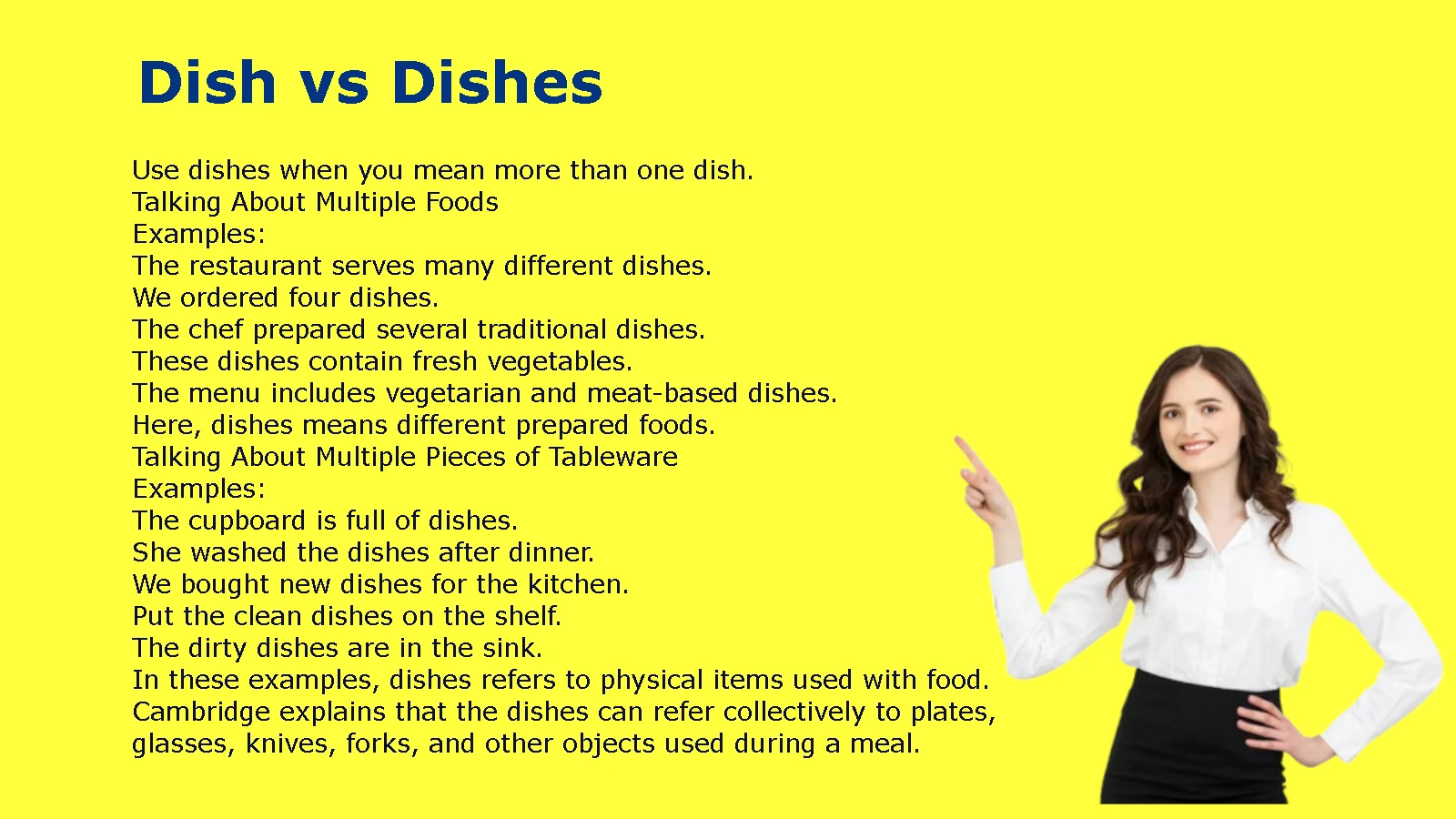
Use dishes when you mean more than one dish.
Talking About Multiple Foods
Examples:
- The restaurant serves many different dishes.
- We ordered four dishes.
- The chef prepared several traditional dishes.
- These dishes contain fresh vegetables.
- The menu includes vegetarian and meat-based dishes.
Here, dishes means different prepared foods.
Talking About Multiple Pieces of Tableware
Examples:
- The cupboard is full of dishes.
- She washed the dishes after dinner.
- We bought new dishes for the kitchen.
- Put the clean dishes on the shelf.
- The dirty dishes are in the sink.
In these examples, dishes refers to physical items used with food.
Cambridge explains that the dishes can refer collectively to plates, glasses, knives, forks, and other objects used during a meal.
Dish vs Dishes in Food Contexts
The distinction becomes especially important when dish refers to food.
A dish can be one particular prepared food that forms part of a meal.
For example:
The restaurant serves an excellent seafood dish.
The speaker has one particular food preparation in mind.
If there are several:
The restaurant serves several seafood dishes.
The plural tells the reader that more than one prepared food is being discussed.
One Dish
Consider these examples:
- a rice dish
- a pasta dish
- a chicken dish
- a vegetable dish
- a dessert dish
Each phrase describes one type or preparation of food.
Multiple Dishes
The plural form works like this:
- rice dishes
- pasta dishes
- chicken dishes
- vegetable dishes
- dessert dishes
For example:
The restaurant offers several vegetarian dishes.
That means the restaurant offers more than one vegetarian food option.
Why Dish Can Mean Different Things
One reason dish vs dishes can seem confusing is that dish has more than one established meaning.
It can refer to:
- A food preparation
- A container used for food
- A group of used tableware when used in the expression “the dishes”
- An object with a dish-like shape, such as a satellite dish
Oxford lists these different noun senses, including a container, prepared food, a dish-shaped object, and the plural expression the dishes.
Context normally makes the intended meaning clear.
Compare:
The chef created a new dish.
Here, dish means food.
Put the fruit in the dish.
Here, dish means a container.
I need to wash the dishes.
Here, dishes refers collectively to used tableware.
The house has a satellite dish.
Here, dish refers to a curved antenna.
Dish vs Plate vs Bowl
Dish, plate, and bowl overlap, but they are not interchangeable in every situation.
A plate is generally a flat piece of tableware used for serving or eating food. A bowl is typically deeper and designed to hold foods such as soup, cereal, or other liquids and semi-liquid foods.
Dish is broader. It can refer to certain containers used for serving or cooking, and in some contexts it can function as a general term for tableware. Cambridge defines tableware more broadly as items such as knives, forks, spoons, plates, and glasses used for meals.
| Word | Typical meaning | Example |
| Dish | A container for food or a prepared food | Put the salad in the dish. |
| Plate | Usually a relatively flat piece of tableware | Put the sandwich on the plate. |
| Bowl | A deeper container for food | Pour the soup into the bowl. |
| Tableware | General category of meal-related items | The restaurant uses ceramic tableware. |
Is Every Plate a Dish?
Not necessarily in every context.
Dish can be used broadly, but plate is more specific. If you are describing the exact type of tableware, plate may be the more precise word.
For example:
She placed the cake on a plate.
This tells us exactly what type of object was used.
Compare:
She placed the cake in a dish.
This is possible, but the shape and function of the container are less specifically identified.
Is Every Bowl a Dish?
The relationship is similar. Dish can describe certain food containers, but bowl identifies a particular shape and type.
That is why the words should not automatically be treated as exact synonyms.
Is Dish Singular or Plural?
Dish is singular.
Use it with singular determiners and singular verbs when it functions as a singular subject.
Correct:
- A dish is ready.
- This dish is spicy.
- That dish looks delicious.
- One dish was missing.
Incorrect:
- A dish are ready.
- This dish are spicy.
- One dish were missing.
The key is simple: one dish = singular.
Is Dishes Singular or Plural?
Dishes is plural.
Use it when referring to two or more dishes.
Examples:
- The dishes are ready.
- These dishes look delicious.
- Several dishes were prepared.
- The dishes need to be washed.
Do not use a singular determiner such as a directly before the plural noun.
Correct:
A dish is on the table.
Correct:
Several dishes are on the table.
Incorrect:
A dishes are on the table.
How to Make Dish Plural
The plural of dish is dishes.
You do not simply add s:
dish + s ❌ = dishs
Instead, because dish ends in -sh, the standard plural form adds -es:
dish + es = dishes
Oxford’s grammar material specifically lists dish → dishes among nouns that form their plurals with -es after endings such as -sh, -ch, -x, and -ss.
Similar Plural Patterns
The same pattern appears in words such as:
- wish → wishes
- brush → brushes
- bush → bushes
- box → boxes
- class → classes
- church → churches
So if you know how wish → wishes works, dish → dishes follows the same basic pattern.
Dish vs Dishes Pronunciation
The spelling changes, and so does the pronunciation.
Dish is pronounced /dɪʃ/.
Dishes is pronounced /ˈdɪʃɪz/ in standard dictionary notation.
The plural ending adds an extra syllable:
- dish → one syllable
- dishes → two syllables
The ending in dishes is pronounced like -iz, not simply like an added /s/.
This same pronunciation pattern appears in words such as:
- wishes
- brushes
- bushes
- boxes
- churches
So dishes should sound like DI-shiz, rather than simply dishs.
Dish vs Dishes in Sentences
Seeing the words side by side makes the distinction easier.
Singular Examples
- This dish is too spicy.
- I ordered a chicken dish.
- She prepared a traditional dish.
- That dish contains rice and vegetables.
- The chef created a new dish.
- Put the food in the dish.
- The dish is on the table.
Plural Examples
- These dishes are too spicy.
- I ordered several chicken dishes.
- She prepared three traditional dishes.
- Those dishes contain rice and vegetables.
- The chef created several new dishes.
- Put the clean dishes away.
- The dishes are on the table.
The important grammatical change is not just the noun. The surrounding words may change too.
Compare:
This dish is ready.
with:
These dishes are ready.
The singular demonstrative this becomes the plural these, and the singular verb is becomes the plural verb are.
Dish vs Dishes and Subject-Verb Agreement
This is one of the most useful grammar points to understand.
When dish is the subject, use a singular verb.
The dish is delicious.
When dishes is the subject, use a plural verb.
The dishes are delicious.
More Examples
| Singular | Plural |
| The dish is ready. | The dishes are ready. |
| This dish looks good. | These dishes look good. |
| The dish contains rice. | The dishes contain rice. |
| That dish was expensive. | Those dishes were expensive. |
| A dish needs more salt. | Several dishes need more salt. |
A common mistake is to focus only on the noun and forget that the verb must agree with it.
Incorrect
The dishes is ready.
Correct
The dishes are ready.
Likewise:
Incorrect
The dish are ready.
Correct
The dish is ready.
Dish and Dishes in Everyday Expressions
Some expressions use dish or dishes in ways that are worth learning as complete phrases.
Do the Dishes
Do the dishes is a common expression meaning to wash or clean the dishes after a meal.
For example:
I need to do the dishes after dinner.
Who is going to do the dishes tonight?
Oxford and Cambridge both document this use.
Here, dishes has a broader collective meaning. It refers to the used plates, bowls, cups, and related items that need cleaning.
Wash the Dishes
You can also say:
I need to wash the dishes.
This is more literal and directly describes cleaning the items.
A Side Dish
A side dish is a food served alongside the main part of a meal.
Examples include:
- a side dish of vegetables
- a side dish of rice
- a side dish of potatoes
Here, dish is singular because the phrase describes one food preparation.
Main Dish
A main dish is a principal food item in a meal.
For example:
Chicken was the main dish.
If there are several:
The menu includes several main dishes.
Common Mistakes With Dish and Dishes
Although the basic distinction is simple, several mistakes appear frequently.
Using Dish After a Plural Number
Incorrect:
I ordered three dish.
Correct:
I ordered three dishes.
A number greater than one normally requires the plural noun.
Using Dishes After A or One
Incorrect:
I ordered a dishes.
Correct:
I ordered a dish.
Likewise:
One dish was enough.
Not:
One dishes was enough.
Writing Dishs Instead of Dishes
Incorrect:
The restaurant offers many dishs.
Correct:
The restaurant offers many dishes.
The standard plural is dishes because dish ends in -sh.
Using the Wrong Verb
Incorrect:
The dishes is ready.
Correct:
The dishes are ready.
Assuming Dishes Always Means Food
The word dishes can refer to prepared foods:
The restaurant serves Asian dishes.
But it can also refer to tableware:
The dishes are in the sink.
Context determines the meaning.
Dish vs Dishes in Restaurant Menus
Restaurant language provides some of the clearest examples.
A menu may contain:
- a chicken dish
- a pasta dish
- a vegetarian dish
- several seafood dishes
- several main dishes
- different side dishes
Consider this sentence:
The restaurant has an excellent vegetarian dish.
The speaker is referring to one food option.
Now compare:
The restaurant has several vegetarian dishes.
The speaker means multiple food options.
Example Restaurant Description
The chef specializes in traditional dishes.
Here, dishes refers to multiple prepared foods.
If the restaurant has one especially famous item:
The chef’s signature dish is grilled fish.
Here, dish is singular.
This distinction is particularly important in food writing because dish can describe both an individual preparation and a category of food preparation.
Dish vs Dishes in Recipes
Recipe instructions also commonly use the singular and plural forms.
Singular
Transfer the mixture to a baking dish.
Here, dish means one cooking container.
This dish takes about 30 minutes to prepare.
Here, dish means the prepared food.
Plural
Prepare the vegetables for both dishes.
Here, dishes refers to two separate food preparations.
The two dishes can be prepared at the same time.
Again, the plural form indicates more than one prepared food.
Dish vs Dishes in Home and Kitchen Contexts
In a kitchen, dish and dishes can refer to physical objects.
For example:
Please put the clean dish on the shelf.
This means one item.
But:
Please put the clean dishes on the shelf.
This means multiple items.
The expression the dishes is especially common when discussing household chores.
The sink is full of dishes.
I’ll wash the dishes after dinner.
The clean dishes are in the cabinet.
Oxford specifically describes the dishes as plates, bowls, cups, and similar items used for a meal and needing to be washed.
Dish vs Dishes in British and American English
The singular/plural distinction is essentially the same in British and American English:
- dish = singular
- dishes = plural
Both varieties use dish for prepared food and for various food containers.
Both also use the dishes for used tableware.
Cambridge’s British and American dictionary entries document these core meanings, including food, containers, and the dishes as used tableware.
So there is no major British-versus-American spelling difference such as the one found with words like color/colour.
Example in Both Varieties
This dish is popular.
These dishes are popular.
The grammar remains the same.
Real-World Examples of Dish vs Dishes
Understanding the words in realistic situations is more useful than memorizing a rule alone.
At a Restaurant
I ordered a spicy chicken dish.
One prepared food is being discussed.
We ordered three different dishes.
Three prepared foods are being discussed.
At Home
Please put the dish on the table.
One item is being moved.
Please put the dishes on the table.
Multiple items are being moved.
In a Recipe
Bake the mixture in a shallow dish.
One cooking container is required.
After Dinner
I need to wash the dishes.
The expression refers collectively to the used tableware.
When Discussing Culture
Biryani is a popular dish.
One food preparation is being identified.
The region is known for several traditional dishes.
Multiple foods are being identified.
A Practical Case Study: Choosing Dish or Dishes
Imagine you are writing a restaurant review.
You want to describe one meal:
I ordered a seafood dish with rice.
That is correct because you are talking about one particular food.
Now imagine that you sampled several foods:
We tried five seafood dishes.
The plural is required because the number is five.
Now switch to the kitchen:
The restaurant’s serving dishes were beautifully designed.
Here, dishes refers to multiple physical containers.
Finally, after the meal:
The staff quickly cleared the dishes.
Here, the meaning is determined by the context. The reader understands that dishes refers to the used tableware rather than several types of food.
The lesson: don’t choose dish or dishes based only on the general topic. Look at whether you mean one or more than one, and then use the surrounding context to make the intended meaning clear.
Dish vs Dishes: Quick Comparison
| Feature | Dish | Dishes |
| Number | Singular | Plural |
| One prepared food | Yes | No |
| Multiple prepared foods | No | Yes |
| One food container | Yes | No |
| Multiple food containers | No | Yes |
| One item | Yes | No |
| Two or more items | No | Yes |
| Correct plural spelling | — | Dishes |
| Singular verb | Usually | No |
| Plural verb | No | Usually |
| Example | This dish is good. | These dishes are good. |
The simplest rule remains:
One = dish. More than one = dishes.
The main complication is that both forms can describe food or physical objects, depending on context.
Facts to Remember About Dish and Dishes
Here are the most important points to keep in mind:
- Dish is a singular countable noun.
- Dishes is the plural of dish.
- The correct plural spelling is dishes, not dishs.
- Dish can mean a prepared food.
- Dish can also mean a container used for cooking or serving food.
- Dishes can mean multiple prepared foods.
- The dishes can mean used plates, bowls, cups, and related tableware.
- Use is with a singular subject such as dish.
- Use are with a plural subject such as dishes.
- Dish and plate are related but are not always exact synonyms.
- Dish and bowl can overlap in meaning, but bowl identifies a more specific type of container.
- The expression do the dishes means to clean the used tableware.
Frequently Asked Questions About Dish vs Dishes
Is dish singular or plural?
Dish is singular. You use it when referring to one food preparation, container, or other object described by the noun.
This dish is delicious.
Is dishes the plural of dish?
Yes. Dishes is the standard plural form of dish.
One dish → two dishes
The -es ending is used because dish ends in -sh.
What is the plural of dish?
The plural of dish is dishes.
The spelling dishs is incorrect.
What is the difference between dish and dishes?
The main difference is number.
Dish refers to one, while dishes refers to more than one.
She prepared one dish.
She prepared several dishes.
Can dish mean food?
Yes. Dish can mean a particular type of food or food prepared in a particular way as part of a meal.
For example:
Pasta is my favorite dish.
Can dish mean a plate?
Sometimes, but dish is broader than plate. A dish can be a container used for serving or cooking food, while a plate is a more specific type of tableware.
Is “do the dishes” grammatically correct?
Yes. Do the dishes is a standard expression meaning to wash or clean the used dishes and other tableware after a meal.
Is “dishes” only used for food?
No. Dishes can refer to multiple prepared foods, but the dishes can also refer collectively to used tableware.
Compare:
The chef prepared several dishes.
The sink is full of dishes.
The context gives the reader the intended meaning.
What is the difference between a dish and a plate?
A plate is a specific type of relatively flat tableware. Dish is a broader word that can describe certain food containers and can also refer to prepared food. The exact distinction depends on context.
Is “dish” countable?
Yes. In its ordinary noun uses, dish is a countable noun.
You can say:
- a dish
- one dish
- two dishes
- several dishes
- many dishes
Oxford identifies dish as a countable noun in its food-container and food-related senses.
Final Takeaway: Dish vs Dishes
The difference between dish vs dishes is simple once you separate number from meaning.
Dish is singular:
I ordered a dish.
Dishes is plural:
I ordered three dishes.
The words can refer to different things depending on context. Dish may describe a prepared food or a container used for cooking or serving. Dishes can describe multiple foods or multiple physical items. In the familiar expression the dishes, it commonly refers collectively to used plates, bowls, cups, and similar tableware.
The plural spelling is dishes, because nouns ending in -sh commonly take -es in the plural.
If you remember only one rule, remember this:
Dish = one. Dishes = more than one.
Once that distinction is clear, choosing between the two becomes straightforward in sentences, menus, recipes, restaurant reviews, and everyday conversations.