Have you ever wondered whether you should write watch or watches in a sentence? Both forms are correct, but they are used differently depending on the subject and grammatical context. The confusion usually comes from knowing when a verb needs the -es ending and when it should remain in its base form.
Watch means to look at something carefully or observe it, while watches is the third-person singular verb form or the plural of watch as a noun.
Watch is the base form of the verb, meaning to look at or observe something carefully, while watches is usually the third-person singular present-tense form used with he, she, or it. For example, you can say, “I watch movies every weekend,” but “She watches movies every weekend.”
| Word | Correct? | Common Use | Example |
| Watch | ✅ Correct | Base verb; also a noun | I watch TV every evening. |
| Watches | ✅ Correct | Third-person singular verb; plural noun | She watches TV every evening. |
The spelling difference is simple: when watch is used as a verb with he, she, or it in the simple present tense, it becomes watches, not watchs. This happens because verbs ending in -ch generally take -es rather than simply adding -s.
However, watches can also be the plural form of the noun watch, referring to more than one timepiece. For example, “The store sells expensive watches.”
In this guide, you’ll learn the complete difference between Watch vs Watches, including their meaning, grammar, pronunciation, singular and plural forms, verb usage, noun usage, spelling rules, and example sentences. You’ll also learn when to use watch and when to use watches so you can choose the correct form confidently.
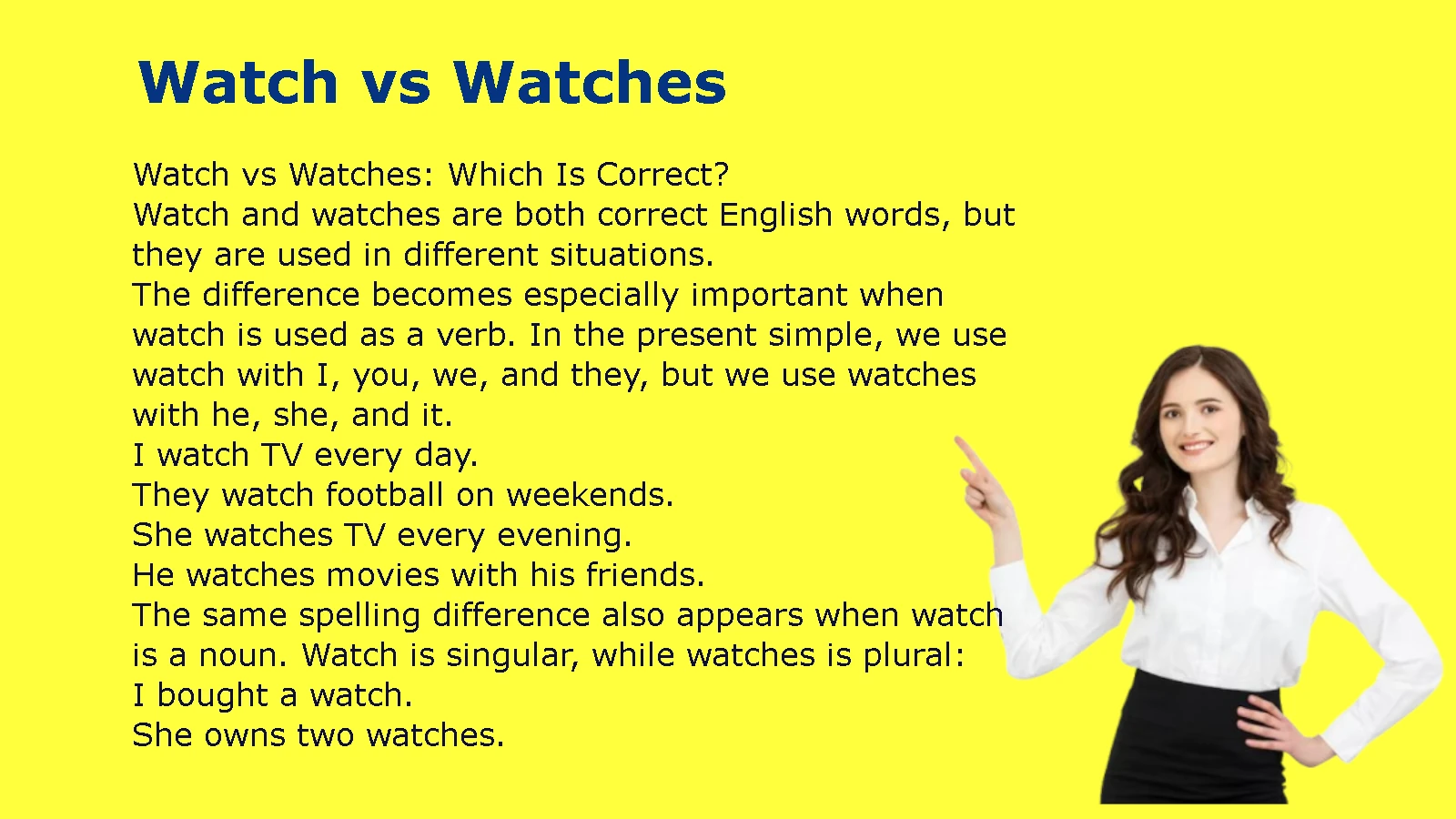
Watch vs Watches: Which Is Correct?
Watch and watches are both correct English words, but they are used in different situations.
The difference becomes especially important when watch is used as a verb. In the present simple, we use watch with I, you, we, and they, but we use watches with he, she, and it.
- I watch TV every day.
- They watch football on weekends.
- She watches TV every evening.
- He watches movies with his friends.
The same spelling difference also appears when watch is a noun. Watch is singular, while watches is plural:
- I bought a watch.
- She owns two watches.
There is also an important spelling point: watchs is incorrect. The correct plural noun and third-person singular verb form is watches. English adds -es to nouns ending in -ch, such as watch → watches.
This guide explains the difference between watch vs watches, including verb agreement, noun forms, questions, negatives, examples, and common mistakes.
What Does Watch Mean?
Watch can function as both a verb and a noun.
As a verb, watch generally means to look at something for a period of time, particularly something that is moving or changing. Cambridge Dictionary gives examples involving watching television, sporting events, and people.
As a noun, watch can refer to a small timepiece worn on the wrist. It can also refer to the act or period of watching or guarding something.
Watch as a Verb
When watch is a verb, it can mean to look at something carefully or continuously.
Examples:
- I watch the news every morning.
- We watch movies together.
- They watch football on Sundays.
- You watch the children while I cook.
- I like to watch birds in the garden.
The base form watch is used with I, you, we, and they in the present simple.
It is also used after auxiliary verbs such as do, does, did, and modal verbs.
For example:
- Do you watch television?
- Does she watch television?
- Did he watch the game?
- She can watch the children.
- He will watch the movie later.
Notice that watch remains in its base form after these auxiliary or modal verbs.
Watch as a Noun
As a noun, watch commonly means a small clock worn on the wrist.
Examples:
- I bought a new watch.
- His watch stopped working.
- She looked at her watch.
- My watch is five minutes slow.
- This watch has a leather strap.
When there is more than one, the plural form is watches.
- one watch
- two watches
- three watches
- several watches
Cambridge Dictionary defines this noun as a small clock worn on a strap around the wrist or, in some cases, attached to clothing by a chain.
What Does Watches Mean?
Watches has two main grammatical uses.
It can be:
- The third-person singular present form of the verb watch
- The plural form of the noun watch
These uses look identical in spelling, but the context tells you which one is being used.
Watches as a Verb
When watch is a present-simple verb and the subject is he, she, or it, the form becomes watches.
Examples:
- He watches TV every night.
- She watches documentaries.
- My brother watches football.
- Sarah watches the children.
- The dog watches the door.
The basic rule is:
I/you/we/they watch
he/she/it watches
This is a standard present-simple subject-verb agreement pattern.
Watches as a Plural Noun
Watches is also the plural of the noun watch.
Examples:
- I own two watches.
- These watches are expensive.
- The store sells luxury watches.
- His collection contains several watches.
- The watches are displayed in a glass case.
Cambridge’s grammar guidance lists watch → watches as the plural pattern for nouns ending in -ch.
Watch vs Watches: The Main Grammar Rule
The easiest way to understand watch vs watches is to look at the subject.
| Subject | Correct Form | Example |
| I | watch | I watch TV. |
| You | watch | You watch movies. |
| We | watch | We watch football. |
| They | watch | They watch the news. |
| He | watches | He watches TV. |
| She | watches | She watches movies. |
| It | watches | It watches the entrance. |
The key point is that watches is not simply a more formal version of watch. It is required when the present-simple subject is third-person singular.
Why Does Watch Become Watches?
The verb watch ends in -ch. In the present simple, verbs ending in certain sounds and spellings take -es with he, she, and it.
For example:
- watch → watches
- catch → catches
- match → matches
- teach → teaches
- reach → reaches
The same spelling pattern appears when forming plural nouns:
- watch → watches
- match → matches
- church → churches
This is why watchs is not the standard spelling. The correct form is watches.
He Watch or Watches?
He watches is correct.
Because he is a third-person singular subject, the present-simple verb takes -es.
Correct
- He watches TV every night.
- He watches football after work.
- He watches the children carefully.
- He watches the news before bed.
Incorrect
- He watch TV every night.
- He watch football after work.
The incorrect sentences are missing the third-person singular ending.
A useful comparison is:
- I watch TV.
- You watch TV.
- We watch TV.
- They watch TV.
- He watches TV.
- She watches TV.
The subject determines the form of the verb.
I Watch or Watches TV Every Day?
The correct sentence is:
I watch TV every day.
Not:
I watches TV every day.
The reason is simple: I takes the base form of the verb in the present simple.
Compare:
- I watch TV every day.
- You watch TV every day.
- We watch TV every day.
- They watch TV every day.
- He watches TV every day.
- She watches TV every day.
The same rule applies to other present-simple verbs:
- I work → She works
- I play → He plays
- I read → She reads
- I watch → He watches
So if the sentence begins with I, use watch, not watches.
Watchs or Watches: Which Spelling Is Correct?
Watches is correct.
Watchs is incorrect in standard English.
The spelling changes because watch ends in -ch. When forming the plural noun, English uses -es:
watch → watches
The same pattern occurs with other words ending in -ch, -sh, -s, -x, and -z. Cambridge Dictionary specifically gives watch → watches as an example of this plural formation rule.
Examples
| Singular | Correct Plural |
| watch | watches |
| match | matches |
| church | churches |
| brush | brushes |
| bus | buses |
| box | boxes |
Therefore:
- one watch
- two watches
Not:
- two watchs
Watch vs Watches as Nouns
When watch is a noun, the difference is mainly about number.
Watch means one item.
Watches means more than one.
Singular Noun
Use watch when referring to one timepiece.
Examples:
- I bought a watch.
- This watch is expensive.
- Her watch stopped.
- He wears a watch every day.
You can often use an article such as a or the with the singular noun:
- a watch
- the watch
- my watch
- this watch
Plural Noun
Use watches when referring to two or more.
Examples:
- I bought two watches.
- The watches are on the table.
- She collects vintage watches.
- Those watches are made of stainless steel.
You can use plural determiners such as:
- two watches
- several watches
- many watches
- these watches
- those watches
The distinction is the same basic singular/plural distinction found throughout English nouns.
Watch vs Watches in the Present Simple
The present simple is where learners most often confuse watch and watches.
The rule is:
I, you, we, they + watch
he, she, it + watches
With I
- I watch TV.
- I watch sports.
- I watch the news.
You
- You watch too much television.
- You watch the game every week.
With We
- We watch movies together.
- We watch the children after school.
With They
- They watch football.
- They watch television at night.
He
- He watches TV.
- He watches football.
- He watches the news.
With She
- She watches movies.
- She watches documentaries.
- She watches the children.
It
- The camera watches the entrance.
- The security system watches the area.
Cambridge defines watch as a verb meaning to look at something for a period of time, particularly something changing or moving. The examples above apply the standard present-simple agreement pattern to that verb.
Watch vs Watches in Questions and Negatives
One of the most important details about watch vs watches appears in questions and negative sentences.
When you use does, the main verb returns to its base form:
Does + subject + watch
Not:
Does + subject + watches
The same principle applies to does not or doesn’t.
Questions
Correct:
- Do you watch TV?
- Do they watch movies?
- Does he watch TV?
- Does she watch football?
Incorrect:
- Does he watches TV?
- Does she watches football?
Why?
Because does already carries the third-person singular present-tense marking. The main verb stays in its base form.
So:
He watches TV.
becomes:
Does he watch TV?
Not:
Does he watches TV?
Negative Sentences
The same rule applies to negatives.
Correct:
- I do not watch TV.
- They do not watch football.
- He does not watch TV.
- She does not watch movies.
With contractions:
- I don’t watch TV.
- They don’t watch football.
- He doesn’t watch TV.
- She doesn’t watch movies.
Incorrect:
- He doesn’t watches TV.
- She doesn’t watches movies.
The structure is:
doesn’t + watch
not:
doesn’t + watches
A Simple Comparison
| Statement | Question | Negative |
| He watches TV. | Does he watch TV? | He doesn’t watch TV. |
| She watches movies. | Does she watch movies? | She doesn’t watch movies. |
| They watch TV. | Do they watch TV? | They don’t watch TV. |
This is an especially useful rule to remember because learners sometimes add -es twice.
Watch vs Watches With Different Subjects
Subject-verb agreement becomes easier when you organize the forms into two groups.
Base Form: Watch
Use watch with:
- I
- you
- we
- they
- plural subjects
Examples:
- I watch TV.
- You watch the game.
- We watch movies.
- They watch sports.
- John and Maria watch TV together.
Third-Person Singular: Watches
Use watches with:
- he
- she
- it
- one singular person
- one singular thing
Examples:
- He watches TV.
- She watches movies.
- The dog watches the door.
- David watches football.
- The camera watches the entrance.
Notice that David behaves grammatically like he, while David and Maria behaves like they.
- David watches TV.
- David and Maria watch TV.
That distinction is more useful than simply memorizing individual sentences.
Watch vs Watches Examples
Seeing the two forms side by side makes the rule much easier to remember.
Examples With Watch
- I watch TV after dinner.
- We watch movies on Friday nights.
- They watch football every weekend.
- You watch the news every morning.
- I watch documentaries about history.
- We watch the children at the park.
- They watch birds from the window.
- You watch too many videos online.
- I watch the clock during meetings.
- We watch the sunset from the beach.
Examples With Watches
- He watches TV after dinner.
- She watches movies on Friday nights.
- My brother watches football every weekend.
- Sarah watches the news every morning.
- The child watches the birds.
- David watches documentaries.
- My father watches the clock during meetings.
- The dog watches the door.
- The camera watches the entrance.
- Maria watches videos online.
Watch and Watches in the Same Sentence
Contrastive sentences are particularly useful because they show how changing the subject changes the verb.
I watch movies, but my brother watches documentaries.
They watch football, but Sarah watches tennis.
We watch the children, while the teacher watches the classroom.
You watch the news, but he watches sports.
The verb changes because the subject changes.
Common Mistakes With Watch and Watches
Most errors involving watch vs watches come from either subject-verb agreement or incorrect plural spelling.
Mistake: He Watch TV
❌ He watch TV every night.
✅ He watches TV every night.
Why? He is third-person singular, so the present-simple verb needs -es.
Mistake: I Watches TV
❌ I watches TV every day.
✅ I watch TV every day.
Why? I takes the base form watch.
Mistake: They Watches Football
❌ They watches football.
✅ They watch football.
Why? They is plural and takes the base form.
Mistake: Does He Watches TV?
❌ Does he watches TV?
✅ Does he watch TV?
Why? The auxiliary does carries the third-person singular marking, so the main verb remains watch.
Mistake: She Doesn’t Watches Television
❌ She doesn’t watches television.
✅ She doesn’t watch television.
Why? The structure is doesn’t + base verb.
Mistake: Two Watch Are on the Table
❌ Two watch are on the table.
✅ Two watches are on the table.
Why? More than one watch requires the plural noun watches.
Mistake: Two Watchs
❌ I own two watchs.
✅ I own two watches.
Why? The plural of watch is formed with -es, not simply -s.
Watch vs Watches: Common Sentence Patterns
The following patterns cover most everyday uses.
| Pattern | Example |
| I + watch | I watch TV. |
| You + watch | You watch movies. |
| We + watch | We watch football. |
| They + watch | They watch the news. |
| He + watches | He watches TV. |
| She + watches | She watches movies. |
| It + watches | The camera watches the entrance. |
| One + watch | I have one watch. |
| Two + watches | I have two watches. |
| Does + watch | Does she watch TV? |
| Does not + watch | She does not watch TV. |
| Do + watch | Do they watch football? |
| Do not + watch | They do not watch football. |
This table reveals an important distinction: watches is not always a verb.
In She watches TV, it is a verb.
In She owns two watches, it is a plural noun.
Watch vs Watches vs Watched vs Watching
| Form | Use | Example |
| watch | Base form | I watch TV. |
| watches | Third-person singular present / plural noun | She watches TV. |
| watched | Past tense / past participle | We watched a movie. |
| watching | Present participle / gerund | They are watching TV. |
Watch
Use watch as the base form.
I watch television every evening.
Watches
Use watches with third-person singular subjects in the present simple.
She watches television every evening.
Use it as a plural noun when referring to multiple timepieces.
She owns three watches.
Watched
Use watched for the simple past and as the past participle.
I watched a movie last night.
They have watched that film before.
Watching
Use watching in continuous forms and as a gerund.
We are watching a movie.
Watching television late at night can become a habit.
Cambridge lists watch as a verb used for looking at something over a period of time and provides examples of forms such as watched and watching.
Watch vs Watches in Formal and Everyday English
There is no difference in formality between watch and watches.
Both are standard English forms. The correct choice depends on grammar, not the level of formality.
Everyday English
- I watch TV after work.
- She watches football with her family.
Professional English
- We watch the market closely.
- The analyst watches changes in demand.
Academic English
- Researchers watch the participants during the experiment.
- The monitoring system watches for changes in temperature.
The verb watch can also mean being careful or paying close attention. For example, English uses expressions such as watch your language and watch your weight.
So the word has uses beyond simply watching television or movies.
Other Meanings of Watch
Understanding the broader meaning of watch can help you recognize it in different contexts.
Watch as Paying Attention
Watch can mean to look at something for a period of time.
We watched the game.
Watch as Being Careful
It can also mean being careful about something.
Watch your step.
You need to watch what you eat.
Watch as Monitoring
It can describe paying attention to a situation as it develops.
We are watching the situation carefully.
Watch as a Noun Meaning a Timepiece
His watch is on the desk.
Watch as a Noun Meaning Vigilance
The noun can also refer to the act of guarding or paying attention to someone or something.
The guards kept a close watch on the building.
Cambridge lists these noun and verb meanings separately, including the timepiece sense and the sense involving attention or guarding.
Watch vs Watches: A Simple Case Study
Consider two people describing their television habits.
Alex says:
I watch television after dinner.
Maria says:
She watches television after dinner.
Why do the verbs differ?
The underlying verb is the same: watch.
The difference comes from the subject:
- I → watch
- she → watches
Now change the sentence into a question:
Does she watch television after dinner?
The form changes back to watch because does is now the auxiliary verb.
This gives us three useful forms:
- She watches television.
- Does she watch television?
- She doesn’t watch television.
That pattern is one of the most useful things to remember about watch vs watches.
Watch vs Watches: How to Remember the Difference
You do not need to memorize dozens of examples.
Remember these two rules.
Rule for Verbs
I, you, we, they → watch
he, she, it → watches
For example:
- I watch
- you watch
- we watch
- they watch
- he watches
- she watches
- it watches
Rule for Nouns
one watch → two watches
For example:
- a watch
- one watch
- several watches
- two watches
A Quick Memory Trick
If the subject is he, she, or it, think:
He watches. She watches. It watches.
If the subject is I, you, we, or they, think:
I watch. You watch. We watch. They watch.
And if you are talking about timepieces:
one watch, two watches.
Watch vs Watches: Quick Comparison
| Feature | Watch | Watches |
| Verb with I | ✓ | ✗ |
| Verb with you | ✓ | ✗ |
| Verb with we | ✓ | ✗ |
| Verb with they | ✓ | ✗ |
| Verb with he | ✗ | ✓ |
| Verb with she | ✗ | ✓ |
| Verb with it | ✗ | ✓ |
| Singular noun | ✓ | ✗ |
| Plural noun | ✗ | ✓ |
| After does | ✓ | ✗ |
| After doesn’t | ✓ | ✗ |
| Example | I watch TV. | She watches TV. |
| Noun example | one watch | two watches |
FAQs About Watch vs Watches
Is it watch or watches?
Both are correct, depending on the sentence.
Use watch with I, you, we, and they in the present simple.
Use watches with he, she, and it.
- They watch TV.
- She watches TV.
As nouns:
- one watch
- two watches
Is it he watch or he watches?
He watches is correct.
He watches TV every evening.
Because he is third-person singular, the present-simple verb takes -es.
Is watchs correct or watches?
Watches is correct.
Watchs is an incorrect spelling in standard English.
The plural is formed by adding -es:
watch → watches
This follows the plural spelling pattern for nouns ending in -ch.
Is it I watch or I watches TV every day?
I watch TV every day is correct.
The subject I takes the base form watch.
I watch TV every day.
Why do we say she watches but I watch?
Because present-simple verbs take an -s/-es ending with third-person singular subjects.
- I watch
- she watches
This is the same general pattern seen in:
- I work → she works
- I play → she plays
- I wash → she washes
- I watch → she watches
What is the plural of watch?
The plural of watch is watches.
- one watch
- two watches
- several watches
Not watchs.
Do you watch or watches?
The correct form is:
Do you watch?
Not:
Do you watches?
After do, the main verb uses its base form.
Does he watch or watches?
The correct form is:
Does he watch?
Not:
Does he watches?
Although we say He watches, the auxiliary does takes the third-person singular marking in the question.
Is watches a noun or a verb?
Watches can be either a noun or a verb.
As a verb:
She watches television.
As a noun:
She owns two watches.
The sentence context tells you which grammatical role watches has.
What is the difference between watch and watches?
The difference depends on how the word is being used.
As a verb:
- I watch.
- She watches.
As a noun:
- one watch
- two watches
So watch vs watches is not simply a choice between a correct and incorrect word. Both forms are correct; the grammar and meaning determine which one you need.
Final Facts to Remember About Watch vs Watches
Here are the essential rules:
- Watch is the base form of the verb.
- Watches is the third-person singular present form of the verb.
- Use watch with I, you, we, and they.
- Use watches with he, she, and it.
- Watch is the singular noun.
- Watches is the plural noun.
- Watchs is not the correct standard spelling.
- Watch → watches because nouns ending in -ch commonly form their plurals with -es.
- After does, use watch, not watches.
- After doesn’t, use watch, not watches.
- I watch TV every day is correct.
- She watches TV every day is correct.
- Does she watch TV? is correct.
- She doesn’t watch TV is correct.
The simplest rule is:
I/you/we/they watch. He/she/it watches. One watch, two watches.
Once you remember that pattern, most watch vs watches questions become straightforward.
Conclusion
Watch and watches are both correct, but they serve different grammatical purposes.
When watch is a verb in the present simple, use the base form with I, you, we, and they:
I watch TV every day.
Use watches with he, she, and it:
She watches TV every day.
When watch is a noun, it refers to one timepiece:
He bought a watch.
When you mean more than one, use watches:
He bought two watches.
Remember one final spelling rule: watchs is incorrect; watches is correct. English uses -es after watch when forming the plural noun and the third-person singular present form.
If you are unsure, identify the subject first. That single step will usually tell you whether you need watch or watches.