Stopped vs stoped is a common spelling question, especially when you’re unsure whether to double the p before adding -ed. If you’ve come across the words “stopped” and “stoped” and wondered which spelling is correct, the answer is straightforward: “stopped” is the standard and correct spelling when you mean the past tense or past participle of the verb stop.
The stopped vs stoped distinction comes down to English spelling rules. Stopped is formed by adding -ed to stop, with the final consonant p doubled. Stoped, with only one p, is generally considered a misspelling when you mean that someone or something ceased an action, movement, or activity. The word stopped can be used in many contexts, including stopped walking, stopped working, stopped talking, stopped the car, and stopped the process.
In this guide, you’ll learn whether “stopped” or “stoped” is correct, why “stop” becomes “stopped,” how the spelling rule works, what “stopped” means, and how to use it correctly in sentences. You’ll also see clear examples to help you avoid this common spelling mistake.
By the end, you’ll know exactly why “stopped” is spelled with two p’s, when to use it, and why “stoped” is usually incorrect in standard English.
Quick Answer: Stopped or Stoped?
Stopped is correct.
Stoped is incorrect when you’re using the verb stop to mean ending an action, movement, process, or activity.
| Spelling | Correct? | Use |
| stopped | ✅ Yes | Past tense and past participle of stop |
| stoped | ❌ No | Incorrect spelling of stopped |
| stopping | ✅ Yes | Present participle/gerund of stop |
| stoping | ❌ No | Incorrect spelling when you mean stopping |
For example:
- The car stopped at the intersection. ✅
- The car stoped at the intersection. ❌
- She stopped talking. ✅
- She stoped talking. ❌
The reason is simple: stop ends with a short vowel sound followed by a single consonant. When you add -ed, you double the final consonant.
stop + -ed → stopped
Cambridge’s grammar guidance describes this as the doubling of a final consonant before certain vowel-starting suffixes such as -ed and -ing. Cambridge Dictionary
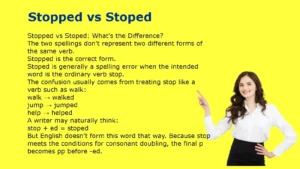
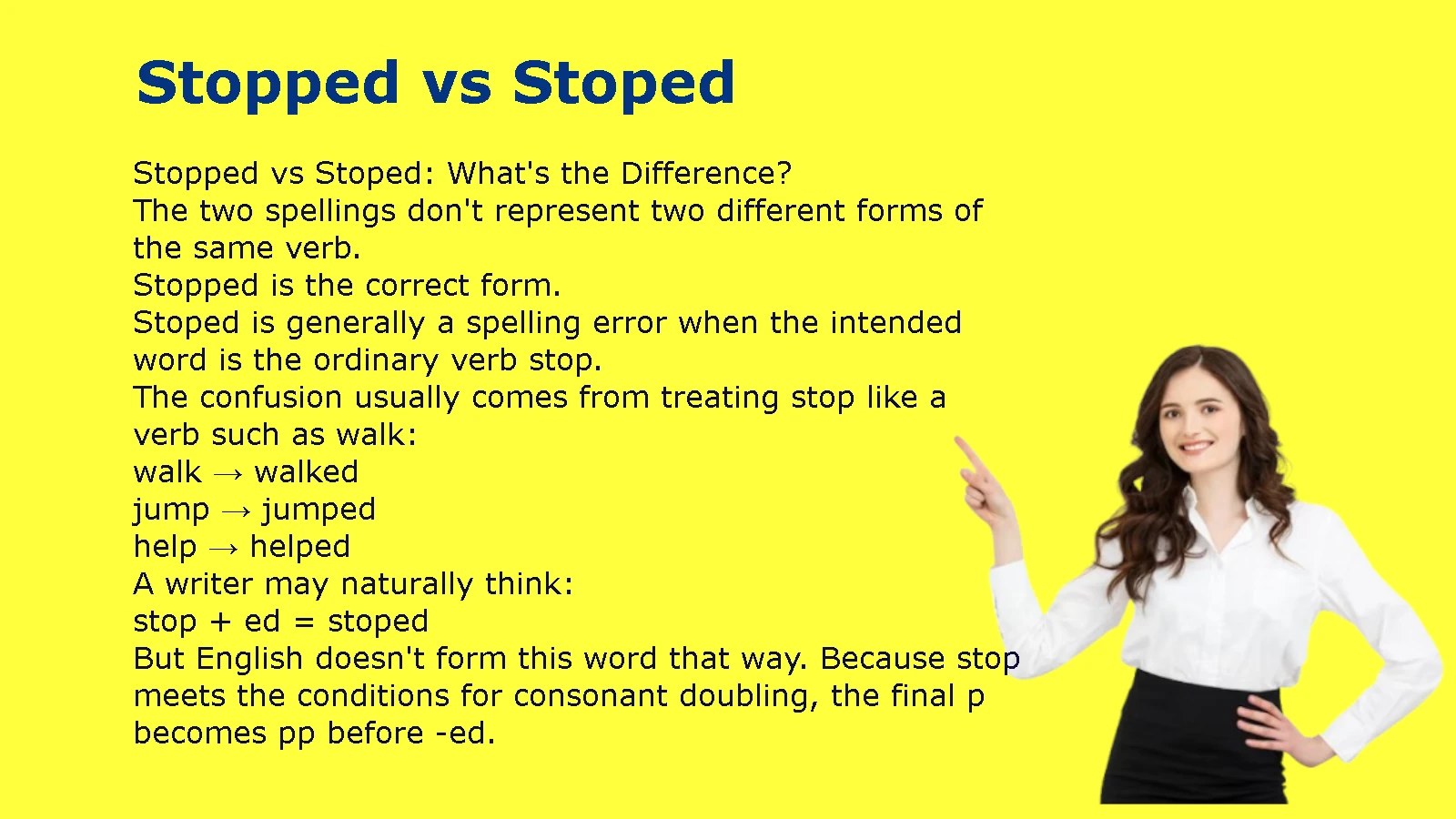
Stopped vs Stoped: What’s the Difference?
The two spellings don’t represent two different forms of the same verb.
Stopped is the correct form.
Stoped is generally a spelling error when the intended word is the ordinary verb stop.
The confusion usually comes from treating stop like a verb such as walk:
- walk → walked
- jump → jumped
- help → helped
A writer may naturally think:
stop + ed = stoped
But English doesn’t form this word that way. Because stop meets the conditions for consonant doubling, the final p becomes pp before -ed.
The Basic Pattern
Think of the transformation like this:
stop → stopped
Not:
stop → stoped
The same pattern appears in several familiar verbs:
| Base verb | Past tense |
| stop | stopped |
| hop | hopped |
| plan | planned |
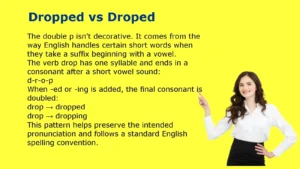
| drop | dropped |
| shop | shopped |
| clap | clapped |
| rob | robbed |
So if you already know that hop becomes hopped, you can apply the same idea to stop.
What Does Stopped Mean?
Stopped is the past tense and past participle of the verb stop.
The verb stop has several related meanings, but its central idea is bringing movement, activity, or continuation to an end.
For example:
- The bus stopped.
- The music stopped.
- We stopped working.
- She stopped the machine.
- They stopped arguing.
The subject doesn’t always have to stop itself. A person can also cause another person, object, or process to stop.
Compare these:
The car stopped.
Here, the car came to a halt.
The driver stopped the car.
Here, the driver caused the car to come to a halt.
That distinction is useful because stop can function as both an intransitive and transitive verb depending on the sentence.
Why Is Stopped Spelled With Two Ps?
The double p comes from an established English spelling rule known as the final-consonant doubling rule.
When a short, one-syllable verb ends in a consonant after a short vowel, English commonly doubles the final consonant before adding a suffix that begins with a vowel, such as -ed or -ing.
The word stop fits the pattern.
Breaking Down Stop
Look at the letters:
- s = consonant
- t = consonant
- o = vowel
- p = consonant
More importantly, the word ends with the short vowel sound /ɑ/ or /ɒ/ depending on the variety of English, followed by p.
When you add -ed, the final p doubles:
stop → stopped
When you add -ing, it doubles again:
stop → stopping
This isn’t a special rule invented just for stop. The same pattern appears in many other common words. Cambridge gives examples such as hop → hopped, sit → sitting, and rub → rubbed. Cambridge Dictionary
The Rule in Action
| Base word | + -ed | + -ing |
| stop | stopped | stopping |
| hop | hopped | hopping |
| plan | planned | planning |
| drop | dropped | dropping |
| shop | shopped | shopping |
| clap | clapped | clapping |
The pattern becomes much easier to recognize when you see several examples together.
Why Is Stoped Incorrect?
The spelling stoped doesn’t follow the standard spelling pattern for the verb stop.
The problem is the missing p.
When you attach -ed to stop, you don’t simply place the suffix after the final letter. You first double the final consonant:
stop + p + ed → stopped
Writing stoped skips that doubling step.
Incorrect and Correct Examples
Incorrect:
I stoped the car.
Correct:
I stopped the car.
Incorrect:
The rain stoped suddenly.
Correct:
The rain stopped suddenly.
Incorrect:
She stoped working at noon.
Correct:
She stopped working at noon.
The difference is only one letter, but that letter determines whether the spelling follows standard English usage.
Stopped as the Past Tense of Stop
You use stopped as the simple past form when an action happened and ended in the past.
For example:
- The train stopped at the station.
- He stopped the video.
- We stopped for lunch.
- The noise stopped after midnight.
- She stopped laughing.
- They stopped the experiment.
The time can be stated explicitly:
The meeting stopped at 4 p.m.
Or the past context can be understood from the sentence:
I stopped by your office yesterday.
Stopped With Different Subjects
The spelling doesn’t change according to the subject.
| Subject | Example |
| I | I stopped the car. |
| You | You stopped too soon. |
| He | He stopped talking. |
| She | She stopped the machine. |
| It | It stopped working. |
| We | We stopped for coffee. |
| They | They stopped the discussion. |
Unlike the present tense, the past tense doesn’t require different forms such as stop, stops, and so on. Stopped works with every subject.
Stopped as the Past Participle
A past participle often appears with auxiliary verbs such as has, have, had, or forms of be.
Present Perfect
Use has stopped or have stopped when a past action has a connection to the present.
Examples:
- The rain has stopped.
- The machine has stopped working.
- They have stopped arguing.
- We have stopped using that software.
The form stays stopped regardless of whether you use has or have.
Past Perfect
Use had stopped when one past event happened before another past event.
For example:
The rain had stopped before we left.
The stopping happened first. Leaving happened afterward.
Another example:
The factory had stopped production before the inspection began.
Passive Constructions
Stopped can also appear in passive constructions.
Examples include:
- The car was stopped by the police.
- The project was stopped because of funding problems.
- The production line was stopped for maintenance.
- Several shipments were stopped at the border.
The passive construction focuses on what happened to the subject rather than who performed the action.
Stopped in a Sentence
A single word can appear in many contexts. Seeing stopped in different types of sentences helps you understand how naturally the word works.
Everyday Examples
Here are common examples from ordinary conversation:
- I stopped at the grocery store.
- The dog stopped barking.
- She stopped to answer the phone.
- We stopped for coffee.
- He stopped watching the movie.
- The elevator stopped on the fifth floor.
- The baby finally stopped crying.
Notice that stopped doesn’t always mean completely ending something forever.
For instance:
I stopped watching the movie.
This simply means the person ended their viewing at that point. They might watch it again later.
Professional Examples
In workplace writing, stopped can describe operations, communication, production, or processes.
- The company stopped production temporarily.
- The system stopped responding.
- The team stopped using the old software.
- The manager stopped the meeting to address the issue.
- The factory stopped operations for maintenance.
The word works in both casual and formal contexts.
Academic Examples
Academic writing also uses stopped when describing experiments, processes, or actions.
- The researchers stopped the experiment after observing the reaction.
- The participants stopped responding after several minutes.
- The reaction stopped when the temperature decreased.
- The study was stopped because the required conditions changed.
In scientific or technical writing, the exact meaning depends on what process or action has ended.
Common Phrases With Stopped
Some constructions appear so often that they’re worth learning as complete patterns.
Stopped Working
Stopped working means something ceased to function.
My computer stopped working this morning.
It can also describe a person ending their work:
She stopped working at six.
Context tells you which meaning applies.
Stopped Talking
This means someone ceased speaking.
The students stopped talking when the teacher entered.
It can also refer to ending communication more broadly:
They stopped talking to each other after the argument.
Stopped Moving
This means movement ended.
The train stopped moving suddenly.
Stopped Trying
This means someone ceased making an effort.
He stopped trying after several unsuccessful attempts.
Stopped Using
This means someone discontinued the use of something.
The company stopped using the old system.
Stopped By
Stopped by has a different meaning from simply stopped.
In casual American English, stop by commonly means visit somewhere briefly.
I stopped by her house after work.
It can also refer to making a brief visit to a business:
We stopped by the store on the way home.
Don’t confuse this with:
The police stopped the car.
In the second sentence, stopped means brought something to a halt.
Stopped vs Stoped: Common Spelling Mistake
The error usually comes from a reasonable-looking but incorrect assumption:
stop + ed = stoped
That pattern works for some verbs:
- walk → walked
- talk → talked
- clean → cleaned
- jump → jumped
But stop belongs to a different spelling pattern.
It becomes:
stop → stopped
The same principle explains:
stop → stopping
Once you recognize the base word as a short one-syllable verb ending in the relevant consonant pattern, the spelling becomes predictable.
Stop, Stops, Stopped, and Stopping
The four forms are easy to confuse because they all come from the same base verb.
| Form | Grammatical use | Example |
| stop | Base form | I need to stop. |
| stops | Third-person singular present | The bus stops here. |
| stopped | Past tense/past participle | The bus stopped here. |
| stopping | Present participle/gerund | The bus is stopping here. |
The key spelling point is that both stopped and stopping contain two Ps.
Stop → Stopped
For the past tense:
stop + ed → stopped
Stop → Stopping
For the -ing form:
stop + ing → stopping
This gives you a useful memory shortcut:
If stop takes -ed or -ing, keep the double P.
Why Does Stop Become Stopping and Stopped?
The same consonant-doubling principle explains both forms.
Consider these transformations:
- stop → stopped
- stop → stopping
- hop → hopped
- hop → hopping
- shop → shopped
- shop → shopping
The final consonant doubles before the vowel-starting suffix.
However, don’t turn this into an overly broad rule that says every verb doubles its final consonant. English spelling depends on factors such as syllable count, stress, vowel patterns, and the letters already present in the word.
For example:
- look → looked, not lookked
- help → helped, not helpped
- rain → rained, not rainned
Cambridge notes that consonants aren’t doubled when the word already ends in two written consonants or when the relevant vowel pattern doesn’t meet the conditions for doubling. Cambridge Dictionary
When Do You Double the Final Consonant?
A practical rule works especially well for short, one-syllable verbs.
When a one-syllable verb ends in a single vowel sound followed by a single consonant, you commonly double the final consonant before adding -ed, -ing, or certain other suffixes.
Examples:
- stop → stopped
- plan → planned
- drop → dropped
- rub → rubbed
- slim → slimmer
- sit → sitting
The rule becomes more complicated with longer words because stress matters. Cambridge’s grammar guidance gives examples such as prefer → preferred and admit → admitting, while visit becomes visited rather than visitted because the stress falls elsewhere. Cambridge Dictionary
For stop, however, there’s no complicated stress question to solve. It’s a one-syllable verb and the final consonant follows the short-vowel pattern.
Stopped vs Stopping: Don’t Drop the Second P
A closely related mistake is writing stoping instead of stopping.
When stop takes -ing, the final p doubles:
stop → stopping
Not:
stop → stoping
This matters because the two forms can look deceptively similar.
| Incorrect | Correct |
| stoped | stopped |
| stoping | stopping |
If you’re writing about the act of bringing something to an end, stopping is the standard form. The technical word stoping exists in mining terminology with a different meaning, but that isn’t the ordinary -ing form of the verb stop. Define Syntax
Stopped in American and British English
There is no spelling difference between American and British English for stopped.
Both use:
stopped
The same applies to stopping.
| Variety | Past tense | -ing form |
| American English | stopped | stopping |
| British English | stopped | stopping |
This is useful because English does have genuine US/UK spelling differences in other words.
For example:
- American: traveled
- British: travelled
But stop doesn’t create that kind of variation.
You should therefore use stopped regardless of whether your audience follows American or British spelling.
Common Mistakes With Stop
The most important mistakes involve adding suffixes incorrectly.
Stoped Instead of Stopped
❌ She stoped the car.
✅ She stopped the car.
Stoping Instead of Stopping
❌ The machine is stoping.
✅ The machine is stopping.
Using Stop Instead of Stopped
❌ Yesterday, I stop at the store.
✅ Yesterday, I stopped at the store.
The base form stop normally needs to change to stopped when you’re describing a completed action in the simple past.
Forgetting the Double P in Fast Writing
Typing quickly can make this error especially easy to miss because stoped looks visually plausible.
A quick proofreading trick is to search for stoped whenever you’ve written about something that ended in the past. If you find it, check whether you meant stopped.
How to Remember the Spelling of Stopped
A simple memory trick is better than memorizing a complicated grammar paragraph.
Remember:
STOP doesn’t stop at one P when you add -ed.
The spelling becomes:
STOP → STOPPED
You can also connect it to stopping:
STOP → STOPPING
If you remember one, the other becomes easier.
A Useful Pattern
Memorize this small group:
- hop → hopped
- stop → stopped
- shop → shopped
- drop → dropped
- plan → planned
Seeing the same pattern across several verbs makes the rule easier to recall.
A Quick Spelling Test: Stopped or Stoped?
Choose stopped or stoped in each sentence.
Question One
The bus ______ outside the school.
Question Two
She ______ talking when the phone rang.
Question Three
The rain ______ before we left.
Question Four
He ______ the machine immediately.
Question Five
The music ______ at midnight.
Answers
- The bus stopped outside the school.
- She stopped talking when the phone rang.
- The rain stopped before we left.
- He stopped the machine immediately.
- The music stopped at midnight.
Every answer contains two Ps.
That’s the pattern to remember.
A Simple Case Study: Correcting a Common Spelling Error
Consider this sentence:
The production line stoped working at 3 p.m.
At first glance, the sentence looks fine. The problem is the spelling of stoped.
Start with the base verb:
stop
Now identify the ending:
-ed
Because stop follows the final-consonant doubling pattern, double the p before adding -ed:
stop + p + ed = stopped
The corrected sentence becomes:
The production line stopped working at 3 p.m.
The grammatical structure doesn’t change. Only the spelling needs correction.
This is a good example of why learning the rule is more useful than memorizing a single answer. Once you know that stop becomes stopped, you can also predict stopping.
Stopped vs Stoped in Formal Writing
Correct spelling matters most when your writing represents you in a professional or academic setting.
Use stopped in:
- Business emails
- Reports
- School assignments
- Essays
- Academic papers
- Resumes and cover letters
- Professional documentation
- Applications
- Presentations
Although readers can usually understand stoped, it still looks like a spelling mistake. There’s little reason to leave it uncorrected when the standard form is easy to learn.
Example in Professional Writing
Incorrect:
Production stoped because of a mechanical problem.
Correct:
Production stopped because of a mechanical problem.
The second version immediately looks polished and standard.
Is Stopped the Correct Spelling?
Yes. Stopped is the correct spelling when it’s the past tense or past participle of stop.
For example:
The train stopped at the station.
She has stopped using the software.
The machine had stopped working.
The spelling remains stopped in each case.
Is Stoped a Word?
If you mean the ordinary verb stop, stoped is not the standard spelling.
When you want to describe something that stopped in the past, use stopped.
One technical detail is worth knowing: English has specialized vocabulary in which similar-looking forms can occur with meanings unrelated to the everyday verb stop. Mining terminology, for example, uses stope as a noun and verb. That specialized word can produce forms such as stoped in technical contexts. meandecode.com
That doesn’t make stoped a correct alternative spelling of the past tense of stop.
So for ordinary English:
stop → stopped
What Is the Past Tense of Stop?
The simple past tense of stop is stopped.
Examples:
- I stopped the car.
- She stopped the music.
- We stopped for lunch.
- They stopped arguing.
- The rain stopped overnight.
The form doesn’t change based on the subject.
What Is the Past Participle of Stop?
The past participle is also stopped.
You can see it after auxiliary verbs:
- has stopped
- have stopped
- had stopped
- was stopped
- were stopped
- has been stopped
- had been stopped
For example:
The machine has stopped working.
The project had stopped before the new manager arrived.
The vehicle was stopped at the checkpoint.
Is Stoping Correct?
When you’re forming the -ing form of the ordinary verb stop, the correct spelling is stopping, with two Ps.
stop → stopping
Not:
stoping
The same consonant-doubling rule that produces stopped produces stopping.
This makes the pair particularly easy to remember:
stopped and stopping
Both contain two Ps.
What Is the Difference Between Stopped and Stopping?
The main difference is grammatical.
Stopped usually refers to a completed action or state.
The car stopped.
Stopping describes an action in progress or can function as a gerund.
The car is stopping.
Another example makes the contrast clearer:
The rain stopped.
This tells you the rain has ceased.
The rain is stopping.
This describes the process of the rain coming to an end.
Is Stopped Spelled the Same in American and British English?
Yes.
Both American English and British English spell the word:
stopped
Neither standard variety uses stoped as the ordinary past tense of stop.
The consonant-doubling rule applies in both varieties. Some other words have US/UK spelling differences, but stopped isn’t one of them.
Why Do We Double the P in Stopped?
The short answer is that stop meets the conditions for final-consonant doubling before -ed.
The practical pattern is:
short vowel + single final consonant → double the consonant before certain suffixes
So:
stop + ed → stopped
The same principle gives us:
- hop → hopped
- plan → planned
- drop → dropped
- rub → rubbed
English spelling rules aren’t always perfectly mechanical, but stopped follows a very regular and well-established pattern. Cambridge Dictionary
Stopped vs Stoped: Key Facts to Remember
If you only remember a few points, remember these:
- Stopped is the correct standard spelling for the past tense of stop.
- Stoped is incorrect when it is intended as the past form of stop.
- The p doubles before -ed.
- The same doubling happens in stopping.
- Stopped is used in both American and British English.
- Stopped can function as both the simple past and past participle.
- The spelling doesn’t change according to the subject.
- The rule reflects the broader English pattern of doubling certain final consonants before vowel-starting suffixes.
- Specialized technical vocabulary can contain stoped from the separate verb stope, but that doesn’t make it an alternative spelling of stopped. meandecode.com
FAQs About Stopped vs Stoped
Is stopped the correct spelling?
Yes. Stopped is the correct standard spelling of the past tense and past participle of stop.
Is stoped a word?
Not as the ordinary past tense of stop. In standard everyday English, use stopped. A specialized mining term derived from stope can produce stoped, but that is a different word and meaning. meandecode.com
Why does stopped have two Ps?
The final p doubles before -ed because stop follows the English final-consonant doubling pattern.
stop → stopped
What is the past tense of stop?
The past tense is stopped.
She stopped the car.
What is the past participle of stop?
The past participle is also stopped.
She has stopped the car.
Is stoping correct?
Not when you mean the -ing form of stop. The correct form is stopping.
What is the difference between stopped and stopping?
Stopped generally describes a completed action or past state.
Stopping describes an action in progress or functions as a gerund.
Is stopped spelled differently in British English?
No. Stopped has the same spelling in American and British English.
Why can’t I just add -ed to stop?
You do add -ed, but English spelling requires the final consonant to double first:
stop + p + ed = stopped
Simply writing stoped doesn’t follow the standard spelling rule.
How can I remember stopped?
Remember the pair:
stopped / stopping
Both forms have two Ps.
You can also memorize:
stop → stopped → stopping
Once that sequence becomes familiar, the spelling is hard to forget.
Conclusion: Stopped Is the Correct Spelling
When you’re choosing between stopped vs stoped, choose stopped.
The word stopped is the standard past tense and past participle of stop. The extra p follows the English consonant-doubling rule used when certain short verbs take endings such as -ed and -ing.
The pattern is simple:
stop → stopped → stopping
So write:
“The car stopped.” ✅
Not:
“The car stoped.” ❌
The same rule also explains stopping, hopped, planned, dropped, and many other familiar forms. Once you recognize the pattern, stopped becomes more than a spelling to memorize. It becomes a spelling you can understand.