Have you ever wondered whether you should write “formulas” or “formulae”? Both words are correct, but the choice can depend on English variety, context, and personal preference. If you’ve ever paused while writing because you weren’t sure which form to use, you’re not alone.
Formulas and formulae are both plural forms of formula, a word used for mathematical expressions, scientific rules, recipes, and established methods. Formulas is the more common plural form in American English, while formulae is traditionally preferred in British English, especially in scientific and academic writing.
Examples:
- Scientists use formulas to calculate the reaction rate.
- The textbook includes several mathematical formulae.
The confusion is understandable. You may see formulas vs formulae, formula or formulae, is formulae correct, or what is the plural of formula while writing for school, work, or academic purposes. And here’s the kicker: neither word is automatically wrong. The better choice often depends on your audience and the type of writing you’re doing.
In this guide, you’ll learn the complete difference between formulas and formulae, including their meaning, plural forms, pronunciation, usage, and examples in sentences. You’ll also discover when to use formulas or formulae, which form is more common in American and British English, and how to choose the right word for your writing.
Formulas vs Formulae: What’s the Difference?
At the most basic level, formulas and formulae have the same grammatical job. Both are plural nouns that refer to more than one formula.
For example:
- The textbook contains several formulas.
- The textbook contains several formulae.
The meaning is essentially the same. The difference lies mainly in usage, tradition, discipline, and editorial preference.
Cambridge lists formulas or formulae as the plural forms of formula. Oxford does the same and specifically notes that formulae is used especially in scientific language.
That distinction matters because English has a long history of borrowing words from Latin and Greek. Some borrowed words kept their traditional plural forms, while others developed regular English plurals. Formula happens to have both.
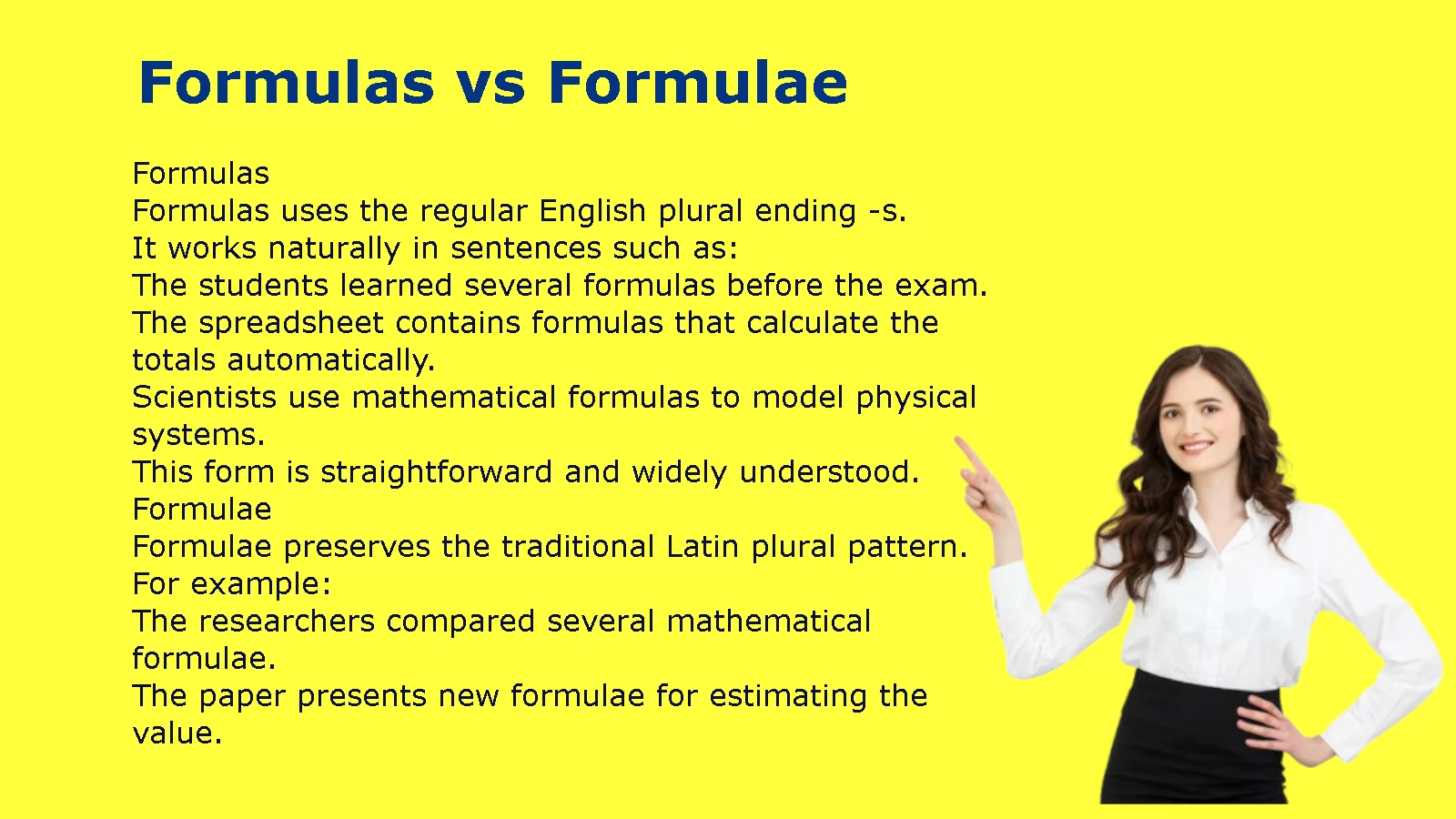
Formulas
Formulas uses the regular English plural ending -s.
It works naturally in sentences such as:
The students learned several formulas before the exam.
The spreadsheet contains formulas that calculate the totals automatically.
Scientists use mathematical formulas to model physical systems.
This form is straightforward and widely understood.
Formulae
Formulae preserves the traditional Latin plural pattern.
For example:
The researchers compared several mathematical formulae.
The paper presents new formulae for estimating the value.
The students studied the chemical formulae of several compounds.
The form can sound more traditional or specialized, particularly in scientific contexts. That doesn’t make it inherently more correct.
What Does “Formula” Mean?
Before choosing between formulas and formulae, it helps to understand what formula actually means. The word has several related meanings, and you can encounter it far beyond a mathematics classroom.
Cambridge defines formula as a standard or accepted way of doing something, as well as a mathematical rule expressed through numbers and letters. It also uses the word for chemical compositions.
Formula in Mathematics
In mathematics, a formula is a symbolic expression that represents a rule, relationship, or calculation.
For example:
A = πr²
This formula gives the area of a circle.
If you have several such expressions, you can call them formulas or formulae.
- The chapter introduces five formulas for calculating geometric measurements.
- The chapter introduces five formulae for calculating geometric measurements.
Both sentences are grammatically sound.
Formula in Chemistry
In chemistry, a formula represents the composition of a substance using chemical symbols and numbers.
For example:
- H₂O represents water.
- CO₂ represents carbon dioxide.
- NaCl represents sodium chloride.
You might therefore write:
- The students memorized the chemical formulas.
- The students memorized the chemical formulae.
Both forms work.
Oxford specifically lists chemistry as one of the contexts in which formula has a technical meaning.
Formula as a Method
The word can also mean a method or approach for achieving a particular result.
For example:
There is no magic formula for success.
If you’re talking about several methods, you could write:
Different formulas can produce similar results.
Here, formulas usually sounds more natural because the word has a general, nontechnical meaning.
Formula as a Recipe or Composition
A formula can also describe the ingredients or proportions used to make a product.
For example:
The company changed the formula of its detergent.
The plural could be:
The company tested several formulas before choosing the final version.
Merriam-Webster includes meanings related to recipes, prescriptions, mixtures, methods, and mathematical or scientific expressions.
Formula in Racing
You may also see formula in motorsports, as in Formula One or Formula Two.
In this context, formula refers to a class or specification of racing vehicles rather than a mathematical equation.
That meaning doesn’t create a special plural rule. When the noun is genuinely plural, formulas or formulae can still be grammatically possible, although the racing term is often used as part of a proper name.
Is “Formulas” Correct?
Yes. Absolutely.
Formulas is a standard plural of formula. You can use it in formal writing, professional writing, academic writing, and everyday English.
Merriam-Webster gives formulas and formulae as plural forms. Cambridge does the same. Oxford’s American English dictionary also lists formulas, formulae.
There is no grammatical rule saying that you must write formulae simply because you’re discussing science or mathematics.
Consider these examples:
- The book explains several formulas for calculating interest.
- The software uses formulas to process the data.
- The researcher tested three formulas.
- Students often memorize formulas before a mathematics exam.
- The engineer created formulas to model the system.
Nothing is wrong with any of these sentences.
Why “Formulas” Feels Natural
English regularly forms plurals with -s. When speakers encounter a borrowed noun that can easily fit the English plural system, they often use the regular form.
That’s exactly what happened with formula.
Instead of requiring readers to know the Latin plural, modern English allows the simpler formulas.
This makes the word especially convenient in general writing:
These formulas are easier to understand than the previous ones.
It’s clear, familiar, and immediately recognizable.
Is “Formulae” Correct?
Yes.
Formulae is also a fully established English plural. It isn’t a spelling mistake, and it isn’t simply an outdated version of formulas.
Cambridge defines formulae as the plural of formula. Oxford likewise lists it as an accepted plural and notes that it is used especially in scientific language.
For example:
- The paper presents several mathematical formulae.
- The researchers derived new formulae.
- The textbook contains important chemical formulae.
- These formulae describe the behavior of the system.
The form is particularly recognizable in specialized academic writing.
Why “Formulae” Still Exists
The answer goes back to Latin.
The English noun formula comes from Latin formula, which meant things such as a form, draft, rule, or method. The word entered English centuries ago and developed several meanings over time. The mathematical sense emerged in English in the late 18th century, while the chemistry sense developed in the 19th century.
Latin uses formulae as the plural.
English did not have to preserve that ending. In fact, it often doesn’t preserve traditional Latin plurals. However, some fields continued using the Latin-derived form, especially scholarly and scientific communities.
That’s why formulae remains alive today.
When Should You Use “Formulas”?
For most general writing, formulas is an excellent choice.
Use it when your audience includes general readers and you don’t have a publication style guide requiring another form.
Use “Formulas” in General English
If formula means a method, recipe, strategy, or general rule, formulas usually fits naturally.
Examples:
- Several formulas were proposed for solving the problem.
- The company tested different pricing formulas.
- There are several formulas for calculating compound interest.
- The author explains common formulas for writing persuasive copy.
- The spreadsheet contains formulas for each column.
Notice how natural the regular plural feels. You don’t need a Latin ending to make the sentence sound professional.
Use “Formulas” in American English
For a general US audience, formulas is a strong default.
That doesn’t mean Americans never use formulae. They do, particularly in academic and scientific settings. Oxford’s American English dictionary lists both forms, while Merriam-Webster also recognizes both.
The practical rule is simple:
If you’re writing general American English and no style guide tells you otherwise, “formulas” is usually the safest choice.
That rule helps you avoid unnecessary formality without suggesting that formulae is incorrect.
When Should You Use “Formulae”?
Formulae makes sense when it matches the conventions of your field or publication.
Oxford explicitly says that formulae is used especially in scientific language.
Scientific Writing
Scientific literature has a long tradition of using Latin-derived plurals.
You may encounter sentences such as:
- The researchers derived several formulae.
- The paper compares mathematical formulae used in previous studies.
- The chemical formulae were analyzed using spectroscopy.
In such writing, formulae can fit the established tone of the discipline.
However, don’t turn that preference into a hard grammatical rule.
Formulas remains correct.
Academic Writing
Academic writing often follows the preferences of a university, journal, publisher, or discipline.
For example, a scientific journal might consistently use traditional Latin plurals. Another publication may prefer plain modern English.
The best approach is to follow the relevant style guide.
That principle is more useful than memorizing an artificial rule such as “scientists must use formulae.”
Mathematical Writing
Mathematics provides another setting where both forms appear.
You might see:
The formulas below can be used to calculate the area.
Or:
The formulae below can be used to calculate the area.
Neither sentence contains a grammatical error.
The choice may reflect the author’s preferred style, the textbook’s conventions, or the publication’s editorial policy.
Formulas vs Formulae in American English
If you’re specifically writing American English, the choice becomes easier but not absolute.
Formulas is generally the better default for broad US audiences.
American English frequently favors regular English plurals where British or highly specialized academic traditions may preserve older forms. Still, formulae remains part of standard American English.
Oxford’s American English dictionary lists both:
- formulas
- formulae
It also gives the same basic meanings for mathematical, chemical, methodological, and compositional uses.
So don’t write:
Formulae is British English, while formulas is American English.
That’s too simplistic.
A better explanation is:
Both forms are used in American English, but “formulas” is generally the more natural general-purpose choice.
The distinction is about frequency and context, not grammatical permission.
Formulas vs Formulae in British English
British English also uses both forms.
Formulae has a particularly strong traditional presence in scientific and mathematical writing. However, formulas is not an American-only spelling.
Cambridge lists both plural forms and gives examples using formulae in technical contexts.
Collins likewise lists formulae and formulas as plural forms.
So the common shortcut:
American = formulas
British = formulae
isn’t reliable enough.
A better distinction is:
| Context | Likely choice |
| General US English | formulas |
| General British English | formulas or formulae |
| Scientific writing | formulae or formulas |
| Mathematical writing | formulae or formulas |
| Publication with a house style | Follow the style guide |
The publication’s conventions can matter more than geography.
Formulas vs Formulae in Math and Science
Science and mathematics are where the two forms cause the most confusion.
Oxford University has a particularly useful style note: its style guide gives formula → formulas for general use but formulae in maths/chemistry.
That is a style choice, not evidence that formulas becomes incorrect in mathematics or chemistry.
This distinction is worth remembering.
Mathematics
Suppose you’re writing about geometry.
These formulas calculate the area of different shapes.
That is perfectly acceptable.
You could also write:
These formulae calculate the area of different shapes.
Also correct.
Chemistry
Consider a chemistry textbook.
Students should learn the chemical formulas of common compounds.
Correct.
You could also write:
Students should learn the chemical formulae of common compounds.
Correct again.
The Oxford style guide’s preference demonstrates why readers may encounter formulae more often in specialized scientific material.
Physics
The same principle applies to physics.
A textbook might say:
The formulas below describe the motion of an object.
Another might say:
The formulae below describe the motion of an object.
Both convey the same grammatical meaning.
The important thing is to match the style of the surrounding document.
Why Does “Formulae” Have an “-ae” Ending?
The -ae ending comes from Latin.
The English word formula was borrowed from Latin formula, and the traditional Latin plural is formulae. The Latin word itself was related to forma, meaning “form.” Etymological sources describe formula as literally a diminutive related to forma.
English eventually developed the regular plural formulas alongside the traditional form.
This isn’t unusual.
English contains many words with competing plural patterns:
| Singular | Traditional or borrowed plural | Regular plural |
| formula | formulae | formulas |
| index | indices | indexes |
| appendix | appendices | appendixes |
| medium | media | mediums |
| cactus | cacti | cactuses |
However, the meanings and preferred contexts can differ for some of these words. That’s why you shouldn’t assume every Latin-looking plural behaves exactly like every other one.
With formula, both plural forms are well established.
The History of “Formula” in English
The history of formula helps explain why the word has such a wide range of meanings today.
The word entered English in the 17th century from Latin. Early English uses involved words or statements used in ceremonies and rituals. Later, the word developed senses connected with prescriptions and recipes. Its mathematical use emerged around the end of the 18th century, followed by its chemistry sense in the 19th century.
That evolution produced the modern meanings you’re familiar with:
- a mathematical expression
- a chemical representation
- a recipe or composition
- a method
- a standard procedure
- a conventional expression
- a racing classification
So when you see formulas and formulae, you’re looking at two plural forms attached to a word with a surprisingly long history.
How to Pronounce “Formulas” and “Formulae”
The two plurals don’t sound exactly alike.
Cambridge gives the US pronunciation of formula as /ˈfɔːr.mjə.lə/ and lists the plural pronunciation of formulae as /ˈfɔːr.mjə.liː/. Merriam-Webster likewise records pronunciations for both plural forms.
The easiest way to remember the distinction is this:
- formulas ends with the regular plural -s sound.
- formulae ends with an ee sound.
When speaking, the difference is therefore quite noticeable.
If you’re learning English, hearing the two forms in context can help reinforce which spelling you’re looking at.
Formulas vs Formulae: Example Sentences
The easiest way to understand the difference is to see the words working in real sentences.
| Context | Formulas | Formulae |
| Mathematics | The students learned several formulas. | The students learned several formulae. |
| Chemistry | The textbook lists chemical formulas. | The textbook lists chemical formulae. |
| Physics | These formulas describe motion. | These formulae describe motion. |
| Engineering | The engineer used several formulas. | The engineer used several formulae. |
| Business | The company tested different pricing formulas. | The company tested different pricing formulae. |
| General writing | There are several formulas for success. | There are several formulae for success. |
The final example is especially useful because it shows that formulae isn’t restricted to literal mathematical equations.
The word can describe methods and conventional patterns too.
A Practical Case Study: Choosing a Form in Three Different Articles
Imagine three writers are using the word formula.
Case Study: A Math Blog
A math website publishes an article called 10 Formulas Every Algebra Student Should Know.
Formulas is a natural choice.
The audience includes students, parents, teachers, and general readers. A straightforward English plural improves readability.
Case Study: A Chemistry Journal
A research journal publishes a technical paper discussing newly derived expressions.
The authors write:
The proposed formulae were compared with those reported in previous studies.
Here, formulae fits the specialized academic tradition.
It isn’t more “correct” than formulas. It simply matches the publication’s established style.
Case Study: A University Style Guide
Suppose a university tells authors to use traditional Latin plurals in mathematics and chemistry.
In that environment, formulae becomes the preferred editorial choice.
But the key word is preferred.
A style guide can establish a house convention without changing the underlying grammar of English.
A Quote From a Major Dictionary
Oxford’s usage note is especially useful because it makes the context distinction explicit:
“Formulae is used especially in scientific language.”
That short statement captures the practical difference better than a rigid regional rule.
Common Mistakes With Formulas and Formulae
Most mistakes with these words aren’t actually about choosing between the two plural forms. They’re about number and agreement.
Using “Formula” When You Need a Plural
Incorrect:
These formula are difficult to understand.
Correct:
These formulas are difficult to understand.
Or:
These formulae are difficult to understand.
The singular formula cannot normally follow the plural demonstrative these.
Treating “Formulae” as Singular
Incorrect:
This formulae is complicated.
Correct:
This formula is complicated.
Or, if the sentence is plural:
These formulae are complicated.
The ending -ae doesn’t make formulae singular. It is a plural form.
Assuming “Formulae” Is Always More Formal
This is a common misconception.
Formulae can sound more traditional or specialized, but that doesn’t automatically make it better writing.
For example:
The software uses five formulas to calculate the result.
There is no need to replace formulas with formulae just to make the sentence sound academic.
Good writing isn’t about making every noun wear a tuxedo.
Assuming “Formulas” Is Too Informal for Science
The opposite mistake also occurs.
Formulas is not grammatically inferior in scientific writing.
Major dictionaries recognize it as a plural form, and Merriam-Webster explicitly lists formulas or formulae.
If your journal or institution prefers formulae, use it. Otherwise, formulas remains legitimate.
Switching Between Both Forms Randomly
Using both forms isn’t automatically incorrect. However, inconsistent usage can make a document look poorly edited.
For example:
The first section introduces three formulas. The next section discusses five formulae. The final section returns to four formulas.
There’s no grammatical disaster here. Still, unless the change has a reason, consistency would usually make the article cleaner.
Pick the form that fits your audience and style. Then stick with it.
Formulas vs Formulae vs. Formula
Here’s the simplest way to keep the three forms straight:
| Number | Correct form | Example |
| Singular | formula | This formula works. |
| Plural | formulas | These formulas work. |
| Plural | formulae | These formulae work. |
The verb also needs to agree with the noun.
Singular
The formula is correct.
Plural with “formulas”
The formulas are correct.
Plural with “formulae”
The formulae are correct.
That’s all the grammar you need for number agreement.
Which Is More Common: “Formulas” or “Formulae”?
Formulas is generally the more widely used form.
That doesn’t make formulae unusual or incorrect. It simply means that formulas is the broader modern English choice.
Dictionary.com describes formulas as more widely used, while major dictionaries such as Cambridge, Oxford, and Merriam-Webster recognize both forms.
A useful way to think about it is:
Formulas = broad default
Formulae = established specialized alternative
That isn’t an absolute rule. Real-world usage depends on the writer, region, field, and publication.
Should You Use “Formulas” or “Formulae” in SEO Content?
If you’re writing for a broad online audience, formulas will usually be the clearer default.
Search readers tend to want a direct answer, not a lesson in Latin morphology. If the article discusses mathematical or scientific formulas, use the form that sounds natural for your audience.
For general US English content:
- Prefer formulas as the default.
- Mention formulae as the accepted alternative.
- Explain the scientific and academic preference where relevant.
- Don’t tell readers that one is wrong.
- Use both naturally when explaining the distinction.
This approach also lets an article capture related searches such as:
- formulas vs formulae
- formulas or formulae
- plural of formula
- is formulae correct
- is formulas correct
- formulae vs formulas
- American English formulas or formulae
- mathematical formulas or formulae
- chemical formulas or formulae
The key is to answer those questions naturally rather than stuffing the phrases into every paragraph.
Formulas or Formulae? The Quick Rule
If you need a quick decision, use this table.
| Situation | Recommended choice |
| General American English | formulas |
| Everyday writing | formulas |
| General educational content | formulas |
| Business writing | formulas |
| Popular science | formulas |
| Scientific writing | formulas or formulae |
| Mathematical writing | formulas or formulae |
| Academic publication | Follow the publication’s style |
| Traditional scientific style | formulae |
There is no need to overthink the choice when you’re writing ordinary English.
Use formulas by default.
Choose formulae when the context or style guide makes that form a natural fit.
FAQs About Formulas vs Formulae
Is “formulas” grammatically correct?
Yes. Formulas is a standard plural of formula. Cambridge, Oxford, and Merriam-Webster all recognize it.
Is “formulae” grammatically correct?
Yes. Formulae is also a standard plural of formula. It preserves the traditional Latin plural and remains especially common in scientific language.
What is the plural of formula?
The two accepted plural forms are formulas and formulae.
Is formulae more formal than formulas?
Not automatically. Formulae can sound more traditional or specialized, especially in scientific and academic contexts. However, formulas is also appropriate in formal writing.
Which is better in American English, formulas or formulae?
Formulas is generally the better default for general American English. However, formulae is also correct and appears in American scientific and academic writing. Oxford’s American English dictionary lists both forms.
Which is better in British English?
Both are used. Formulae has a strong traditional presence in British scientific and mathematical writing, but formulas is also an established plural.
Should I use formulae in scientific writing?
You can. In fact, formulae is especially common in scientific language. However, formulas is also correct. Check the style guide of the journal, publisher, university, or organization you’re writing for.
Is formulae the Latin plural of formula?
Yes. Formulae is the traditional Latin plural of formula. English retained that form while also developing the regular English plural formulas.
Are formulas and formulae pronounced differently?
Yes. Formulae ends with an ee sound, while formulas uses the regular English plural ending.
Can I use both formulas and formulae in the same article?
Yes, but consistency usually makes the writing cleaner. If the article follows a particular style guide, use the preferred form throughout unless a specific reason calls for a different form.
Is “formulas” only used for mathematics?
No. Formulas can refer to mathematical expressions, chemical compositions, recipes, methods, strategies, and other established approaches.
Is “formulae” only used in science?
No. It can appear in other contexts too. However, scientific and mathematical writing is where readers are most likely to encounter the traditional plural.
Final Verdict: Formulas or Formulae?
Both “formulas” and “formulae” are correct plurals of “formula.”
The difference is mainly one of usage and style, not grammatical correctness.
If you’re writing general American English, formulas is usually the best default. It’s clear, familiar, and widely used.
If you’re writing scientific, mathematical, or academic material, formulae may fit the traditional style of the field. Oxford specifically notes its use in scientific language, while its style guide gives formulae as a preferred form in mathematics and chemistry.
The most useful rule is therefore simple:
Use “formulas” for general English. Use “formulae” when the context or style guide favors the traditional scientific form.
Neither choice is a grammatical mistake.
The bottom line
- Formula = singular
- Formulas = correct plural
- Formulae = correct plural
- Formulas = generally the broader modern choice
- Formulae = especially common in scientific language
- American English = both are acceptable, with formulas a strong general default
- British English = both are acceptable
- Scientific and mathematical writing = choose according to field or style guide
- Most important rule = be consistent
When in doubt, formulas is the safe choice for general US English. When a scientific or academic house style calls for formulae, use it confidently. Both belong in standard English.