Gripped vs griped can be confusing because these words look and sound similar, but they have completely different meanings and uses. Gripped is the past tense and past participle of grip, meaning to hold something tightly, while griped is the past tense of gripe, meaning to complain or express dissatisfaction. If you’ve come across “gripped” and “griped” and wondered which word is correct, the difference becomes clear once you understand their meanings, spelling, and context.
The gripped vs griped difference comes down to the verbs grip and gripe. Gripped can describe holding something firmly, being strongly affected by an emotion, or being intensely interested in something. Griped, on the other hand, usually means complained about something or expressed annoyance. Although the words differ by only one letter, they cannot normally be used interchangeably.
In this guide, you’ll learn the difference between gripped and griped, what each word means, how to use them in sentences, and how their forms relate to the verbs “grip” and “gripe.” You’ll also see clear examples to help you understand when to use gripped and when to use griped.
By the end, you’ll know exactly when to use gripped vs griped and how to choose the correct word naturally and confidently.
Quick Answer: Gripped vs Griped
| Word | Base verb | Meaning | Example |
| gripped | grip | held tightly; strongly affected; kept someone’s attention | He gripped the railing. |
| griped | gripe | complained | He griped about the delay. |
The simplest rule is:
Grip → gripped = hold tightly
Gripe → griped = complain
Cambridge lists gripped as both the simple past and past participle of grip. It defines grip as holding something very tightly and also uses the verb for situations in which an emotion strongly affects someone or something keeps a person’s attention.
Cambridge likewise lists griped as the simple past and past participle of gripe, which means to complain continuously about something in an annoying way.
So, both gripped and griped are correct English words. The question is which one fits your sentence.
What Does “Gripped” Mean?
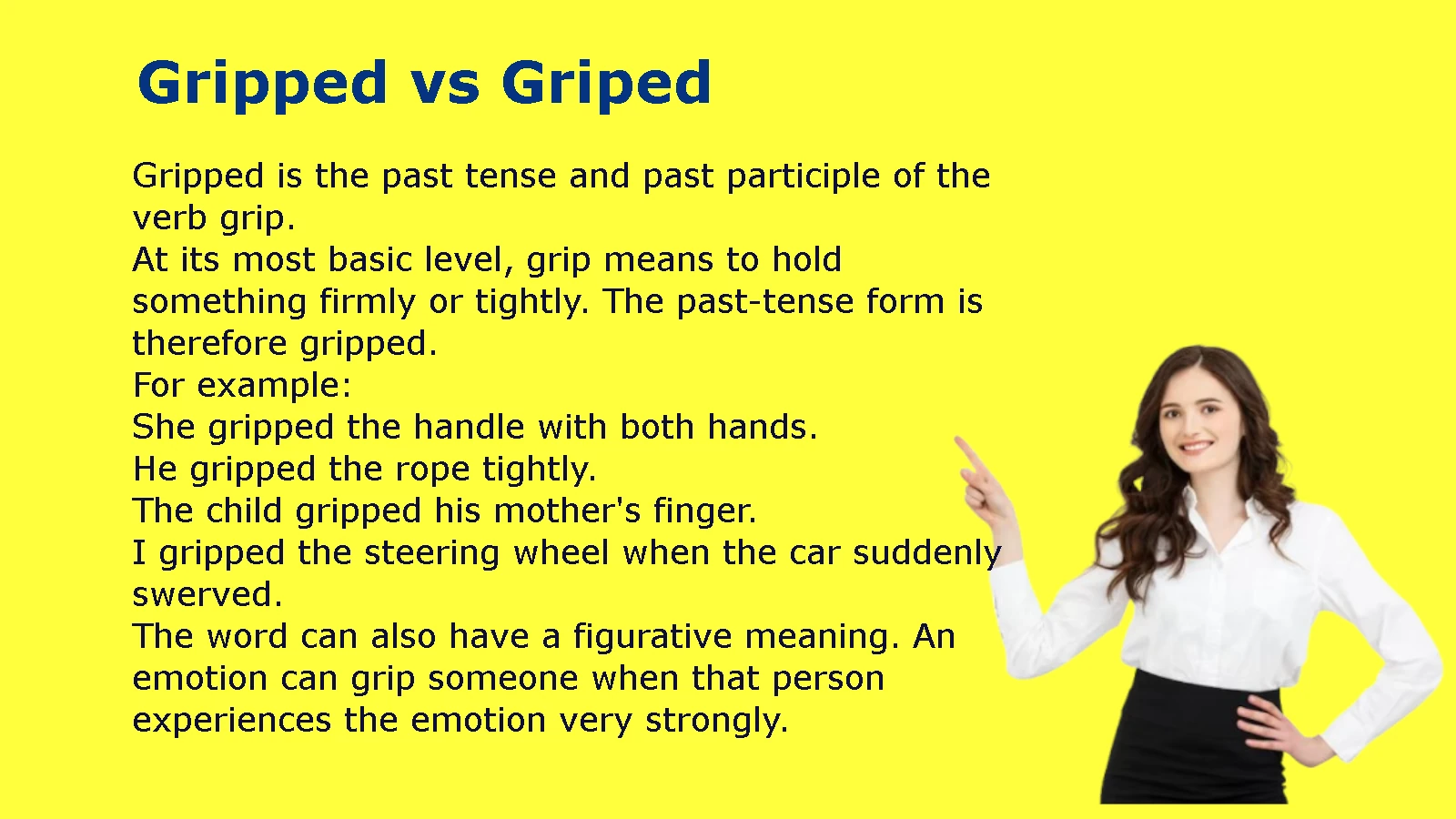
Gripped is the past tense and past participle of the verb grip.
At its most basic level, grip means to hold something firmly or tightly. The past-tense form is therefore gripped.
For example:
- She gripped the handle with both hands.
- He gripped the rope tightly.
- The child gripped his mother’s finger.
- I gripped the steering wheel when the car suddenly swerved.
The word can also have a figurative meaning. An emotion can grip someone when that person experiences the emotion very strongly.
For instance:
- Fear gripped the crowd.
- Panic gripped the passengers.
- The city was gripped by uncertainty.
The verb also describes something that captures someone’s attention completely:
- The mystery gripped the audience.
- The documentary gripped viewers from the opening scene.
These meanings are not separate accidents. They all grow from the basic idea of holding something firmly. A person can physically hold an object tightly. Figuratively, fear can “hold” someone’s emotions or a story can “hold” someone’s attention.
Cambridge specifically recognizes these uses of grip, including physical holding, keeping someone’s attention, and strongly affecting someone through an emotion.
Gripped as the Past Tense of Grip
When you describe an action that happened in the past, use gripped.
The basic pattern is:
grip → gripped
Examples:
- He gripped the ladder.
- She gripped my hand.
- The goalkeeper gripped the ball.
- The passengers gripped their seats during the turbulence.
Notice that gripped takes the regular -ed past-tense ending, but the final p doubles.
This gives you:
grip + ed = gripped
Not:
- ❌ griped when you mean “held”
- ❌ griped as the past tense of grip
The spelling matters because griped is already a different word.
Gripped as a Past Participle
Gripped also functions as the past participle of grip.
That means you can use it with forms of have in perfect constructions:
- She has gripped the railing.
- He had gripped the handle before the machine moved.
- They have gripped the edges of the table.
It can also appear in passive constructions:
- The audience was gripped by the suspense.
- The country was gripped by fear.
Dictionary.com also identifies gripped as both the past-tense form and past participle of grip.
Gripped as an Adjective
In some sentences, gripped works like an adjective or participial modifier.
For example:
- The nation remained gripped by fear.
- The audience was gripped by the final scene.
- She sat there, completely gripped by the story.
Here, gripped describes a person, group, or situation that has come under a strong physical, emotional, or psychological hold.
The construction gripped by is especially common when the thing doing the “gripping” is an emotion, crisis, event, or powerful experience.
What Does “Griped” Mean?
Griped is the past tense and past participle of gripe.
Unlike grip, the verb gripe means to complain, particularly about something irritating or frustrating.
Cambridge labels gripe as an informal verb and defines it as complaining continuously about something in an annoying way.
For example:
- He griped about the price.
- She griped about her workload.
- The customers griped about the long wait.
- Several employees griped about the new schedule.
The word often carries a slightly negative or dismissive tone. If someone gripes, they’re not simply reporting a problem. They’re complaining about it.
Compare these:
The employees complained about the schedule.
The employees griped about the schedule.
The first sentence sounds neutral. The second suggests that the employees repeatedly complained or expressed irritation.
Griped as the Past Tense of Gripe
The base verb is gripe, so its past-tense form is:
gripe → griped
Examples:
- He griped about the cost.
- She griped about the traffic.
- They griped about the hotel.
- The workers griped about the policy.
This is where the spelling becomes especially important.
The final e in gripe helps distinguish the word from grip.
Grip and gripe aren’t different forms of the same verb. They are different verbs.
Griped as a Past Participle
Because griped is also the past participle of gripe, it can appear with perfect forms of have.
Examples include:
- He has griped about the issue before.
- She had griped about the same problem several times.
- They have griped about the new rules since they were introduced.
These constructions are grammatically possible, although everyday English often uses simpler alternatives such as has complained or had complained.
Gripped vs Griped: The Key Difference
The easiest way to understand gripped vs griped is to ignore the spelling for a moment and identify the base verb.
Grip → Gripped
Grip means to hold tightly or maintain a firm hold.
She gripped the railing.
She physically held the railing.
Gripe → Griped
Gripe means to complain.
She griped about the broken railing.
She complained about it.
The two words may look like near twins, but their meanings go in completely different directions.
| Form | Meaning | Example |
| grip | hold tightly | Grip the handle. |
| gripped | held tightly | He gripped the handle. |
| gripe | complain | Don’t gripe about the price. |
| griped | complained | He griped about the price. |
The Easiest Way to Remember Gripped vs Griped
Use the E as your memory trigger.
Gripe contains an E, and it means complain.
So:
Gripe → griped → complained
Meanwhile:
Grip → gripped → held tightly
A quick mental image can make the difference stick. Imagine someone gripping a steering wheel with both hands. Then imagine the same person griping about the traffic.
One person is holding.
The other is complaining.
Gripped vs Griped in Sentences
Real sentences make the distinction much easier to recognize.
Examples With “Gripped”
Here are natural examples of gripped:
- She gripped the railing as the boat rocked.
- He gripped the steering wheel tightly.
- The climber gripped the rope with both hands.
- Fear gripped the passengers.
- The suspense gripped the audience.
- The crisis gripped the region.
- She gripped my arm when she heard the noise.
- The novel gripped me from the first chapter.
Notice that the word doesn’t always describe a literal handhold.
In fear gripped the passengers, fear isn’t physically holding anyone. The sentence uses the word figuratively to show that the emotion affected them intensely.
Likewise, when a novel grips a reader, the book holds the reader’s attention.
Examples With “Griped”
Now compare those sentences with examples of griped:
- He griped about the price of gas.
- She griped about having to work late.
- The passengers griped about the delay.
- Several customers griped about the service.
- The employees griped about the new schedule.
- He griped to his friends about his boss.
- They griped about the lack of parking.
- She griped that nobody had warned her.
Here, the action involves complaining, not holding.
Side-by-Side Examples
The difference becomes almost impossible to miss when you put the words next to each other:
| Gripped | Griped |
| She gripped the wheel. | She griped about the traffic. |
| He gripped the rope. | He griped about the climb. |
| Fear gripped the town. | Residents griped about the disruption. |
| The story gripped the audience. | Viewers griped about the ending. |
| He gripped the handle. | He griped about the broken handle. |
The context tells you which word belongs.
Why Are “Gripped” and “Griped” Spelled Differently?
The spelling difference comes from their different base verbs.
The Spelling of Gripped
The base verb is:
grip
Add -ed:
grip + ed = gripped
The final p doubles.
This follows the regular consonant-doubling pattern found in words such as:
- stop → stopped
- plan → planned
- drop → dropped
- slip → slipped
- grip → gripped
The result is gripped, with two p’s.
The Spelling of Griped
The base verb is:
gripe
Its regular past form is:
gripe + d = griped
The final e is retained before the d.
Compare:
- gripe → griped
- hope → hoped
- smile → smiled
- move → moved
So the correct forms are:
grip → gripped
and
gripe → griped
The spelling isn’t interchangeable because the underlying verbs aren’t interchangeable.
Gripped vs Griped: Pronunciation
The words also have different vowel sounds.
Gripped is pronounced with the short vowel sound found in words such as ship and sit. Its IPA pronunciation is commonly represented as /ɡrɪpt/.
Griped has the long vowel sound found in type and five. Cambridge gives gripe as /ɡraɪp/, and griped follows that vowel pattern.
So the central sound difference is the vowel:
- gripped → short /ɪ/ sound
- griped → /aɪ/ sound
The endings are also important. In both words, the final -ed is pronounced with a /t/ sound because the base verbs end in the voiceless consonants p.
That means the two words don’t sound the same even though their spellings are extremely similar.
Common Phrases With “Gripped”
Gripped appears in several common constructions.
Gripped Tightly
This is a straightforward physical use.
- He gripped the rope tightly.
- She gripped the handle tightly.
Gripped Firmly
This emphasizes strength and control.
- The mechanic gripped the tool firmly.
- She gripped the railing firmly.
Gripped by Fear
This is a common figurative construction.
- The passengers were gripped by fear.
- The city was gripped by fear after the earthquake.
The structure is:
be + gripped by + emotion
Other possibilities include:
- gripped by panic
- gripped by anxiety
- gripped by uncertainty
- gripped by excitement
Gripped by a Story or Event
A book, movie, trial, or event can also grip people by holding their attention.
- The courtroom drama gripped viewers.
- The documentary gripped the audience.
- The trial gripped the nation.
Cambridge specifically gives grip the sense of keeping someone’s attention completely.
Common Phrases With “Griped”
Griped usually appears in contexts involving complaints.
Griped About
The most useful pattern is:
gripe about + subject
Examples:
- He griped about the price.
- She griped about the weather.
- They griped about the long wait.
- Customers griped about the poor service.
Cambridge also gives gripe about as a standard construction.
Griped to Someone
You can also say that someone griped to another person.
- She griped to her manager about the schedule.
- He griped to his friends about the restaurant.
Griped That…
The verb can also introduce a complaint using that.
- He griped that the instructions were unclear.
- She griped that nobody had told her about the change.
In formal writing, however, complained often sounds more neutral.
Gripped vs Griped: Common Mistakes
These words are easy to confuse because they differ by only one letter.
Mistake: Using Griped for “Held”
Incorrect:
❌ She griped the steering wheel.
Correct:
✅ She gripped the steering wheel.
The person is holding the wheel, so the correct verb is gripped.
Mistake: Using Gripped for “Complained”
Incorrect:
❌ He gripped about the price.
Correct:
✅ He griped about the price.
The person is complaining, so the correct verb is griped.
Mistake: Treating Gripe as a Form of Grip
Another common problem is assuming that gripe is simply another spelling of grip.
It isn’t.
Grip and gripe have different meanings, pronunciations, and verb forms.
| Base verb | Past tense | Meaning |
| grip | gripped | hold tightly |
| gripe | griped | complain |
That small distinction solves most spelling questions involving these words.
Gripped vs Griped Word Families
Understanding the full word families can prevent mistakes when you’re writing.
The Grip Word Family
The main forms are:
- grip — present/base form
- grips — third-person singular
- gripped — past tense
- gripped — past participle
- gripping — present participle/gerund
Examples:
- I grip the handle.
- She grips the railing.
- He gripped the rope.
- They have gripped the edge.
- She is gripping the handle.
The Gripe Word Family
The main forms are:
- gripe — present/base form
- gripes — third-person singular
- griped — past tense
- griped — past participle
- griping — present participle/gerund
- gripe — noun meaning a complaint
Examples:
- I gripe about the cost.
- He gripes about everything.
- She griped about the delay.
- They have griped about the policy.
- He is griping about the weather.
Cambridge also recognizes gripe as a noun meaning a strong complaint.
Gripped vs Griping
Don’t confuse gripped with griping.
They come from different verbs:
- gripped → past tense of grip
- griping → present participle of gripe
For example:
She held it firmly.
She was griping about the table.
This distinction matters because griping contains the letters grip, which can make it look related to gripped. The words simply happen to share those first four letters.
Griped vs Griping
The relationship between these two is much more straightforward:
gripe → griped → griping
Examples:
- He griped about the bill yesterday.
- He is griping about the bill today.
Griped describes a completed or past complaint.
Griping describes an ongoing action or functions as a noun-like form.
Cambridge defines griping as the present participle of gripe and gives the sense of complaining continuously in an annoying way.
Gripped vs Griped in Formal Writing
Both words are legitimate English, but they don’t have the same level of formality in every context.
Gripped works comfortably in virtually any type of writing when its meaning fits.
For example:
- The researchers gripped the samples with specialized equipment.
- The crisis gripped the region.
- The novel has gripped readers for decades.
Griped, on the other hand, has an informal flavor because gripe commonly describes persistent or annoying complaints. Cambridge explicitly labels the verb gripe as informal.
In a formal report, you might write:
Employees complained about the revised policy.
In a conversational article, you might write:
Employees griped about the revised policy.
Neither is grammatically wrong. The second simply has a more conversational and slightly critical tone.
Gripped vs Griped: Synonyms
The right synonym depends on the exact meaning.
Synonyms for Gripped
When gripped means physically held:
- held
- grasped
- clutched
- seized
- clasped
- grabbed
For example:
She gripped the railing.
Possible alternatives include:
She grasped the railing.
or:
She clutched the railing.
However, these words aren’t always interchangeable. Clutched can suggest urgency or fear, while gripped emphasizes a firm hold.
When gripped means strongly affected or captivated, alternatives include:
- captivated
- fascinated
- absorbed
- enthralled
- affected
- overwhelmed
Again, context matters.
Synonyms for Griped
Depending on the sentence, griped can be replaced by:
- complained
- grumbled
- protested
- moaned
- whined
- objected
- criticized
For example:
He griped about the price.
could become:
He complained about the price.
Complained is usually more neutral. Griped suggests a more persistent or irritating style of complaining.
Gripped vs Griped in American English
In American English, both gripped and griped are standard spellings.
There isn’t an American spelling of one and a British spelling of the other.
The distinction remains:
- gripped = past tense/past participle of grip
- griped = past tense/past participle of gripe
The pronunciation also preserves the difference between the two words.
Cambridge’s American Dictionary entries list grip with the pronunciation /ɡrɪp/ and define it as holding something tightly or experiencing the strong effect of an emotion.
So if you’re writing for a US audience, you don’t need to choose between British and American spelling here. You simply need to choose the correct word.
A Simple Case Study: Gripped or Griped?
Imagine a sentence in a workplace report:
Several employees ___ about the new schedule.
Which word belongs in the blank?
Griped.
Why?
Because the employees are complaining about the schedule.
Now change the sentence:
Several employees ___ the railing during the emergency.
The answer becomes gripped.
Why?
Because the employees are holding the railing tightly.
The sentence structure can look almost identical, yet the correct word changes because the meaning changes.
| Sentence | Correct word | Reason |
| Employees ___ about the schedule. | griped | They complained. |
| Employees ___ the railing. | gripped | They held it tightly. |
| Fear ___ the crowd. | gripped | Fear strongly affected them. |
| Customers ___ about the cost. | griped | Customers complained. |
| The story ___ the audience. | gripped | The story held their attention. |
This is why checking the meaning is more useful than simply looking at the spelling.
Quick Test: Gripped or Griped?
Test yourself before checking the answers.
Choose the Correct Word
- She ___ the steering wheel when the car slid.
- He ___ about the expensive ticket.
- Fear ___ the passengers.
- The customers ___ about the slow service.
- The movie ___ me from beginning to end.
- He ___ the rope with both hands.
- Several employees ___ about the new policy.
- Panic ___ the crowd.
- She ___ my arm during the storm.
- He ___ about having to work late.
Answers
- gripped
- griped
- gripped
- griped
- gripped
- gripped
- griped
- gripped
- gripped
- griped
There’s a simple pattern behind every answer.
If someone holds, seizes, or becomes strongly affected, use gripped.
If someone complains, use griped.
How to Remember Gripped vs Griped
The fastest memory trick is to remember the base verbs rather than memorizing the past forms separately.
Remember “Grip” as a Physical Hold
Picture your hand around an object.
Grip → gripped
He gripped the handle.
Remember “Gripe” as a Complaint
Picture someone complaining about an everyday annoyance.
Gripe → griped
He griped about the handle.
The E can serve as your visual clue for gripe.
Another useful shortcut is:
Grip it = hold it.
Gripe about it = complain about it.
Once that distinction becomes automatic, the spelling usually follows naturally.
Is “Gripped” a Correct Word?
Yes. Gripped is the correct past tense and past participle of grip.
Use it when someone or something:
- holds something tightly
- maintains a firm physical hold
- strongly affects someone
- captures someone’s attention
Examples:
- She gripped the railing.
- Fear gripped him.
- The story gripped the audience.
Cambridge directly lists gripped as the simple past and past participle of grip.
Is “Griped” a Correct Word?
Yes. Griped is also a correct English word.
It is the past tense and past participle of gripe.
Use it when someone complained about something.
Examples:
- He griped about the price.
- She griped about the delay.
- They had griped about the same problem before.
Cambridge lists griped as the simple past and past participle of gripe.
Is “Griped” the Past Tense of “Grip”?
No.
This is one of the most important points in the gripped vs griped debate.
The past tense of grip is:
gripped
The past tense of gripe is:
griped
Therefore:
- ❌ He griped the rope.
- ✅ He gripped the rope.
But:
- ❌ He gripped about the price.
- ✅ He griped about the price.
The missing e in grip changes the verb and its past-tense spelling.
Is “Griped” a Synonym for “Gripped”?
No.
Although the words look similar, griped is not another spelling of gripped.
They have different meanings:
Gripped means held tightly, strongly affected, or captivated.
Griped means complained.
Replacing one with the other can completely change the meaning of a sentence.
Compare:
The story gripped the audience.
The audience found the story highly engaging.
The audience griped about the story.
The first sentence describes captivation.
The second describes dissatisfaction.
Are Gripped and Griped Interchangeable?
No. Gripped and griped cannot normally be used interchangeably.
They come from different verbs and express different actions.
Use gripped when the underlying verb is grip.
Use griped when the underlying verb is gripe.
A useful editing trick is to remove the -ed ending mentally.
If the sentence needs grip, use gripped.
If it needs gripe, use griped.
For example:
She ___ the handle.
The natural base form is grip the handle, so the past form is gripped.
She ___ about the handle.
The natural base form is gripe about the handle, so the past form is griped.
Gripped vs Griped: Facts to Remember
Keep these points in mind:
- Gripped is the past tense and past participle of grip.
- Griped is the past tense and past participle of gripe.
- Grip means to hold tightly.
- Gripe means to complain.
- Gripped can also mean strongly affected or captivated.
- Griped usually describes a complaint and has an informal tone.
- Gripped contains a doubled p.
- Griped keeps the e from gripe.
- Gripped and griped have different vowel sounds.
- Neither spelling is a British-only or American-only form.
- Gripped and griped are both legitimate English words.
- The correct choice depends on the meaning of the sentence, not simply on how the word looks.
Frequently Asked Questions About Gripped vs Griped
Is “gripped” the correct spelling?
Yes. Gripped is the correct past tense and past participle of grip.
Is “griped” a word?
Yes. Griped is the correct past tense and past participle of gripe. It means complained.
What is the difference between gripped and griped?
Gripped means held tightly, strongly affected, or captivated. Griped means complained.
Is gripped the past tense of grip?
Yes.
Grip → gripped
For example:
She gripped the railing.
Is griped the past tense of gripe?
Yes.
Gripe → griped
For example:
He griped about the price.
Does gripped mean held tightly?
Yes. Its most basic meaning is held firmly or tightly. It can also describe something that strongly affects a person or captures their attention.
Does griped mean complained?
Yes. Griped means complained, particularly in a persistent or annoying way.
Why does gripped have two p’s?
Gripped comes from the one-syllable verb grip. When -ed is added, the final p doubles:
grip + ed = gripped
Why does griped have an e?
Griped comes from gripe. The final e remains when the past-tense -d is added:
gripe + d = griped
Are gripped and griped pronounced differently?
Yes. Gripped has the short vowel sound found in ship, while griped has the long vowel sound found in type. The final -ed in both words is pronounced with a /t/ sound. The pronunciation of grip is /ɡrɪp/, while gripe is /ɡraɪp/.
Is gripped spelled differently in British English?
No. Gripped is spelled the same in American and British English.
Is griped spelled differently in British English?
No. Griped is also spelled the same in American and British English.
Is gripe formal or informal?
Gripe is generally considered informal. In formal writing, complain or object may be a better choice depending on the context.
What is the easiest way to remember gripped vs griped?
Remember the base verbs:
Grip → gripped → held
Gripe → griped → complained
If someone is holding something, choose gripped. If someone is complaining, choose griped.
Final Verdict: Gripped or Griped?
Gripped and griped are both correct, but they aren’t interchangeable.
Use gripped when you mean held tightly, seized, strongly affected, or captivated:
She gripped the railing.
Use griped when you mean complained:
She griped about the delay.
The easiest rule to remember is:
Grip → gripped = hold tightly
Gripe → griped = complain
When you’re unsure, look at the base verb. If the sentence calls for grip, write gripped. If it calls for gripe, write griped.
That’s the whole distinction. One letter changes the spelling, but the meaning changes completely.