Have you ever wondered whether access or accesses is the correct word to use? Both forms are correct, but they are used differently depending on the meaning and grammar of the sentence.
Access is usually a noun meaning the ability or right to enter, reach, use, or obtain something. It can also be a verb meaning to enter, reach, or use something. Accesses is the plural form of the noun access or the third-person singular present form of the verb access.
Here’s the basic difference:
| Word | Part of Speech | Meaning / Use | Example |
| Access | Noun / Verb | The ability to reach or use something; to reach or use something | She has access to the building. |
| Accesses | Noun / Verb | More than one means of access; or “he/she/it accesses” | The system accesses the database automatically. |
The confusion often comes from the fact that access can be both a noun and a verb, while accesses has two possible grammatical roles. As a noun, accesses refers to multiple ways or points of reaching or entering something. As a verb, accesses is used with a singular third-person subject, such as he, she, it, or a singular noun.
For example, “The employee has access to the files” uses access as a noun, while “The employee accesses the files every morning” uses accesses as a verb.
In this guide, you’ll learn the complete difference between Access vs Accesses, including their meanings, parts of speech, plural usage, verb forms, pronunciation, examples, and common mistakes. You’ll also learn when to use access and when accesses is the correct choice.
Quick Answer: Access vs Accesses
Here is the basic distinction:
| Word | Grammatical role | Meaning/use | Example |
| access | Noun | The right, ability, or way to reach or use something | I have access to the files. |
| access | Verb | To enter, use, open, or retrieve something | They access the files. |
| accesses | Verb | Third-person singular present form of access | She accesses the files. |
| accesses | Noun | Plural of access in contexts involving separate means or points of access | The property has several accesses. |
The easiest rule to remember is:
I/you/we/they access; he/she/it accesses.
As a noun, access is normally uncountable in common expressions such as access to information, access to healthcare, and access to the internet. Oxford and Cambridge both identify this common noun use as uncountable.
What Does Access Mean?
Access has two major grammatical uses: it can be a noun or a verb.
As a noun, access generally refers to the right, opportunity, ability, method, or means of reaching, entering, using, or obtaining something.
As a verb, access means to enter, use, open, retrieve, or obtain something, particularly information or a computer system.
Cambridge gives examples involving physical places, services, information, websites, databases, and computer files.
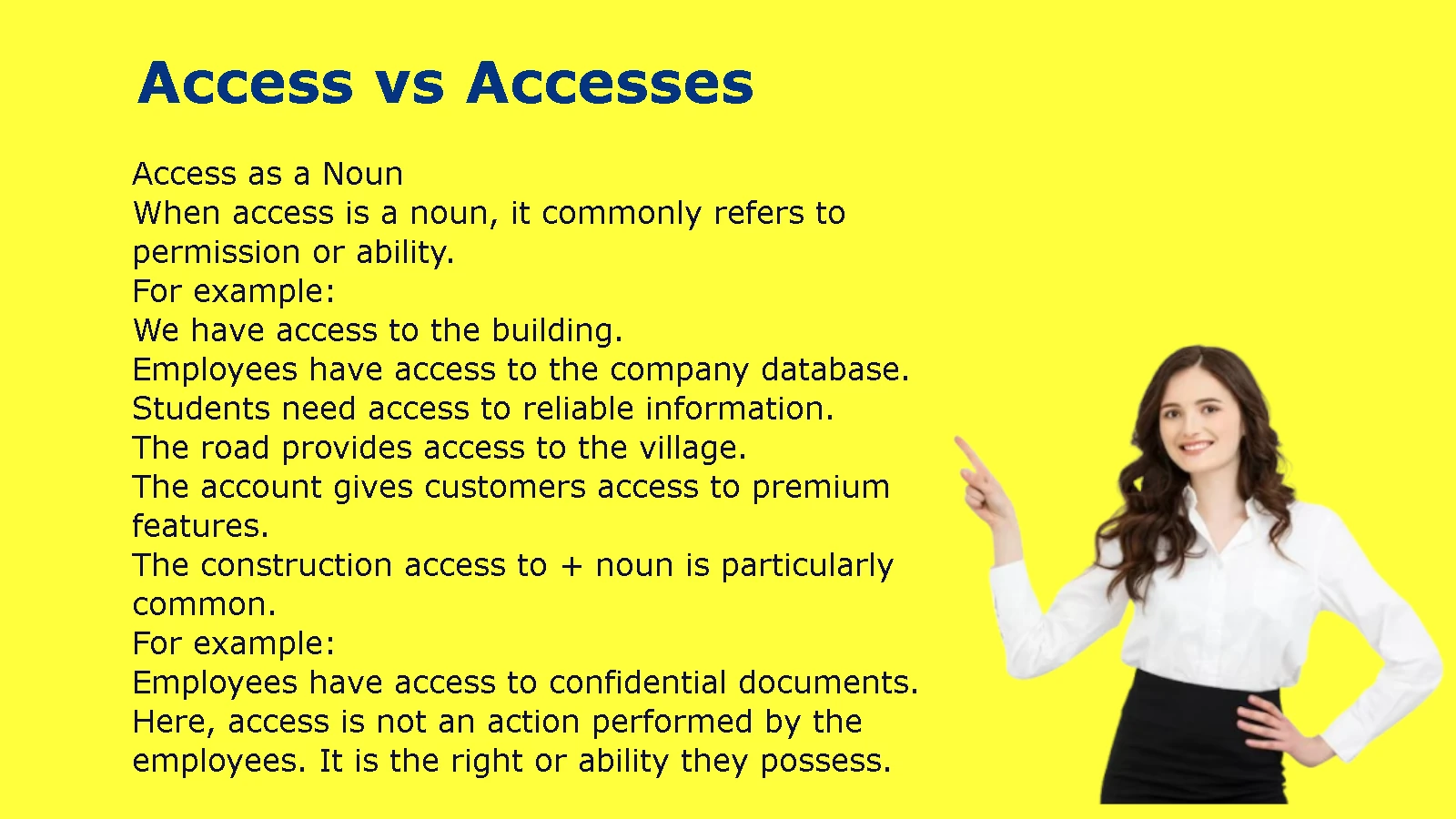
Access as a Noun
When access is a noun, it commonly refers to permission or ability.
For example:
- We have access to the building.
- Employees have access to the company database.
- Students need access to reliable information.
- The road provides access to the village.
- The account gives customers access to premium features.
The construction access to + noun is particularly common.
For example:
Employees have access to confidential documents.
Here, access is not an action performed by the employees. It is the right or ability they possess.
Cambridge defines noun access in terms including a method or possibility of getting near a place and the right or opportunity to use or look at something.
Common Noun Expressions With Access
Some very common patterns include:
- access to information
- access to education
- access to healthcare
- access to the internet
- access to a building
- access to resources
- access to services
- access to data
- access to an account
- access to records
You can also use access with verbs such as:
- gain access
- have access
- provide access
- give access
- grant access
- deny access
- restrict access
- allow access
- maintain access
For example:
The administrator granted access to the new employee.
The company restricted access to sensitive files.
Customers have access to the online portal.
Access as a Verb
As a verb, access describes the action of getting to, entering, using, opening, or obtaining something.
For example:
- I access my account online.
- We access the files remotely.
- They access the database every morning.
- You can access the course from your phone.
- Employees access company resources through the portal.
The verb is especially common in technology and computing. Cambridge defines it as opening a computer file or website to look at or change information.
However, the verb is not limited to computers.
You can also say:
Visitors can access the building through the main entrance.
Patients can access medical services online.
Students can access educational resources from home.
What Does Accesses Mean?
Accesses has two possible grammatical functions.
It can be:
- The third-person singular present-tense form of the verb access, or
- The plural form of the noun access.
These two uses are grammatically different.
Accesses as a Verb
When accesses is a verb, it normally follows a singular third-person subject such as:
- he
- she
- it
- a person
- the company
- the system
- the application
- the website
- the device
Examples:
- She accesses the database every morning.
- He accesses his account from his phone.
- The program accesses stored information.
- The application accesses the user’s location.
- The system accesses the server automatically.
This follows the standard English present-tense pattern in which many verbs take -s with a third-person singular subject.
Compare:
- I access the account.
- You access the account.
- We access the account.
- They access the account.
- She accesses the account.
- He accesses the account.
- The system accesses the account.
Dictionary.com specifically identifies accesses as both the plural of the noun access and the present-tense third-person singular form of the verb access.
Accesses as a Plural Noun
Accesses can also be the plural of the noun access.
This use is legitimate, but it deserves some explanation.
When access is used in its common sense of a general right or opportunity to use something, it is normally uncountable:
Employees have access to the software.
You would not normally write:
Employees have accesses to the software.
However, access can be countable when you are talking about separate means, routes, entrances, or points of access.
For example:
The property has several accesses from surrounding roads.
The plural form exists in dictionaries, but everyday English often chooses a more specific expression.
For example, instead of:
The building has several accesses.
a writer might naturally say:
The building has several access points.
Or:
The building has several entrances.
This distinction matters because a word can have a grammatically valid plural without that plural being the most natural choice in every context.
Access vs Accesses: Key Difference
The most important distinction is grammatical.
| Sentence | Why it works |
| I access the website. | Access is the base-form verb after I. |
| They access the website. | Access is the base-form verb after they. |
| She accesses the website. | Accesses is the third-person singular present form. |
| The software accesses the database. | Accesses agrees with singular software. |
| We have access to the website. | Access is an uncountable noun. |
| The property has several accesses. | Accesses is a plural noun referring to separate means or points of access. |
The easiest way to determine which form you need is to identify what role the word plays in the sentence.
If it describes an action performed by he, she, it, or another singular third-person subject, use accesses.
When the subject is I, you, we, or they, use access.
If you are talking about the right or ability to use something, use the noun access.
Access vs Accesses in Sentences
Seeing the forms side by side makes the difference clearer.
Examples With Access
As a noun:
- I have access to the company’s records.
- Students need access to reliable sources.
- The building has wheelchair access.
- The password gives you access to your account.
- The road provides access to the farm.
As a verb:
- I access my email every morning.
- We access the database remotely.
- They access the website through their phones.
- You can access the report online.
- Employees access the system with a password.
Examples With Accesses
As a verb:
- She accesses the database every morning.
- He accesses his account from home.
- The application accesses stored data.
- The software accesses the server automatically.
- The device accesses the network through a secure connection.
As a plural noun:
- The property has several accesses from the surrounding roads.
- The historic site has multiple accesses.
- Engineers inspected the different accesses to the underground facility.
Notice that the plural noun examples are more specialized. In many everyday situations, access points, entrances, routes, or ways in would sound more natural.
When Should You Use Access Instead of Accesses?
Use access when the grammar of the sentence calls for the base form or the noun.
Use Access With I, You, We, and They
Examples:
- I access the portal.
- You access the portal.
- We access the portal.
- They access the portal.
Do not add -es simply because the sentence describes a repeated action.
Incorrect:
They accesses the system every day.
Correct:
They access the system every day.
The subject they requires the base form access.
Use Access With Modal Verbs
After modal verbs such as can, could, will, would, should, may, might, and must, use the base form access, not accesses.
Correct:
- She can access the files.
- He will access the account later.
- The program must access the database.
- They should access the information first.
Incorrect:
- She can accesses the files.
- He will accesses the account later.
- The program must accesses the database.
The modal already carries the relevant grammatical structure, so the main verb remains in its base form.
Use Access as a Noun in Common Expressions
Use access when you mean the right, opportunity, or ability to use or reach something.
Examples:
We need access to the data.
She was given access to the building.
Students have access to online resources.
The subscription provides access to premium content.
This is one of the most important patterns for avoiding the incorrect plural accesses.
When Should You Use Accesses?
Use accesses as a verb when the subject is singular and third person.
Examples:
- She accesses the system.
- He accesses the account.
- The computer accesses the server.
- The application accesses the data.
- The website accesses your location.
A useful formula is:
Singular third-person subject + accesses + object
For example:
The application accesses your location.
Here, application is singular, so the verb takes -es.
Why Is It Accesses Instead of Accesss?
The spelling is accesses, not accesss.
The base verb is access. Because it ends in -ss, the third-person singular form takes -es:
access → accesses
This follows the same spelling pattern seen in verbs such as:
- pass → passes
- miss → misses
- discuss → discusses
- kiss → kisses
So:
She accesses the website.
is correct.
Access vs Accesses: Common Grammar Mistakes
Mistake: She Access the Website
Incorrect:
She access the website every morning.
Correct:
She accesses the website every morning.
The subject she is third-person singular, so the present-tense verb needs -es.
Mistake: They Accesses the Files
Incorrect:
They accesses the files every day.
Correct:
They access the files every day.
The subject they takes the base form.
Mistake: I Have Accesses to the Database
Incorrect:
I have accesses to the database.
Correct:
I have access to the database.
In this common construction, access is an uncountable noun meaning the right or ability to use something. Cambridge and Oxford both identify this noun use as uncountable.
Mistake: He Can Accesses the Account
Incorrect:
He can accesses the account.
Correct:
He can access the account.
The modal can is followed by the base form of the verb.
Mistake: The System Access the Data
Incorrect:
The system access the data automatically.
Correct:
The system accesses the data automatically.
Here, system is singular, so the verb needs accesses.
Is Access Singular or Plural?
The answer depends on whether access is functioning as a noun or a verb and on what meaning you intend.
As a noun, access is commonly uncountable when it means the general right or ability to use or reach something.
For example:
Everyone should have access to education.
I don’t have access to the file.
Employees need access to the system.
Oxford labels this common noun use as uncountable, and Cambridge likewise labels its principal noun uses as uncountable.
However, accesses exists as a plural noun when separate forms or points of access are being counted.
For example:
The property has several accesses.
In modern everyday writing, though, a more specific plural expression is often preferable:
- access points
- entrances
- routes
- entry points
- ways of access
What Is the Plural of Access?
The dictionary plural is accesses.
However, whether you should actually use that plural depends on the meaning.
Compare:
The students have access to three databases.
Here, access remains uncountable. You are not counting three “accesses.” You are saying that students can use three databases.
By contrast:
The site has three separate accesses.
Here, you are treating the points or means of entry as separate countable things.
This is an important distinction because pluralizing a noun does not automatically make the underlying concept countable in every construction.
Access vs Accesses in Different Contexts
Technology and Computers
Technology is one of the most common areas where access appears as a verb.
Examples include:
- access a file
- access a database
- access an account
- access a website
- access a server
- access information
- access stored data
With a singular third-person subject, the form changes:
The application accesses the database.
The user accesses the account.
The system accesses stored information.
Cambridge specifically lists computer files, websites, databases, servers, and online accounts among common objects of the verb access.
Education
The noun is common in education:
Students need access to educational resources.
The program gives students access to online courses.
As a verb:
Students access their lessons online.
The student accesses the course from home.
Buildings and Property
In physical contexts, access often describes a route or means of entering a place:
The building has easy access from the main road.
Visitors can access the building through the side entrance.
The property has several access points.
This is one area where accesses as a plural noun can appear, but access points or entrances may be clearer when you specifically mean separate physical entry locations.
Websites and Online Accounts
Both forms can occur naturally:
I access my account from my laptop.
She accesses her account from her phone.
We have access to the customer portal.
The application accesses account information securely.
The grammar depends on whether access is being used as a noun or verb and what the subject is.
Access vs Accesses vs Accessing vs Accessed
English has several forms of the verb access, and each has a different grammatical function.
| Form | Grammatical use | Example |
| access | Base form/present with I, you, we, they | They access the system. |
| accesses | Third-person singular present | She accesses the system. |
| accessing | Present participle/gerund | She is accessing the system. |
| accessed | Past tense/past participle | They accessed the system yesterday. |
Access
Use the base form after:
- I
- you
- we
- they
- modal verbs
Examples:
They access the files.
She can access the files.
Accesses
Use this present-tense form with singular third-person subjects:
He accesses the files.
The program accesses the files.
Accessing
Use accessing in progressive constructions or where the present participle/gerund is required:
She is accessing the database.
Accessing the account requires authentication.
Accessed
Use accessed for the simple past or as a past participle:
We accessed the records yesterday.
The files were accessed without authorization.
Cambridge identifies accessed as the past simple and past participle of access.
Access vs Assess vs Excess
Access, assess, and excess often cause confusion because they look and sound similar. Their meanings, however, are quite different: access relates to reaching or using something, assess means to evaluate or judge something, and excess refers to an amount that is more than necessary or expected.
| Word | Meaning | Example |
| access | To reach, enter, use, or obtain; or the right/opportunity to do so | I can access the file. |
| assess | To evaluate or judge something | We need to assess the damage. |
| excess | An amount greater than what is needed or allowed | The machine produces excess heat. |
Access vs Assess
This relates to reaching or using something
Assess means to evaluate, estimate, or judge something.
Compare:
The employee can access the report.
This means the employee can open, reach, or use it.
The manager will assess the report.
This means the manager will evaluate it.
A useful memory aid is:
access = reach or use
assess = evaluate
Access vs Excess
Access concerns reaching, entering, using, or obtaining something.
Excess refers to more than necessary or more than an appropriate amount.
Compare:
Employees have access to the equipment.
The machine generates excess heat.
These words should never be substituted for each other.
Is Accesses Correct English?
Yes. Accesses is a correct English word.
It has two grammatical uses.
Accesses as a Verb
It is the third-person singular present form of access:
She accesses the database.
The system accesses the information.
He accesses his account online.
Accesses as a Plural Noun
It can also be the plural of noun access when separate means or points of access are being discussed:
The site has several accesses.
However, this plural noun use is less common in ordinary modern writing than the uncountable noun access.
Dictionary.com explicitly lists accesses as both the plural noun and the third-person singular present-tense verb.
How Do You Pronounce Access and Accesses?
Access and accesses have closely related pronunciations.
Cambridge gives access as approximately /ˈæk.ses/ in both American and British English.
Accesses adds another syllable because of the -es ending.
The important point for learners is that the plural/third-person form is not pronounced as though the final letters were simply ignored. The added ending creates an additional syllable.
If you’re writing rather than speaking, the spelling rule is usually easier to remember:
access → accesses
The same type of spelling pattern occurs with verbs ending in -ss, such as:
- pass → passes
- miss → misses
- discuss → discusses
Access vs Accesses: Common Expressions
The noun access appears in many established expressions.
Access to Information
Everyone should have access to information.
Access to Education
The program aims to improve access to education.
Access to Healthcare
The policy focuses on improving access to healthcare.
Access to the Internet
Many services now require access to the internet.
Gain Access
The technician gained access to the server.
Have Access
Employees have access to the internal portal.
Provide Access
The administrator provided access to the new employee.
Restrict Access
The company restricted access to confidential records.
Deny Access
The security system denied access to the unauthorized user.
Remote Access
Employees can use remote access to connect to the system.
These patterns are much more natural than forcing accesses into sentences where the noun is functioning as an uncountable concept.
A Simple Case Study: Choosing Access or Accesses
Consider this short workplace example.
A manager is writing instructions for employees:
Employees can ___ the customer database from their laptops.
The correct answer is access:
Employees can access the customer database from their laptops.
Why?
Because can is a modal verb, and modal verbs are followed by the base form.
Now change the subject:
The employee ___ the customer database every morning.
The correct answer is accesses:
The employee accesses the customer database every morning.
Why?
Because employee is singular and third person.
Now change the sentence again:
The employee has ___ to the customer database.
The correct answer is access:
The employee has access to the customer database.
Here, access is a noun, not a verb.
The Three-Sentence Test
You can therefore remember the difference through three sentences:
They access the database.
She accesses the database.
She has access to the database.
The spelling changes because the grammatical role and sentence structure change.
Access vs Accesses: Quick Decision Guide
When you’re unsure which form to use, ask these questions.
Are you talking about the right or ability to use something?
Use access.
I have access to the account.
Is the subject I, you, we, or they?
Use access.
They access the website.
Is the subject he, she, it, or another singular noun?
Use accesses.
She accesses the website.
Does a modal verb come before it?
Use access.
He can access the website.
Are you talking about multiple physical or distinct means of access?
Accesses can be used as a plural noun, although a more specific phrase may be preferable.
The building has several access points.
This decision guide covers most everyday uses.
Access vs Accesses: Common Questions
Is accesses a correct word?
Yes. Accesses is the third-person singular present form of the verb access and can also be the plural noun form of access.
What is the difference between access and accesses?
Access is the base form of the verb and is also a commonly used noun. Accesses is the third-person singular present verb form or, in certain contexts, the plural noun form.
They access the files.
She accesses the files.
Is access a noun or a verb?
It can be both.
As a noun:
I have access to the information.
As a verb:
I can access the information.
Major dictionaries list both noun and verb uses.
Is accesses a noun or a verb?
It can be both.
As a verb:
The program accesses the database.
As a plural noun:
The property has several accesses.
The verb use is much more likely to appear in ordinary modern writing.
Is access singular or plural?
As a noun meaning a general right or ability to use something, access is normally uncountable, so it does not usually take a plural in expressions such as access to information.
However, accesses can be used as a plural when separate means or points of access are being counted.
What is the plural of access?
The plural form is accesses.
However, don’t automatically use it whenever you are talking about more than one thing that can be reached.
For example:
Students have access to three databases.
not:
Students have accesses to three databases.
Should I say access or accesses?
It depends on the grammar.
Use access after I, you, we, and they:
They access the system.
Use accesses after a singular third-person subject:
She accesses the system.
Use access as a noun in expressions such as:
She has access to the system.
Is it correct to say accesses the website?
Yes.
The application accesses the website automatically.
The singular subject application requires the third-person singular verb form accesses.
Is it correct to say access to information?
Yes. Access to information is a standard and very common noun phrase.
Everyone should have access to information.
What is the difference between access and assess?
Access means to reach, enter, use, or obtain something.
Assess means to evaluate or judge something.
You can access the report.
You can assess the report.
What is the difference between access and excess?
Access concerns reaching, entering, using, or obtaining something.
Excess means an amount that is greater than necessary or appropriate.
We have access to the equipment.
The machine produces excess heat.
Final Comparison: Access vs Accesses
The distinction between access and accesses becomes straightforward once you identify the grammar of the sentence.
Access is the base form of the verb:
They access the system.
It is also the common noun used to describe a right, opportunity, ability, or means of reaching or using something:
They have access to the system.
Accesses is the third-person singular present form:
She accesses the system.
It can also function as a plural noun when separate means or points of access are being discussed:
The property has several accesses.
For everyday writing, remember the simplest rule:
I/you/we/they access. He/she/it accesses.
When you’re talking about the general right or ability to use or reach something, access is normally the correct noun. For example, we commonly talk about:
the internet
information
education
healthcare
Once you separate the noun use from the verb use, the difference between access and accesses is much easier to understand and apply correctly.