Have you ever wondered whether anemia or anaemia is the correct spelling? While Anemia vs Anaemia may look like a simple spelling difference, the choice usually depends on the type of English, country, and writing context in which the word is used.
Anemia and anaemia have the same meaning. Both refer to a condition in which the blood does not have enough healthy red blood cells or enough hemoglobin to carry oxygen effectively. Anemia is the standard spelling in American English, while anaemia is traditionally used in British English and other varieties influenced by British spelling.
Examples:
- The doctor diagnosed the patient with anemia.
- The doctor diagnosed the patient with anaemia.
The confusion is understandable. People often search for anemia vs anaemia, anemia or anaemia, which spelling is correct, or anaemia meaning in English because both spellings are accepted, yet they follow different spelling conventions. And here’s the kicker: neither spelling changes the word’s meaning or pronunciation.
In this guide, you’ll learn the complete difference between Anemia vs Anaemia, including their meaning, pronunciation, origin, correct spelling, and usage. You’ll also discover which spelling to use in American English vs British English, along with clear examples to help you choose the right form.
Anemia vs Anaemia: Quick Answer
The simplest answer is this:
| Spelling | Standard variety | Meaning |
| Anemia | American English | A condition involving low red blood cells or hemoglobin |
| Anaemia | British English | The same medical condition |
Both spellings refer to the same condition.
For example:
- American English: The blood test showed that she had anemia.
- British English: The blood test showed that she had anaemia.
Nothing about the patient’s condition changes between these sentences. Only the spelling changes.
Oxford lists anemia as the North American form and anaemia as the British form. Both entries carry essentially the same definition.
The same pattern appears in related medical vocabulary:
| American English | British English |
| anemia | anaemia |
| anemic | anaemic |
| hemoglobin | haemoglobin |
| hematology | haematology |
This pattern is one reason the two spellings often appear together. British English frequently retains ae in certain words derived from Greek, while American English commonly uses the simplified e form. Cambridge identifies anaemia → anemia as an example of this broader spelling difference.
What Does Anemia Mean?
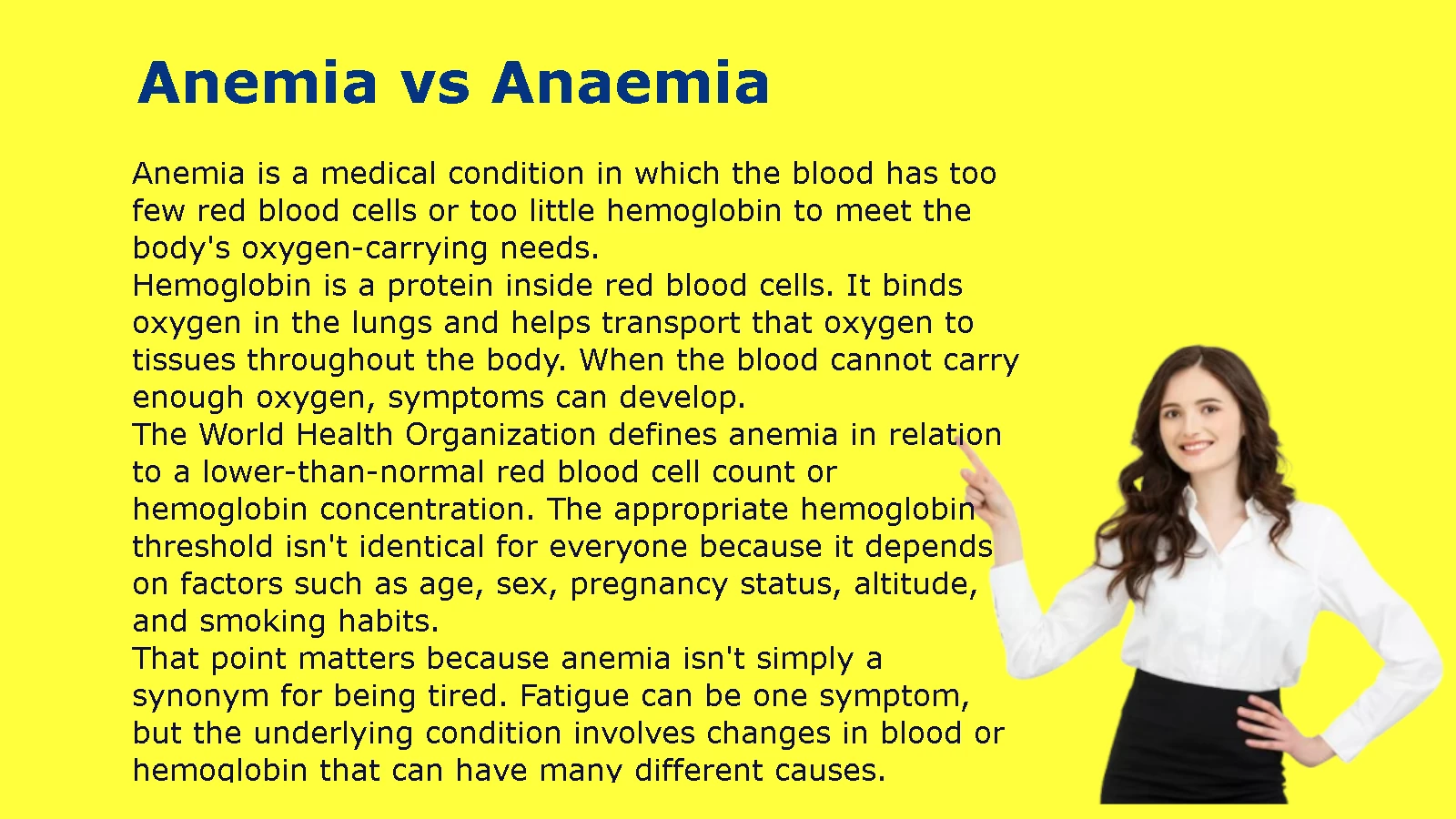
Anemia is a medical condition in which the blood has too few red blood cells or too little hemoglobin to meet the body’s oxygen-carrying needs.
Hemoglobin is a protein inside red blood cells. It binds oxygen in the lungs and helps transport that oxygen to tissues throughout the body. When the blood cannot carry enough oxygen, symptoms can develop.
The World Health Organization defines anemia in relation to a lower-than-normal red blood cell count or hemoglobin concentration. The appropriate hemoglobin threshold isn’t identical for everyone because it depends on factors such as age, sex, pregnancy status, altitude, and smoking habits.
That point matters because anemia isn’t simply a synonym for being tired. Fatigue can be one symptom, but the underlying condition involves changes in blood or hemoglobin that can have many different causes.
Common Symptoms of Anemia
Symptoms can vary considerably depending on the cause and severity. Common symptoms include:
- Tiredness or fatigue
- Weakness
- Dizziness or light-headedness
- Shortness of breath, especially during physical activity
- Headaches
- Cold hands and feet
- Pale skin or mucous membranes
- Reduced physical capacity
The WHO notes that anemia can produce nonspecific symptoms such as tiredness, weakness, dizziness, drowsiness, and shortness of breath. More severe cases can cause additional physical signs and complications.
A person can also have anemia without immediately recognizing it. Some cases develop gradually, allowing the body to adapt for a time.
Common Causes of Anemia
Anemia isn’t one single disease with one universal cause.
Instead, it can develop through several mechanisms. The body may fail to produce enough red blood cells, lose blood, or destroy red blood cells faster than it can replace them.
Common causes include:
- Iron deficiency
- Vitamin B12 deficiency
- Folate deficiency
- Blood loss
- Heavy menstrual bleeding
- Blood loss associated with childbirth
- Chronic diseases
- Inflammation
- Certain infections
- Malaria and parasitic infections
- Inherited blood disorders
- Disorders affecting red blood cell production
Iron deficiency is the most common nutritional cause of anemia, although other nutrient deficiencies and medical conditions can also contribute.
That distinction is important because treating anemia effectively requires identifying why it happened rather than assuming every case results from low dietary iron.
What Does Anaemia Mean?
Anaemia has the same meaning as anemia.
The only difference is spelling.
In British English, anaemia is the standard form. Oxford identifies anaemia as the British English spelling and anemia as the North American form.
Cambridge likewise defines anaemia as a medical condition involving an insufficient number of red blood cells and lists anemia as its US spelling.
For example:
The patient was diagnosed with iron-deficiency anaemia.
A US publication would normally write:
The patient was diagnosed with iron-deficiency anemia.
The underlying medical statement remains unchanged.
Anaemia in a Sentence
Here are several natural examples:
- The blood test confirmed that she had anaemia.
- Iron deficiency can contribute to anaemia.
- The doctor investigated the cause of his anaemia.
- Severe anaemia may cause shortness of breath and weakness.
- The patient received further testing for persistent anaemia.
If you’re writing for British readers, these forms will look natural and familiar.
Why Do Anemia and Anaemia Have Different Spellings?
The difference comes from the history of English spelling and the word’s Greek origin.
Oxford traces anaemia to the early 19th century, through Modern Latin from the Greek anaimia. The Greek elements are an-, meaning “without,” and haima, meaning “blood.”
Over time, English developed different spelling conventions in Britain and the United States.
One important pattern involves words containing the letter combination ae. British English often retains the combination, while American English frequently simplifies it to e.
That gives us pairs such as:
- anaemia → anemia
- foetus → fetus
- haemoglobin → hemoglobin
- haematology → hematology
Cambridge English explicitly identifies anaemia/anemia as an example of British ae becoming American e.
So the spelling difference isn’t random. It’s part of a broader historical pattern.
Is Anemia or Anaemia the American Spelling?
Anemia is the standard American English spelling.
If you’re writing an article, report, medical document, school assignment, or general communication primarily for readers in the United States, anemia is the natural choice.
For example:
Iron-deficiency anemia is one of the most common forms of anemia.
American medical sources also generally use this spelling. The US National Heart, Lung, and Blood Institute, for example, uses anemia throughout its patient information and explains that anemia can occur when the body doesn’t produce enough red blood cells or loses too many.
American Examples
- The doctor ordered blood tests to investigate the patient’s anemia.
- Iron deficiency is a common cause of anemia.
- Severe anemia can reduce the blood’s oxygen-carrying capacity.
- The patient has a history of iron-deficiency anemia.
- The symptoms may be related to anemia.
For a US audience, adding the extra a in anaemia isn’t necessary and can make the spelling look foreign or inconsistent with the surrounding American vocabulary.
Is Anemia or Anaemia the British Spelling?
Anaemia is the standard British English spelling.
If your audience is primarily in the United Kingdom, use anaemia consistently.
For example:
Iron-deficiency anaemia is a common health problem.
British medical writing also commonly uses related forms such as haemoglobin and haematology.
This creates a recognizable spelling pattern:
anaemia → haemoglobin → haematology
American English generally uses:
anemia → hemoglobin → hematology
Neither system is inherently more correct. They’re simply different established varieties of English.
Anemia vs Anaemia in American and British English
The easiest way to choose between the two is to consider your audience.
| Writing situation | Preferred spelling |
| US newspaper | anemia |
| US medical website | anemia |
| US school assignment | anemia |
| American academic paper | anemia |
| UK newspaper | anaemia |
| UK medical website | anaemia |
| British school assignment | anaemia |
| British academic paper | anaemia |
| Quoting a British source | Preserve anaemia |
| Quoting an American source | Preserve anemia |
There is one important caveat: follow the style guide of the publication, institution, or journal when one exists.
A multinational organization may adopt its own editorial convention. In that situation, consistency with the required style matters more than personal preference.
A Simple Rule to Remember
Think of it this way:
Anemia = American English
Anaemia = British English
That’s the core distinction.
Are Anemia and Anaemia Pronounced the Same?
Yes. The two spellings generally have the same pronunciation.
Cambridge gives both forms the pronunciation /əˈniː.mi.ə/. Oxford likewise lists /əˈniːmiə/ for both regional forms.
The extra a in anaemia therefore doesn’t create a separate pronunciation in standard English.
The pronunciation can still sound slightly different from speaker to speaker because accents vary. A British speaker and an American speaker may have different overall speech patterns, but the spelling distinction itself doesn’t represent two different words.
Anemia vs Anaemia: Examples in Real Writing
Seeing the words side by side makes the distinction easier to understand.
Examples With Anemia
The blood test showed that Maria had anemia.
The doctor suspected iron-deficiency anemia after reviewing the laboratory results.
Severe anemia can cause fatigue and shortness of breath.
The patient returned for follow-up testing after treatment for anemia.
Examples With Anaemia
The blood test showed that Maria had anaemia.
The doctor suspected iron-deficiency anaemia after reviewing the laboratory results.
Severe anaemia can cause fatigue and shortness of breath.
The patient returned for follow-up testing after treatment for anaemia.
Notice what stays the same: the meaning, grammar, and sentence structure.
Only the regional spelling changes.
Common Types and Forms of Anemia
The word anemia appears in the names of many different conditions. These aren’t simply different spellings of the same type of anemia. Each can have a different underlying mechanism.
Some commonly encountered forms include:
- Iron-deficiency anemia
- Vitamin B12 deficiency anemia
- Folate-deficiency anemia
- Aplastic anemia
- Hemolytic anemia
- Sickle cell anemia
- Pernicious anemia
- Anemia of chronic disease
- Anemia of inflammation
British English generally changes the spelling of the main term:
- iron-deficiency anaemia
- sickle cell anaemia
- hemolytic anaemia
- aplastic anaemia
The exact naming conventions can vary between medical sources, especially for compound terms. When writing professionally, the terminology used by the relevant medical authority or publication should take priority.
Why the Type Matters
Calling something simply anemia tells you that a problem exists, but it doesn’t necessarily explain the cause.
For example, iron-deficiency anemia develops when inadequate iron availability ultimately limits normal red blood cell production. Other forms have entirely different mechanisms.
That is why anemia is often treated as a sign or manifestation of an underlying problem, rather than as one single disease with one standard treatment. WHO describes anemia as associated with a wide range of nutritional, infectious, inflammatory, chronic, obstetric, and inherited causes.
Common Phrases With Anemia and Anaemia
You’ll frequently see these words used in specific medical combinations.
Common American English Phrases
- anemia symptoms
- anemia treatment
- anemia diagnosis
- iron-deficiency anemia
- severe anemia
- mild anemia
- chronic anemia
- sickle cell anemia
- aplastic anemia
- anemia during pregnancy
- vitamin B12 deficiency anemia
Common British English Phrases
- anaemia symptoms
- anaemia treatment
- anaemia diagnosis
- iron-deficiency anaemia
- severe anaemia
- mild anaemia
- chronic anaemia
- sickle cell anaemia
- aplastic anaemia
- anaemia during pregnancy
- vitamin B12 deficiency anaemia
The pattern is straightforward: replace the regional spelling of the noun while keeping the surrounding terminology appropriate to the same variety of English.
Anemia vs Anaemia: Which One Should You Use?
The best spelling depends on who will read your writing.
Use anemia when:
- Your audience is primarily American.
- You’re following US English.
- You’re writing for an American publication.
- Your institution requires American spelling.
- You’re following an American medical or academic style.
Use anaemia when:
- Your audience is primarily British.
- You’re following UK English.
- You’re writing for a British publication.
- Your institution requires British spelling.
- You’re following a British editorial style.
What About International English?
International writing can be trickier.
A global website may attract readers from the United States, United Kingdom, Canada, Australia, India, and many other countries. In that situation, the most important thing is to establish a consistent editorial style.
Don’t alternate randomly:
The patient has anemia. Her anaemia became worse during pregnancy.
That looks like an editing mistake.
Instead, choose one spelling according to the publication’s style and stick with it.
Anemia vs Anaemia vs Anemic vs Anaemic
The noun isn’t the only word with a regional spelling difference.
The adjective also changes:
| American English | British English |
| anemia | anaemia |
| anemic | anaemic |
Oxford lists anaemic as the British form and anemic as the North American form.
For example:
American English:
The patient appeared anemic.
British English:
The patient appeared anaemic.
Again, these aren’t two different conditions.
The spelling follows the same regional distinction.
Interestingly, anaemic can also have a figurative meaning in British English. Oxford notes that it can describe something weak or lacking force, as in an anaemic performance.
The American form anemic can also be used figuratively in appropriate contexts.
Anemia vs Anaemia vs Iron Deficiency
One common mistake deserves special attention: anemia and iron deficiency aren’t automatically the same thing.
Iron deficiency means the body doesn’t have enough available iron. Anemia refers to a condition involving insufficient red blood cells or hemoglobin relative to the relevant clinical threshold.
Iron deficiency can lead to iron-deficiency anemia, but the terms shouldn’t simply be treated as interchangeable.
This distinction matters because anemia has many possible causes. WHO identifies iron deficiency as the most common nutritional cause but also lists deficiencies involving folate, vitamin B12, and vitamin A, along with infections, inflammation, chronic diseases, blood loss, and inherited disorders.
Think of it like this:
Iron deficiency → can contribute to → iron-deficiency anemia
But:
Anemia → can result from → many different causes
That simple distinction prevents a lot of misleading explanations.
Why Anemia Is More Than a Spelling Question
Although anemia vs anaemia is fundamentally a language question, the word refers to a significant global health issue.
The WHO estimates that anemia affects about 40% of children aged 6–59 months, 37% of pregnant women, and 30% of women aged 15–49 years worldwide.
A 2025 WHO fact sheet also reported that anemia affects an estimated half a billion women aged 15–49 and 269 million children aged 6–59 months worldwide.
Those numbers help explain why the term appears so frequently in health, nutrition, pregnancy, and public-health writing.
Groups at Greater Risk
Certain groups are particularly vulnerable, including:
- Young children
- Infants
- Pregnant women
- Postpartum women
- Menstruating adolescent girls
- Women of reproductive age
- People with certain chronic diseases
- People affected by infections or inherited blood disorders
The reasons differ between groups. Growing children have increased nutritional requirements. Pregnancy increases physiological demands. Blood loss can contribute to iron depletion. Certain infections and inherited disorders can affect red blood cell production or survival.
Common Mistakes With Anemia and Anaemia
Treating Them as Different Conditions
The most important mistake is assuming anemia and anaemia describe different diseases.
They don’t.
They’re regional spellings of the same word.
Assuming Anaemia Is Incorrect
Some American readers may see anaemia and assume it is misspelled.
It isn’t.
Anaemia is the standard British English form, and major dictionaries such as Oxford and Cambridge recognize it.
Assuming Anemia Is Incorrect
The reverse mistake happens too.
A British reader may be more accustomed to anaemia, but anemia is the standard American form.
Mixing the Two Spellings
Using both spellings in the same article without a reason can make your writing look poorly edited.
Choose the appropriate regional variety and maintain it.
Changing a Quotation
If you’re quoting a source, don’t casually change its spelling.
For example, if a British medical source says anaemia, preserve that spelling in a direct quotation unless your editorial rules specifically require otherwise.
If you paraphrase the source instead, you can use the spelling appropriate to your own publication.
Anemia vs Anaemia: A Practical Style Guide
Here’s a quick reference you can use while editing.
| If you’re writing for… | Use… |
| United States | anemia |
| United Kingdom | anaemia |
| American medical audience | anemia |
| British medical audience | anaemia |
| American academic audience | anemia |
| British academic audience | anaemia |
| A publication with a house style | Follow its style |
| A direct quotation | Preserve the source’s spelling |
The same principle applies to related words.
| US English | British English |
| anemia | anaemia |
| anemic | anaemic |
| hemoglobin | haemoglobin |
| hematology | haematology |
However, don’t assume every word follows the same pattern. English spelling contains plenty of exceptions and historical quirks. Use a reliable dictionary or the publication’s style guide when you’re unsure.
Anemia vs Anaemia: A Simple Memory Trick
Here’s an easy way to remember the difference:
Anemia = American English
Anaemia = British English
The extra a in anaemia can also remind you of other British spellings such as haemoglobin.
Another useful visual comparison is:
US: anemia → hemoglobin → hematology
UK: anaemia → haemoglobin → haematology
Once you recognize the pattern, the spelling becomes much easier to remember.
Frequently Asked Questions About Anemia vs Anaemia
Is anemia and anaemia the same thing?
Yes. Anemia and anaemia refer to the same medical condition. Anemia is the standard American English spelling, while anaemia is the standard British English spelling.
Which is correct, anemia or anaemia?
Both are correct. Use anemia for American English and anaemia for British English.
Is anemia American or British?
Anemia is the standard American English spelling. Cambridge and Oxford both identify it as the North American form.
Is anaemia British or American?
Anaemia is the standard British English spelling. Cambridge identifies anemia as the US spelling of the word.
Do anemia and anaemia have the same pronunciation?
Yes. They are generally pronounced the same. Both Oxford and Cambridge give a pronunciation equivalent to /əˈniːmiə/.
Is anemic or anaemic correct?
Both are correct regional forms. Anemic is the American spelling, while anaemic is the British spelling.
Is anemia only caused by iron deficiency?
No. Iron deficiency is a major nutritional cause, but anemia can also result from blood loss, vitamin deficiencies, chronic diseases, inflammation, infections, and inherited blood disorders.
Is iron deficiency the same as anemia?
No. Iron deficiency can cause anemia, but the terms don’t mean exactly the same thing. A person can have iron deficiency, while anemia refers to an insufficient red blood cell or hemoglobin level under the relevant clinical definition.
Which spelling should I use in academic writing?
Use the spelling required by your university, journal, publisher, or style guide. If no specific rule exists, match the variety of English used throughout the paper and keep it consistent.
Should I use anemia or anaemia on a US website?
For a US English website, anemia is the natural choice. It matches standard American spelling and common US medical usage.
Should I use anaemia in British English?
Yes. Anaemia is the standard British English form and is widely used in British medical and general writing.
Anemia vs Anaemia: Final Verdict
The difference between anemia and anaemia is surprisingly simple once you separate spelling from meaning.
Anemia is the standard American English spelling.
Anaemia is the standard British English spelling.
Both words refer to the same medical condition involving insufficient red blood cells or hemoglobin relative to the relevant clinical standard. The condition can have many causes, including iron deficiency, nutritional deficiencies, blood loss, infections, chronic disease, inflammation, and inherited disorders.
The spelling difference comes from established British and American English conventions, particularly the treatment of ae in certain Greek-derived words. Cambridge specifically lists anaemia → anemia as an example of this pattern.
So, when you’re choosing between the two, don’t ask which word is “more correct.” Ask which variety of English you’re using.
US English: anemia
UK English: anaemia
Pick the form that matches your audience, follow the relevant style guide when one exists, and keep the spelling consistent throughout your writing.