Have you ever written “characterize” and wondered if “characterise” would be the correct spelling instead? The difference between Characterize vs Characterise can be confusing, especially when American and British English use different spelling conventions.
Characterize and characterise have the same meaning. Both words mean to describe the qualities, features, or nature of someone or something. The main difference is regional spelling: characterize is the standard spelling in American English, while characterise is commonly used in British English and other varieties of English.
Examples:
- The author characterizes the main character as brave and thoughtful.
- The author characterises the main character as brave and thoughtful.
The confusion is understandable. People often search for characterize vs characterise, characterize or characterise, characterize meaning, or characterise meaning because both spellings are correct, but the right choice depends on the type of English you’re using. And here’s the kicker: changing just one letter can reveal which English spelling convention you’re following.
In this guide, you’ll learn the complete difference between Characterize vs Characterise, including their meaning, definition, pronunciation, correct usage, and examples in sentences. You’ll also discover when to use characterize in American English, when to use characterise in British English, and how this spelling difference compares with other -ize vs -ise words.
Characterize vs Characterise: Quick Answer
The easiest way to remember the difference is this:
| Word | Standard variety | Meaning |
| characterize | American English | To describe the qualities or features of someone or something |
| characterise | British English | The same meaning |
| characterized | American English | Past tense and past participle |
| characterised | British English | Past tense and past participle |
| characterizing | American English | Present participle |
| characterising | British English | Present participle |
| characterization | American English | Noun |
| characterisation | British English | Noun |
There’s no hidden difference in meaning between the two base forms. The z/s spelling reflects a regional convention, much like color/colour, favor/favour, and organize/organise.
Cambridge defines characterize as either being typical of something or describing something by stating its main qualities. Oxford gives essentially the same two uses and explicitly identifies characterise as the British form.
In short:
Characterize = American English
Characterise = British English
That’s the core answer. The rest comes down to understanding how and when the verb works in a sentence.
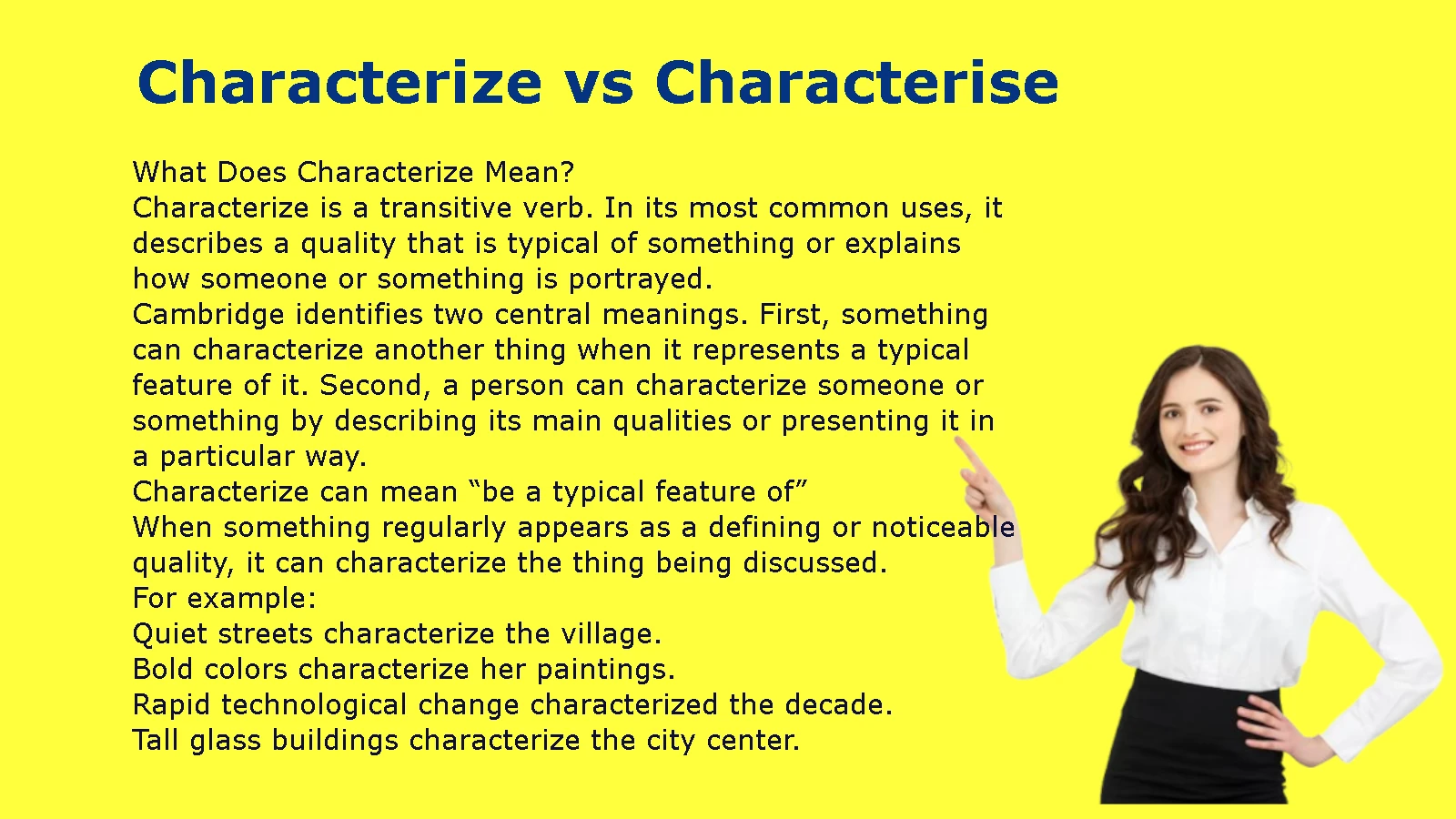
What Does Characterize Mean?
Characterize is a transitive verb. In its most common uses, it describes a quality that is typical of something or explains how someone or something is portrayed.
Cambridge identifies two central meanings. First, something can characterize another thing when it represents a typical feature of it. Second, a person can characterize someone or something by describing its main qualities or presenting it in a particular way.
Characterize can mean “be a typical feature of”
When something regularly appears as a defining or noticeable quality, it can characterize the thing being discussed.
For example:
- Quiet streets characterize the village.
- Bold colors characterize her paintings.
- Rapid technological change characterized the decade.
- Tall glass buildings characterize the city center.
In these sentences, the verb connects a recognizable feature with the thing it describes.
The structure often looks like this:
Feature + characterize + person, place, thing, or period
For example:
Several architectural features characterize the historic district.
The sentence means that those features are typical or distinctive parts of the district.
Characterize can mean “describe in a particular way”
The second major use involves description or portrayal.
You might characterize a person as patient, a situation as unusual, or an event as a turning point.
For example:
- She characterized the decision as unnecessary.
- Critics characterized the novel as ambitious.
- He characterized the meeting as productive.
- How would you characterize the current situation?
This construction often follows the pattern:
characterize + someone/something + as + description
Oxford gives examples such as asking how someone would characterize the mood of a particular period or describing political views as “extreme.”
Merriam-Webster likewise defines characterize as describing the character or quality of something and as being a characteristic of something.
What Does Characterise Mean?
Characterise has the same meanings as characterize. The difference is the spelling.
British English commonly uses characterise, while American English normally uses characterize. Cambridge specifically marks characterise as the usual UK form, and Collins lists characterise as the British variant.
Consider these sentences:
- The landscape is characterised by rolling hills.
- Critics characterised the book as groundbreaking.
- Several traditions characterise the region.
- Her writing is characterised by precise observations.
Nothing about the meaning changes when z becomes s.
The same sentence can therefore appear in two versions:
American English:
The region is characterized by its dry climate.
British English:
The region is characterised by its dry climate.
Both sentences communicate exactly the same idea.
Characterize vs Characterise Examples
Seeing the two forms side by side makes the distinction much easier.
| American English | British English |
| The region is characterized by dry weather. | The region is characterised by dry weather. |
| Several features characterize the building. | Several features characterise the building. |
| Critics characterized the novel as controversial. | Critics characterised the novel as controversial. |
| Her work is characterized by careful research. | Her work is characterised by careful research. |
| What would you characterize as the main problem? | What would you characterise as the main problem? |
| The era was characterized by social change. | The era was characterised by social change. |
Notice what stays the same: meaning, grammar, sentence structure, and pronunciation.
Only the spelling convention changes.
Characterize in American English
American English generally uses -ize in words of this type.
Examples include:
- characterize
- organize
- recognize
- realize
- emphasize
- specialize
- summarize
The NCBI Style Guide lists characterise/characterize, analyse/analyze, criticise/criticize, realise/realize, and several other pairs as British/American spelling differences.
Characterise in British English
British English commonly uses -ise for the same group of spellings:
- characterise
- organise
- recognise
- realise
- emphasise
- specialise
- summarise
This doesn’t mean that every British word ending in this sound must use -ise. English spelling has exceptions and historical complications. For this particular word, however, characterise is the usual British form.
Is Characterize American or British?
Characterize is the standard American spelling.
That makes it the natural choice when you’re writing for a US audience or following an American English style guide.
For example:
The study characterizes the region as economically diverse.
Several features characterize the species.
The period was characterized by rapid growth.
American dictionaries such as Merriam-Webster list characterize as the headword and give its forms as characterized and characterizing.
However, there’s an important nuance: characterize is not simply an “American only” word.
British dictionaries recognize the spelling as well. Cambridge labels characterise as the usual UK form rather than claiming that characterize has a completely different meaning or is an invalid English word. Oxford similarly lists characterise as the British English form of characterize.
So the better rule is:
Use characterize when following American spelling conventions.
Is Characterise British or American?
Characterise is the standard British spelling.
It appears frequently in British English writing, including academic, professional, journalistic, and general prose.
For example:
Several features characterise the region.
The report characterised the policy as ineffective.
These traditions characterise rural communities in the area.
Merriam-Webster explicitly describes characterise as a British spelling of characterize, while Collins lists it as the British variant.
For American readers, characterize will generally look more familiar. For British readers, characterise fits the conventional spelling system.
Do Characterize and Characterise Have the Same Meaning?
Yes. They mean the same thing.
Both words can describe a quality that is typical of a person, place, object, period, or situation. They can also describe how someone presents or portrays something.
Merriam-Webster gives two central senses:
- To describe the character or quality of something.
- To be a characteristic of something or distinguish it.
Cambridge expresses the distinction similarly. Something that characterizes another thing is typical of it, while someone can characterize something by describing its main qualities.
Meaning example: a typical feature
Broad beaches characterize the coastline.
Here, broad beaches are a typical or distinctive feature of the coastline.
The British version is:
Broad beaches characterise the coastline.
Same meaning. Different spelling.
Meaning example: a description
The researchers characterized the result as unexpected.
This means the researchers described the result as unexpected.
In British English:
The researchers characterised the result as unexpected.
Again, the meaning doesn’t move an inch.
Characterize vs Characterise in a Sentence
The word often appears in formal writing because it allows writers to make precise descriptions without relying on a long phrase.
Compare:
The city has many old buildings.
with:
Historic buildings characterize the city center.
The second version doesn’t merely say that old buildings exist. It presents them as a defining feature.
Likewise:
The manager said the change was unnecessary.
can become:
The manager characterized the change as unnecessary.
The second sentence makes the act of description explicit.
Common sentence patterns
Pattern: characterize something
Several features characterize the species.
Here, the features distinguish the species.
Pattern: be characterized by
The region is characterized by heavy rainfall.
This construction means that heavy rainfall is a prominent or typical feature of the region.
Pattern: characterize something as something
The committee characterized the proposal as unrealistic.
This means the committee described or presented the proposal as unrealistic.
These patterns work equally well with characterise in British English.
Characterized vs Characterised
The spelling difference doesn’t disappear when the verb changes tense.
The American form is:
characterized
The British form is:
characterised
Both are the past tense and past participle of the verb.
| American English | British English |
| characterize | characterise |
| characterizes | characterises |
| characterized | characterised |
| characterizing | characterising |
Cambridge identifies characterized as the past simple and past participle of characterize. Collins likewise lists characterized as the past tense and past participle.
Examples of characterized and characterised
American English:
The decade was characterized by rapid social change.
British English:
The decade was characterised by rapid social change.
American English:
The disease is characterized by several symptoms.
British English:
The disease is characterised by several symptoms.
The grammatical role remains identical.
Characterizing vs Characterising
The same spelling rule applies to the -ing form.
American English: characterizing
British English: characterising
For example:
The researchers identified several factors characterizing the population.
British English would write:
The researchers identified several factors characterising the population.
Cambridge identifies characterizing as the present participle of characterize.
The spelling change is therefore systematic:
-ize → -ise
rather than a change in pronunciation or meaning.
Characterization vs Characterisation
The noun follows the same regional pattern.
Characterization is the standard American spelling.
Characterisation is the British spelling.
The noun can refer to the way a person, fictional character, situation, or subject gets described or portrayed. It can also refer more broadly to the process of identifying or presenting distinctive qualities.
For example:
The author’s characterization of the protagonist is subtle.
British English:
The author’s characterisation of the protagonist is subtle.
Merriam-Webster identifies characterisation as the British spelling of characterization.
Related forms at a glance
| American English | British English |
| characterize | characterise |
| characterizes | characterises |
| characterized | characterised |
| characterizing | characterising |
| characterization | characterisation |
| characterizable | characterisable |
| characterizer | characteriser |
Collins lists characterizable/characterisable and characterizer/characteriser among the derived forms.
This is useful when editing a longer document. Changing only the base word may leave inconsistent spellings elsewhere on the page.
When Should You Use Characterize?
Use characterize when your writing follows American English.
That includes most writing intended for:
- US schools and universities
- American businesses
- US publications
- American news outlets
- US government or institutional documents
- Websites targeting primarily American readers
- American academic and professional audiences
For example:
The report characterizes the industry as highly competitive.
If the rest of your document uses spellings such as color, favor, organize, and recognize, then characterize belongs naturally in that system.
Consistency matters.
A document that uses American spelling throughout can look careless if it suddenly switches to characterise without a reason.
When Should You Use Characterise?
Use characterise when your writing follows British English conventions.
This includes writing intended for:
- UK readers
- British publications
- British academic institutions
- UK businesses
- British government or institutional audiences
- Publications that follow British spelling conventions
For example:
The report characterises the industry as highly competitive.
If the surrounding document uses colour, favour, organise, and recognise, then characterise keeps the spelling system consistent.
What about international English?
International audiences make the choice slightly more strategic.
If you’re writing for a global website, the best approach is usually to choose a consistent house style rather than switching between American and British spellings from page to page.
Why Does American English Use Characterize While British English Uses Characterise?
The -ize/-ise distinction has a long history in English spelling.
The important point for everyday writing is that the two endings represent a regional spelling variation. American English has strongly favored -ize, while British English commonly uses -ise for many verbs of this type.
The pattern affects a substantial group of words:
| American English | British English |
| characterize | characterise |
| analyze | analyse |
| organize | organise |
| recognize | recognise |
| realize | realise |
| emphasize | emphasise |
| criticize | criticise |
| summarize | summarise |
| specialize | specialise |
| prioritize | prioritise |
The NCBI Style Guide includes these pairs in its British and American spelling table.
There is a useful historical wrinkle here. The -ize ending has Greek and Latin historical roots, and English has used both -ize and -ise spellings over time. Etymological sources trace characterize to Greek charaktērizein through later Latin and French forms.
That history explains why the spelling difference exists, but you don’t need to memorize it to use the word correctly.
For practical writing, the rule is much simpler:
US English generally favors -ize. British English commonly uses -ise.
Is Characterize or Characterise Correct?
Both are correct.
The right choice depends on the variety of English you’re using.
| If you’re writing in… | Use… |
| American English | characterize |
| British English | characterise |
| American academic English | characterize |
| British academic English | characterise |
| US business English | characterize |
| UK business English | characterise |
Calling one form “correct” and the other “incorrect” misses the real issue.
It’s more accurate to say that the spellings belong to different regional conventions.
Think of it like color and colour. Neither spelling changes the underlying concept. The spelling simply signals which English convention the writer is following.
Common Mistakes With Characterize and Characterise
Most mistakes involving these words aren’t grammatical errors. They’re usually consistency errors.
Mistake: Treating the words as different in meaning
Some readers assume that characterize and characterise describe slightly different ideas.
They don’t.
The spelling changes. The meaning does not.
Mistake: Mixing American and British spellings
Consider this sentence:
The study characterises the region and analyzes its color patterns.
If the document follows American English, characterises stands out. If it follows British English, analyzes and color stand out.
A cleaner American version is:
The study characterizes the region and analyzes its color patterns.
A British version is:
The study characterises the region and analyses its colour patterns.
The second version changes several spellings because British English follows a broader spelling system.
Mistake: Assuming -ise is always British and -ize is always American
That shortcut works well for characterize/characterise, but English has exceptions.
Some words traditionally end in -ise in both major varieties, including words such as advertise, surprise, and exercise.
So don’t create a blanket rule that every word ending in this sound can simply switch between -ize and -ise.
For characterize, however, the regional distinction is clear.
Mistake: Changing only one related form
A writer may change:
characterize → characterise
but forget:
characterized → characterised
or:
characterization → characterisation
When editing a document, check the entire word family.
A Practical Case Study: Editing the Same Paragraph
Imagine an article written for an American audience:
The city’s historic buildings characterize its downtown area. Local historians have characterized the district as one of the best preserved parts of the region. Its architecture is characterized by narrow streets, colorful facades, and ornate entrances.
Every form follows American spelling.
Now convert it to British English:
The city’s historic buildings characterise its downtown area. Local historians have characterised the district as one of the best preserved parts of the region. Its architecture is characterised by narrow streets, colourful facades, and ornate entrances.
Notice something important: the spelling change goes beyond the target word.
If you’re converting a document from US English to British English, you need to check the broader spelling system rather than replacing one word in isolation.
The reverse works the same way.
This is why style consistency matters more than memorizing individual spelling pairs.
Characterize vs Characterise: Facts at a Glance
Here are the essential facts in one place:
- Characterize is the standard American spelling.
- Characterise is the usual British spelling.
- Both forms are verbs.
- Both forms have the same meaning.
- Both can mean to be a typical feature of something.
- Both can mean to describe someone or something in a particular way.
- Characterized is the American past form.
- Characterised is the British past form.
- Characterizing is the American participle.
- Characterising is the British participle.
- Characterization is the American noun.
- Characterisation is the British noun.
- The pronunciation does not change simply because the spelling uses z or s.
- The difference is primarily a matter of regional spelling convention.
Cambridge, Oxford, Collins, Merriam-Webster, and the NCBI Style Guide all support the core distinction.
Characterize vs Characterise: Comparison Table
| Feature | Characterize | Characterise |
| Main variety | American English | British English |
| Word class | Verb | Verb |
| Meaning | To describe qualities or identify typical features | Same |
| Present form | characterize | characterise |
| Third person | characterizes | characterises |
| Past tense | characterized | characterised |
| Present participle | characterizing | characterising |
| Noun form | characterization | characterisation |
| Main spelling difference | z | s |
| Meaning difference | None | None |
| Appropriate for US English | Yes | Usually no |
| Appropriate for British English | Recognized | Yes |
FAQs About Characterize vs Characterise
Is characterize American or British spelling?
Characterize is the standard American spelling. British English commonly uses characterise. British dictionaries still recognize characterize, so it is more accurate to describe characterise as the usual British form rather than claiming that characterize is impossible in British English.
Is characterise the British spelling?
Yes. Characterise is the usual British spelling of characterize. Collins and Merriam-Webster both identify it as a British variant.
Do characterize and characterise mean the same thing?
Yes. Characterize and characterise have the same core meanings. Both can describe the typical qualities of something or describe something in a particular way.
Which is correct, characterize or characterise?
Both are correct. Use characterize for American English and characterise for British English.
Is characterise wrong in American English?
Characterise isn’t the standard American spelling. American English normally uses characterize.
Is characterize wrong in British English?
No. British English commonly uses characterise, but major dictionaries recognize characterize as well. Oxford lists characterise as the British English form, while Cambridge marks it as “UK usually characterise.”
What is the past tense of characterize?
The American past tense is characterized. The British form is characterised.
What is the -ing form of characterize?
The American form is characterizing. The British form is characterising.
What is the noun form of characterize?
The American noun is characterization. The British spelling is characterisation. Merriam-Webster identifies characterisation as the British spelling of characterization.
Does characterize have a different pronunciation from characterise?
No meaningful pronunciation difference follows from the spelling distinction. The z/s spelling is primarily regional, not a change in the word’s meaning or basic pronunciation.
Can you use characterize in British English?
Yes. British dictionaries recognize characterize, although characterise is the usual British spelling. If you’re writing specifically in British English, characterise will generally fit the expected style better.
Can you use characterise in American English?
You may encounter it, particularly in writing influenced by British English, but characterize is the standard American spelling. For consistent US English, use characterize.
Is characterization American or British?
Characterization is the American spelling. Characterisation is the British spelling.
Final Verdict: Characterize vs Characterise
The difference between characterize and characterise is simple once you separate meaning from spelling.
Characterize is the standard American English form.
Characterise is the usual British English form.
Both words mean the same thing. They can describe the qualities that define something, identify a typical feature, or explain how someone portrays or describes a person, event, idea, or situation.
The same regional pattern carries through the word family:
- characterize → characterise
- characterized → characterised
- characterizing → characterising
- characterization → characterisation
So, if you’re writing for a US audience, stick with characterize. If you’re following British English conventions, choose characterise.
The best spelling isn’t the one that wins an imaginary spelling contest. It’s the one that matches the English variety used throughout your writing.