Real estate term means a word or phrase used to describe property, real estate transactions, ownership, financing, development, or other aspects of the real estate industry. Common real estate terms include mortgage, appraisal, escrow, equity, foreclosure, and closing costs.
If you’re searching for “real estate term meaning,” “real estate terminology,” or “real estate terms and definitions,” you’re likely looking for simple explanations of words used when buying, selling, renting, or investing in property. Real estate terminology can seem confusing at first, but understanding the key terms makes property listings, contracts, and financial discussions much easier to follow.
What Does Real Estate Term Mean?
A real estate term is a word or phrase that has a specific meaning in the real estate industry. It may describe a property, transaction, legal concept, financial arrangement, or role involved in real estate.
| Question | Answer |
| What is a real estate term? | A word or phrase used in the real estate industry. |
| What does real estate terminology mean? | The specialized vocabulary used when discussing property and real estate transactions. |
| Why are real estate terms important? | They help buyers, sellers, renters, and investors understand property-related information. |
| What are common real estate terms? | Mortgage, appraisal, escrow, equity, foreclosure, and closing costs. |
What Does Real Estate Term Mean?
A real estate term is a word or phrase used to describe some part of property ownership, property transactions, land use, financing, valuation, development, or management.
For example:
- Mortgage describes a loan arrangement used to finance property.
- Appraisal refers to a professional opinion of a property’s value.
- Listing refers to property offered for sale or lease.
- Closing refers to the final stage of a property transaction.
- Equity describes the owner’s financial interest in a property after accounting for debt.
- Easement describes a legal right to use another person’s land for a particular purpose.
So, when someone asks for the real estate term meaning, they may be asking about the meaning of the phrase real estate itself. They may also be looking for explanations of terminology commonly used in the real estate industry.
Real Estate Meaning in Simple English
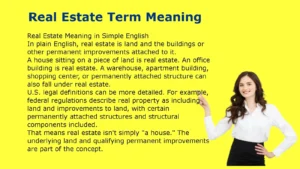
In plain English, real estate is land and the buildings or other permanent improvements attached to it.
A house sitting on a piece of land is real estate. An office building is real estate. A warehouse, apartment building, shopping center, or permanently attached structure can also fall under real estate.
U.S. legal definitions can be more detailed. For example, federal regulations describe real property as including land and improvements to land, with certain permanently attached structures and structural components included.
That means real estate isn’t simply “a house.” The underlying land and qualifying permanent improvements are part of the concept.
What Does Real Estate Mean?
Real estate means property in the form of land or buildings. Cambridge gives essentially this everyday definition and also notes that American business usage can refer to both property itself and the activity of buying and selling land and buildings.
The term can therefore appear in two closely connected ways.
Real Estate as Property
When someone says:
“They bought real estate in Texas.”
They mean they purchased property, such as land, a house, an apartment building, or another qualifying property.
Real Estate as an Industry
When someone says:
“She works in real estate.”
They may mean she works in the business of buying, selling, leasing, developing, financing, or managing property.
This distinction matters because real estate doesn’t always describe the physical property itself. Depending on the sentence, it can refer to the broader commercial activity surrounding property.
What Counts as Real Estate?
Common examples include:
- Houses
- Condominiums
- Apartment buildings
- Office buildings
- Retail stores
- Warehouses
- Factories
- Hotels
- Farms
- Vacant land
- Industrial sites
- Permanently attached structures
- Certain permanent fixtures and improvements
Federal regulations provide a more technical definition that includes land, permanently attached buildings, and other inherently permanent structures.
Natural resources can also matter. Depending on the applicable legal definition, land can include things such as growing crops, timber, minerals, or water while they remain associated with the land.
What Is a Real Estate Term?
A real estate term is specialized vocabulary used to describe a particular concept in property transactions or property ownership.
Think of real estate terminology as the industry’s shorthand. A single word can replace an entire explanation.
For example, instead of saying:
“The buyer deposits money to demonstrate that they genuinely intend to complete the purchase.”
Real estate professionals can use the term earnest money.
The Consumer Financial Protection Bureau defines earnest money as a deposit a buyer makes to demonstrate good faith under a contract to purchase a home. Depending on the circumstances, it may later be applied to closing costs or the down payment.
That shorthand makes contracts and conversations more efficient.
Why Real Estate Has So Many Specialized Terms
Property transactions combine several areas at once:
- Law
- Finance
- Construction
- Taxation
- Insurance
- Land use
- Contracts
- Valuation
- Sales
- Property management
As a result, the vocabulary becomes highly specific.
A buyer might talk about preapproval and down payment. An appraiser might discuss comparable sales. A title professional might focus on liens and ownership records. A landlord may care about leases, rent, vacancies, and operating expenses.
They’re all talking about real estate, but each person uses terminology suited to a different part of the process.
What Are the Main Types of Real Estate?
Most basic real estate discussions divide property into four broad categories:
- Residential
- Commercial
- Industrial
- Land
These categories help explain how a property is primarily used.
| Type | What it generally includes | Example |
| Residential real estate | Property intended primarily for housing | Single-family house |
| Commercial real estate | Property used for business or commercial activities | Office building |
| Industrial real estate | Property used for manufacturing, production, storage, or distribution | Warehouse |
| Land | Undeveloped or developable land | Vacant building lot |
The exact classification can vary depending on the legal, tax, zoning, lending, or industry context. However, these four categories provide a useful starting point.
Residential Real Estate
Residential real estate consists primarily of property used as housing.
Examples include:
- Single-family homes
- Townhouses
- Condominiums
- Duplexes
- Apartment buildings
- Vacation homes
A small residential property transaction can still involve a surprisingly large amount of terminology. Buyers may encounter mortgages, inspections, appraisals, contingencies, title searches, insurance, taxes, and closing documents.
Commercial Real Estate
Commercial real estate generally refers to property used for business or commercial purposes.
Examples include:
- Office buildings
- Retail stores
- Shopping centers
- Hotels
- Restaurants
- Certain mixed-use properties
A commercial property deal often involves more complicated leases, financing arrangements, operating expenses, and due diligence than a straightforward residential purchase.
Industrial Real Estate
Industrial real estate serves production, storage, manufacturing, logistics, or distribution needs.
Examples include:
- Warehouses
- Manufacturing facilities
- Distribution centers
- Industrial parks
- Certain specialized production facilities
A warehouse near a major transportation route, for example, can have a very different value proposition from a suburban house even though both are technically real estate.
Land
Land can be vacant, agricultural, recreational, or intended for future development.
A vacant parcel may have no building on it yet, but it can still be real estate.
Its potential use often depends on factors such as:
- Zoning
- Access
- Utilities
- Location
- Soil conditions
- Environmental restrictions
- Development regulations
- Easements
- Market demand
Land ownership also involves more than the visible surface. Legal interests can include rights associated with the space above or below the land, subject to applicable law.
What Does a Real Estate Agent Mean?
A real estate agent is a licensed professional who helps clients buy and sell property.
The National Association of REALTORS® describes real estate agents as licensed professionals who facilitate property transactions between buyers and sellers. Agents can use knowledge of local markets, property values, and negotiation to assist clients.
An agent may help with tasks such as:
- Finding properties
- Marketing a property
- Arranging showings
- Preparing or presenting offers
- Communicating with other parties
- Negotiating transaction terms
- Coordinating parts of the transaction
- Helping clients navigate transaction paperwork
Real Estate Agent vs. REALTOR®
These terms aren’t interchangeable.
A real estate agent is a licensed professional who facilitates property transactions.
A REALTOR® is a real estate professional who belongs to the National Association of REALTORS® and follows its Code of Ethics. Not every real estate agent is a REALTOR®.
That distinction is useful when you see both terms in property listings or real estate articles.
What Does Real Estate Work Mean?
Real estate work generally means professional activity connected with property.
Someone who says:
“I work in real estate.”
could be describing many different careers.
Common Real Estate Jobs
| Job | Main role |
| Real estate agent | Helps clients buy or sell property |
| Real estate broker | Performs brokerage activities and may supervise agents, subject to state law |
| Property manager | Oversees rental property and its day-to-day operation |
| Appraiser | Provides an opinion of property value |
| Real estate investor | Purchases or controls property for investment purposes |
| Developer | Coordinates the creation or redevelopment of property |
| Leasing professional | Helps arrange rental or commercial lease transactions |
| Mortgage professional | Helps borrowers obtain property financing |
Real estate work isn’t limited to showing houses. The industry includes professionals involved in construction, finance, valuation, management, legal services, insurance, and property development.
What Does the Real Estate Industry Mean?
The real estate industry is the broad economic sector connected with property.
It includes activities such as:
- Buying property
- Selling property
- Renting property
- Leasing commercial space
- Developing land
- Constructing buildings
- Managing properties
- Financing purchases
- Valuing property
- Marketing property
- Investing in property
The phrase real estate industry therefore covers much more than real estate agents.
A developer might purchase raw land, obtain approvals, arrange financing, construct buildings, and eventually sell or lease the completed properties. A property manager might then operate those buildings after tenants move in.
One property can therefore pass through several parts of the industry during its life.
Common Real Estate Terms and Their Meanings
Real estate vocabulary becomes much easier when you group terms by purpose.
Property Terms
Property: Land, buildings, or an ownership interest in them.
Parcel: A defined piece of land.
Lot: A specific piece of land that can be separately identified, often within a subdivision.
Acreage: Land measured or described in acres.
Square footage: The area of a property or building measured in square feet.
Zoning: Local land-use rules that determine how property may be used or developed.
Zoning can have a major effect on what an owner can do with a property. A parcel that looks suitable for a particular project may face restrictions based on its zoning classification.
Buying and Selling Terms
Listing: Property offered for sale or lease.
Offer: A buyer’s proposal to purchase property under specified terms.
Counteroffer: A response that changes the terms of an existing offer.
Purchase agreement: A contract setting out the terms of a property sale.
Earnest money: A deposit showing the buyer’s good-faith commitment to a purchase contract.
Contingency: A contractual condition that must be satisfied for a transaction to proceed under the agreed terms.
Closing: The final stage of a property purchase and financing transaction. The CFPB explains that mortgage closing involves signing the necessary documents, with the loan becoming final and funds being distributed.
Ownership Terms
Deed: A legal instrument used to transfer an ownership interest in real property.
Title: The legal ownership interest or rights associated with property.
Lien: A legal claim against property that can secure an obligation or debt.
Easement: A legal right to use another person’s land for a specific purpose.
Encumbrance: A claim, restriction, or other interest that can affect property rights.
Equity: The owner’s interest in a property after subtracting applicable debt from the property’s value.
For example, if a property is worth $400,000 and the owner owes $250,000 on the mortgage, the owner’s equity is approximately $150,000 before considering other claims or transaction costs.
Financing Terms
Mortgage: A loan arrangement secured by property. The lender generally has rights against the property if the borrower fails to repay the loan.
Down payment: Money a buyer pays toward a home upfront rather than financing the entire purchase price.
Principal: The amount borrowed before interest and other costs.
Interest: The cost charged for borrowing money.
Loan-to-value ratio (LTV): The loan amount compared with the property’s value.
For example, a $240,000 mortgage on a $300,000 property produces an LTV of 80%.
Valuation Terms
Appraisal: A professional opinion of a property’s value.
Market value: The value a property may command in a market under relevant assumptions.
Comparable sales: Recently sold properties used to help analyze the value of another property.
Assessed value: A value assigned for property-tax purposes under applicable local rules.
These values don’t necessarily match.
A property’s listing price is what the seller asks. An appraised value is a professional valuation under the applicable appraisal process. An assessed value may exist primarily for taxation.
Rental Terms
Lease: A contract that gives a tenant the right to use property under specified conditions for a specified period.
Rent: Payment made for the use of property.
Security deposit: Money a tenant provides under a lease to protect the landlord against certain obligations, subject to applicable law.
Landlord: A person or entity that owns or controls property offered for rent.
Tenant: A person or entity with a contractual right to occupy or use rental property.
Real Estate Terms in Simple Examples
Context often makes unfamiliar terminology much easier to understand.
| Sentence | Term | Meaning |
| “The buyer submitted an offer for $350,000.” | Offer | Proposal to buy the property |
| “The buyer deposited $7,000 in earnest money.” | Earnest money | Good-faith deposit connected to the purchase contract |
| “The lender required an appraisal.” | Appraisal | Professional valuation of the property |
| “The property has an easement.” | Easement | Legal right affecting the use of land |
| “The owner has $120,000 in equity.” | Equity | Owner’s interest after accounting for debt |
| “They signed the lease for three years.” | Lease | Contract governing the tenant’s use of property |
| “The transaction is scheduled to close Friday.” | Closing | Final stage of the purchase and financing process |
Example: A Home Purchase
Imagine a buyer wants to purchase a $300,000 house.
The buyer might first obtain mortgage preapproval. After finding a suitable property, the buyer submits an offer.
The seller accepts the offer. The buyer then provides earnest money according to the contract.
The lender orders an appraisal to help evaluate the property for the loan. The parties complete required inspections, documentation, and other contractual conditions.
Finally, the buyer reaches closing, signs the required documents, and completes the purchase process.
The buyer didn’t just buy a house. The transaction involved an entire vocabulary of real estate terms.
Real Estate vs. Personal Property
The distinction between real estate and personal property is fundamental.
Real estate generally concerns land and things permanently attached to it. Personal property generally consists of movable property.
For example:
| Real estate | Personal property |
| House | Car |
| Land | Sofa |
| Permanently attached building | Television |
| Permanently installed structure | Bicycle |
| Certain permanent fixtures | Furniture |
The legal line isn’t always as simple as “if it can move, it’s personal property.” Fixtures, permanent installations, local law, contracts, and the circumstances surrounding an item can affect its classification.
The Cornell Legal Information Institute describes real property as land and things permanently attached to it, contrasting it with movable personal property.
Why the Difference Matters
The classification can affect:
- What transfers with a property
- How a sale is documented
- Tax treatment
- Financing
- Ownership rights
- Legal disputes
- Lease obligations
Suppose a seller removes a permanently installed fixture before closing. Whether that item should have remained with the property may depend on the purchase agreement, applicable law, and the nature of the fixture.
That’s why property contracts often specify exactly what is included.
What Is the Difference Between Real Estate and Real Property?
Real estate and real property are often used interchangeably in ordinary conversation.
There can be a subtle distinction in legal usage, however.
Real estate commonly refers to the physical land and improvements. Real property can be broader because it may refer not only to the physical property but also to the legal rights and interests associated with it.
The exact distinction depends on the legal context and jurisdiction. Cornell’s Wex, for example, describes real property as including land and permanently attached things while also recognizing different types of legal interests in property.
For everyday English, you can usually think of them as closely related terms.
What Is the Difference Between Real Estate and Realty?
Realty is another term for real estate or real property.
In American English, you may see all three expressions:
- Real estate
- Real property
- Realty
For example:
“She invests in real estate.”
and:
“She invests in realty.”
can communicate essentially the same basic idea in ordinary usage.
Dictionary sources identify realty as a synonym or related term for real estate and real property.
Real estate remains the more familiar expression in everyday American conversation.
Where Does the Term Real Estate Come From?
The history of real estate is older than modern real estate agencies, mortgages, and property listings.
The word real developed through Old French and Late Latin. Etymological sources connect it to Latin res, meaning a thing, matter, or property. The specific phrase real estate appears in English records by the 17th century.
The important point is that real in this expression does not simply mean “genuine” or “not fake.”
Historically, it developed a property-related legal sense connected with physical or immovable things.
Does Real Mean Royal?
A common question asks whether real estate has something to do with royalty.
The historical evidence points elsewhere. The property-related sense of real traces through Latin realis and res, rather than simply being a shortened form of “royal.” Etymological references place the phrase real estate in English usage by the 1600s.
So the phrase isn’t best understood as “royal estate.”
Instead, its history is tied to the legal distinction between property considered real and property considered personal.
Real Estate Meaning in Everyday English
You can understand the phrase by looking at how people actually use it.
“I bought real estate.”
This means the speaker purchased property, such as land or a building.
“She works in real estate.”
This usually means she works in the property business or industry.
“Real estate prices increased.”
Here, real estate refers to property as a market or asset category.
“He’s a real estate investor.”
This describes someone who invests in property.
“The real estate agent showed us three houses.”
Here, real estate agent refers to the professional facilitating the property transaction.
The surrounding words tell you which sense applies.
Why Understanding Real Estate Terms Matters
Property transactions involve significant financial and legal commitments. A misunderstanding that seems small at first can become expensive when it affects a contract, loan, valuation, or ownership right.
Knowing the vocabulary helps you ask better questions.
For example, if a document mentions earnest money, you know you’re dealing with a deposit associated with the purchase contract. If it mentions LTV, you know the discussion involves the relationship between a loan and property value.
The same principle applies to renting.
A tenant who understands the difference between rent, security deposit, lease term, renewal, and maintenance obligations can read a lease more carefully and identify questions before signing.
A Simple Rule for Reading Real Estate Documents
When you encounter an unfamiliar term:
- Identify the term.
- Read the sentence around it.
- Determine whether it concerns ownership, money, property condition, or legal rights.
- Check the definition used in the applicable document or jurisdiction.
- Ask the relevant professional if the term affects your legal or financial obligations.
That last step matters. A dictionary definition can explain a word, but it can’t replace the specific legal language of a contract.
Quick Real Estate Terms Glossary
| Real estate term | Simple definition |
| Real estate | Land and buildings or other qualifying permanent improvements attached to it |
| Real property | Property and associated legal interests, depending on context |
| Realty | Another term for real estate |
| Residential real estate | Property primarily used for housing |
| Commercial real estate | Property used for commercial or business purposes |
| Industrial real estate | Property used for industrial, manufacturing, storage, or distribution purposes |
| Parcel | A defined piece of land |
| Listing | Property offered for sale or lease |
| Offer | A proposal to purchase property under specified terms |
| Earnest money | Good-faith deposit associated with a purchase contract |
| Mortgage | Loan arrangement secured by property |
| Down payment | Upfront amount paid toward a property purchase |
| Appraisal | Professional opinion of property value |
| Equity | Owner’s interest in property after accounting for debt |
| Deed | Legal instrument used to transfer property ownership |
| Title | Ownership interest or rights associated with property |
| Lien | Legal claim against property securing an obligation |
| Easement | Legal right to use another person’s land for a specified purpose |
| Lease | Contract granting a right to use property for a specified period |
| Closing | Final stage of a property purchase and associated financing |
Frequently Asked Questions About Real Estate Term Meaning
What does real estate mean in English?
Real estate means land and buildings or other permanent improvements attached to land. In American English, the phrase can also refer to the business of buying, selling, renting, developing, and managing property.
What is a real estate term?
A real estate term is a word or phrase used to describe a concept related to property ownership, transactions, financing, valuation, development, land use, or management.
Examples include mortgage, appraisal, deed, title, equity, listing, lease, and closing.
What are the four main types of real estate?
The four broad categories commonly used in basic real estate discussions are residential, commercial, industrial, and land. Individual properties can have more specific classifications depending on their use and the applicable legal or industry system.
What does a real estate agent do?
A real estate agent is a licensed professional who helps facilitate property transactions between buyers and sellers. Their work can include marketing, property searches, showings, offers, negotiations, and transaction coordination.
What does real estate work mean?
Real estate work refers broadly to professional activities involving property. It can include sales, leasing, property management, appraisal, development, investment, financing, and related services.
What does the real estate industry mean?
The real estate industry is the broader sector involved in owning, buying, selling, renting, developing, financing, valuing, and managing property.
What is the difference between real estate and personal property?
Real estate generally involves land and permanently attached structures or improvements. Personal property generally consists of movable items such as vehicles, furniture, and other possessions. The exact legal classification of certain items can depend on applicable law and the circumstances.
What is the difference between real estate and real property?
The terms are closely related and are often used interchangeably. Real property can carry a broader legal meaning that includes ownership interests and rights associated with land, while real estate commonly emphasizes the property itself.
Where does the term real estate come from?
The property-related sense of real traces through Old French and Late Latin to Latin res, associated with a thing or property. The phrase real estate has been recorded in English since the 17th century.
Is real estate only houses?
No. Real estate includes much more than houses. It can include apartments, offices, warehouses, retail properties, industrial facilities, farms, vacant land, and other qualifying property.
What does “real estate” mean when someone says they work in it?
In that context, real estate usually means the property industry rather than one specific building or parcel. The person could work in sales, leasing, development, investment, management, valuation, financing, or another property-related field.
Final Meaning of Real Estate
The simplest real estate term meaning is land and property permanently attached to it. That includes familiar things such as houses and buildings, along with other permanent improvements recognized as real property under the applicable rules.
The phrase also has a broader business meaning. When someone says they work in real estate, they’re usually talking about an industry that connects property owners, buyers, sellers, renters, investors, developers, lenders, agents, appraisers, and property managers.
Once you understand that basic distinction, the rest of real estate terminology becomes easier to organize. A mortgage deals with financing. An appraisal deals with value. A deed deals with transferring ownership. A lease deals with the use of property. A closing completes a transaction.
That’s the key to understanding real estate language: don’t memorize isolated words. Understand what role each term plays in the property process.