Have you ever wondered whether furniture or furnitures is the correct form to use when talking about tables, chairs, beds, and other household items? The difference in Furniture vs Furnitures can be confusing because many English nouns take an -s when you talk about more than one. However, furniture works differently.
Furniture is the standard and correct word for the general category of movable items used to equip a home, office, or other space. In standard English, furniture is an uncountable noun, so furnitures is generally not used to mean multiple pieces of furniture. When you want to refer to individual items, use pieces of furniture, items of furniture, or name the specific objects.
Examples:
- We bought some new furniture for the living room.
- The store sells several pieces of furniture.
The confusion is understandable. People often search for furniture vs furnitures, furniture or furnitures, is furniture plural, or can you say furnitures because the word refers to multiple objects but does not normally take a plural -s. And here’s the kicker: furniture is already used to describe a collection of items, so adding -s is unnecessary in most everyday English.
In this guide, you’ll learn the complete difference between Furniture vs Furnitures, including their meaning, plural form, correct usage, grammar, and common mistakes. You’ll also discover how to talk about multiple furniture items correctly, along with clear examples to help you use furniture naturally and confidently.
Furniture vs Furnitures: What’s the Difference?
The main difference is simple: furniture is the standard English noun, while furnitures is not the normal plural form of furniture.
The word furniture describes a collection or category of movable objects used to equip a room. A sofa, desk, chair, table, bed, and cabinet can all be considered furniture.
However, English treats the category as an uncountable noun.
| Form | Correct? | Example |
| furniture | ✓ | The furniture is beautiful. |
| furnitures | ✗ in standard everyday English | The furnitures are beautiful. |
| a piece of furniture | ✓ | I bought a piece of furniture. |
| two pieces of furniture | ✓ | We bought two pieces of furniture. |
| three chairs | ✓ | We bought three chairs. |
The important point is that the individual objects can be counted even though the word furniture cannot normally be counted directly.
Think of furniture as a category label. You can have ten objects in that category, but the category name itself doesn’t become furnitures.
Examples of Correct Furniture Usage
Here are several natural examples:
- The furniture is quite expensive.
- We need some furniture for the new apartment.
- They bought several pieces of furniture.
- The office has modern furniture.
- That sofa is my favorite piece of furniture.
- The movers damaged some of the furniture.
Notice something important in these examples. Even when furniture refers to many physical objects, the noun itself stays unchanged.
Is Furniture Singular or Plural?
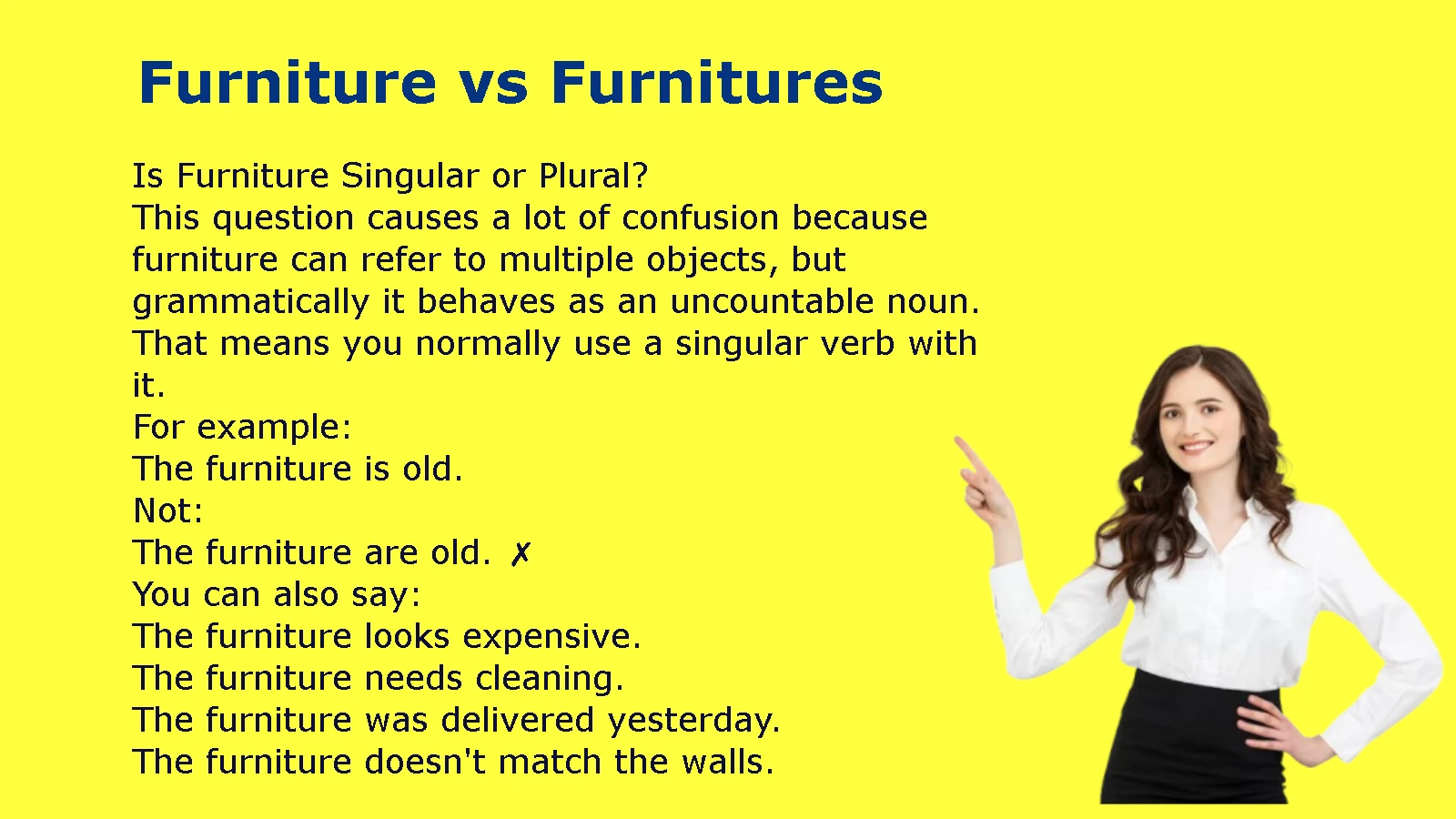
This question causes a lot of confusion because furniture can refer to multiple objects, but grammatically it behaves as an uncountable noun.
That means you normally use a singular verb with it.
For example:
The furniture is old.
Not:
The furniture are old. ✗
You can also say:
- The furniture looks expensive.
- The furniture needs cleaning.
- The furniture was delivered yesterday.
- The furniture doesn’t match the walls.
The reason isn’t that furniture refers to one physical object. It doesn’t necessarily do that. Instead, English treats the noun as a noncount category.
Cambridge explains that uncountable nouns don’t normally form regular plurals and don’t take a or an. Furniture is one of the common examples.
Why Can Furniture Refer to Many Things?
Consider this sentence:
The furniture in the house is beautiful.
The house might contain:
- a sofa
- six chairs
- two tables
- three beds
- several cabinets
- a desk
That’s a lot of physical objects. Still, the sentence uses is, not are.
The noun furniture groups all those objects into one uncountable category.
This same idea appears with other nouns. For example:
- The equipment is expensive.
- The luggage is heavy.
- The information is useful.
- The furniture is modern.
You can have many individual pieces of equipment or luggage, but the nouns themselves don’t normally take a regular plural -s in these constructions. Cambridge lists furniture, equipment, luggage, information, and several other nouns as common sources of countability mistakes.
Why Is Furnitures Incorrect?
The mistake usually happens because English learners know that adding -s often creates a plural.
For example:
- chair → chairs
- table → tables
- desk → desks
- sofa → sofas
- cabinet → cabinets
So it seems logical to assume:
furniture → furnitures
English, however, doesn’t work that way with every noun.
Some nouns are uncountable, which means you don’t normally make them plural with -s. Furniture belongs to this group.
Cambridge’s grammar resources explicitly use furniture as an example of an uncountable noun and warn against forms such as furnitures.
Compare Furniture With a Countable Noun
Look at the difference:
| Countable noun | Uncountable noun |
| one chair | some furniture |
| two chairs | some furniture |
| three chairs | a lot of furniture |
| many chairs | much furniture |
| several chairs | several pieces of furniture |
You can put a number directly before chairs because chair is countable.
You cannot normally put a number directly before furniture.
So:
- three chairs ✓
- three pieces of furniture ✓
- three furniture ✗
- three furnitures ✗
How Do You Make Furniture Plural?
Technically, you don’t make furniture plural in standard everyday English.
Instead, you make a phrase around it countable.
The most useful structure is:
number + pieces of furniture
For example:
- one piece of furniture
- two pieces of furniture
- three pieces of furniture
- five pieces of furniture
- several pieces of furniture
You can also use items of furniture.
For example:
The store delivered six items of furniture.
However, pieces of furniture is especially common and natural when you’re talking about individual objects.
Cambridge specifically recommends piece of furniture for referring to individual items or different kinds of furniture.
Furniture Quantity Examples
| Meaning | Natural expression |
| One item | a piece of furniture |
| Two items | two pieces of furniture |
| Several items | several pieces of furniture |
| An unspecified amount | some furniture |
| A large amount | a lot of furniture |
| Different categories | different types of furniture |
| Individual objects | chairs, tables, desks, sofas |
This gives you plenty of ways to express quantity without ever needing furnitures.
Can You Say “A Furniture”?
No. In standard English, a furniture is incorrect.
You normally can’t use a or an directly before an uncountable noun.
So these forms are incorrect:
- a furniture ✗
- an furniture ✗
- one furniture ✗
Instead, use a countable expression:
- a piece of furniture ✓
- an item of furniture ✓
- a chair ✓
- a table ✓
- a sofa ✓
For example:
We need a piece of furniture for the empty corner.
Or, if you know exactly what the object is:
We need a small table for the empty corner.
The second version often sounds more natural because it tells the reader exactly what you’re talking about.
How to Talk About One Piece of Furniture
When you need to identify one individual object without naming it specifically, a piece of furniture is the safest choice.
For example:
- We need one more piece of furniture for the bedroom.
- That antique chair is a beautiful piece of furniture.
- The desk is the oldest piece of furniture in the house.
- She bought a handmade piece of furniture.
You can also use an item of furniture:
The damaged item of furniture was removed from the room.
Both expressions work, but piece of furniture is especially common in ordinary conversation and writing.
Use the Specific Noun When Possible
If you know what the object is, there’s often no reason to say piece of furniture.
Instead of:
We bought three pieces of furniture for the dining room.
You might say:
We bought a dining table and two chairs.
The second sentence gives the reader more information.
That’s one reason furniture works best as a general category word. When you need precision, name the object.
How to Talk About Multiple Pieces of Furniture
When you need to count furniture, use a quantity phrase.
Here are some natural patterns:
With Exact Numbers
- two pieces of furniture
- four pieces of furniture
- ten pieces of furniture
Example:
The moving company transported eight pieces of furniture.
With General Quantities
- some furniture
- a lot of furniture
- a little furniture
- much furniture
- several pieces of furniture
- a few pieces of furniture
Example:
The apartment doesn’t have much furniture yet.
With Types
When you’re talking about categories rather than individual objects, use types of furniture:
The store sells several types of furniture for small apartments.
This distinction matters because pieces and types don’t mean the same thing.
Three pieces of furniture means three individual objects.
Three types of furniture means three categories or styles.
Furniture vs Pieces of Furniture
The difference becomes much clearer when you put the two expressions side by side.
Furniture refers to the general category or collection.
Pieces of furniture refers to individual objects within that category.
| Expression | What it means | Example |
| furniture | Furniture generally | We need new furniture. |
| a piece of furniture | One individual object | We need one piece of furniture. |
| three pieces of furniture | Three individual objects | They bought three pieces of furniture. |
| types of furniture | Categories or kinds | The store sells several types of furniture. |
| items of furniture | Individual objects | Five items of furniture arrived today. |
A useful way to remember the distinction is to imagine a large box labeled FURNITURE.
Inside the box might be chairs, tables, beds, and desks.
The word furniture names the whole category. The individual objects are the pieces.
Furniture vs Furnishings
Don’t confuse furniture with furnishings.
The words overlap in meaning, but they aren’t identical.
Furniture normally refers to movable objects such as chairs, tables, beds, desks, and sofas.
Furnishings can have a broader sense and can refer to objects used to equip or decorate an interior. Merriam-Webster lists furnishings as a plural noun and gives furniture as a synonym.
For example:
The room has expensive wooden furniture.
You could also say:
The room has expensive wooden furnishings.
The second version can sound broader because furnishings can include more than the core furniture pieces.
Merriam-Webster defines a furnishing as an object that adds comfort or utility and notes that the term commonly appears in the plural.
Furniture and Furnishings Compared
| Word | Typical use |
| furniture | Chairs, tables, beds, desks, sofas, and similar movable objects |
| furnishing | An individual object that helps furnish a space |
| furnishings | A collection of objects used to furnish or decorate a space |
The key grammar difference is important: furnishings is a legitimate plural form, while furnitures isn’t the standard plural of furniture.
Furniture vs Furniture Items
You may also see furniture items, especially in formal, commercial, inventory, or product-related contexts.
For example:
The company delivered several furniture items to the hotel.
This construction works because items is countable. The noun furniture acts as a modifier.
Compare:
We bought new furniture.
with:
We bought several furniture items.
Both are grammatical, but they serve different purposes.
The first sentence speaks about furniture generally.
The second emphasizes individual items.
In everyday conversation, pieces of furniture often sounds more natural:
We bought several pieces of furniture.
For inventory records or product descriptions, however, furniture items can be useful because the context already focuses on individual products.
Correct and Incorrect Examples of Furniture
The fastest way to master this rule is to see it in action.
Correct Examples
The furniture is expensive.
Here, furniture is uncountable and takes the singular verb is.
We bought some new furniture.
The word some works naturally with an uncountable noun.
They bought three pieces of furniture.
The quantity applies to pieces, not directly to furniture.
That desk is a beautiful piece of furniture.
The singular countable word piece allows you to refer to one object.
The furniture in the office looks modern.
Again, furniture takes the singular verb looks.
Several items of furniture were damaged during the move.
The plural verb were agrees with items, not furniture.
Incorrect Examples
The furnitures are expensive. ✗
Correct:
The furniture is expensive.
Or:
The pieces of furniture are expensive.
We bought two furnitures. ✗
Correct:
We bought two pieces of furniture.
She bought a furniture. ✗
Correct:
She bought a piece of furniture.
Or:
She bought a chair.
The furniture are modern. ✗
Correct:
The furniture is modern.
There are three furniture in the room. ✗
Correct:
There are three pieces of furniture in the room.
Or:
There are three chairs in the room.
Common Mistakes With Furniture
Several mistakes appear again and again because the logic seems reasonable at first.
Adding -s to Furniture
The most obvious mistake is:
furnitures
English uses -s for many plurals, but not for this noun.
Use:
furniture
Or:
pieces of furniture
Using A or An Before Furniture
Don’t say:
a furniture
Use:
a piece of furniture
Or name the object:
a sofa
Using a Number Directly Before Furniture
Don’t say:
three furniture
Instead, say:
three pieces of furniture
Cambridge’s grammar materials specifically identify three furniture and furnitures as incorrect constructions because furniture is uncountable.
Using a Plural Verb With Furniture
Don’t say:
The furniture are old.
Use:
The furniture is old.
The same principle applies when furniture refers to many objects.
Confusing Individual Objects With the Category
A chair is countable.
You can say:
- one chair
- two chairs
- ten chairs
Furniture is uncountable.
You say:
- some furniture
- a piece of furniture
- ten pieces of furniture
That distinction is the heart of the whole issue.
Furniture in Everyday English
The easiest way to understand furniture is to see how it behaves in real situations.
At Home
We need some new furniture for the living room.
Here, the speaker doesn’t care about the exact number of objects. They’re talking about furniture generally.
If the speaker wants to specify the quantity:
We need three pieces of furniture for the living room.
If the objects are already known:
We need a sofa, two chairs, and a coffee table.
Each version gives a different level of detail.
At a Furniture Store
A salesperson might say:
This furniture is made from solid oak.
Or:
We have several pieces of furniture in this collection.
The first sentence describes the collection generally. The second emphasizes individual products.
During a Move
Most of the furniture has already been moved.
This is a useful example because most of works naturally with an uncountable noun.
You could also say:
Most of the pieces of furniture have already been moved.
Notice the verb changes.
Furniture has
Pieces have
That’s because the verb agrees with the grammatical noun that follows the quantity expression.
In an Office
The office furniture is outdated.
You could make the individual objects countable:
The office has twenty pieces of furniture that need replacing.
Or identify them:
The office has twelve desks and eight chairs.
Furniture as an Uncountable Noun
The technical term behind all of this is uncountable noun, also called a noncount noun.
Countable nouns can normally appear in singular and plural forms:
- chair → chairs
- table → tables
- desk → desks
- sofa → sofas
Uncountable nouns don’t normally behave this way.
For example:
- furniture
- information
- advice
- equipment
- luggage
- research
Cambridge explains that countable nouns can take forms such as a book and books, while uncountable nouns don’t normally take a/an or a regular plural form.
Why Does English Treat Furniture as Uncountable?
Furniture describes a category containing many kinds of objects.
A chair is furniture.
A desk is furniture.
A bed is furniture.
A sofa is furniture.
Instead of treating furniture as one countable object that can be multiplied, English treats it as a general category of movable objects.
Cambridge describes this type of noun as a collection of other usually countable nouns. Furniture includes tables and chairs in the same way that luggage can include suitcases and bags.
This explains why the grammar can feel strange at first.
You can physically count the objects. You simply can’t count them by putting a number directly in front of the word furniture.
How Countable and Uncountable Furniture Works
Consider these two sentences:
I bought three chairs.
and:
I bought three pieces of furniture.
The first sentence uses a straightforward countable noun.
The second sentence turns the uncountable noun into a countable phrase by adding pieces.
The structure looks like this:
three + pieces + of + furniture
The number modifies pieces.
It doesn’t modify furniture directly.
A Simple Grammar Formula
Remember this pattern:
Uncountable:
some furniture
One item:
a piece of furniture
More than one item:
two pieces of furniture
Specific object:
two chairs
Once you understand that pattern, most furniture-related grammar questions become easy.
Is “Furnitures” Ever Used?
In standard everyday English, furnitures is not the normal plural form of furniture.
That distinction matters because you may occasionally encounter unusual dictionary entries or specialized uses online. Some sources may record rare or historical uses, while learner dictionaries and mainstream grammar references tell you what form to use in ordinary English.
For normal conversation, school writing, business writing, websites, and general professional communication, use:
furniture
not:
furnitures
Cambridge’s learner materials explicitly state that furniture is uncountable and that learners should not say furnitures.
So if you’re writing an email, article, report, essay, product description, or everyday message, furniture is the safe standard choice.
Furniture vs Furnitures in American English
In American English, the standard usage is still furniture.
You don’t normally pluralize it as furnitures.
For example:
- The furniture is beautiful.
- We need some new furniture.
- They bought several pieces of furniture.
- The furniture was delivered this morning.
The basic grammar rule doesn’t change.
If you’re writing for a US audience, stick with furniture and use a countable word such as piece, item, chair, or table when you need to express a number.
Merriam-Webster defines furniture as movable articles such as tables, beds, and chairs and gives examples such as some new furniture and a large piece of furniture.
A Quick Case Study: Choosing the Right Form
Imagine someone has just moved into a new apartment.
They bought:
- one sofa
- two armchairs
- one dining table
- four dining chairs
- one bed
- two nightstands
That’s 11 individual objects.
A learner might write:
I bought 11 furnitures for my new apartment. ✗
The sentence fails because furniture is uncountable.
There are several better choices.
If the Exact Objects Matter
I bought a sofa, two armchairs, a dining table, four dining chairs, a bed, and two nightstands.
This gives the most information.
If the Number Matters
I bought 11 pieces of furniture for my new apartment.
This tells the reader the total number without listing everything.
If the Details Don’t Matter
I bought some new furniture for my apartment.
This focuses on the general category.
Each sentence is correct. The best choice depends on what information the reader needs.
Furniture Quantity Words You Can Use
Because furniture is uncountable, choosing the right quantity expression matters.
Common Expressions
Use:
- some furniture
- much furniture
- a lot of furniture
- a little furniture
- enough furniture
- too much furniture
- more furniture
- less furniture
- a piece of furniture
- several pieces of furniture
- a few pieces of furniture
Examples:
The room has too much furniture.
We need more furniture for the guest room.
There isn’t enough furniture for all the guests.
They bought a few pieces of furniture for the office.
Avoid These Forms
Don’t normally use:
- a furniture
- two furniture
- many furniture
- furnitures
- these furniture
- the furniture are
Instead, change the construction:
| Incorrect | Correct |
| a furniture | a piece of furniture |
| two furniture | two pieces of furniture |
| many furniture | many pieces of furniture / a lot of furniture |
| furnitures | furniture |
| these furniture | this furniture / these pieces of furniture |
| furniture are | furniture is |
Why “Furniture Is” Is Correct
A particularly common question is whether you should say furniture is or furniture are.
The answer is:
Furniture is ✓
For example:
The furniture is too large for the room.
Even if the room contains a sofa, table, chairs, and shelves, furniture remains an uncountable noun.
Compare these sentences:
The furniture is expensive.
Here, furniture is uncountable.
The pieces of furniture are expensive.
Here, pieces is plural and countable, so are is correct.
The important lesson is that the verb follows the grammatical number of the noun phrase.
Furniture vs Furnitures: Quick Comparison
| Question | Correct Answer |
| Is furniture correct? | Yes |
| Is furnitures the normal plural? | No |
| Is furniture countable? | No, it is normally uncountable |
| Can you say a furniture? | No |
| Can you say two furniture? | No |
| Can you say two pieces of furniture? | Yes |
| Can you say a piece of furniture? | Yes |
| Should you say furniture is? | Yes |
| Should you say furniture are? | No |
| Can you say three chairs? | Yes |
| Can you say three furnitures? | No |
| Can you say some furniture? | Yes |
| Can you say different types of furniture? | Yes |
The Easiest Rule to Remember
Here’s the rule worth remembering:
Furniture is uncountable, so don’t add -s to make it plural. Use “piece of furniture” when you need to count individual items.
The basic pattern is:
furniture → a piece of furniture → two pieces of furniture
For specific objects:
chair → one chair → two chairs
table → one table → two tables
sofa → one sofa → two sofas
This small distinction will prevent most furniture-related grammar errors.
Furniture vs Furnitures: Frequently Asked Questions
Is “furnitures” a correct word?
Furnitures is not the standard plural form used in ordinary English. The standard noun is furniture, which is normally uncountable. If you need to count individual objects, use pieces of furniture or name the specific objects.
What is the plural of furniture?
Furniture does not normally have a plural form in standard English. Instead, use expressions such as pieces of furniture, items of furniture, or specific plural nouns such as chairs, tables, and desks.
Can I say “two furniture”?
No. Say two pieces of furniture or name the objects directly.
For example:
We bought two pieces of furniture.
Or:
We bought two chairs.
Is it “furniture is” or “furniture are”?
Use furniture is.
For example:
The furniture is new.
Furniture is normally uncountable and takes a singular verb.
Can I say “a furniture”?
No. Say a piece of furniture or use the specific noun.
For example:
She bought a piece of furniture.
Or:
She bought a desk.
What is the correct way to count furniture?
Use piece of furniture or item of furniture.
For example:
- one piece of furniture
- two pieces of furniture
- five pieces of furniture
- several items of furniture
Is “furniture items” correct?
Yes. Furniture items is grammatically possible because items is the countable noun. However, pieces of furniture is often the more natural general expression.
Does furniture take a singular or plural verb?
Furniture normally takes a singular verb.
Correct:
The furniture is old.
Incorrect:
The furniture are old.
Can furniture refer to more than one object?
Yes. That’s one of the reasons this word can confuse learners. Furniture can refer collectively to many objects while remaining grammatically uncountable.
For example:
The furniture in the house is expensive.
That furniture could include dozens of individual objects.
What is the difference between furniture and furnishings?
Furniture commonly refers to movable objects such as tables, chairs, beds, desks, and sofas. Furnishings can refer more broadly to objects used to furnish or decorate a room. Merriam-Webster treats furnishings as a plural noun.
Final Takeaway: Furniture or Furnitures?
When choosing between furniture vs furnitures, the answer is straightforward: use furniture in standard English.
The word furniture is an uncountable noun. It doesn’t normally take a plural -s, and it doesn’t normally follow a/an or a number directly.
So remember these three patterns:
- some furniture
- a piece of furniture
- three pieces of furniture
If you know the exact objects, you can simply name them:
three chairs, two tables, and a sofa
The key is to separate the category from the individual objects. Furniture names the category, while pieces of furniture lets you count what’s inside that category.
So when you’re writing your next sentence, don’t reach for furnitures. Keep it simple:
Furniture is correct. Pieces of furniture is the correct way to count it.