Synchronize or synchronise? Both spellings are correct, but the preferred form depends on the variety of English you use. Synchronize is the standard spelling in American English, while synchronise is common in British English and other varieties that follow British spelling conventions. Both words have the same meaning: to make two or more things happen, operate, or work together at the same time.
Understanding the difference between American English spelling, British English spelling, and related forms such as synchronization, synchronisation, sync, and synchronizer helps you write consistently. You’ll also learn the synchronize meaning, common synonyms, pronunciation, word origin, and specialized use of Synchronise in Pokémon.
Synchronize vs. Synchronise: What’s the Difference?
Synchronize and synchronise are alternative spellings of the same verb. American English generally uses the ending -ize, while British English often uses -ise for this word. Neither spelling changes the meaning or pronunciation significantly. Choose the form that matches your audience, publication style, or preferred variety of English.
| Feature | Synchronize | Synchronise |
| Main spelling convention | American English | Common British English |
| Meaning | To coordinate events or operations in time | To coordinate events or operations in time |
| Pronunciation | Essentially the same | Essentially the same |
| Example | Synchronize your phone with your laptop. | Synchronise your phone with your laptop. |
| Related noun | Synchronization | Synchronisation |
| Short form | Sync | Sync |
The key difference is regional spelling, not meaning. A US technology company might write, “Synchronize your files automatically,” while a UK company might write, “Synchronise your files automatically.”
Both sentences communicate the same instruction.
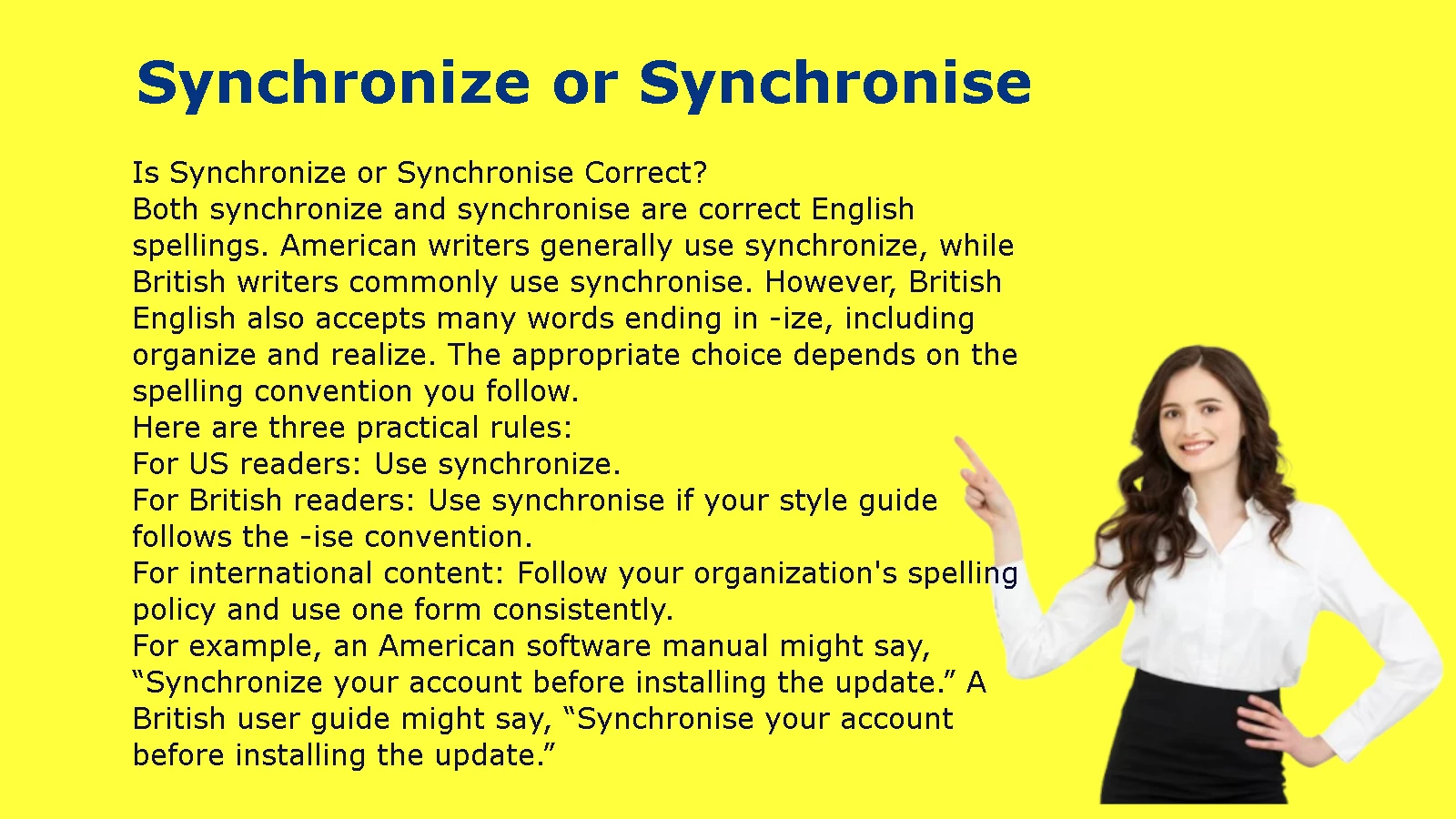
Is Synchronize or Synchronise Correct?
Both synchronize and synchronise are correct English spellings. American writers generally use synchronize, while British writers commonly use synchronise. However, British English also accepts many words ending in -ize, including organize and realize. The appropriate choice depends on the spelling convention you follow.
Here are three practical rules:
- For US readers: Use synchronize.
- For British readers: Use synchronise if your style guide follows the -ise convention.
- For international content: Follow your organization’s spelling policy and use one form consistently.
For example, an American software manual might say, “Synchronize your account before installing the update.” A British user guide might say, “Synchronise your account before installing the update.”
Neither sentence needs correction when used in its intended regional context.
Synchronize vs. Synchronise in American and British English
The difference between synchronize and synchronise reflects broader spelling preferences across English-speaking regions.
American English commonly favors -ize in words such as organize, recognize, and synchronize. British English uses both -ize and -ise in many words, although -ise forms are common in British publications and everyday writing.
The same pattern appears in related forms.
| American English | Common British -ise form |
| Synchronize | Synchronise |
| Synchronization | Synchronisation |
| Synchronizing | Synchronising |
| Synchronized | Synchronised |
| Synchronizes | Synchronises |
Notice that the difference usually extends to the related forms. If you choose synchronise, you would normally write synchronisation and synchronising in a publication that follows the same convention.
However, not every English word ending in -ize has a British -ise alternative. These patterns depend on the individual word, so avoid applying the rule blindly.
Synchronize or Synchronise: Example Sentences
Examples make the distinction easier to understand. The spelling changes, but the meaning remains the same.
American English examples
- Please synchronize your calendar with your work account.
- The technician synchronized the two clocks before the experiment.
- This application synchronizes your contacts across multiple devices.
- We are synchronizing the audio with the video before publishing the recording.
- The team synchronized its schedules to complete the project on time.
British English examples
- Please synchronise your calendar with your work account.
- The technician synchronised the two clocks before the experiment.
- This application synchronises your contacts across multiple devices.
- We are synchronising the audio with the video before publishing the recording.
- The team synchronised its schedules to complete the project on time.
Each pair expresses the same idea. The appropriate version depends on the English convention used throughout the document.
Which Spelling Should You Use?
Choose the spelling that matches your intended readers and the style guide you follow. Consistency matters more than choosing one variant as universally correct.
Consider these situations:
- Writing for an American website: Use synchronize and synchronization.
- Writing for a British publication that prefers -ise: Use synchronise and synchronisation.
- Editing an international company’s documentation: Check the organization’s existing style guide.
- Writing academic or technical material: Follow the spelling convention required by the institution, publisher, or journal.
Imagine you’re editing a product manual that uses customize, organize, and personalize. Changing only synchronize to synchronise would create an inconsistent spelling pattern. Unless the style guide requires that change, keep the forms aligned.
What Does Synchronize Mean?
Synchronize means to make two or more things happen, operate, or correspond at the same time or in a coordinated way. You can synchronize clocks, devices, schedules, movements, or processes. The word can also describe systems that exchange information so their data stays consistent.
The idea behind synchronization is coordination. The things involved do not always need to be identical, but their timing, actions, or information must match in a relevant way.
Synchronize Meaning and Definition
The verb synchronize has several closely related uses.
1. To make events happen at the same time
You can synchronize two activities so that they begin, end, or occur together.
Example: “The director synchronized the actors’ movements with the music.”
The actors do not need to perform identical movements. They need to coordinate their timing with the musical cues.
2. To coordinate clocks, devices, or systems
Synchronization can ensure that different devices or systems follow the same timing or maintain matching information.
Example: “The server synchronizes its clock with a trusted time source.”
This helps systems record events using consistent timestamps.
3. To make data consistent across locations
In computing, synchronization often involves updating information between devices, applications, or servers.
Example: “The app synchronizes your saved notes across your phone and computer.”
When you edit a note on one device, the application can update the corresponding version elsewhere.
4. To coordinate actions or schedules
The word also applies to people and organizations.
Example: “The marketing and sales departments synchronized their launch plans.”
Here, the departments coordinate their activities rather than exchange files or match clock settings.
These meanings share a common idea: bringing timing, actions, or information into alignment.
How to Use Synchronize in a Sentence
The word commonly appears in constructions such as synchronize something with something else and synchronize with something.
| Sentence | Meaning |
| Synchronize your phone with your laptop. | Connect the devices so relevant information matches. |
| The dancers synchronized their steps with the beat. | They coordinated their movements with the music. |
| The two clocks synchronized automatically. | The clocks adjusted to show coordinated time. |
| We synchronized our calendars before booking the trip. | We compared or aligned our schedules. |
| The software synchronizes changes across several computers. | It updates information across devices. |
You can use the verb with or without a direct object.
Transitive use: The subject synchronizes something.
Example: “The engineer synchronized the recording devices.”
The engineer performs the action on the devices.
Intransitive use: The subject synchronizes without a direct object.
Example: “The recording devices synchronized automatically.”
The devices coordinated their timing without the sentence specifying a direct object.
In technical writing, choose the construction that explains who or what performs the action. This often makes instructions easier to follow.
Synchronize as a Verb: Grammar and Word Forms
Synchronize is a verb. Its form changes according to tense, subject, and grammatical structure.
| Word form | Part of speech or use | Example |
| Synchronize | Base verb | Synchronize the devices before recording. |
| Synchronizes | Third-person singular present | The application synchronizes files automatically. |
| Synchronized | Simple past or past participle | We synchronized the clocks yesterday. |
| Synchronizing | Present participle or gerund | Synchronizing the data takes a few seconds. |
| Synchronization | Noun | Synchronization keeps the systems coordinated. |
| Synchronizer | Noun | The synchronizer coordinates the signals. |
The British -ise forms follow the same grammatical pattern: synchronise, synchronises, synchronised, and synchronising.
A common mistake is to write synchronizating. The correct form is synchronizing in American English or synchronising in the common British -ise convention.
Another useful distinction is between the action and its result:
- Synchronize: Perform the action.
- Synchronization: The process or state of coordinating.
- Synchronized: Already coordinated or brought into alignment.
- Synchronizer: A person, device, or system that performs the coordinating function.
Synchronize Synonyms: What Words Can You Use Instead?
Common synonyms for synchronize include coordinate, align, match, harmonize, and time. These words overlap in meaning, but each emphasizes a different aspect of coordination. Choose the alternative that best describes whether you are matching timing, arranging activities, aligning information, or coordinating separate systems.
Common Synonyms for Synchronize
Here are several useful alternatives, along with their meanings.
Coordinate means to organize different activities or people so they work together effectively.
Example: “We coordinated the delivery schedule with the installation team.”
Use coordinate when the main goal involves planning or cooperation rather than exact timing.
Align means to bring things into agreement, a shared position, or a compatible arrangement.
Example: “The company aligned its project milestones with the client’s deadlines.”
Use align when you want to emphasize consistency or agreement.
Match means to make two things correspond or fit one another.
Example: “The editor matched the subtitles to the spoken dialogue.”
Use match when the focus is on correspondence between two things.
Harmonize means to make different elements work together without conflict.
Example: “The departments harmonized their reporting procedures.”
Use harmonize when the focus is on compatibility, agreement, or a coordinated whole.
Time means to arrange an action so it occurs at a suitable or intended moment.
Example: “The technician timed the camera flashes with the experiment.”
Use time when the precise moment of an action matters.
Sync is the familiar shortened form of synchronize.
Example: “Sync your phone before leaving the office.”
Use sync in everyday conversation, software interfaces, and concise technical instructions.
Best Synonyms for Different Contexts
The best synonym depends on what you want to communicate.
| Context | Suitable synonym | Example |
| Project planning | Coordinate | Coordinate the tasks across both teams. |
| Data and settings | Align | Align the records before generating the report. |
| Audio and video | Match | Match the audio with the video track. |
| Music and movement | Time | Time the movements to the beat. |
| Procedures and policies | Harmonize | Harmonize the procedures across departments. |
| Informal technology use | Sync | Sync your files to the cloud. |
These alternatives are not always interchangeable.
For example, you can coordinate two teams without making them perform tasks at precisely the same moment. You can also align two policies even when the policies do not involve timing. By contrast, synchronize two clocks specifically suggests that their time readings or operation should correspond.
When editing, ask yourself what needs to match: timing, information, position, plans, or behavior. That question usually points you toward the most precise word.
Synchronize vs. Sync
Sync is the common shortened form of synchronize. It appears frequently in technology, everyday conversation, and product interfaces.
Compare these examples:
- Full form: “Synchronize your contacts with your email account.”
- Short form: “Sync your contacts with your email account.”
- Noun phrase: “The two devices are in sync.”
The full verb often suits formal explanations, detailed documentation, or situations where the complete term improves clarity. The short form works well when the audience already understands the concept.
For example, a software button might simply say Sync Now. A technical guide could explain, “The application synchronizes local changes with the remote server.”
Both expressions are natural. The right choice depends on the audience, space, and level of technical detail.
Also, sync can function as a verb or a noun:
- Verb: “Sync your files before closing the application.”
- Noun: “The sync failed because the connection dropped.”
- Phrase: “Keep your calendar in sync with your team.”
In American English, sync can shorten synchronize or synchronization, depending on how the sentence uses it. The same short form appears in British English.
How Do You Pronounce Synchronize?
The pronunciation of synchronize is generally the same as that of synchronise. In standard American English, the word is commonly pronounced /ˈsɪŋ.krə.naɪz/. The stress falls on the first syllable, and the ending sounds like “eyes” followed by a voiced z sound.
Synchronize Pronunciation
The word contains four syllables:
syn-chro-nize
Its pronunciation can be broken down into manageable parts:
- Syn: Begins with a sound similar to the start of sink.
- Chro: Contains the consonant cluster kr followed by a short vowel sound.
- Nize: Ends with the sound found in eyes, followed by a voiced z.
The first syllable carries the main stress.
The British spelling synchronise does not generally change the word’s pronunciation. Regional accents can affect particular vowel sounds, but the spelling difference itself does not require a different reading.
A useful practice sentence is:
“Please synchronize the recording before the presentation.”
Say the word naturally within the sentence rather than giving equal emphasis to every syllable.
Is Synchronize Pronounced Differently in British English?
There is no fundamental pronunciation difference caused by the -ize versus -ise spelling. The two forms represent the same word, so the spelling alone does not tell you to pronounce the ending differently.
Accent differences may still influence the vowel sounds or rhythm.
For example, an American speaker and a British speaker might pronounce certain vowels differently while both use the correct regional form. Neither variation changes the basic meaning of the word.
The most important pronunciation points are:
- Stress the first syllable.
- Keep the middle consonant sounds connected rather than inserting an extra syllable.
- Finish with a clear voiced z sound.
How to Remember the Pronunciation
Think of synchronize as a word related to synchronous, which describes things that occur together in time.
You can also practice it in phrases you are likely to use:
- Synchronize the clocks.
- Synchronize the audio.
- Synchronize the calendars.
- Synchronize the data.
Repeating the word in familiar phrases makes it easier to use naturally in speech.
What Is the Short Form of Synchronize?
The standard short form of synchronize is sync. It is widely used in everyday English and technology-related writing. You might sync contacts, sync files, or keep two calendars in sync. The abbreviation communicates the same general idea without requiring the longer verb.
Is Sync Short for Synchronize?
Yes. Sync is a shortened form associated with synchronize and synchronization.
You will commonly encounter it in technology:
- Sync contacts: Make contact information consistent across connected devices or accounts.
- Sync files: Update files between locations or systems.
- Sync calendars: Coordinate calendar information across accounts.
- Audio sync: Alignment between audio and video timing.
- Out of sync: Not properly aligned or coordinated.
The exact behavior depends on the system. For example, syncing files may involve copying changes in both directions, uploading changes to a server, or downloading updated information. The word itself does not guarantee which synchronization method an application uses.
In everyday conversation, the term can also describe people or plans.
Example: “Let’s sync before the client meeting.”
In a workplace, this usually means arranging a short conversation to exchange updates and coordinate next steps.
Sync vs. Synchronize: Which Should You Use?
Use sync when brevity and familiarity matter. Choose synchronize when you want a more formal tone or need to explain a process carefully.
| Situation | Recommended wording |
| A software button | Sync Now |
| A casual workplace message | Let’s sync tomorrow. |
| A technical explanation | The system synchronizes data every five minutes. |
| A formal procedure | Synchronize the clocks before beginning the test. |
| A general description | The devices are in sync. |
Avoid assuming that syncing always means an immediate or perfect match. A device might queue changes while offline, and two systems might take time to exchange updates.
For example, if you edit a document on your laptop without an internet connection, the application may synchronize that change only after the connection returns. In this case, sync describes the process, not necessarily an instant result.
Synchronise Etymology: Where Does the Word Come From?
The word synchronize comes through modern European languages from Greek roots associated with time and being together. Its underlying idea is that separate events or processes share a timing relationship. The same origin explains why the word applies to clocks, coordinated movements, technical systems, and activities that must occur together.
Origin of Synchronize and Synchronise
The word is built around the idea of time. Its historical roots include the Greek syn, meaning “together,” and chronos, meaning “time.”
The element chron- appears in several familiar English words:
- Chronology: The arrangement of events in time order.
- Chronological: Organized according to time.
- Chronicle: A record of events arranged in historical sequence.
- Synchronous: Occurring at the same time or according to a coordinated timing relationship.
These related words help explain the central idea behind synchronize: bringing events into a shared timing relationship.
The two spellings, synchronize and synchronise, developed as regional spelling preferences. They do not represent separate words with different origins or meanings.
How the Meaning of Synchronize Has Evolved
The concept of synchronization applies to much more than clocks.
In performance and movement, synchronization means coordinating actions with music, cues, or other performers.
Example: “The dancers synchronized their movements with the orchestra.”
In engineering, it can mean coordinating the timing of machines or electronic signals.
Example: “The controller synchronized the equipment before production began.”
In computing, it often refers to maintaining consistent data across devices, applications, or servers.
Example: “The service synchronized the latest changes across all connected accounts.”
In communications, it can refer to coordinating timing so a receiver interprets incoming signals correctly.
These uses share a common principle, but their technical requirements differ. Synchronizing dancers requires coordinated movement. Synchronizing clocks requires agreement about time.
Understanding the context helps you interpret what synchronization actually accomplishes.
Why Are There Two Spellings?
English spelling developed differently across regions, and writers do not always follow one universal convention for words ending in -ize or -ise.
American English generally prefers -ize in synchronize. British English commonly uses *-ise, although the -ize form is also accepted in many British contexts.
The same regional distinction often appears in the related noun:
- American English: synchronization
- Common British -ise convention: synchronisation
This is a spelling preference rather than a grammatical difference. Both forms describe the same process.
If you write for an audience that uses both varieties of English, a consistent editorial policy can prevent unnecessary changes during proofreading.
What Does Synchronise Mean in Pokémon?
In Pokémon, Synchronise is the name of an ability in English-language games that use this spelling convention. It is a specialized use of the word, not simply a reference to synchronizing clocks or digital information. The ability’s gameplay effect depends on the relevant game rules.
Synchronise Ability in Pokémon
In Pokémon games, Synchronise is an ability associated with certain Pokémon. In games where the standard Synchronize ability mechanics apply, it can pass a burn, paralysis, or poison status condition to the Pokémon that inflicted it, subject to the game’s specific rules and exceptions.
This is a specialized meaning of the word. The ability name uses the spelling selected for the game’s English localization.
The ordinary verb synchronize means to coordinate things in time or operation. The Pokémon ability name, by contrast, refers to a defined gameplay mechanic.
That distinction matters when searching for the term. Someone looking for synchronise Pokémon may want game information rather than a dictionary definition.
Is Synchronise the Same as Synchronize in Pokémon?
The spelling depends on the localization and naming convention used in a particular game or resource. In general English usage, synchronise and synchronize are spelling variants of the same verb. In Pokémon, the official localized ability name should be preserved when discussing a specific game’s terminology.
For example:
- In a spelling article, explain that both forms are correct regional variants.
- In a Pokémon guide, use the ability name as it appears in the relevant game.
- In a search query, retain the spelling the player encountered so they can find the correct information.
Do not assume that the ordinary meaning of the word fully describes the game’s ability. The specific gameplay effect comes from the game’s mechanics.
What Is a Synchronizer?
A synchronizer is a person, device, or system that brings separate events, signals, machines, or processes into a coordinated state. The word appears in computing, electronics, machinery, and other technical fields. Its precise meaning depends on what the device or person synchronizes.
Synchronizer Meaning
The suffix -er often identifies a person or thing that performs an action. In synchronizer, it points to something that synchronizes.
For example, a synchronizer might:
- Coordinate signals in an electronic system.
- Help align timing between components.
- Manage synchronization between separate processes.
- Refer to a mechanism that coordinates rotating components in machinery.
In computing, synchronization mechanisms may help coordinate concurrent activities or manage access to shared resources. In electronics, a synchronizer can help a digital circuit handle a signal that arrives without matching the circuit’s clock timing.
These technical uses are related, but they are not identical. When reading a technical document, use the surrounding context to determine what kind of synchronizer the author means.
Synchronizer vs. Synchronization
The words have different grammatical roles.
Synchronizer refers to the person, device, or mechanism that performs the action.
Example: “The synchronizer coordinates the signals from the two systems.”
Synchronization refers to the process or state of coordination.
Example: “Synchronization prevents the recordings from drifting out of alignment.”
Compare the terms in this table.
| Term | Meaning | Example |
| Synchronize | To coordinate | Synchronize the two systems. |
| Synchronizer | The agent or mechanism | The synchronizer manages signal timing. |
| Synchronization | The process or state | Synchronization keeps the signals aligned. |
| Synchronized | Coordinated or aligned | The systems are synchronized. |
In American English, the noun is generally synchronization. In the common British -ise convention, it is synchronisation.
Synchronizer vs. Sync
Although synchronizer and sync are related, they do not usually mean the same thing.
Sync commonly refers to the action, process, or state of synchronization.
Example: “The sync finished after the connection returned.”
Synchronizer usually identifies the mechanism or component responsible for coordinating something.
Example: “The synchronizer manages the timing between the signals.”
In informal contexts, the distinction may not matter much. In technical documentation, however, using the more precise term can prevent confusion.
Related Words and Common Spelling Mistakes
The related forms of synchronize follow predictable patterns, but American and British spelling conventions affect several of them. Learning the main forms helps you avoid errors in articles, emails, product instructions, and technical documentation.
Synchronize, Synchronise, and Synchronization
The verb and noun forms follow the spelling convention used in the document.
| American English | Common British -ise form | Word type |
| Synchronize | Synchronise | Verb, base form |
| Synchronizes | Synchronises | Verb, present tense |
| Synchronized | Synchronised | Verb, past tense or participle |
| Synchronizing | Synchronising | Verb, participle |
| Synchronization | Synchronisation | Noun |
| Synchronized | Synchronised | Adjective or participle, depending on context |
For example:
- American: “The application is synchronizing the files.”
- British: “The application is synchronising the files.”
- American: “The synchronization failed.”
- British: “The synchronisation failed.”
Both versions are grammatically correct. The spelling convention determines which one fits the document.
Common Forms of Synchronize
Understanding the grammatical forms helps you select the correct word for each sentence.
Present tense
“The software synchronizes the data every hour.”
Use synchronizes with a third-person singular subject such as it, the software, or the application.
Past tense
“The team synchronized the records yesterday.”
Use synchronized for a completed past action in American English.
Present participle
“The system is synchronizing the files.”
Use synchronizing with forms of be to describe an ongoing action.
Noun
“Synchronization takes place after the connection is restored.”
Use synchronization when referring to the process or state rather than the action as a verb.
Agent noun
“The synchronizer controls the timing.”
Use synchronizer when referring to a person, device, or mechanism that performs the function.
Common Mistakes to Avoid
A few spelling and usage mistakes appear frequently.
Treating one spelling as universally wrong
Incorrect assumption: “Synchronise is always a misspelling.”
Better understanding: Both spellings are correct. Choose the one appropriate to your English variety or style guide.
Mixing regional conventions
Example: “The application synchronises files and then starts the synchronization process.”
This sentence mixes common British -ise spelling with the American -ization noun form.
A consistent British-style version would use synchronises and synchronisation. A consistent American version would use synchronizes and synchronization.
Using the wrong verb form
Incorrect: “The application is synchronizating the files.”
Correct American form: “The application is synchronizing the files.”
Correct common British form: “The application is synchronising the files.”
Confusing synchronization with identical behavior
Two systems can be synchronized without performing exactly the same tasks. They may simply need matching timestamps, coordinated actions, or consistent records.
For example, synchronizing two calendars means aligning relevant events or entries. It does not mean that both calendars must contain every possible detail about their users.
Assuming synchronization always happens instantly
A synchronization process may take time, especially when a system has a large amount of data or a slow connection. If an application displays “Sync pending,” the updates may not have reached the other device yet.
Precise writing should describe the actual behavior rather than imply that synchronization always happens immediately.
Frequently Asked Questions
Is Synchronize or Synchronise the Correct Spelling?
Both spellings are correct. Synchronize is standard in American English, while synchronise is common in British English and publications that follow the -ise convention. The words have the same meaning, so choose the form that matches your audience and remain consistent.
Is Synchronise British English?
Yes. Synchronise is a common British English spelling. However, British English also accepts many -ize spellings, including organize and recognize. Whether a British publication uses synchronise or synchronize depends on its preferred spelling convention.
What Is the Meaning of Synchronize?
Synchronize means to coordinate events, actions, devices, or systems so they occur together or maintain a relevant timing or information relationship. Examples include synchronizing clocks, aligning audio with video, coordinating schedules, and updating files across devices.
What Is Another Word for Synchronize?
Common alternatives include coordinate, align, match, harmonize, time, and sync. Use coordinate for organized activities, align for agreement or consistency, match for correspondence, and time when a specific moment matters.
What Is the Short Form of Synchronize?
The standard short form is sync. You might sync your files, sync your contacts, or keep two calendars in sync. The term works as a verb and a noun, especially in everyday conversation and technology-related writing.
What Does Synchronise Mean in Pokémon?
In Pokémon, Synchronise is the name of an ability in games that use this spelling convention. Under the applicable game mechanics, the ability can pass certain status conditions, such as burn, paralysis, or poison, to the Pokémon that inflicted them, subject to game-specific rules and exceptions.
Conclusion: Choose the Right Spelling for Your Audience
The choice between synchronize or synchronise comes down to spelling convention. American English generally uses synchronize, while British English commonly uses synchronise. Both forms describe the same action: coordinating events, devices, movements, or information so they operate together or maintain a consistent relationship.
Once you understand the difference, the related forms become easier to use. American-style writing typically uses synchronization and synchronizing, while the common British -ise convention uses synchronisation and synchronising. The short form sync works in both varieties.
Before publishing, check three things:
- Audience: Are you writing for American or British readers?
- Consistency: Do the verb, noun, and related forms follow the same convention?
- Context: Does synchronize describe timing, data, activities, or a technical process accurately?
Choose the spelling that fits your audience, apply it consistently, and use the word that expresses your intended meaning. If you’re editing a larger article, review related words such as synchronization, organize, and recognize to keep your spelling choices consistent throughout.