Utilize and utilise have the same meaning, but the spelling you use depends mainly on the variety of English you are writing. Both forms are verbs meaning to use something, especially for a particular purpose or practical advantage. If you’ve come across “utilize” and “utilise” and wondered which spelling is correct, the difference is closely connected to American English, British English, spelling conventions, usage, and regional preferences.
The utilize vs utilise distinction is mainly a matter of spelling rather than meaning. Utilize is the standard spelling in American English, while utilise is commonly preferred in British English and other varieties influenced by British spelling. Both forms can describe using a resource, tool, method, or opportunity for a specific purpose, although use is often the simpler and more natural choice in everyday writing.
In this guide, you’ll learn whether “utilize” or “utilise” is correct, how the two spellings differ, when to use each form, and how they are used in American and British English. You’ll also see clear examples to help you understand the difference and avoid common spelling mistakes.
By the end, you’ll know exactly when to use utilize and utilise and how to choose the correct spelling for your audience, location, and style of English.
Utilize vs Utilise at a Glance
The quickest way to understand utilize vs utilise is to compare the two spellings directly.
| Feature | Utilize | Utilise |
| Basic meaning | Make practical or effective use of something | Make practical or effective use of something |
| Main spelling association | American English | British English |
| Part of speech | Verb | Verb |
| Pronunciation | Generally the same | Generally the same |
| Past tense | utilized | utilised |
| -ing form | utilizing | utilising |
| Third-person singular | utilizes | utilises |
| Meaning difference | None in ordinary usage | None in ordinary usage |
Cambridge Dictionary defines utilize as a verb meaning to use something in an effective way and identifies utilise as the usual UK spelling.
Oxford Learner’s Dictionaries likewise lists utilize and notes that British English also uses utilise. Oxford defines the verb as using something, particularly for a practical purpose.
The Simple Rule
Use:
- utilize when following American English spelling
- utilise when following a British English spelling system
- use when you simply mean “use” and do not need the more formal word
Consistency matters. If an article, report, or website follows American English, utilize, utilized, utilizing, and utilizes should normally be used consistently. If it follows a spelling system that uses -ise, use utilise, utilised, utilising, and utilises.
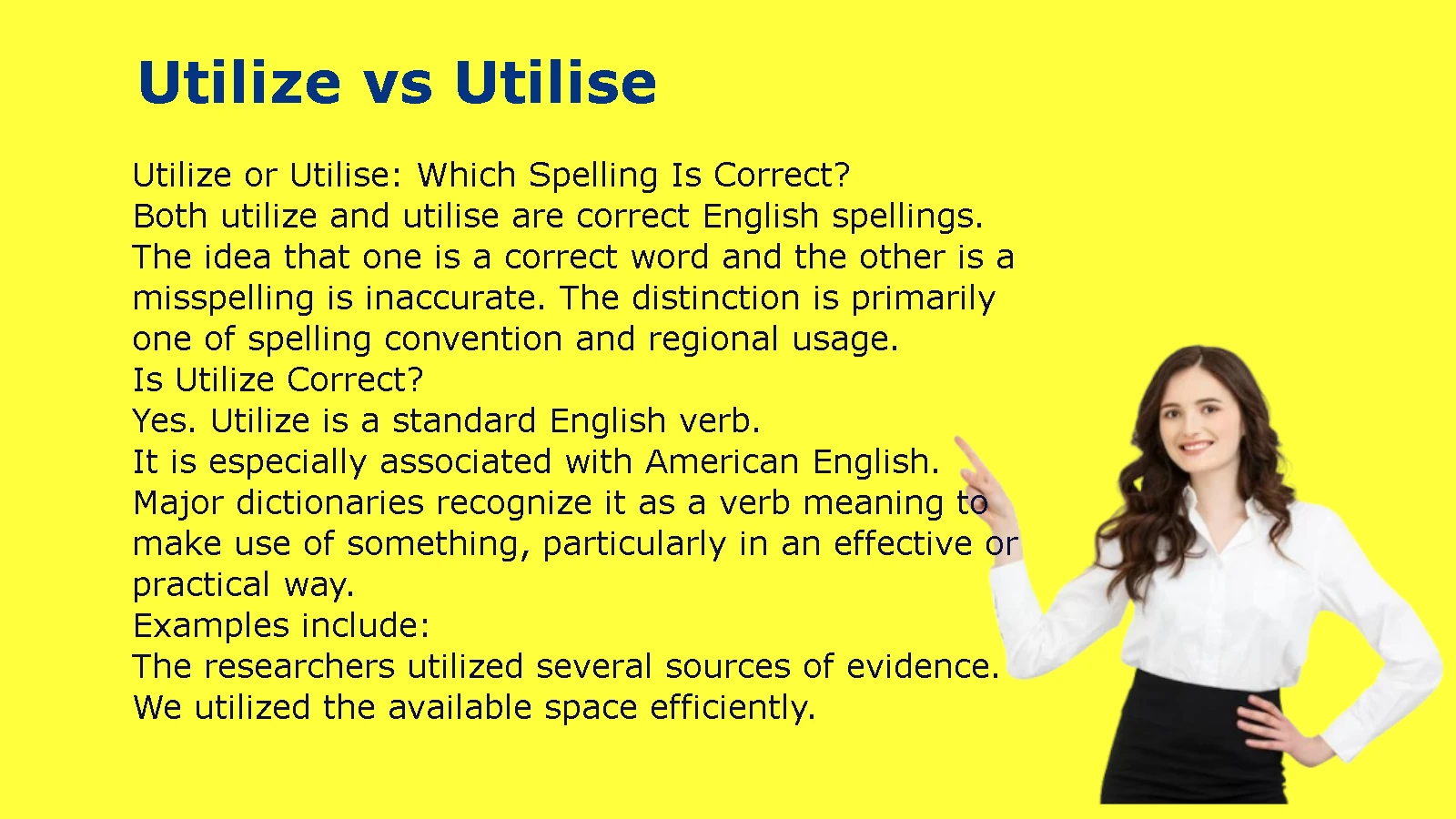
Utilize or Utilise: Which Spelling Is Correct?
Both utilize and utilise are correct English spellings.
The idea that one is a correct word and the other is a misspelling is inaccurate. The distinction is primarily one of spelling convention and regional usage.
Is Utilize Correct?
Yes. Utilize is a standard English verb.
It is especially associated with American English. Major dictionaries recognize it as a verb meaning to make use of something, particularly in an effective or practical way.
Examples include:
The researchers utilized several sources of evidence.
We utilized the available space efficiently.
The software allows users to utilize several advanced features.
In American English, the related forms are:
- utilize
- utilizes
- utilized
- utilizing
Is Utilise Correct?
Yes. Utilise is also a standard English spelling.
It is particularly common in British English. Cambridge explicitly identifies utilise as the usual UK spelling of utilize.
Examples include:
The researchers utilised several sources of evidence.
We utilised the available space efficiently.
The software allows users to utilise several advanced features.
The grammatical meaning does not change when z becomes s.
Are Utilize and Utilise the Same Word?
For normal modern English usage, yes.
The difference is essentially:
utilize → American spelling
utilise → British spelling
It is similar to other spelling differences in English, although spelling conventions vary from word to word and are not always perfectly predictable.
Utilize vs Utilise in American and British English
Regional spelling is the most important distinction when comparing utilize vs utilise.
Utilize in American English
Utilize is the conventional spelling in American English.
For example:
The company utilized new software to manage its records.
The laboratory utilized specialized equipment.
Students can utilize the library’s digital resources.
American English generally prefers the -ize spelling in words of this type.
That does not mean every English-speaking country must use utilize. English has multiple established spelling systems, and writers normally follow the conventions expected by their audience.
Utilise in British English
Utilise is commonly used in British English.
For example:
The company utilised new software to manage its records.
The laboratory utilised specialised equipment.
Students can utilise the library’s digital resources.
Notice something important in the second example: specialised also follows a British spelling convention.
This illustrates why consistency matters. A British-English document may contain several spelling choices that differ from American English.
Which Spelling Should You Use?
The best choice depends on your intended audience and style guide.
| Your situation | Preferred form |
| Writing primarily for a U.S. audience | utilize |
| Writing primarily for a UK audience | utilise |
| Following American English | utilize |
| Following a British spelling system | utilise |
| Writing for an international organization | Follow its established style guide |
| Editing an existing document | Match the document’s established spelling system |
You do not need to change the spelling simply because one form looks more familiar to you. Audience and consistency are more useful criteria.
What Does Utilize Mean?
Utilize is a verb meaning to use something, especially for a practical, useful, or effective purpose. Cambridge gives the basic sense as using something in an effective way, while Oxford describes it as using something particularly for a practical purpose.
For example:
The school utilized an unused room as a study area.
Here, utilized means that the school put the room to practical use.
Another example:
The researchers utilized historical records to support their analysis.
Here, utilized means the researchers made use of the records for a particular purpose.
Utilize Meaning in Simple English
In simple English:
Utilize = use something for a particular or useful purpose.
Consider these examples:
- Use the available materials.
- Utilize the available materials.
The two sentences can communicate essentially the same basic idea. The second simply has a more formal tone.
Utilize as a Verb
Utilize is normally a transitive verb, meaning it generally takes an object.
For example:
The team utilized the equipment.
The company utilized its resources.
The students utilized the database.
The object tells us what was used.
Common structures include:
utilize + object
We utilized the available data.
utilize + object + as + noun
The community utilized the building as a temporary shelter.
be + utilized
The equipment is utilized for research purposes.
Oxford’s examples similarly show utilize used with objects such as concrete, resources, and substances.
What Does Utilise Mean?
Utilise has the same basic meaning as utilize.
It means to make use of something, particularly for a practical or effective purpose.
The difference is spelling rather than meaning.
For example:
The council utilised the available funding.
This has the same basic meaning as:
The council utilized the available funding.
The first version follows the -ise spelling, while the second follows the -ize spelling.
Dictionary.com identifies utilise as a variation of utilize, while Collins describes it as the British spelling of utilize.
Utilize vs Use: What Is the Difference?
This is where the comparison becomes more interesting.
Utilize and use overlap heavily in meaning, but they are not always equally natural stylistically.
Oxford defines utilize in terms of using something, especially for a practical purpose.
For example:
You could replace use with utilize:
You can utilize this application to edit photographs.
The second sentence is grammatically fine, but it may sound more formal than necessary.
Does Utilize Mean the Same as Use?
In many contexts, yes.
Both can mean to employ or make use of something.
Compare:
We used the available resources.
We utilized the available resources.
The core meaning is nearly identical.
However, utilize can carry a stronger sense of putting something to practical or effective use, especially when the resource or method is being considered in terms of its usefulness.
When Is Use Better Than Utilize?
In ordinary writing, use is often the clearer choice.
The CDC’s Clear Writing guidance is particularly direct on this point. It recommends avoiding utilize when use communicates the idea and identifies utilize as a word that frequently appears as unnecessary jargon in scientific and professional writing.
For example:
Less direct:
Users should utilize the button to continue.
Clearer:
Users should use the button to continue.
Or:
Less direct:
Please utilize the attached form.
Clearer:
Please use the attached form.
There is nothing grammatically wrong with utilize in these examples. The issue is word choice, not correctness.
When Is Utilize Appropriate?
Utilize can be appropriate when the context genuinely emphasizes practical application, resources, methods, or effective use.
For example:
The researchers utilized satellite imagery to monitor changes in the landscape.
The word works naturally in this formal context.
Another example:
The system is designed to utilize available computing resources efficiently.
Here, utilize fits because the sentence focuses specifically on the practical application of resources.
The key is not to assume that utilize is automatically better because it is longer or more formal.
Utilize vs Utilise Examples
Because utilize and utilise mean the same thing, you can usually create equivalent sentences by changing the spelling.
| American English | British English |
| The team utilized the available data. | The team utilised the available data. |
| We utilized the existing equipment. | We utilised the existing equipment. |
| The company utilized new technology. | The company utilised new technology. |
| Researchers utilized several methods. | Researchers utilised several methods. |
| The building was utilized as a training center. | The building was utilised as a training centre. |
The final example demonstrates another regional difference: center is standard American spelling, while centre is standard British spelling.
Utilize vs Utilise in Academic Writing
Both forms can appear in academic writing.
American academic writing:
The study utilized survey data collected from participants.
British academic writing:
The study utilised survey data collected from participants.
The important issue is consistency with the publication’s preferred style.
Academic writers should also avoid assuming that a more complicated word automatically makes prose more scholarly. If use communicates the idea accurately, it may be preferable.
Utilize vs Utilise in Business Writing
Both forms are common in formal business contexts.
American English:
The company utilized customer feedback to improve the service.
British English:
The company utilised customer feedback to improve the service.
Again, the difference is spelling, not meaning.
Utilize in a Sentence
Here are natural examples of utilize in American English:
The team utilized the available data to identify patterns.
The school utilized an unused classroom for meetings.
Engineers utilized recycled materials in the project.
The application allows users to utilize several editing tools.
Researchers utilized historical documents during the investigation.
The company utilized existing infrastructure rather than building a new system.
Notice that these examples focus on resources, tools, information, space, materials, or methods. That is where utilize often feels most natural.
Utilise in a Sentence
The same ideas can be expressed with British spelling:
The team utilised the available data to identify patterns.
The school utilised an unused classroom for meetings.
Engineers utilised recycled materials in the project.
The application allows users to utilise several editing tools.
Researchers utilised historical documents during the investigation.
The company utilised existing infrastructure rather than building a new system.
The meaning remains unchanged.
Utilize and Utilise: Word Forms
The spelling difference continues through the main grammatical forms of the verb.
| Grammatical form | American English | British English |
| Base form | utilize | utilise |
| Third-person singular | utilizes | utilises |
| Past tense | utilized | utilised |
| Past participle | utilized | utilised |
| Present participle | utilizing | utilising |
Oxford lists the American forms utilize, utilizes, utilized, and utilizing, while Cambridge similarly identifies utilise as the UK form.
Utilizes vs Utilises
Utilizes is the American spelling.
Utilises is the British spelling.
Examples:
The system utilizes renewable energy.
The system utilises renewable energy.
Both sentences use the third-person singular form.
Utilizing vs Utilising
The same spelling distinction appears in the present participle:
- American: utilizing
- British: utilising
Examples:
The company is utilizing new software.
The company is utilising new software.
Do not switch between the two forms randomly within the same document.
Utilized vs Utilised
The past tense and past participle forms are:
- American: utilized
- British: utilised
Examples:
The researchers utilized several sources.
The researchers utilised several sources.
Cambridge lists utilized as the past simple and past participle of utilize.
Is Utilises a Word?
Yes. Utilises is a standard word.
It is the third-person singular present form of utilise.
For example:
The company utilises renewable energy.
The software utilises cloud storage.
It is not a typo simply because American English generally uses utilizes instead.
Utilize vs Utilise Pronunciation
Despite the spelling difference, utilize and utilise are generally pronounced the same way.
Cambridge gives pronunciations based on British and American pronunciation, with the main difference being the expected regional pronunciation rather than a distinction created by the letters s and z in the spelling.
A simplified pronunciation guide is:
utilize / utilise: YOO-tuh-lyze
The stress falls on the first syllable.
The important point is:
The s/z spelling difference does not normally create two different English words with different meanings or pronunciations.
Utilize vs Utilise: Origin of the Spelling Difference
The word has a long history connected with the idea of usefulness.
Oxford traces utilize to the early 19th century and ultimately to Latin utilis, meaning “useful,” through French and Italian forms.
The modern English forms developed from this European vocabulary.
The -ize and -ise spellings are part of a much broader pattern in English spelling. Words such as organize/organise and recognize/recognise demonstrate similar spelling variation.
There is an important complication, however: British English does not universally require -ise in every word ending in this pattern. Some British dictionaries and style systems use -ize spellings for certain words.
That means it is better to learn the spelling of individual words and follow the dictionary or style guide relevant to your audience rather than applying an absolute rule such as “British English always uses -ise.”
Common Mistakes With Utilize and Utilise
Using Utilize for Every Instance of Use
One of the most common problems is replacing use with utilize simply because utilize sounds more formal.
For example:
Please utilize your password to log in.
This is grammatical, but:
Please use your password to log in.
is simpler and more natural.
The CDC specifically warns against using utilize when use will communicate the meaning clearly.
Mixing Utilize and Utilise
Avoid writing:
The company utilized British suppliers and later utilised American software.
This may be grammatically understandable, but if both forms occur in the same document without a deliberate reason, the spelling looks inconsistent.
Choose the convention appropriate for your audience and maintain it.
Assuming Utilise Is Incorrect
Utilise is not an incorrect spelling.
It is a recognized form used particularly in British English. Cambridge explicitly labels it as the usual UK spelling.
Assuming Utilize Is Only American
Likewise, utilize is not exclusively an American word.
It is a standard English spelling and is recognized by British-oriented dictionaries as well. Oxford’s British English entry lists utilize and notes that British English also uses utilise.
The practical distinction is which spelling convention you are following.
Is Utilize More Formal Than Use?
Generally, utilize often sounds more formal than use, but that does not mean it is automatically better for formal writing.
This distinction is important.
Consider:
The students used the online database.
versus:
The students utilized the online database.
Both are grammatical.
The second sounds more formal, but it does not necessarily communicate more information.
The CDC makes a similar point in its plain-language guidance: professional writing does not become better merely by replacing short words with longer ones.
A Practical Writing Test
When deciding between use and utilize, ask:
Does “use” communicate exactly what I mean?
If the answer is yes, use is often the stronger choice.
If the sentence specifically emphasizes putting a resource, method, material, or opportunity to a particular practical purpose, utilize may be appropriate.
For example:
The museum used the building for exhibitions.
This is perfectly natural.
But:
The museum utilized an abandoned warehouse as an exhibition space.
Here, utilized can emphasize the practical repurposing of the warehouse.
The distinction is one of nuance and style, not a strict grammatical rule.
Utilize vs Utilise: A Practical Case Study
Imagine that an American technology company publishes a user guide.
The guide says:
Customers can utilise the dashboard to monitor their accounts.
The sentence is understandable, but if the company’s established style is American English, utilize would be the more consistent spelling:
Customers can utilize the dashboard to monitor their accounts.
Now imagine the same guide is written for a British audience:
Customers can utilise the dashboard to monitor their accounts.
That spelling fits the intended British convention.
But there is another possible improvement:
Customers can use the dashboard to monitor their accounts.
This version is shorter and clearer in either variety.
The lesson: spelling choice and word-choice choice are two separate decisions.
First decide whether you mean use or utilize/utilise. Then choose the spelling appropriate to your English variety.
Utilize vs Utilise: Common Questions About Usage
Can I Use Utilize in British English?
Yes.
Utilize is a recognized English spelling and can appear in British English. However, utilise is the spelling commonly associated with British English. Oxford’s British English entry lists utilize and explicitly notes utilise as the British form.
If you are writing specifically for a British publication, institution, or audience, follow its style guide.
Can I Use Utilise in American English?
Yes, readers will generally understand it.
However, utilize is the conventional American spelling. If your document is written in American English, it is usually better to maintain the American spelling consistently.
Does Utilize Mean Something Different From Utilise?
No significant meaning difference exists in ordinary usage.
Both mean to use something, especially for a practical or effective purpose.
The principal distinction is spelling.
Are Utilize and Utilise Pronounced the Same?
They are generally pronounced the same.
The spelling changes from z to s, but the two forms do not normally represent different words with different meanings.
Does Utilize Mean the Same as Use?
Often, yes.
Both can mean to make use of something. However, utilize can sound more formal and may place greater emphasis on practical or effective application.
Is Utilize More Formal Than Use?
Usually, yes.
Utilize is commonly perceived as more formal or technical than use. That does not mean it should replace use everywhere.
For clear general writing, use is often preferable.
Is Utilises a Word?
Yes.
Utilises is the British spelling of the third-person singular form of utilise.
American English uses utilizes.
What Is the Past Tense of Utilize?
The past tense is utilized.
Example:
The team utilized the available resources.
The British spelling is utilised.
What Is the British Spelling of Utilized?
The British spelling is generally utilised.
For example:
The team utilised the available resources.
Can You Use Utilise in American English?
Yes, it can be understood, but utilize is the standard American spelling.
If you are deliberately following American English, use utilize for consistency.
What Is the Difference Between Utilize and Utilise in a Sentence?
There is normally no difference in meaning.
Compare:
The researchers utilized the available data.
and:
The researchers utilised the available data.
The sentences communicate the same idea. The difference is the spelling convention.
Quick Comparison: Utilize, Utilise, and Use
The three words can be summarized like this:
| Word | Meaning | Typical spelling association | Style |
| use | Employ or make use of something | All major varieties | Neutral and common |
| utilize | Make practical or effective use of something | American English | More formal |
| utilise | Make practical or effective use of something | British English | More formal |
This gives you a useful rule:
Use is the everyday option.
Utilize is the -ize spelling.
Utilise is the -ise spelling.
Final Verdict: Utilize or Utilise?
When comparing utilize vs utilise, neither word is inherently more correct.
Utilize is the standard spelling commonly used in American English.
Utilise is the spelling commonly used in British English.
Both mean essentially to make use of something, especially for a practical or effective purpose.
The related forms follow the same spelling pattern:
- utilize → utilizes → utilized → utilizing
- utilise → utilises → utilised → utilising
If you are writing for an American audience, choose utilize. If you are following British spelling conventions, choose utilise.
But before choosing either one, consider whether you actually need the longer word.
In many sentences, use is simpler and clearer:
Use the available resources.
rather than:
Utilize the available resources.
There is nothing wrong with utilize when it accurately suits the context. The goal is simply to choose the word and spelling that communicate your meaning clearly.
Conclusion
The difference between utilize and utilise is primarily a matter of spelling convention, not meaning.
Utilize is the spelling most closely associated with American English, while utilise is commonly associated with British English. Both function as verbs and refer to making use of something, particularly for a practical or effective purpose.
The distinction becomes clearer when you compare their forms:
| American English | British English |
| utilize | utilise |
| utilizes | utilises |
| utilized | utilised |
| utilizing | utilising |
The words are pronounced similarly and carry the same basic meaning.
The more important writing decision may actually be utilize vs use. Although utilize is perfectly legitimate, it can sound unnecessarily formal when use would say the same thing more directly. Guidance from the CDC and definitions from major dictionaries support the distinction between legitimate usage and unnecessary complexity.
So, remember the simple rule:
American English → utilize
British English → utilise
Simple everyday writing → use when it is the clearest choice
Once you understand that distinction, choosing between utilize vs utilise becomes straightforward. The key is to match your spelling to your audience and your vocabulary to the meaning you actually want to express.