Have you ever wondered whether airplane or aeroplane is the correct spelling? You may have seen both forms in books, websites, airports, or conversations and wondered if one is a spelling mistake. The good news is that both airplane and aeroplane are correct. The difference mainly comes down to where the word is used.
Airplane is the standard spelling in American English, while aeroplane is the traditional spelling used mainly in British English and other varieties influenced by British usage. Both words refer to a powered aircraft with fixed wings that is designed to fly through the air.
| Spelling | Correct? | Common Usage | Meaning |
| Airplane | ✅ Correct | American English | A powered fixed-wing aircraft that flies through the air |
| Aeroplane | ✅ Correct | British English | A powered fixed-wing aircraft that flies through the air |
The difference between airplane vs aeroplane is therefore not a matter of correct versus incorrect spelling. Instead, it is mainly a regional spelling difference. If you are writing for an American audience, airplane is the usual choice. In British English, aeroplane is the traditional form.
The two words are pronounced essentially the same in standard English, although accents can affect their exact pronunciation. Their difference becomes most noticeable in writing, where the -air- spelling in airplane contrasts with the -aero- spelling in aeroplane.
People often search for airplane vs aeroplane, airplane or aeroplane, which is correct airplane or aeroplane, and airplane meaning because the two forms appear in different English varieties. Neither spelling is a misspelling when it is used according to the relevant variety of English.
In this guide, you’ll learn the complete difference between Airplane vs Aeroplane, including their meaning, spelling, pronunciation, regional usage, origin, and examples. You’ll also learn when to use airplane or aeroplane, how the terms developed, and which form is appropriate for American and British English.
Airplane vs Aeroplane at a Glance
The easiest way to understand airplane vs aeroplane is to treat them as two regional forms of the same noun.
| Feature | Airplane | Aeroplane |
| Meaning | A powered flying vehicle with wings and one or more engines | Same |
| Main variety | North American English | British English |
| Part of speech | Noun | Noun |
| Pronunciation | Similar to aeroplane | Similar to airplane |
| Short form | Plane | Plane |
| Correct spelling | Yes | Yes |
| Common in US writing | Yes | Less common |
| Common in UK writing | Less common | Yes |
Oxford identifies airplane as especially North American English and aeroplane as British English. Cambridge likewise labels airplane as US and aeroplane as UK.
So, if you’re wondering “airplane or aeroplane—which is correct?”, the answer is both. The appropriate choice depends mainly on the variety of English you’re using.
What Does Airplane Mean?
An airplane is a vehicle designed for air travel that has wings and one or more engines. Cambridge gives essentially the same definition and identifies airplane as the US form.
The word is particularly common in American English and is also widely recognized internationally.
For example:
- The airplane landed safely.
- We boarded the airplane at noon.
- She was nervous about her first airplane flight.
- The airplane was delayed because of bad weather.
- He looked out of the airplane window.
- The airline operates several types of commercial airplanes.
Airplane in Common Expressions
You will frequently see airplane used with words connected with travel and aviation.
Common combinations include:
- airplane ticket
- airplane flight
- airplane seat
- airplane window
- airplane engine
- airplane cabin
- commercial airplane
- passenger airplane
- military airplane
- private airplane
Oxford gives examples including airplane crash, airplane flight, and commercial/jet/military airplane.
The important point is that airplane is not a different type of vehicle from an aeroplane. The spelling changes according to the English variety, not the object being described.
What Does Aeroplane Mean?
Aeroplane has the same basic meaning as airplane. It refers to a flying vehicle with wings and one or more engines.
The spelling is primarily associated with British English. Oxford labels aeroplane as British English and gives airplane as the especially North American alternative.
Examples include:
- The aeroplane landed safely.
- We boarded the aeroplane at Heathrow.
- The aeroplane was carrying hundreds of passengers.
- She looked out of the aeroplane window.
- The aeroplane took off shortly after sunset.
Cambridge also treats aeroplane as the UK form and airplane as its US equivalent.
Common British-English Combinations
British English commonly uses phrases such as:
- aeroplane ticket
- aeroplane flight
- aeroplane engine
- aeroplane cabin
- commercial aeroplane
- passenger aeroplane
- private aeroplane
- model aeroplane
For example:
The passengers boarded the aeroplane shortly before departure.
An American publication would normally write:
The passengers boarded the airplane shortly before departure.
The meaning is unchanged.
Airplane vs Aeroplane: What’s the Difference?
The central difference between airplane vs aeroplane is spelling and regional usage, not meaning.
Both words identify a powered aircraft with wings. The distinction is comparable to other American/British spelling differences such as color/colour or center/centre: the preferred form depends on the variety of English.
Is Airplane American or British English?
Airplane is especially associated with American and North American English.
Oxford explicitly marks airplane as “especially North American English,” while Cambridge labels it US and gives aeroplane as the UK equivalent.
For US-focused writing, airplane is therefore the natural choice.
Examples:
- American English: airplane ticket
- American English: airplane mode
- American English: airplane flight
- American English: commercial airplane
Is Aeroplane American or British English?
Aeroplane is primarily British English.
Oxford labels it British English, and Cambridge labels it UK.
Examples:
- British English: aeroplane ticket
- British English: aeroplane flight
- British English: commercial aeroplane
- British English: passenger aeroplane
That doesn’t mean an American reader won’t understand aeroplane. It simply isn’t the usual spelling in American English.
Are Airplane and Aeroplane Pronounced the Same?
The pronunciations are very similar, but exact pronunciation varies with accent.
Oxford gives pronunciations for both forms, while Cambridge provides UK and US pronunciation information.
The basic pronunciation can be represented approximately as:
- airplane: AIR-plane
- aeroplane: AIR-uh-plane
The extra vowel represented by aero- can be more noticeable in some British pronunciations.
So while the two words sound extremely similar, it is more accurate to say their pronunciations closely correspond rather than claiming every speaker says them identically.
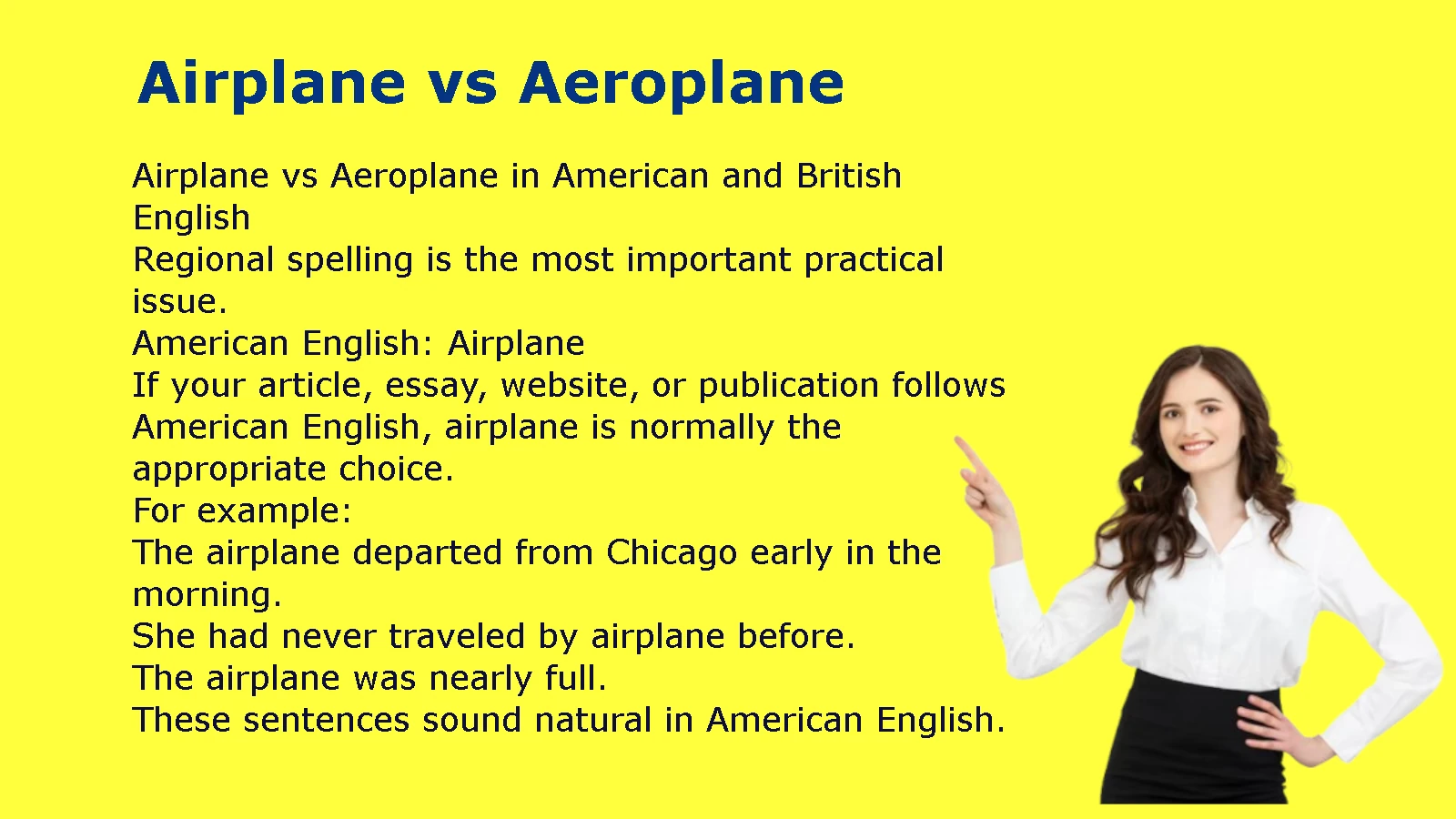
Airplane vs Aeroplane in American and British English
Regional spelling is the most important practical issue.
American English: Airplane
If your article, essay, website, or publication follows American English, airplane is normally the appropriate choice.
For example:
The airplane departed from Chicago early in the morning.
She had never traveled by airplane before.
The airplane was nearly full.
These sentences sound natural in American English.
British English: Aeroplane
In British English, aeroplane is the traditional standard form.
For example:
The aeroplane departed from London early in the morning.
She had never traveled by aeroplane before.
The aeroplane was nearly full.
The underlying meaning remains exactly the same.
Which One Should You Use?
Use the spelling that matches your intended audience.
Use “airplane” when:
- You’re writing in American English.
- Your publication uses US spelling.
- Your primary audience is in the United States.
- You’re maintaining an American-English style throughout an article.
“aeroplane” when:
- You’re writing in British English.
- Your publication follows British spelling.
- Your audience primarily uses British English.
- You’re maintaining a British-English style.
The most important rule is consistency.
If you choose American English, don’t randomly switch between airplane and aeroplane unless you’re specifically discussing the spelling difference.
Airplane vs Aeroplane Examples
Seeing the two forms side by side makes the distinction easy.
| American English | British English |
| The airplane took off. | The aeroplane took off. |
| We boarded the airplane. | We boarded the aeroplane. |
| The airplane was delayed. | The aeroplane was delayed. |
| She traveled by airplane. | She traveled by aeroplane. |
| The airplane landed safely. | The aeroplane landed safely. |
| He watched the airplane disappear into the clouds. | He watched the aeroplane disappear into the clouds. |
| The airplane had two engines. | The aeroplane had two engines. |
| They bought an airplane ticket. | They bought an aeroplane ticket. |
These aren’t differences in grammar or meaning. They are differences in regional vocabulary preference.
Cambridge lists plane as a common synonym for both airplane and aeroplane, reinforcing the fact that the three words can refer to the same kind of vehicle in ordinary usage.
Airplane vs Aeroplane in a Sentence
Both words function as countable nouns.
You can therefore use:
- an airplane
- an aeroplane
- the airplane
- the aeroplane
- airplanes
- aeroplanes
Notice the plural forms:
one airplane → two airplanes
one aeroplane → two aeroplanes
The plural ending follows ordinary English noun formation.
Example Sentences With Airplane
Here are natural examples using the American form:
- The airplane landed just before noon.
- We arrived at the airport early to board the airplane.
- The airplane was flying through heavy clouds.
- She sat beside the window on the airplane.
- The pilot announced that the airplane would land shortly.
- He watched another airplane cross the sky.
- The airline introduced a newer type of airplane.
- They traveled to New York by airplane.
Example Sentences With Aeroplane
The same ideas can be expressed in British English:
- The aeroplane landed just before noon.
- We arrived at the airport early to board the aeroplane.
- The aeroplane was flying through heavy clouds.
- She sat beside the window on the aeroplane.
- The pilot announced that the aeroplane would land shortly.
- He watched another aeroplane cross the sky.
- The airline introduced a newer type of aeroplane.
- They traveled to London by aeroplane.
Airplane/Aeroplane With Common Prepositions
Several constructions are particularly common.
On an airplane / on an aeroplane
I met her on the airplane.
I met her on the aeroplane.
In an airplane / in an aeroplane
He left his phone in the airplane.
He left his phone in the aeroplane.
Both on and in occur naturally, although their use can depend on what you’re expressing.
By airplane / by aeroplane
They traveled by airplane.
They traveled by aeroplane.
The choice of airplane versus aeroplane still follows the regional variety.
Airplane vs Aeroplane vs Plane
A common follow-up question is whether plane is different from airplane or aeroplane.
In ordinary air-travel contexts, plane is the shorter, everyday term for an airplane or aeroplane.
Cambridge defines plane in this sense as a vehicle designed for air travel with wings and one or more engines, and identifies airplane and aeroplane as corresponding forms.
So you can say:
I missed my plane.
I missed my airplane.
The first sentence is usually the most natural in everyday conversation.
Is Plane the Same as Airplane?
In ordinary travel contexts, plane can mean an airplane or aeroplane.
For example:
We boarded the plane at 7:30.
Here, plane communicates the idea without specifying an American or British spelling.
This makes plane especially useful when the regional distinction isn’t important.
However, plane has other meanings in English. It can refer to a flat surface in mathematics, a level or degree, a woodworking tool, or a type of tree.
Context determines which meaning is intended.
Airplane vs Aircraft: Are They the Same?
Airplane and aircraft are related, but they aren’t always interchangeable.
An airplane is a type of aircraft.
The word aircraft is broader. It can refer to different kinds of vehicles designed to operate in the air.
This distinction matters particularly in technical, aviation, and formal writing.
Airplane vs Aircraft Examples
Consider these two sentences:
The airplane landed at 6 p.m.
This specifically identifies the vehicle as an airplane.
Now compare:
The airport handles many types of aircraft.
Here, aircraft is broader and doesn’t restrict the statement to airplanes.
Cambridge’s aviation vocabulary groups airplanes with other types of air vehicles, while dictionary definitions distinguish the more specific airplane from broader aviation terminology.
Why the Distinction Matters
An airplane is characterized by features such as wings and engines and is designed for flight through the air.
But the broader category of aircraft includes other kinds of flying vehicles.
Therefore:
Every airplane is an aircraft, but not every aircraft is necessarily an airplane.
That’s a more precise distinction than simply treating aircraft and airplane as interchangeable synonyms.
Why Are There Two Spellings?
The history of airplane vs aeroplane helps explain why both forms exist.
The older word aeroplane has roots in the French aéroplane. Oxford traces the English word to the late 19th century and connects it with French aéroplane and Greek-derived elements associated with air and wandering/flying.
The form airplane developed later from air + plane.
Etymonline dates airplane in this sense to 1907 and notes that, although its earliest uses were British, it eventually predominated in American English and largely replaced the earlier aeroplane there. Etymonline dates aeroplane in the relevant sense to the 19th century.
This history explains an important point:
Airplane was not simply created as a modern American misspelling of aeroplane.
It developed as a genuine alternative form and became the dominant American spelling.
The Parts of Aeroplane
The word aeroplane contains the element aero-, associated with air.
Oxford gives its word origin as late 19th century, from French aéroplane, with aéro- meaning “air” and a Greek-derived element related to wandering.
That same aero- element appears in other aviation-related words, including:
- aerodynamics
- aerospace
- aeronautics
- aerodrome
- aerodynamic
This is one reason aeroplane fits naturally into the vocabulary of traditional British aviation English.
The Parts of Airplane
Airplane is much more transparent to a modern English speaker:
air + plane
Etymonline identifies the form as air-plane and dates the aviation sense to 1907.
The word therefore directly combines air with plane, which had already developed aviation-related usage.
Airplane or Aeroplane: Which One Should You Use?
There’s no universal need to replace one spelling with the other. Choose based on your English variety and audience.
For American English
Use airplane.
Example:
The airplane arrived in Boston at 4 p.m.
For British English
Use aeroplane.
Example:
The aeroplane arrived in London at 4 p.m.
For Academic or Professional Writing
Follow the style requirements of the publication, institution, or organization.
If you’re writing a paper in American English, airplane will normally fit that variety.
If you’re writing in British English, aeroplane is the natural regional form.
The key is to avoid unnecessary switching.
For International Audiences
Either term will generally be understood.
If your website targets readers from multiple English-speaking countries, you can use one form consistently and briefly clarify the regional alternative when relevant.
For example:
An airplane, also called an aeroplane in British English, is a powered flying vehicle with wings and one or more engines.
That sentence handles both audiences without repeatedly alternating between spellings.
Common Mistakes With Airplane and Aeroplane
Because the words look different, learners sometimes assume there is a larger distinction than there really is.
Here are the most common mistakes worth avoiding.
Treating Aeroplane as Incorrect
Aeroplane is not a misspelling.
It is the established British English form. Oxford and Cambridge both document it as such.
Treating Airplane as Incorrect
Likewise, airplane is not an incorrect version of aeroplane.
It is the established North American form.
Assuming They Describe Different Vehicles
They don’t.
An airplane and an aeroplane refer to the same general kind of flying vehicle.
The difference is primarily regional spelling and usage.
Confusing Aircraft With Airplane
Aircraft is a broader term.
Using aircraft when you specifically mean an airplane can sometimes make a sentence less precise.
Mixing Regional Spellings
A piece of writing can become inconsistent if it uses American and British forms without a reason.
For example, if you’re writing consistently in American English, use airplane rather than alternating between airplane and aeroplane.
Consistency is especially important in:
- academic writing
- business writing
- websites
- textbooks
- professional publications
- edited articles
Airplane vs Aeroplane: Quick Decision Guide
Use this simple guide when you’re unsure.
| Your writing context | Preferred spelling |
| US English | airplane |
| North American English | airplane |
| British English | aeroplane |
| British-English publication | aeroplane |
| General international audience | Either, used consistently |
| Casual conversation | plane is common |
The labels should be understood as usage preferences, not absolute rules about what speakers are allowed to say.
English varieties overlap. A British reader will understand airplane, and an American reader will understand aeroplane. The difference is primarily which form sounds natural within a particular regional variety.
Airplane vs Aeroplane Pronunciation
Pronunciation is another reason people sometimes think these words must have different meanings.
The pronunciation is closely related because the words share the same basic linguistic structure and refer to the same object.
Cambridge gives the UK pronunciation of aeroplane as /ˈeə.rə.pleɪn/ and the US pronunciation as /ˈer.ə.pleɪn/. Its airplane entry gives corresponding UK and US pronunciations.
For learners, an approximate guide is:
- airplane → AIR-plane
- aeroplane → AIR-uh-plane
Accent affects the exact sound, so pronunciation shouldn’t be treated as completely fixed across all English speakers.
Airplane vs Aeroplane in Formal Writing
Both forms are appropriate in formal writing when they match the relevant variety of English.
For example, an American publication might write:
The researchers examined the effects of noise inside a commercial airplane.
A British publication might write:
The researchers examined the effects of noise inside a commercial aeroplane.
Neither version is grammatically superior.
The important consideration is style consistency.
If the rest of your article uses American spellings such as color, center, and organize, then airplane fits that system.
If it uses British spellings such as colour, centre, and organise, then aeroplane fits better.
A Simple Case Study: Choosing the Right Spelling
Imagine you’re writing two versions of the same travel article.
Version for a US Website
What to Do During a Long Airplane Flight
The article uses American spelling throughout and repeatedly refers to airplane tickets, airplane seats, and airplane travel.
That is internally consistent.
Version for a UK Website
What to Do During a Long Aeroplane Flight
The British version uses aeroplane consistently.
The content hasn’t changed. The intended audience has.
This is a good example of why spelling differences don’t necessarily indicate differences in meaning. They can simply reflect the English variety being used.
Airplane vs Aeroplane: Important Facts
Here are the key facts to remember:
- Airplane and aeroplane refer to the same general type of flying vehicle.
- Airplane is especially associated with North American English.
- Aeroplane is associated with British English.
- Plane is a common shorter word for both.
- Aircraft is a broader aviation term.
- The words are nouns.
- Their pronunciations are closely related but vary with accent.
- Aeroplane is historically older in English in the relevant aviation sense.
- Airplane emerged in the early 20th century and became dominant in American English.
Frequently Asked Questions About Airplane vs Aeroplane
Is Airplane or Aeroplane Correct?
Both are correct. Airplane is especially common in North American English, while aeroplane is the British English form.
Is Aeroplane British or American?
Aeroplane is primarily British English. Cambridge labels it UK and gives airplane as the US equivalent.
Is Airplane British or American?
Airplane is especially associated with American and North American English. Oxford specifically marks it as especially North American English.
Do Airplane and Aeroplane Mean the Same Thing?
Yes. Both refer to a flying vehicle with wings and one or more engines.
Is Plane Short for Airplane?
In ordinary aviation and travel contexts, plane is the common shorter term. Cambridge lists plane as a term for a vehicle designed for air travel and gives airplane and aeroplane as regional equivalents.
Is an Airplane an Aircraft?
Yes. An airplane is a type of aircraft. However, aircraft is a broader term and can cover different kinds of flying vehicles.
Which Spelling Should I Use in the US?
Use airplane for standard American English.
Which Spelling Should I Use in the UK?
Use aeroplane for standard British English.
Why Does British English Say Aeroplane?
The form aeroplane has older roots and became established in British English. The word ultimately relates to French aéroplane and Greek-derived elements associated with air.
Why Does American English Say Airplane?
Airplane developed as a compound of air and plane. Although early uses occurred in Britain, the word became predominant in American English and largely displaced aeroplane there.
Is Aeroplane a Different Type of Plane?
No. Aeroplane is simply the British English form corresponding to airplane.
Is Airplane a British Spelling?
It can be understood in Britain, but aeroplane is the traditional British English form. Major dictionaries identify the regional distinction explicitly.
Airplane vs Aeroplane: Quick Recap
The difference can be reduced to a few simple points:
- Airplane = especially North American English
- Aeroplane = British English
- Both words have the same basic meaning.
- Plane = common shorter form used in both varieties.
- Aircraft = broader term that includes airplanes.
- Airplane dates to the early 20th century in its modern sense.
- Aeroplane has older roots and was established in English before airplane.
If you’re writing for Americans, airplane is the straightforward choice. If you’re writing in British English, aeroplane is the conventional choice.
Conclusion
The answer to “airplane vs aeroplane: which spelling is correct?” is simple: both are correct.
The difference is mainly regional. Airplane is especially common in North American English, while aeroplane is the traditional British English spelling. Both describe a powered flying vehicle with wings and one or more engines.
You can also use plane as the shorter everyday term. When greater technical precision is needed, remember that aircraft is broader than airplane.
So the practical rule is:
American English → airplane
British English → aeroplane
Once you know the regional distinction, there’s no need to treat one spelling as a mistake. The best choice is simply the one that matches the English variety and audience of your writing.