Have you ever wondered whether you should say “phenomenon” or “phenomena” when talking about something unusual or remarkable? While Phenomenon vs Phenomena may look like a simple grammar question, the difference comes down to singular and plural usage.
Phenomenon is the singular form, meaning one observable event, fact, or occurrence. Phenomena is the plural form, referring to two or more observable events, facts, or occurrences.
Examples:
- The northern lights are a natural phenomenon.
- Scientists study various natural phenomena.
The confusion is understandable. Many people search for phenomenon vs phenomena, phenomenon plural, phenomena singular, or even what is the plural of phenomenon because these words follow a less familiar plural pattern. And here’s the kicker: although phenomena may sound like a completely different word, it is simply the plural form of phenomenon.
In this guide, you’ll learn the complete difference between Phenomenon vs Phenomena, including their meanings, definitions, pronunciation, singular and plural forms, and correct usage. You’ll also see clear examples in sentences and learn when to use phenomenon and when to use phenomena.
Phenomenon vs Phenomena at a Glance
| Word | Grammatical number | Basic meaning | Example |
| phenomenon | Singular | One event, fact, experience, or occurrence | A solar eclipse is a natural phenomenon. |
| phenomena | Plural | Two or more events, facts, experiences, or occurrences | Eclipses and auroras are natural phenomena. |
| phenomenons | Plural in a specific sense | Exceptional or impressive people or things | The young athletes became international phenomenons. |
The safest rule for everyday, academic, scientific, and professional writing is simple:
One phenomenon. Two or more phenomena.
Cambridge lists phenomena as the plural of phenomenon, while Oxford gives the same standard plural and separately identifies phenomenons for the sense involving a very successful or impressive person or thing.
What Does Phenomenon Mean?
Phenomenon is a singular countable noun. It generally refers to something that exists or happens and can be observed, experienced, or noticed.
It often describes something unusual, interesting, important, or not fully understood. The word works in many fields, including science, nature, psychology, sociology, culture, and everyday conversation.
Oxford defines a phenomenon as a fact or event in nature or society, particularly one that isn’t fully understood. Cambridge similarly describes it as something that exists and can be experienced, especially when it’s unusual or interesting.
Phenomenon as One Observable Event or Fact
When you’re discussing one event or occurrence, use phenomenon.
For example:
- A rainbow is a natural phenomenon.
- Gravity is a physical phenomenon.
- The sudden increase in remote work was a social phenomenon.
- Scientists observed an unusual phenomenon in the experiment.
- The northern lights are spectacular, but each observed occurrence can be described as a phenomenon.
- Sleepwalking is a psychological phenomenon that researchers study.
Notice how singular words often accompany phenomenon:
- a phenomenon
- one phenomenon
- this phenomenon
- that phenomenon
- each phenomenon
- another phenomenon
The verb should also agree with the singular noun:
This phenomenon is difficult to explain.
Not:
This phenomenon are difficult to explain.
Phenomenon Can Describe Something Remarkable
There’s another important meaning.
A phenomenon can be a person or thing that stands out because of exceptional talent, popularity, success, or unusual qualities. Cambridge gives this sense for someone or something that is extremely successful, often because of special abilities.
For example:
- The young pianist is a phenomenon.
- The movie became a cultural phenomenon.
- The athlete quickly became a sporting phenomenon.
- Her rise to fame was a media phenomenon.
This explains why you might see sentences such as:
The singer became a global phenomenon.
Here, phenomenon doesn’t necessarily mean a strange physical event. It can describe a remarkable level of popularity or influence.
What Does Phenomena Mean?
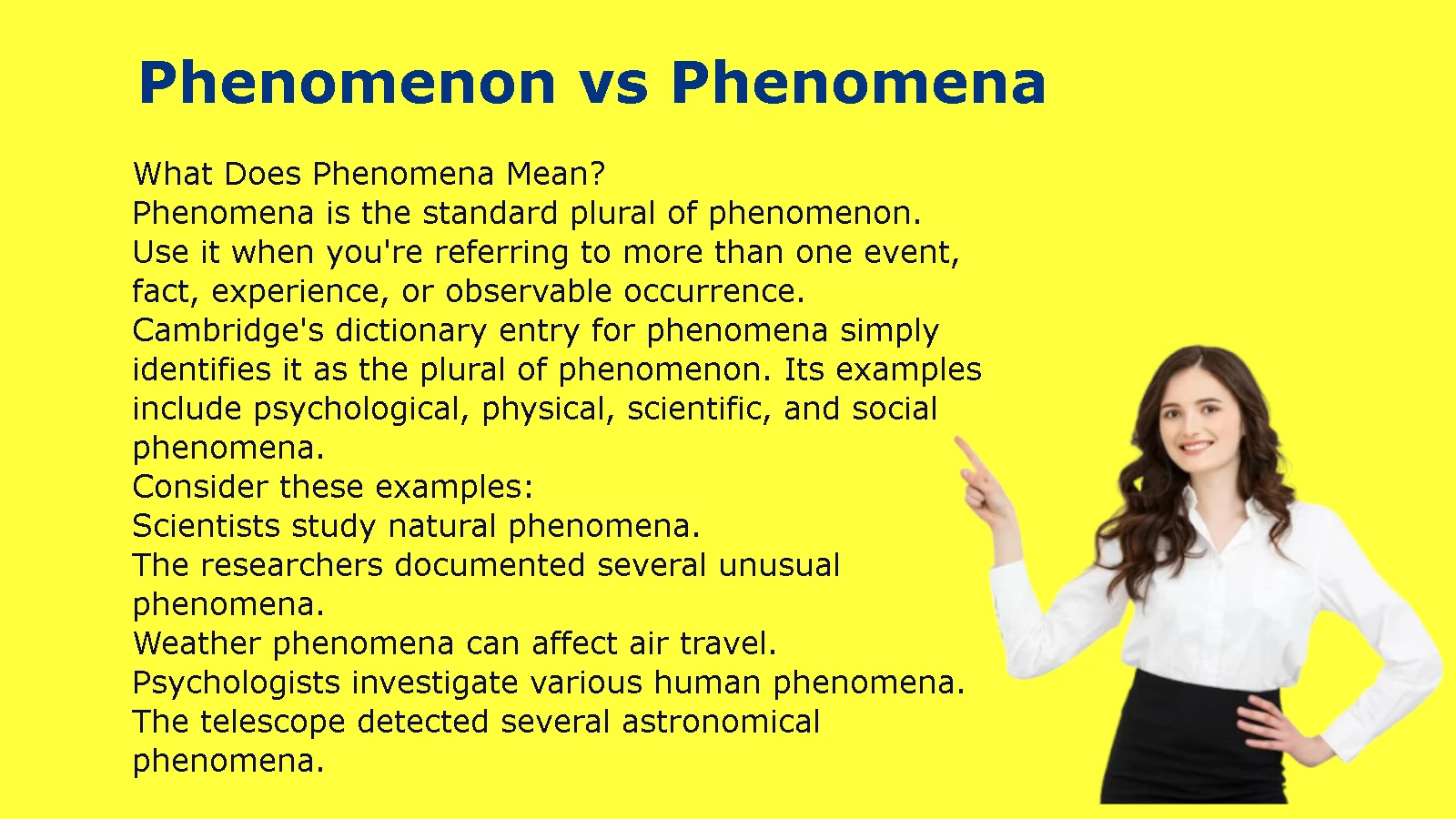
Phenomena is the standard plural of phenomenon.
Use it when you’re referring to more than one event, fact, experience, or observable occurrence.
Cambridge’s dictionary entry for phenomena simply identifies it as the plural of phenomenon. Its examples include psychological, physical, scientific, and social phenomena.
Consider these examples:
- Scientists study natural phenomena.
- The researchers documented several unusual phenomena.
- Weather phenomena can affect air travel.
- Psychologists investigate various human phenomena.
- The telescope detected several astronomical phenomena.
- Social media has created new cultural phenomena.
The plural noun normally takes plural verbs:
These phenomena are difficult to explain.
Not:
These phenomena is difficult to explain.
That verb agreement is one of the easiest ways to catch a mistake.
Phenomenon vs Phenomena: What’s the Difference?
The central difference between phenomenon and phenomena is grammatical number.
Phenomenon = one
Phenomena = more than one
That’s the whole foundation of the distinction.
| Singular | Plural |
| a phenomenon | phenomena |
| one phenomenon | several phenomena |
| this phenomenon | these phenomena |
| that phenomenon | those phenomena |
| another phenomenon | many phenomena |
| the phenomenon | the phenomena |
Compare these sentences:
A rainbow is a natural phenomenon.
There is one phenomenon under discussion.
Rainbows, eclipses, and auroras are natural phenomena.
Now you’re discussing multiple phenomena.
The meaning doesn’t fundamentally change. The number changes.
Use Phenomenon for One
Choose phenomenon when only one occurrence or subject is involved.
Examples:
- This phenomenon occurs naturally.
- The researchers observed a strange phenomenon.
- Climate change is a global phenomenon.
- The effect is a well documented phenomenon.
- The scientists couldn’t explain the phenomenon.
- The trend became a cultural phenomenon.
Use Phenomena for More Than One
Choose phenomena when you’re referring to multiple occurrences or subjects.
Examples:
- These phenomena occur naturally.
- The researchers observed several strange phenomena.
- Climate change and globalization are global phenomena.
- The scientists studied several related phenomena.
- These physical phenomena require further investigation.
- Researchers compared different social phenomena.
Let the Determiner Help You
Determiners can make the choice almost automatic.
If you see a, one, this, that, each, or another, you’re usually dealing with the singular:
- a phenomenon
- one phenomenon
- this phenomenon
- that phenomenon
- each phenomenon
- another phenomenon
If you see these, those, many, several, various, or multiple, you need the plural:
- these phenomena
- those phenomena
- many phenomena
- several phenomena
- various phenomena
- multiple phenomena
This is especially useful when you’re proofreading academic or scientific writing.
Is Phenomena Singular or Plural?
Phenomena is normally plural.
That’s the answer to one of the most common questions about this word.
When phenomena refers to multiple observable events or facts, it takes plural grammar.
Correct
These phenomena are difficult to explain.
Several phenomena were observed during the experiment.
Natural phenomena can occur without human intervention.
Incorrect in Standard Formal Usage
These phenomena is difficult to explain.
Several phenomena was observed during the experiment.
Natural phenomena can occurs without human intervention.
The first two mistakes happen because writers see phenomena as a single word and assume it must behave like a singular noun. Its form may look unfamiliar, but its grammatical role is plural in standard usage.
Can Phenomena Be Singular?
Here’s where the story gets more interesting.
Phenomena is normally plural, but singular use does occur.
Merriam Webster notes that phenomena has occasionally been used as a singular noun since the early 18th century. Its usage guide describes that singular use as relatively uncommon and still borderline, although it sometimes appears in edited prose.
That distinction matters because dictionary evidence records real usage without necessarily recommending it for ordinary writing.
For most readers, the practical rule remains:
Use phenomenon for one and phenomena for more than one.
So if you’re writing an essay, report, article, research paper, email, or professional document, there’s little reason to make your reader stop and wonder whether you’re using the less common singular phenomena intentionally.
Why Does Singular Phenomena Exist?
English has absorbed countless words from other languages. Some retain older plural patterns, while others develop new English forms over time.
Phenomena has sometimes been treated as though it were a singular English noun, much as speakers have reinterpreted other foreign plurals. Merriam Webster notes that this process has affected phenomena and that the singular use appears in speech and occasionally in edited writing.
That doesn’t make singular phenomena the best choice for everyday formal writing.
When clarity matters, stick with the standard distinction.
Is Phenomenon Always Singular?
For the ordinary meaning of an observable event or fact, phenomenon is singular.
However, there is a useful wrinkle: dictionaries recognize phenomenons as a plural in a particular sense.
Merriam Webster lists phenomenon with phenomena as the plural for an observable fact or event. It separately gives phenomenons for the sense referring to someone or something especially popular or impressive.
Oxford makes the same distinction, listing phenomena as the standard plural and phenomenons for its North American English usage involving a highly successful or impressive person or thing.
When Is Phenomenons Used?
Consider:
The two young musicians became international phenomenons.
Here, phenomenons refers to remarkable or exceptionally successful people.
Compare that with:
Scientists studied several natural phenomena.
Here, phenomena refers to observable events or occurrences.
So the distinction isn’t simply “phenomena is correct and phenomenons is wrong.” The meaning of the noun matters.
For most writing, however, phenomena remains the plural you want when you’re talking about observable events, facts, experiences, or scientific subjects.
Why Is the Plural of Phenomenon Phenomena?
The unusual plural comes from the word’s history.
Phenomenon entered English in the late 16th century through Latin from Greek phainomenon, connected with a Greek verb meaning “to appear” or “to show.” Merriam Webster dates its first known English use to 1583.
Because English borrowed the word from Greek through Latin, it retained a plural pattern associated with its classical origin.
That’s why:
phenomenon → phenomena
rather than:
phenomenon → phenomenons
The spelling may look strange if you’re expecting English’s familiar -s plural. But English contains plenty of borrowed words whose plurals don’t follow the simplest pattern.
For example:
- criterion → criteria
- bacterium → bacteria
- medium → media
- phenomenon → phenomena
There are differences in how these words have evolved and how modern speakers use them. Still, they illustrate the same broad idea: borrowed vocabulary doesn’t always behave like an ordinary English noun.
Phenomenon vs Phenomena Examples
The fastest way to understand the distinction is to see the words working in real contexts.
Natural Phenomenon vs. Natural Phenomena
Singular:
A solar eclipse is a remarkable natural phenomenon.
Plural:
Solar eclipses, auroras, and volcanic eruptions are natural phenomena.
The first sentence focuses on one event. The second groups several types of events together.
Scientific Phenomenon vs. Scientific Phenomena
Singular:
The researchers observed an unexpected phenomenon during the experiment.
Plural:
The researchers observed several unexpected phenomena during the experiments.
The same pattern appears in technical writing.
Social Phenomenon vs. Social Phenomena
Singular:
Remote work became a major social phenomenon.
Plural:
Remote work and changing workplace expectations are important social phenomena.
Psychological Phenomenon vs. Psychological Phenomena
Singular:
The effect appears to be a common psychological phenomenon.
Plural:
Researchers continue to investigate related psychological phenomena.
Cambridge’s corpus examples similarly use phenomena for multiple psychological occurrences.
Cultural Phenomenon vs. Cultural Phenomena
Singular:
The franchise became a global cultural phenomenon.
Plural:
Several entertainment trends have become major cultural phenomena.
The word can therefore move easily between scientific and everyday contexts.
Phenomenon vs Phenomena in a Sentence
A side by side comparison makes the grammar even clearer.
| Singular sentence | Plural sentence |
| This phenomenon is unusual. | These phenomena are unusual. |
| A phenomenon occurs under certain conditions. | Several phenomena occur under certain conditions. |
| The scientist studied the phenomenon. | The scientist studied the phenomena. |
| This is a natural phenomenon. | These are natural phenomena. |
| The trend became a cultural phenomenon. | Several trends became cultural phenomena. |
| That phenomenon was unexpected. | Those phenomena were unexpected. |
Look closely at the surrounding grammar.
The difference isn’t just the noun itself. Changing phenomenon to phenomena can also require changes to:
- articles: a → none
- demonstratives: this → these
- verbs: is → are
- pronouns: it → they
- quantifiers: one → several
- adjectives and sentence structure: depending on context
That’s why getting the noun’s number right improves the whole sentence.
Common Mistakes With Phenomenon and Phenomena
These words cause a handful of predictable errors.
Using Phenomena for One Thing
Incorrect:
This phenomena is unusual.
Correct:
This phenomenon is unusual.
The word this points to one thing, so the singular phenomenon fits.
Using Phenomenon for Multiple Things
Incorrect:
These phenomenon are difficult to explain.
Correct:
These phenomena are difficult to explain.
The word these is plural, so the noun must also be plural.
Using a Singular Verb With Phenomena
Incorrect:
These phenomena is widespread.
Correct:
These phenomena are widespread.
Remember that the noun is normally plural.
Adding an Unnecessary S
Another common mistake is treating phenomenon like an ordinary noun and automatically writing phenomenons whenever more than one is involved.
For ordinary observable events, use:
phenomena
For example:
Scientists studied several natural phenomena.
Phenomenons has a recognized but narrower use associated with exceptional or highly successful people or things.
Assuming Every Plural Must End in S
English normally forms plurals with -s or -es, but not every English noun follows that pattern.
That’s particularly true for words borrowed from Greek and Latin.
So don’t “fix” phenomena by changing it to phenomenons simply because the latter looks more English.
A Practical Case Study: Scientific Writing
Imagine a research paper examining unusual atmospheric behavior.
The writer begins:
Researchers observed an unusual atmospheric phenomenon.
That’s correct because the sentence describes one particular occurrence.
Later, the paper discusses several observations:
Researchers compared several atmospheric phenomena.
The noun changes because the scope changes.
Now imagine the writer says:
These atmospheric phenomenon are difficult to model.
The problem is obvious once the surrounding grammar is considered. These and are establish a plural context. The noun should be phenomena.
The corrected sentence is:
These atmospheric phenomena are difficult to model.
This illustrates an important proofreading technique: don’t examine the noun in isolation. Check the words around it.
A Practical Case Study: Everyday Writing
The distinction isn’t limited to science.
Suppose a journalist writes about a popular streaming series:
The show became a cultural phenomenon.
One show is being described as one cultural event or trend.
If the article compares several shows and their influence, the writer could say:
The shows became cultural phenomena.
The same grammar works in business, entertainment, sociology, education, and everyday conversation.
That flexibility is one reason phenomenon is such a useful word.
Phenomenon vs Phenomena in Formal and Academic Writing
In academic writing, precision matters because readers need to know whether you’re discussing one observation or a group of observations.
Scientific and scholarly writing frequently uses both forms.
Examples include:
- biological phenomena
- physical phenomena
- psychological phenomena
- social phenomena
- astronomical phenomena
- geological phenomena
- linguistic phenomena
- cultural phenomena
Oxford specifically provides examples involving cultural, natural, and social phenomena. It also lists verbs commonly used with phenomenon, including investigate, examine, and observe.
Useful Academic Patterns
For one:
Researchers observed a phenomenon that had not been documented previously.
For several:
Researchers observed several phenomena that required further analysis.
For a specific known occurrence:
The researchers examined the phenomenon in detail.
For a group:
The researchers examined the phenomena in detail.
These patterns make the distinction easy to apply in research papers, reports, essays, and technical documents.
Phenomenon vs Phenomena in Science
The words appear frequently in scientific language because science often focuses on things that can be observed, measured, described, or investigated.
Common combinations include:
| Field | Singular | Plural |
| Physics | physical phenomenon | physical phenomena |
| Biology | biological phenomenon | biological phenomena |
| Psychology | psychological phenomenon | psychological phenomena |
| Astronomy | astronomical phenomenon | astronomical phenomena |
| Geology | geological phenomenon | geological phenomena |
| Meteorology | atmospheric phenomenon | atmospheric phenomena |
| Sociology | social phenomenon | social phenomena |
| Linguistics | linguistic phenomenon | linguistic phenomena |
For example:
A solar eclipse is an astronomical phenomenon.
But:
Eclipses, auroras, and meteor showers are astronomical phenomena.
The same rule works regardless of the scientific field.
Phenomenon vs Phenomena in Everyday English
You don’t need to reserve these words for laboratories and research papers.
People use phenomenon in everyday English when they want to describe something notable, widespread, surprising, or difficult to explain.
Examples include:
- The popularity of the app became a cultural phenomenon.
- Road rage is a social phenomenon.
- The sudden trend became an online phenomenon.
- These internet trends are modern cultural phenomena.
- Such behavior isn’t a new phenomenon.
- Similar behaviors are common phenomena in large organizations.
The word often gives an idea a more analytical tone than simpler alternatives such as event, trend, or occurrence.
Phenomenon vs Phenomena: Easy Memory Trick
Here’s the rule worth remembering:
One phenomenon, many phenomena.
If you’re talking about one, use phenomenon.
If you’re talking about more than one, use phenomena.
You can also remember the pattern through familiar phrases:
- a natural phenomenon
- many natural phenomena
- this phenomenon
- these phenomena
- one phenomenon
- several phenomena
When in doubt, look at the determiner.
This phenomenon → one.
These phenomena → more than one.
It’s a tiny grammatical clue that solves a surprisingly common problem.
Phenomenon vs Phenomena: Quick Grammar Test
Choose the correct word in each sentence.
Question One
A solar eclipse is a natural ______.
- phenomenon
- phenomena
Answer: phenomenon
You’re talking about one event or type of occurrence.
Question Two
Scientists studied several unusual ______.
- phenomenon
- phenomena
Answer: phenomena
The word several requires a plural noun.
Question Three
This ______ occurs only under certain conditions.
- phenomenon
- phenomena
Answer: phenomenon
The demonstrative this refers to one thing.
Question Four
These psychological ______ require further study.
- phenomenon
- phenomena
Answer: phenomena
The word these establishes a plural context.
Question Five
The singer became a cultural ______.
- phenomenon
- phenomena
Answer: phenomenon
The sentence describes one person or one cultural success as a remarkable occurrence.
Frequently Asked Questions About Phenomenon vs Phenomena
What is the plural of phenomenon?
The standard plural is phenomena.
For example:
One phenomenon was observed.
Several phenomena were observed.
Cambridge and Oxford both list phenomena as the standard plural of phenomenon.
Is phenomenon singular or plural?
Phenomenon is singular.
Use it when you’re referring to one observable event, fact, experience, or occurrence.
This phenomenon is unusual.
Is phenomena singular or plural?
Phenomena is normally plural.
These phenomena are difficult to explain.
Although singular phenomena has appeared in English, it remains uncommon enough that phenomenon is the better choice when you mean one in standard formal writing. Merriam Webster specifically describes singular phenomena as a borderline usage.
Can I say phenomenons?
Yes, but context matters.
Phenomena is the standard plural when phenomenon means an observable event, fact, or experience.
Phenomenons is recognized in the specific sense of exceptional or highly successful people or things. Oxford and Merriam Webster both document this distinction.
Is “these phenomena” correct?
Yes.
These phenomena are fascinating.
These is plural, and phenomena is normally plural.
Is “this phenomena” correct?
Not when you’re referring to one phenomenon in standard usage.
Use:
This phenomenon is fascinating.
Is “phenomenon are” correct?
Normally, no.
Because phenomenon is singular, it takes a singular verb:
The phenomenon is unusual.
Is “phenomena are” correct?
Yes.
When phenomena means multiple events or occurrences, use a plural verb:
The phenomena are unusual.
What is the difference between phenomenon and phenomena?
The basic difference is number.
Phenomenon refers to one.
Phenomena refers to more than one.
Why doesn’t phenomenon become phenomenons?
Because phenomenon comes from Greek through Latin and retained a classical plural form. The standard plural is phenomena.
Which is correct: “a phenomenon” or “a phenomena”?
A phenomenon is correct.
The article a marks a singular countable noun.
Which is correct: “many phenomenon” or “many phenomena”?
Many phenomena is correct.
The quantifier many requires a plural countable noun.
Final Takeaway: Phenomenon vs Phenomena
The Phenomenon vs Phenomena difference comes down to grammatical number.
| If you mean… | Use… |
| One event or occurrence | phenomenon |
| One observable fact or experience | phenomenon |
| One unusual trend | phenomenon |
| Two or more events or occurrences | phenomena |
| Several observable facts | phenomena |
| Multiple scientific occurrences | phenomena |
| Multiple social or cultural occurrences | phenomena |
The simplest rule is still the best:
One phenomenon. Many phenomena.
Use phenomenon with a, one, this, that, and each. Use phenomena with these, those, many, several, and various.
And remember the small but useful exception: phenomenons can appear when phenomenon refers to an exceptionally successful or impressive person or thing. For the ordinary meaning of observable events or facts, however, phenomena is the standard plural.
Once you see the pattern, the choice becomes much easier. Phenomenon is one; phenomena are several.